Feeds:
Posts
Comments

Posts Tagged ‘offshore drilling’

Growing demand for new offshore oil rigs, partly driven by the Gulf of Mexico spill last year, has led to a spurt of building in shipyards and raised tough questions about what to do with the old rigs. Reuters

What? Have they not looked at the Rigs-to-Reefs+++ page(a BOE exclusive)?

“At a certain point it just doesn’t make any sense to upgrade them or put another 5-10 million bucks into them,” said John Tasdemir, an analyst at Canaccord Genuity. “Better just to scrap them and either start over, or just do something else.”

“Do something else” is correct and there are many options!

Read Full Post »

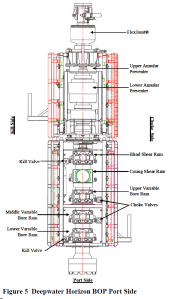
In a previous post, we discussed JL Daeschler’s comments suggesting that the emergency disconnect sequence (EDS) may have actuated the shear ram, but that the sequence aborted when the ram did not close fully. Another knowledgeable commenter, while requesting not to be named, noted that:

Whether the EDS-functions terminated before the sequence was completed is clearly a relevant question.

I agree and believe this possibility may have been dismissed without being fully considered. The DNV report claims that the EDS sequence never actually initiated, probably because of a loss of communication with the stack after the initial explosion.  As evidence, the report offers the following:

There is an account of lights flashing, indicating that the EDS function had initiated. There are no accounts of any specific lights going steady, which would have indicated a function had been completed and confirmed by the subsea control pods.

Comment: Perhaps no light stopped flashing because the first step in the sequence, BSR actuation, was not concluded (i.e. the BSR never fully closed).

Reviewed ROV video indicated no evidence that the sequence had initiated; the LMRP remained latched to the BOP, the Blue and Yellow Control Pod stingers were not retracted.

Comment: This only tells us that the sequence terminated prior to unlatching he LMRP and retracting the pod stingers.  It says nothing about the timing of the BSR closure.

Note that pages 166-167 of the DNV report indicate that the EDS was manually functioned (at the test facility) via surface control and that it functioned as intended.

The report also confirms that the accumulators were functional:

HP Shear Close, EDS, AMF/Deadman and Autoshear have a common reliance on the accumulator bottles (8 x 80 gallon) located on the BOP. Testing of these accumulators determined that they functioned as intended in the as-received condition.

The report goes on to say:

This is further indication the BSR’s were activated either by the Authoshear or possibly the AMF/Deadman functions. No further failure cause analysis was performed.

Comment: So why was the EDS ruled out as the trigger for the BSR activation? Also, if the shear ram was activated by the AMF, why did that sequence terminate after the ram closed (partly)?

Comment on the riser disconnect: While closure of the BSR is a critical first step in the EDS or AMF sequence, riser disconnect, which has received very little attention, is equally important. To prevent flow, you want the well sealed before you disconnect the riser and the column of drilling fluid contained within. However when an EDS is activated, there is a good chance that the well may already have started to flow. Under those circumstances, you need to quickly disconnect the riser so the workers can be removed from the threat. In the case of the Deepwater Horizon, the failure of the riser to disconnect is as significant as the  failure of the BSR to seal the well. Although the EDS may have been activated too late to save the workers who lost their lives, they would likely have been safe if the rig had been disconnected from the well prior to the initial surge.

Read Full Post »

Previewing his speech at a New York City fundraiser last night, Obama said he wants to break “the pattern of being shocked at high prices and then, as prices go down, being lulled into a trance.”

“Let’s actually have a plan,” he said. “Let’s, yes, increase domestic oil production, but let’s also invest in solar and wind and geothermal and bio-fuels and let’s make our buildings more efficient and our cars more efficient.” USA Today

Encouraging.

Read Full Post »

Secretary of the Interior Salazar will be hosting the “Ministerial Forum on Offshore Drilling Containment” on April 14, 2011, in Washington DC. Click for the draft agenda and additional information.

Read Full Post »

Everyone agrees that a series of failures and mistakes leading to the use of containment systems is totally unacceptable. Capping stacks and containment devices, while necessary and important, should never have to be used in the post-Macondo offshore world.

The same cannot be said for blowout preventers. BOPs will be used and will have to work when needed. No matter how carefully drilling programs are planned and executed, there will be hydrocarbon influxes into well bores. While most of these influxes will be “routine kicks,” the equipment must work and the personnel must be trained to use it properly and to function effectively as a team.

The DNV report on the Deepwater Horizon BOP failure included some unexpected findings. These findings will be discussed at the Joint Investigation hearings which begin on 4 April, and will hopefully be televised or streamed live. While attention will focus on specific components, BOPs must be evaluated as complete systems. What new risks have been identified? What are the options for addressing these risks? What risks are posed by the solutions? What other risks, related and unrelated, need to be addressed?

I doubt that there will be any argument with the DNV recommendations.  These include studies on elastic buckling, shear blade surfaces, the effectiveness of ROV intervention, and well control procedures (including the sequencing of annular preventer and pipe ram closures); revised testing procedures for backup control systems; improved capabilities for monitoring of the status of BOP functions; and requirements for backup control system performance.

BOP stacks with redundant blind shear rams are becoming more common, and would generally seem to be appropriate for subsea wells. However, attention must be paid to the entire stack with the goal of optimizing overall performance and most effectively managing risks for the type of well that is being drilled and the site-specific conditions.

Read Full Post »

Just released.

The DNV report will be discussed in the upcoming hearings:

The Bureau of Ocean Energy Management, Regulation and Enforcement (BOEMRE)/U.S. Coast Guard (USCG) Joint Investigation Team, which is examining the Deepwater Horizon explosion and resulting oil spill, today announced that it will hold a seventh session of public hearings the week of April 4, 2011. The hearings, which will focus specifically on the forensic examination of the Deepwater Horizon blowout preventer (BOP), are scheduled to take place at the Holiday Inn Metairie, New Orleans Airport, 2261 North Causeway Blvd., Metairie, La.

Read Full Post »

from SeabedRig.com

Advances in drilling technology tend to be evolutionary, not revolutionary. Floating rigs, dynamic positioning, top-drive systems, measurement-while-drilling, automated rig floors, and other important advances were logical next steps, not radical makeovers.

Many of us have long been fascinated by the possibility of locating drilling equipment on the seafloor, particularly for deepwater wells. Why operate from a massive floating vessel that requires a sophisticated stationkeeping system and a long riser to connect to the wellhead? Why link surface personnel to seafloor risks? Why increase the complexity of balancing well pressures (without fracturing formations) by adding thousands of feet to the mud column? Why heave and roll on the surface when you can operate from the seafloor?

It’s not that easy, of course, and there are many questions and issues. While fully automated drilling systems are no longer a reach, what about reliability and repairs?  How will casing be set and cemented? How will downhole measurements be transmitted to the control center? Cuttings samples? Coring? Well testing? The list of challenges is daunting.

At least one company, Seabed Rig, is committed to developing and demonstrating seafloor drilling technology. Earlier this month, Seabed Rig reached agreement with NASA to create the first autonomous drilling rig. While a lot of work remains, Seabed Rig and other pioneering companies are applauded for their innovative thinking and willingness to challenge conventional practices and wisdom.

Read Full Post »

Per the Platts Oilgram report that we posted on 17 March, here is the complete court filing..

These are the additional tests recommended by BP’s consultant Ralph Linenberger:

  • Removal and forensic analysis of each annular element
  • Hydraulic signature testing of the annular preventer operator and ram preventers operators
  • Disassembly and inspection of the annular preventer and ram preventer bonnets
  • Laser scanning of (i) the entire BOP wellbore; (ii) the upper annular packer and upper annular cap; (iii) the inside of the riser kink; and (iv) the wellbore-facing surfaces of the casing shear ram bonnets
  • Hydraulic circuitry pressure test
  • ST lock circuit confirmation
  • Solenoid pie connector pin measurement and corresponding female receptacle analysis.

Is anyone else surprised that some (all?) of these tests hadn’t already been conducted? That would seem to be the biggest revelation from the BP court filing.

Read Full Post »

Speakers list and link to live streaming

The Subcommittee on Energy and Power announces a multi-day hearing on “The American Energy Initiative.”  The first day of the hearing will be on Thursday, March 17, 2011, at 9:00 a.m. in 2123 Rayburn House Office Building.  It will focus on oil supplies, gasoline prices, and jobs in the Gulf of Mexico.


Read Full Post »

Add Sonangol, Angola’s state-owned oil company, to the intriguing list of companies that will be involved in Cuban exploration:

“We have signed agreements with Cupet (the Cuban state-run oil company) to explore and develop two blocks,” said Mateus de Brito, a member of the corporate executive committee. El Universal

Read Full Post »

« Newer Posts - Older Posts »