Feeds:
Posts
Comments

Posts Tagged ‘Montara’

G’Day Australia.  There are now only 2 weeks until the Federal election. Ironically, the election, which may have delayed the release of the Montara Inquiry report, will be held on the first anniversary of that blowout.

This report will play an important role in keeping our workers safe, protecting our environment and safeguarding our energy security. Minister Martin Ferguson

BOE fully agrees with Minister Ferguson’s statement about the importance of the Montara Inquiry report and hopes that he or his successor promptly releases the report after the election.  The lessons learned at Montara will not only prevent accidents in Australia, but elsewhere in the world. In light of the disturbing similarities between the two blowouts, it is possible that closer international attention to Montara might even have prevented the Macondo blowout.
Read Full Post »

Kent Well’s response to a reporter’s question and Colin Leach’s comment on BOE seem to give credence to our suspicion that the flow path for the Macondo well was inside the production casing!  If true, this is enormously significant for the following reasons:

  1. The root cause of Macondo is eerily similar to that at Montara in that oil and gas entered the well via compromised cement in the casing shoe and a failed float.  Did the BP engineers and TO crew even know about Montara?  This shows why accident information must be promptly circulated and brought to the attention of key personnel everywhere in the world. It also demonstrates why the Montara report needs to be released without further delay.
  2. Presumed contributing factors that would be irrelevant or less significant: the long string vs. liner/tieback decision, and the failure to run a Cement Bond Log, additional centralizers, or a lockdown sleeve on the casing seal.
  3. Contributing factors that would have even greater importance: selection of the casing point (integrity at the base of the well), waiting on cement time, timing of the positive and negative pressure tests (this is a topic that warrants much more scrutiny and discussion), and failure to set a cement plug before displacing the mud with sea water.

Read Full Post »

I awoke to an email message from Odd Finnestad linking the BP announcement.  It’s only fitting that Odd delivered the news. He and I have been following Montara and Macondo on a daily basis since August 21, 2009, the day the Montara well blew out in the Timor Sea.  A few thoughts:

  • The real end date for the blowout was July 15th, when the containment cap shut-in the well.  It was an uncertain ending with the capping described as a temporary integrity test and talk about re-opening well vents. Fortunately, good judgement and common sense prevailed, and the well remained shut-in.
  • The efforts to prevent recurrence can now proceed with fewer distractions. It’s difficult to calmly address the issues while video images of oil gushing into the Gulf are being broadcast worldwide.
  • We need to do more than react to Macondo, and every offshore operator and contractor needs to be involved. Only 20% of Gulf of Mexico operators attended a critical industry-government hurricane conference after Katrina and Rita.  (No, I’m not going to stop ranting about this!)
  • Industry needs to look at EVERY aspect of offshore operations, not just the drilling issues associated with Macondo.  Fixing what happened at Macondo doesn’t prevent production, pipeline, and other types of drilling disasters.  Helicopter safety, lifting operations, and workplace safety issues also need to be further addressed.
  • This is a major effort and everyone needs to participate.  If you aren’t committed to improving overall safety performance, in the US and worldwide, you shouldn’t be in the business.

Read Full Post »

In the Gulf of Mexico, deepwater drilling is more risky because that is where the high-rate wells are, not because the water is deep.
  • Water depth had little to do with the well integrity problems at Macondo. Similar errors in planning and execution would have yielded similar results in any water depth or on land.  Has Montara already been forgotten?
  • Subsea BOP stacks have a much better performance record than the surface stacks used in shallow water drilling (more on this later in the week).
  • Historical data indicate that blowouts occur less frequently in deep water, not more frequently (more to follow).
  • Obviously, blowouts involving high-rate wells are likely to do more damage.   This applies regardless of the water depth.   You can reduce the spill risk by prohibiting drilling in the areas with the highest production potential, but that wouldn’t be very sound energy policy and you won’t find many buyers for the leases.
  • It is safer to conduct intervention and capping operations on subsea wells.  Regulators would not even allow surface capping to be considered at Montara because of the high risk to workers.  The subsurface ROV work is perhaps the biggest Macondo success story.
  • If the Macondo well was in shallow water (with the wellhead above the water surface), and well integrity concerns precluded a risky surface capping operation, how would the flow have been contained and collected?
  • Other things being equal, the environmental risk is less at deepwater locations which tend to be farther from shore.

Water depth is just one well planning consideration.  Abnormal pressures and temperatures, shallow gas, hydrogen sulfide, ice, permafrost, storms, currents, extended reach targets, and horizontal completions are some of the others.  To prevent another Macondo, in the US or anywhere else in the world, we need to focus our attention on the 3 categories of issues listed below.  These issues are important in all water depths and in all environments.

  1. Well integrity including design, construction, barriers, verification, and monitoring.
  2. BOPE performance and reliability under all conditions.
  3. Capping, containing, and collecting oil in the event of a blowout.

Read Full Post »

We believe that we should not start the static kill operation until we have installed the last liner run in the bottom of the relief well.  Admiral Allen

Comment: This is understandable given the potential for communication between the 2 wells at or near the reservoir level.

– There has been some media talk about allowing the well to flow during a possible hurricane evacuation.  I don’t see any direct quotes from Admiral Allen that specifically say that, so I hope these media reports are inaccurate.  As indicated in previous posts, this is an unnecessary measure that could be viewed as irresponsible.

-Safety Leadership has been a major emphasis of drilling contractor training programs in recent years.  Transocean’s program is summarized here.  Safety leaders create an environment in which each employee is comfortable raising any and all concerns without fear of repercussions.  Safety leaders are also encouraged to raise safety issues with the companies that contract their rigs.  Judging by comments at the BOEMRE-CG Macondo hearings, some DWH employees were not comfortable raising safety concerns to their supervisors or the operator.   During the Montara blowout hearings, there was evidence of similar reluctance on the part of contract employees.   Drilling and other contractors need to take a close look at their Safety Leadership programs and find out why these entrenched attitudes persist.

Read Full Post »

“I will act promptly and appropriately on the report once I have had an opportunity to review its contents,” Minister Ferguson said.  18 June news release

Read Full Post »

The Federal Government is unnecessarily delaying the release of a report into last year’s Montara oil spill off Australia’s north coast, the Northern Territory Opposition says.

link

On a related note, it would be great if preliminary findings from the DOI/DHS Macondo investigation could be released as soon as possible.  There is much work to be done and all interested parties (in the US and elsewhere) need the best available information so that they can assess their programs.  Better to err on the side of releasing findings to soon with any necessary caveats and disclaimers.  In that regard, the House Committee on Energy and Commerce has done a good job of making their findings available without delay.

Read Full Post »

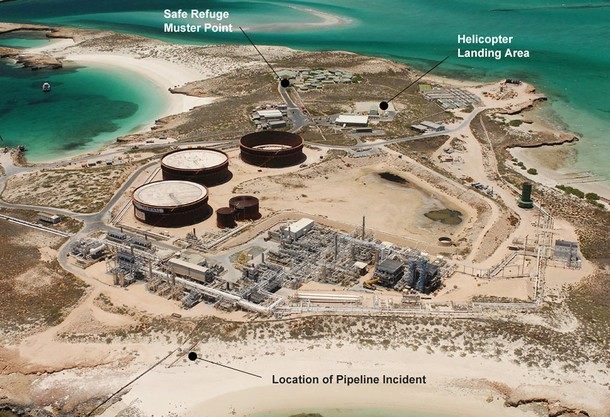
Varanus Island, Western Australia

Odd Finnestad, BOE’s Senior Vice-President for International Activities (note the recent promotion), and his talented, multi-lingual staff keep close tabs on investigations and accident reports worldwide.  Odd thinks we may be in for a long wait for the Montara report, so the BOE cyber vigil will not include any rash measures like hunger strikes.

While Australia does a great job of investigating, holding hearings, and preparing reports, they seem to struggle with the simple step of releasing those reports.  Odd reminds us that the report on the 2008 Varanus Island gas plant explosion has still not been released.  This important accident reduced Western Australia’s gas supply by one-third, and thus had major economic consequences. The Veranus report was finalized in June 2009, but maneuvering by the responsible party and legal reviews within the Western Australia Ministry for Mines and Petroleum have kept this report under wraps.  Now we are getting the same uncomfortable feeling about the Montara report.  Perhaps, Minister Ferguson will prove us wrong and release the Montara report without further delay.  We hope so!

Read Full Post »

  1. The big question with regard to acoustic backup systems for BOPs is whether ambient noise associated with a seafloor blowout prevents the signal from being reliably received.  The Macondo well would seem to provide an excellent opportunity for testing acoustic systems to see how effectively the signals are received under such challenging conditions.  Too late?
  2. Still no regular relief well reports, but Admiral Allen commented yesterday that they only have about 200′ to drill.  I’m assuming the 9 7/8″ liner has been set.  If all this is accurate and there are no weather or technical delays, they should be ready to intercept the well bore soon (1-2 weeks?), even with the added time for special ranging and directional surveys.
  3. Unless the relief well is delayed, it doesn’t seem to make sense to change the LMRP cap at this time.  Collection might improve somewhat with the new cap, but the well would be wide open during the change.
  4. Day 21 since the Montara report was delivered to the Ministry, and there are no recent news updates.  No interest?
  5. Very good article in Platts as the media begins to show more interest in regulatory approaches.

Read Full Post »

  1. Montara watch: 19 days have now elapsed since the Montara Inquiry Report was presented to Minister Ferguson, and there are no recent media updates on the release of the report. Meanwhile, Australian radio has a good piece on Montara – long, but worth the time.
  2. Macondo: The relief well reports continue to be sketchy and inconsistent.  On July 4, the Unified Command reported that the primary relief well had reached 17,400′ (presumably measured depth), while  BP’s update for the same date indicated that the first well had reached 17,725′ (this too must also be measure depth, not true vertical depth).  It’s unclear whether the final casing (9 7/8″ liner) has been set.  Admiral Allen will likely provide a better update today.
  3. More regulatory philosophy: The regulatory system is at least as important as the specific operating requirements.   This UNEP piece provides a good summary of the strengths and weaknesses of different approaches.

Read Full Post »

« Newer Posts - Older Posts »