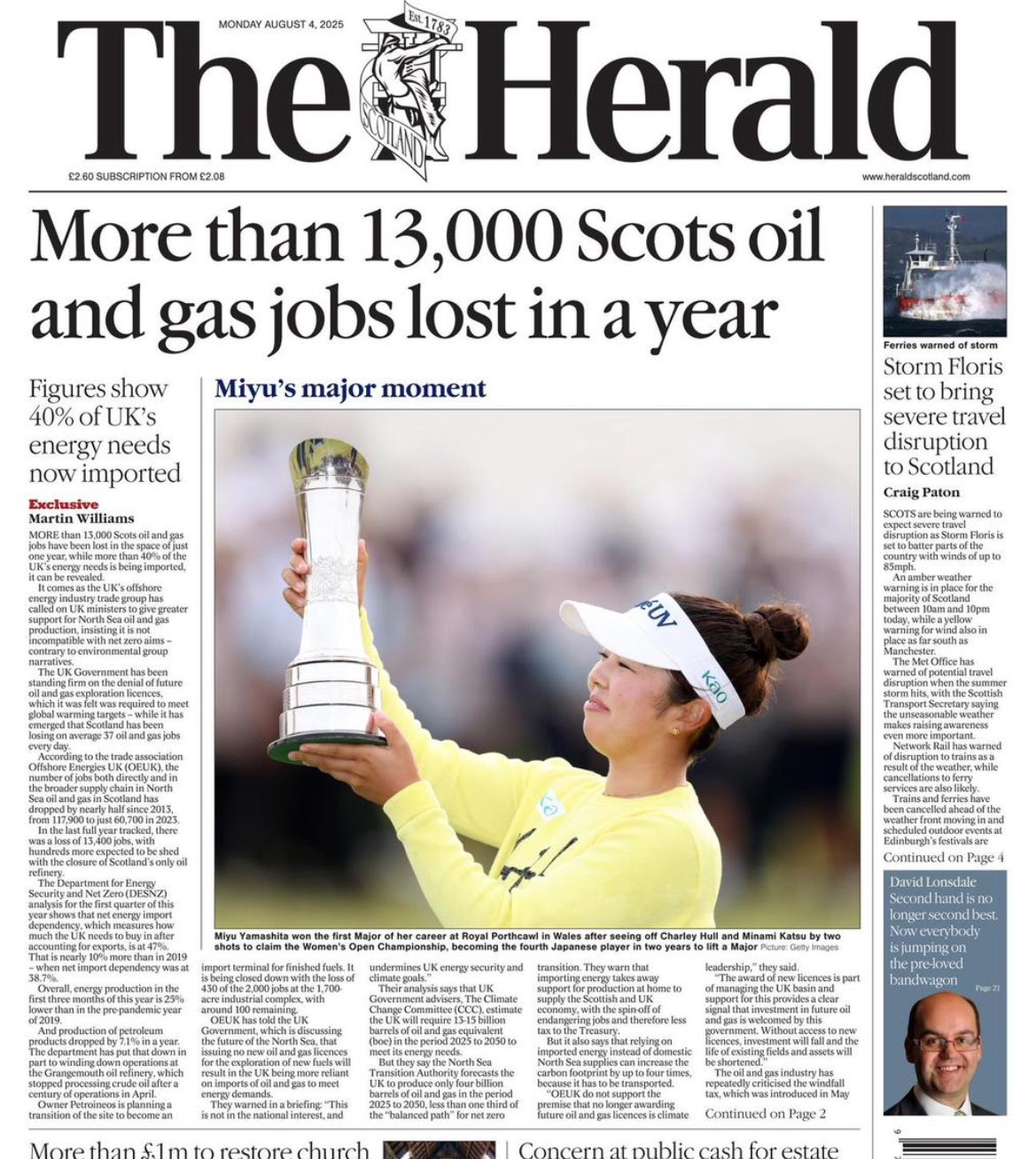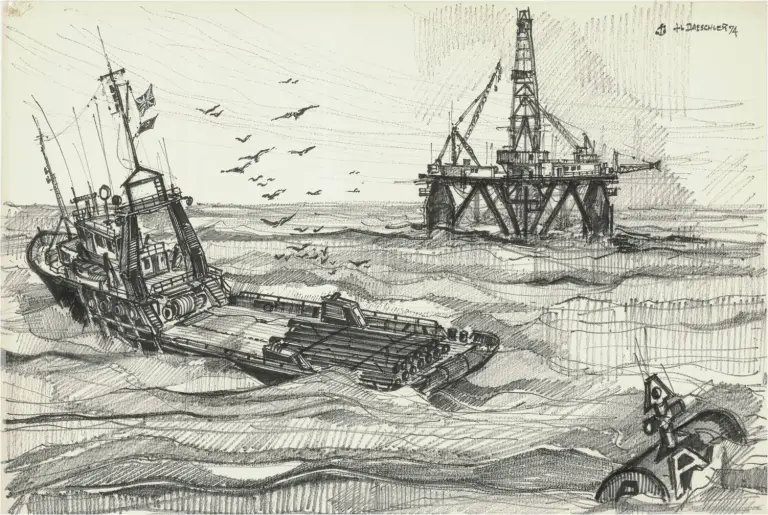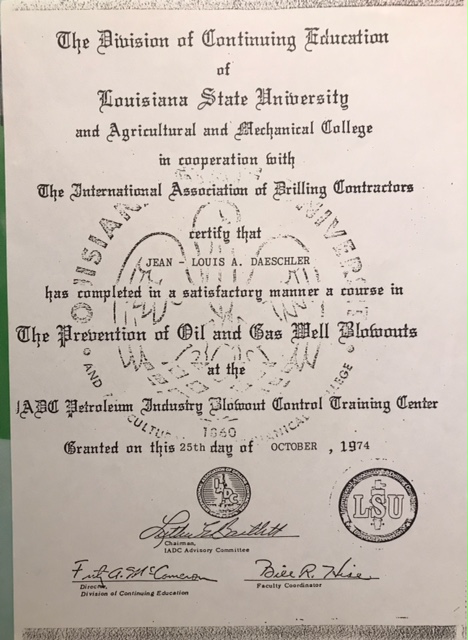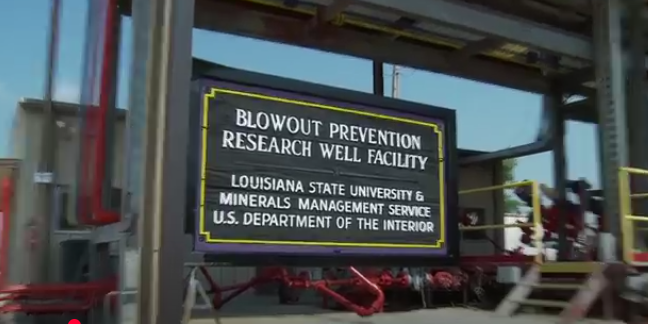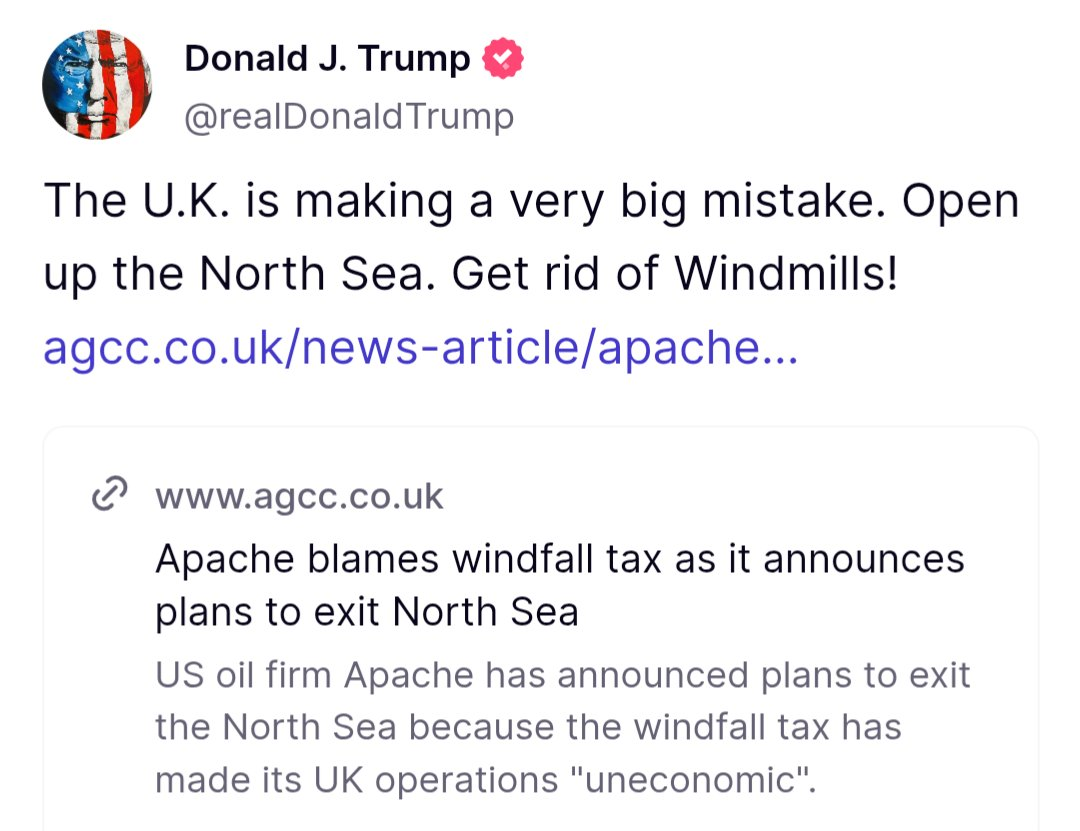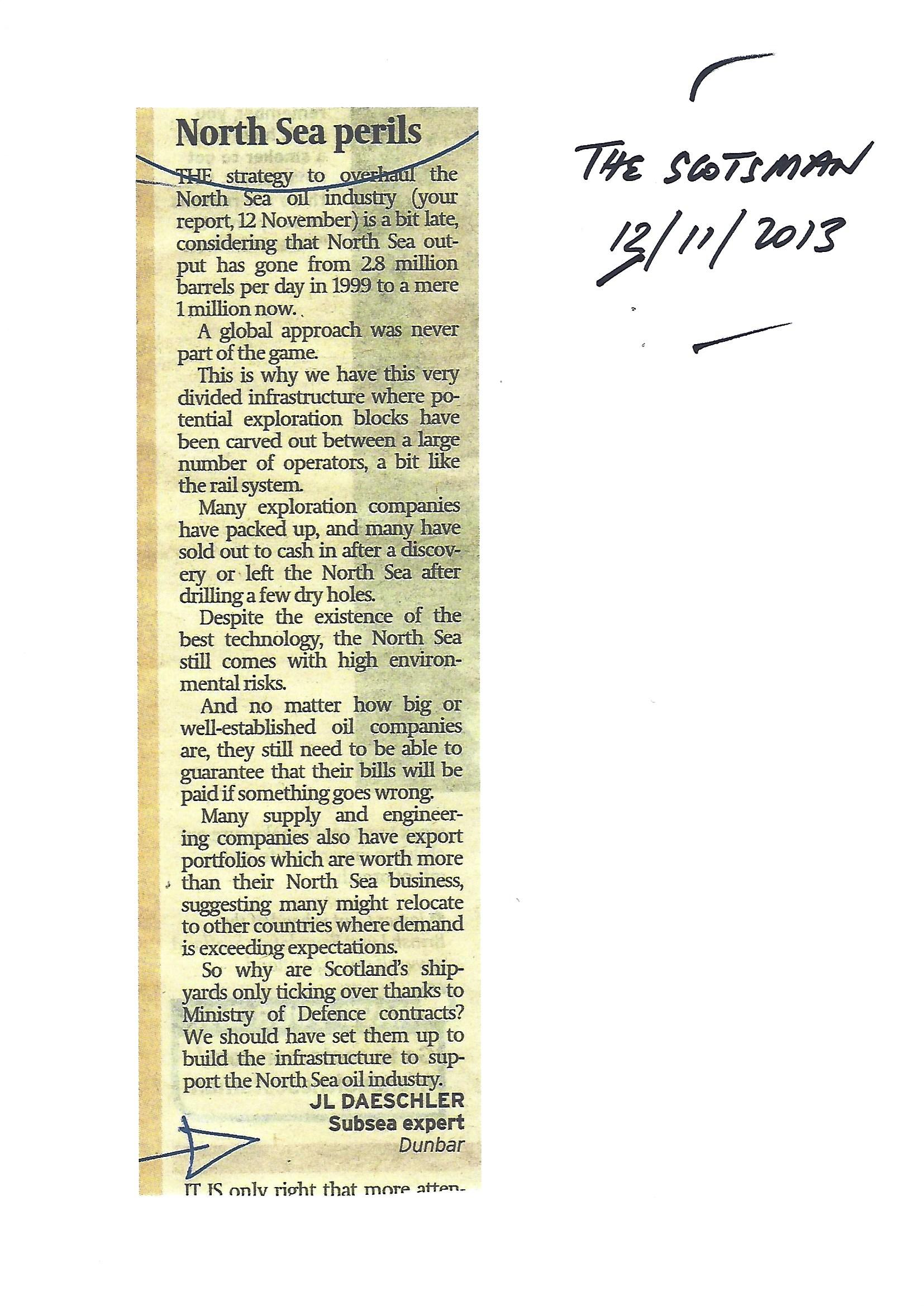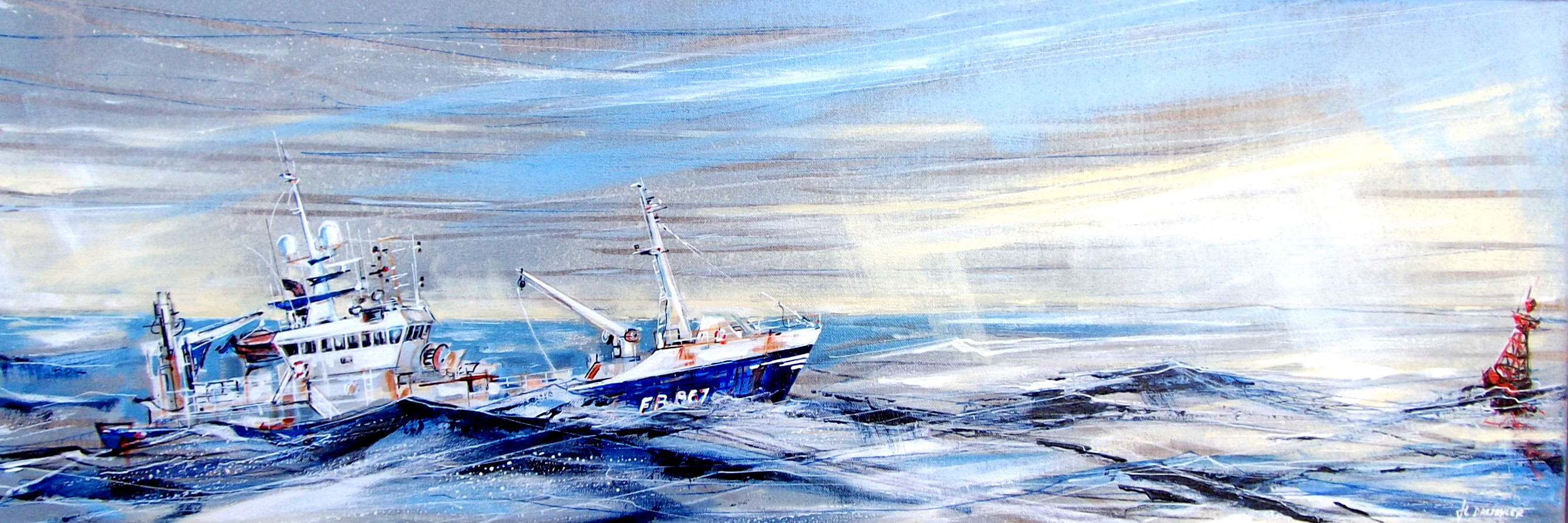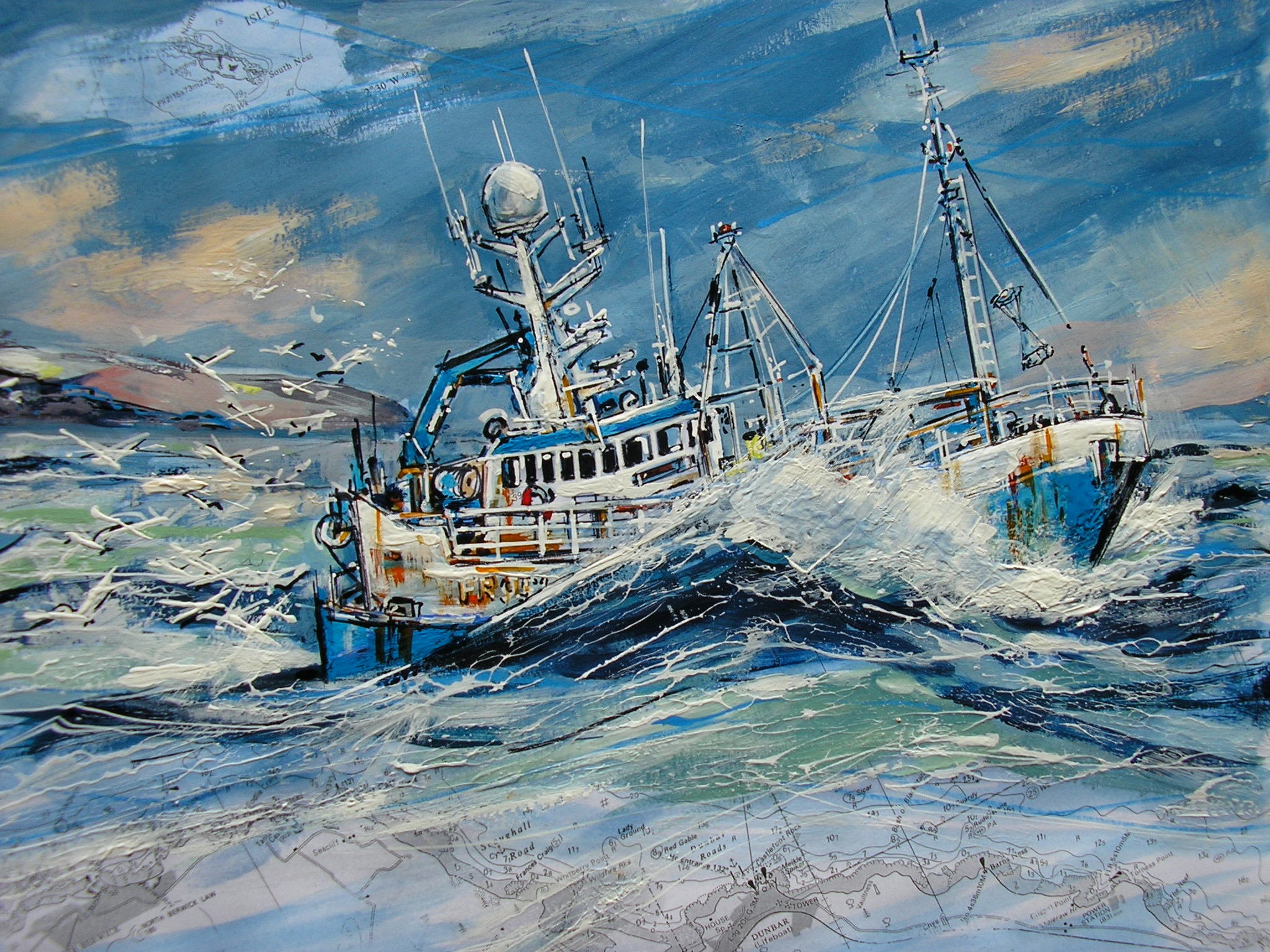
JL Daeschler, a BOE contributor, subsea engineer, and resident of Scotland, warned 11 years ago (see clip below) about the demise of North Sea infrastructure and the exit of important companies. JL now comments as follows:
“We have unfortunately taken down all the support facilities needed to conduct a complete offshore sequence – finding, engineering, and producing – even under a more favorable tax climate. We will have to call on Norway to do anything!”
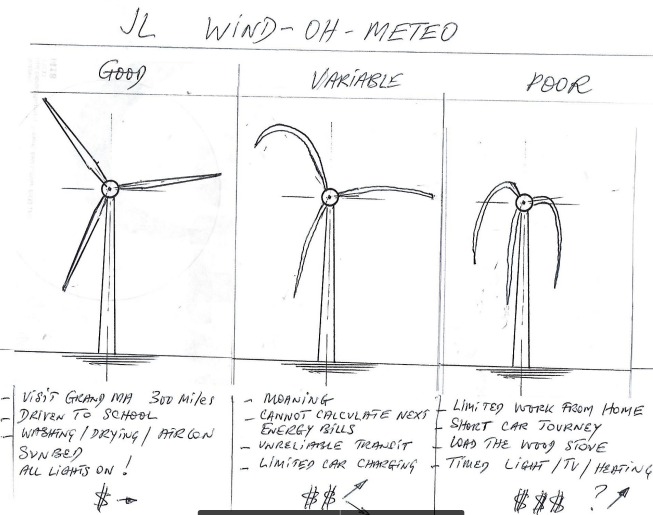
JL Daeschler reports that there has been no wind for the past 4 days at his home in Scotland, and his wind gauge is droopy. (See his sketch below and read the fine print 😉)
Pockets of Light at Dawn by JL DaeschlerIsle of May in the Sky by JL DaeschlerProvincetown Pier by Karen DanenbergerEvening Calm, Boat Meadow by Karen Danenberger
Jean-Louis Daeschler, is an artist and pioneering subsea engineer. A native of France (Brittany), he has worked in the offshore industry worldwide and lives in Scotland. His wife is from Singapore and his children and grandchildren live in England and Canada.
Before beginning his engineering career, JL had the distinct honor of exhibiting his artwork at the French National Assembly (Parliament) in Paris (article below). How many offshore engineers can say that? None would be a good guess.
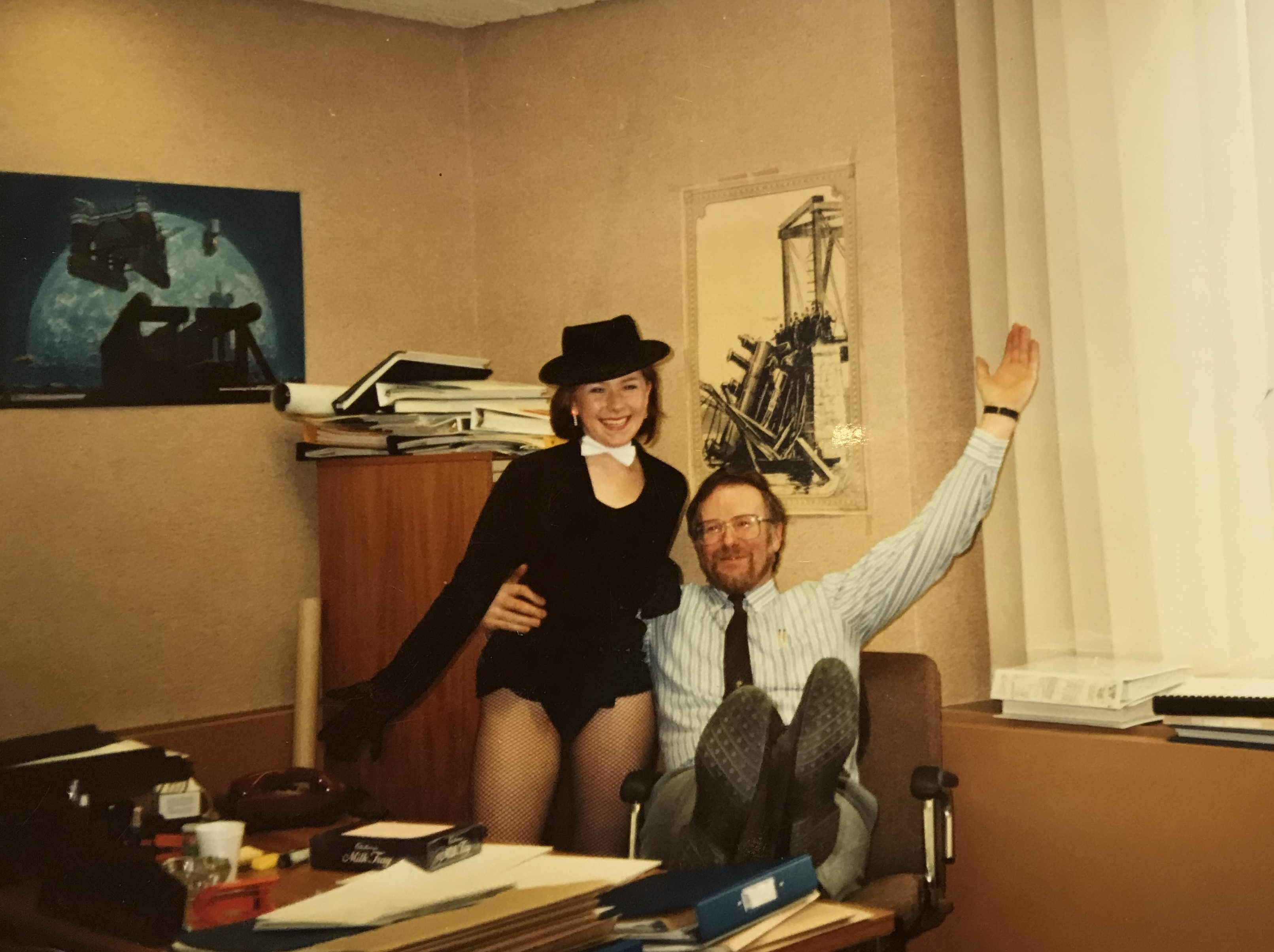
When he was called upon to work in Total’s onshore office, his boss told him “the best offshore job is in the office!” The photo below suggests that JL made the most of those onshore assignments! 😀
JL Daeschler, part of Total’s subsea team, enjoying his onshore assignment in 1985
Congratulations to JL on his many contributions to the offshore industry, art, and society!
On Constitution Day, best wishes to our Norwegian friends!
This JL Daeschler photo was taken in Stavanger harbor in 2003. JL’s wife Debra, a Petrodata Marine editor, is pictured in the foreground. The rig in the background is the Maersk (now Noble) Innovator, a large jackup capable of operating in water depths to 492 ft. The legs are 674 ft (Washington Monument = 555 ft).
JL Daeschler, pioneering subsea engineer and BOE contributor, recounted a frightening incident in 1976, a year after UK North Sea production began:
We found ourselves in a drastic situation. While working on a subsea well, the wireline retrievable tubing safety valve got tangled up in the tree area. We had an open well situation and couldn’t cut the wire in the subsea tree. Further, the weather was bad, and keeping on location was difficult. The riser hydraulic release was faulty, so there was an imminent high risk of a “jammed ” subsea tree, bent/damaged riser, and uncontrollable well flow.
We got through this, but recognized that improved well control capabilities were needed during workover operations. Management decided that any future workover operations on a subsea tree/well would require a small diameter workover BOP with shearing capability immediately above the Xmas tree. A year later, we had the hybrid kit pictured below (with JL). Note that the guide funnels are slim to run on guide lines and not overshoot the guide base posts.
JL’s story reminds us once again that safety achievement is dependent on continuous improvement driven by experience, research, and technological advances.
When I was a young engineer with the US Geological Survey, the OCS safety regulator at the time, my boss and mentor Richard Krahl (known as “Mr. OCS” for his commitment to offshore safety) slammed😀 a copy of the first edition of API RP 14C (Analysis, Design, Installation, and Testing of Safety Systems for Offshore Production Facilities) on my desk and told me to read it carefully. That pioneering process safety document has grown with the offshore industry and is now in its 8th edition.
Similarly, API RP 2A-WSD (Planning, Designing, and Constructing Fixed Offshore Platforms— Working Stress Design) is now in its 22nd edition and API STD 53 (Well Control Equipment Systems for Drilling Wells) is in its 5th edition. There are countless other examples of the progression in safety equipment and practices.
As individuals, companies, agencies, and collectively as an industry, there can be no standing still. Nothing is routine and the challenges continue to grow: deeper wells, more complex geology, higher temperature and pressure, deeper water, harsher environments, remote locations, new security risks, and more. We get better or we get worse, and the latter is not an option. Onward!
JL Daeschler is a pioneering subsea engineer and artist extraordinaire who is a native of France (Brittany) and lives in Scotland. He has shared 2 more of his exceptional drawings. (Click on the images to enlarge.)
This is a drawing of the Ocean Viking (Odeco) in the Norwegian North Sea in 1968. The rig was built in Oslo as a sister ship to the Ocean Traveler, which was already working at the same location. The Ekofisk field was discovered later in 1969. The mast-type derrick could be lowered for long ocean tow or bridge clearance. It would have been difficult to evacuate a 100 + personnel to the standby vessel, a decommissioned trawler. Things have changed so much in 56 years!Inclined jack up legs with rack and pinion drive ( Marathon Le Tourneau), Gulf of Mexico
Jean-Louis Daeschler, a native of France who lives in Scotland, was a pioneering subsea engineer who worked on rigs worldwide. Below, he recounts a 1969 incident on the Sedco 135 E.
Sedco 135 E
Sept. 1969 on the Sedco 135 E offshore Miri, East Malaysia
At about 10.00 PM the crew was running 24 ” riser pipe. The rig used a 2 stack BOP system. The weather was superb – no wind and a temperature of 26 deg C.
When the 4th joint of riser pipe (45 ft) was picked up through the “V” door and was almost vertical, it unlatched from the elevator. There was a massive clang followed by silence. The riser pipe hit the drill floor, fell backward into the derrick frame and got jammed there. No one was hurt.
The incident would have been much worse if the pipe had fallen through the catwalk, perforated the maindeck, fell into the water, and damaged the the rig’s sponson tanks !!!! A piece of pipe falling overboard turns into a high velocity torpedo. A dropped 13 3/8″ casing joint is sometimes found 400 ft away. Heavy drill collars go almost straight down, which is the worst case given the potential for damage to the wellhead equipment.
I left the office and went to the rig floor, which was silent. Everyone was looking up and down. With the brake tied down, I asked Bill Ellis what we were going to do now. Bill was an experienced 45+ year old driller from Ruidoso New Mexico. His answer was “Go back home to the USA” with a big smile. He was always in control.
Bill demonstrated great leadership; there was no panic or blame. The all-Chinese and Malay crew was listening and smiling. After some rigging up, we got the operations back into swing. We checked the elevator latch and other equipment, laid down the joint that had been stuck, picked up another one, and continued running the riser.
I met again with Bill and Jo, his wife, in Aberdeen in 1975, and we still talked about that night-shift event.
As we approach the 55th anniversary of the Santa Barbara blowout (more to follow), pioneering subsea engineer JL Daeschler reminds us of a lesser known, but very serious, drilling blowout that occurred the same year offshore Northern Australia.
As is the case with most historic incidents, the lessons learned are still pertinent today and should be studied by those involved with well operations. Training sessions should consider what went wrong then, how technology and practices have changed since, how similar incidents could still occur, and innovations and improved practices that could further mitigate well control risks.
While well control technology and procedures are much improved, the fundamental issues discussed in the attached video remain the same. Well control must always be considered a work in progress with continuous improvement being the objective.
(The Sedco 135G semisubmersible that drilled this well is of the same design as the Sedco 135B rig that sank offshore Borneo in 1965.)
converted semi-submersible initiates production at the Argyll field
JL Daeschler, a pioneering subsea engineer who lives in Scotland, has fond memories of his interactions with Fred and Ferris Hamilton, the brothers whose company was the first to produce oil in the UK sector of the North Sea (1975). Their small company aced the super-majors by initiating production at the Argyll Field with subsea wells and the Transworld 58, a converted semi-submersible drilling rig. Their rig conversion was an early predecessor to the modern floating production units that have become the surface facilities of choice for deepwater development.
JL recalls that Ferris and Fred took time to discuss any problem with any employee. Should there be arguments, they were often followed by more relaxed discussions about sailing, cars, cooking, and other topics of mutual interest. The brothers would travel from Denver for the annual Christmas dinner in Aberdeen, and invited everyone from the warehouse crew to the production manager. There was a great sense of community among the employees and contractors.
As JL notes, there were no satellite positioning systems, and real time communications with the rig were short and limited to the normal marine radio channels. This was a remarkable era of achievement for the North Sea and the offshore industry, as operations expanded and technology advanced to support them. I have much respect for these offshore pioneers and their contributions to societies around the world.
British Secretary of State for Energy Tony Benn, center, with Frederic Hamilton and Captain Harry Koutsoukos opening a valve to release the first oil from the North Sea into the BP refinery on the Isle of Grain in 1975.