Feeds:
Posts
Comments

Posts Tagged ‘hydrates’

China plans to build an “Offshore Space Station” 2,000 meters below the ocean surface in the South China Sea. The plan is to complete the station, which will accommodate 6 scientists, by 2030.

This is by far the deepest water for which a subsea human habitat has been proposed. By comparison, the planned Proteus (Fabien Cousteau) underwater station will be in just 20 meters of water off the northeast coast of Curaçao. A Sentinel/UK habitat is planned for depths up to 200 meters in the Mediterranean.

The primary focus of the deepwater South China Sea facility will reportedly be the study of deepwater seep ecosystems which are rich in marine life and deposits of methane hydrates. Hydrates are an energy resource that has much potential. However, because of the risk of uncontrolled methane releases and seafloor instability, there is limited support for the production of hydrate methane.

A deepwater science station near hydrates and methane seeps would be a dangerous operating environment given the potential for methane blowouts and cratering caused by destabilized hydrates. Given that nearly all of the research could be conducted safer and cheaper with Autonomous Underwater Vehichles (AUVs) and advanced robotics, the scientific value of a deepwater station seems questionable.

The offshore oil and gas industry considered subsea habitats in the 1970s but has since abandoned the idea. Lockheed designed a one atmosphere seafloor chamber (diagram below) that was installed in the Gulf in 1972 at a water depth of 375 ft.

Dry chamber well and production systems lost favor because of concerns about flooding, high costs, and safety risks associated with transporting workers to the chambers and placing them in close proximity to “live” wells and production equipment.

Perhaps the main drivers for China’s deepwater “space station” are geopolitical. Taiwan, Vietnam, the Philippines, Malaysia, and Brunei reject Beijing’s claims of sovereignty and each claim parts of the South China Sea (see map below).

By establishing a seafloor community in a strategic location, China could strengthen its highly questionable claim to the entire South China Sea. China would also have reason to increase Navy vessel activity in disputed waters to support and defend their subsea community.

This will be a project to watch if it actually goes forward.

Read Full Post »

Cheryl Anderson forwarded this interesting Anchorage Daily News update on hydrate production research and linked information about the specific Department of Energy research projects.

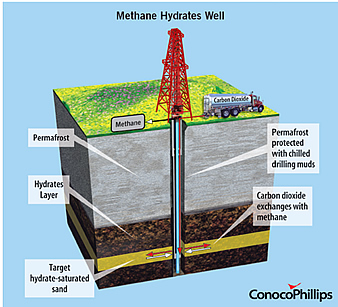
The methane – carbon dioxide exchange project is particularly interesting and is summarized nicely by the Daily News:

Conoco Phillips will try injecting carbon dioxide into the hydrate. Laboratory tests show that injecting carbon dioxide displaces methane, which comes out of the hydrate as a gas. The idea is that the carbon dioxide molecules take the place of the methane molecules in the hydrate, keeping it stable.

This could be neat, if it works. Carbon dioxide would be permanently sequestered, or stored, underground, while the methane is extracted and the hydrate is left intact.

One question the Conoco Phillips production test will attempt to answer is whether this reaction in the hydrate can occur fast enough for methane production to reach practical volumes.

The comment below is an understatement, but the enormous energy potential justifies the research.
This isn’t a slam dunk, though. The technical challenges are considerable.

Read Full Post »

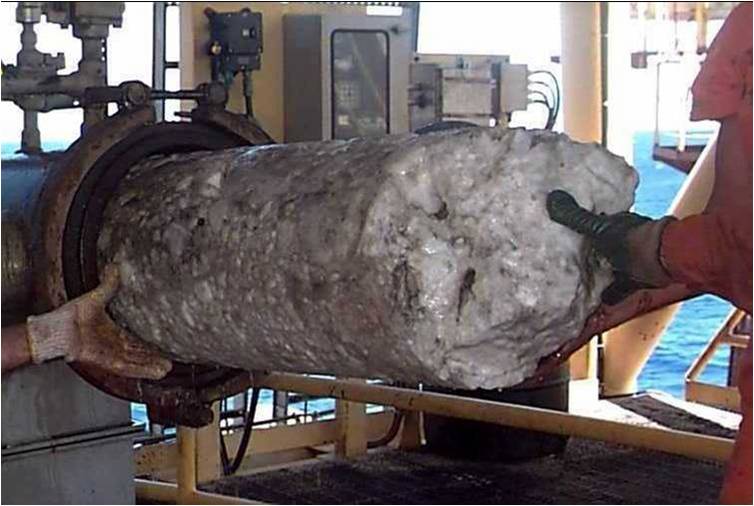
hydrate plug removed from pipeline

In a recent conversation, Colin Leach suggested an interesting plugging option for the Macondo well – hydrates.   Why not take advantage of nature and induce hydrate formation to plug the well?  We know that hydrates are difficult to prevent when methane mixes with water under the pressure conditions at Macondo.  Why not pump cold water down the choke line where it will mix with methane in the stack to form hydrates and plug the well?  To optimize the hydrate formation, methane could be injected down the kill line.

Hydrates would definitely form.  Chances are good that natural forces would form a solid hydrate plug that would prevent further flow from the well.  The only risk would be that the hydrates would form too slowly (unlikely given the experience with the seafloor containment chamber) or that they wouldn’t completely plug the well.    The presence of a hydrate plug would also require additional caution when the well is finally re-entered (after the relief well has secured the downhole flowpaths).   The best time to attempt the hydrate option would seem to be right now, after the more conventional BOP intervention attempts and before cutting the riser to install the cap.

Read Full Post »