Feeds:
Posts
Comments

Posts Tagged ‘helicopters’

Presentations from the January 2023 HSAC meeting have now been posted. None of the presentations addresses the tragic crash in the Gulf of Mexico on 29 December. This is understandable given the ongoing investigation.

Attached is an update from the Helideck Committee which also addresses wind farm issues.

Read Full Post »

Note the third paragraph in the cover letter for the attached Helicopter Safety Advisory Conference (HSAC) 2021 Safety Review (dated 2/10/2022), particularly this sentence:

There is a trend of doing more with less, for example decreases in the numbers of helicopters across the board, yet increases year-over-year in passengers carried, hours flown, and number of flights conducted.

The 2022 data will not be pretty. Clearly there are issues to be addressed.

Read Full Post »

Chevron may be the only GoM operator to own its helicopter fleet. Data on their safety performance relative to GoM helicopter contractors do not appear to be available online.

Their news release focuses on hurricane preparedness and the benefits of owning their fleet. I’m not sure how significant these advantages are given that other companies can ensure similar availability through their contracts. A comparative analysis would be of interest.

“Other companies that depend on contracted helicopters to evacuate can’t create their own schedule and might have to start departing the platform days in advance,” said Jose Jaramillo, manager of Chevron’s aircraft operations in the Gulf of Mexico. “With our own helicopters on standby, we have more flexibility in determining when to safely shut down the platform, and after the storm passes, we can quickly remobilize, assess our facilities and bring production back online days faster.”

Chevron.com

The Helicopter Safety Advisory Conference (HSAC) does a very good job of identifying and addressing Gulf of Mexico helicopter safety issues. Per HSAC (report attached):

The leading causes, not all inclusive, of the accidents since 1999 are listed below, and secondary causes of these events include 13 related to helideck size or design related issues.
• 21 engine related,
• 25 loss of control or improper procedures,
• 18 helideck obstacle strikes,
• 13 controlled flight into terrain, and
• 12 other technical failures

Read Full Post »

In light of the 2009 helicopter crash that killed 17 workers offshore Newfoundland and the rash of other helicopter incidents around the world, helicopter safety is a major concern for the offshore industry and regulators. This FAA decision (link courtesy of Cheryl Anderson) is sure to be controversial in Atlantic Canada and elsewhere.

The U.S. aviation regulator says it won’t require the retrofit of a gearbox blamed in a fatal helicopter crash off Newfoundland because it would be too expensive for the industry.

 The decision by the Federal Aviation Administration rejects a call by the Transportation Safety Board of Canada to phase-in a requirement that all Sikorsky S-92A gearboxes be capable of operating at least 30 minutes after losing oil.

The March 2009 crash of Cougar Flight 491 resulted in 17 deaths during a flight to an offshore oil platform, and has brought demands from the families of the victims that regulators in the United States, Canada and Europe change the rules governing the gearbox.

The FAA memo on the decision, obtained by The Canadian Press under U.S. freedom of information legislation, says the service record of the helicopter no longer supports the certification’s basic premise that the chances of an oil leak are “extremely remote.”

Read Full Post »

BOE’s Cheryl Anderson picked up this AP report.  Helicopter accidents continue to be a leading cause of offshore casualties.

A helicopter carrying crew from an offshore drilling rig crashed into the sea off Myanmar, killing three people on board. Eight were rescued.

The aircraft was carrying staff of the Malaysian oil company Petronas from the Yetagun offshore gas field in the Andaman Sea.

The oil field is operated by Petronas Carigali of Malaysia, PTTEP of Thailand and Japan’s Nippon Oil company. Petronas also operates a cross-border gas pipeline to transport gas from Yetagun to Thailand.

Read Full Post »


Congratulations to Bristow for winning the 2011 National Ocean Industries Association (NOIA) Safety-in-Seas Award. Bristow, a helicopter company, was recognized for its “Target Zero” program.

I was honored to serve as one of the judges, and Bristow is a most deserving recipient of this prestigious award. To the best of my knowledge, the Safety-in-Seas program, which began in 1978, is the oldest safety award program for offshore oil and gas operations.

I would also like to congratulate the other Safety-in-Seas nominees. All of the nominations were outstanding. While we must learn from accidents and failures, we can also learn from successes. The achievements of outstanding companies and safety leaders deserve attention and recognition.

KATC.com provides more information on Bristow’s selection:

“Target Zero” is a comprehensive cultural and training system that seeks to achieve zero accidents, zero harm to people and zero harm to the environment across Bristow’s operations. Building on statistical data that indicated human error contributed to 4 out of 5 accidents or incidents, Bristow’s “Target Zero” has reduced the rate of air accidents in for example the Gulf of Mexico from 2 reportable air accidents and one air incident in 2007 to zero accidents or incidents, with similar results in subsequent years. Bristow has achieved a 47% improvement year on year in Lost Work-time Cases, with overall improvement from 2007 – 2009 of 88%. When it comes to the environment, Bristow’s “Target Zero has maintained a record of zero environmental incidents and has stepped up pro-active efforts to ensure this stays constant. 

Read Full Post »
Toronto Sun

“If the sea state is too rough for a successful emergency ditching, then a helicopter shouldn’t be operating, period,” TSB’s Wendy Tadros said at a press conference in St. John’s Wednesday afternoon.

On Friday, the Canadian Association of Petroleum Producers said Newfoundland’s three offshore oil operators — Hibernia, Terra Nova and White Rose — would adopt the TSB’s recommendation.

Read Full Post »

Area map with helicopter track and impact position

BOE’s Cheryl Anderson has been tracking this story. Click here for the full TSB report.

Occurrence Summary:

On 12 March 2009 a Cougar Helicopters’ Sikorsky S-92A on a flight to the Hibernia oil production platform had a total loss of oil in the transmission’s main gear box. The flight crew descended to 800 feet and headed towards St. John’s. Approximately 35 nautical miles from St. John’s, during an attempted ditching, the helicopter struck the water in a high rate of descent. One passenger survived with serious injuries and the other seventeen occupants of the helicopter died of drowning.

Safety Issues

  • Category A rotorcraft certified under the “extremely remote” criteria may not be capable of continued operation for 30 minutes with only residual main gear box lubrication.
  • Given today’s operating environments, it may now be technically feasible and economically justifiable to produce a helicopter that can operate in excess of 30 minutes following a massive loss of main gear box lubricant.
  • Helicopter crews and passengers in Canada remain at risk where helicopters are operated over sea states exceeding the capability of their Emergency Flotation Systems.
  • Without a supplemental breathing system, occupants have very little time to egress from a submerged or capsized helicopter before breaking their breath-holds in cold water.

TSB Recommendations

  • The Federal Aviation Administration, Transport Canada and the European Aviation Safety Agency remove the “extremely remote” provision from the rule requiring 30 minutes of safe operation following the loss of main gearbox lubricant for all newly constructed Category A transport helicopters and, after a phase-in period, for all existing ones.
  • The Federal Aviation Administration assess the adequacy of the 30 minute main gearbox run dry requirement for Category A transport helicopters.
  • Transport Canada prohibit commercial operation of Category A transport helicopters over water when the sea state will not permit safe ditching and successful evacuation.
  • Transport Canada require that supplemental underwater breathing apparatus be mandatory for all occupants of helicopters involved in overwater flights who are required to wear a Passenger Transportation Suit System.


Read Full Post »

The Canadian Transportation Safety Board’s report on the March 2009 helicopter crash that killed 17 workers offshore Newfoundland will be released on 9 February. This CTV piece provides a good summary of some of the significant issues that have surfaced in the press including:

Pre-crash warnings:

A Canadian investigator who red flagged main gearbox problems months before a Sikorsky helicopter crashed off Newfoundland says he’ll closely read a federal report on what caused the deadly accident.

Criticism of the FAA for their failure to respond:

He forwarded his results to the Federal Aviation Administration, the U.S. agency that originally certified the aircraft, saying he hoped to hear what a deeper probe would find.

FAA says “Not My Job:”

Les Dorr said the agency didn’t send any follow up research it did to Yearwood because it wasn’t under any obligation to do so under international agreements.

Transport Canada says “Not My Job” and points the finger at FAA:

Maryse Durette, a spokeswoman for the agency, says in an email the matter was the FAA’s responsibility and Transport Canada would wait for the original certifier to make recommendations before acting.

While the data suggest that the risk to offshore workers may be greatest when they are travelling to and from a facility, this investigation has received very little attention outside of Canada. That is unfortunate.

Read Full Post »

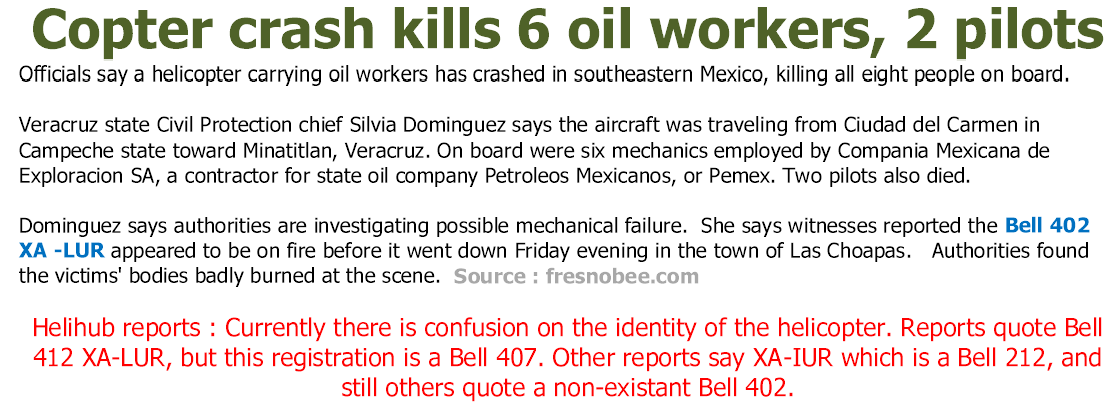
Helicopter Crash

From the Fresno Bee (18 Oct).  Click on visual to enlarge:


Read Full Post »