Feeds:
Posts
Comments

Posts Tagged ‘fatalities’

The Center for Offshore Safety (COS) was established in response to a recommendation by the National Commission on the BP Deepwater Horizon Oil Spill and Offshore Drilling for improved self-regulation by the offshore industry. The Commission supported the creation of a non-profit, industry-funded organization similar to the Institute of Nuclear Power Operations, to promote the highest levels of safety and operational excellence. 

The COS has been effective in strengthening corporate Safety and Environmental Management Systems, influencing the industry’s safety culture, and sharing best practices and lessons learned. These are important accomplishments.

The COS has fallen short in gathering the data needed to assess the offshore industry’s safety performance. As is the case with most voluntary reporting programs, data completeness and accuracy issues limit the significance of COS performance reviews.

Observations regarding the most recent COS Offshore Safety Performance Report follow:

  • The COS uses accepted performance indicators and a logical classification scheme.
  • COS reports that their members accounted for 78% of OCS oil and gas activity in 2024. This is accurate when cross-checked with BSEE hours worked data. However, the % of hours worked is not a good measure of the % of incidents reported in any category.
  • Companies not participating included important operators like LLOG, Cantium, Walter, and W&T, a host of smaller Gulf independents, the 2024 violations leader (by a wide margin) Cox, and troubled Fieldwood. (See Fieldwood’s 2021 and 2022 performance.)
  • Only two drilling contractors – Helmerich & Payne and Valaris – are members. Major contractors like Noble, Transocean, and Seadrill are not members. Their incidents will thus not be reported if they are not working for a COS member.
  • No production contractors are COS members. These companies conduct most of the platform operations on the shelf, where many of the lease operators are not COS members.
  • Pacific and Alaska Region operators do not participate.
  • Looking only at fatalities (table below), the most important and easily verified incident category, there are troubling omissions:
    • COS reports no 2024 fatalities when in fact there was a fatality during an operation for a COS member.
    • COS reports no 2022 fatalities when there were actually five. A workover incident took the life of one worker, and four died in a helideck crash on an OCS platform. In both cases, the facility operator was a non-member company.
    • COS records one 2021 fatality, but fails to include a 2021 Fieldwood fatality. There were also 6 “non-occupational” fatalities on OCS facilities in 2021, as classified by BSEE. Given the importance of worker health (the H in HSE), such a high number of non-occupational fatalities should be of interest industry-wide.
    • The COS report includes only two of the six 2020 fatalities, 2 of which were classified by BSEE as non-occupational.
    • The bottom line is that COS accounted for only 3 of 12 (25%) occupational fatalities during the 2020-24 period. There were at least 20 fatalities if you include the non-occupational incidents.
fatalities per COSoccupational
fatalities (from BSEE data)
non-occupational
fatalities (from BSEE data)
202401?
202300?
202205?
2021126
2020242

The offshore industry is only as good as its worst performer, so complete participation is essential. Voluntary reporting is seldom complete reporting, because some companies are more concerned about confidentiality than completeness and information sharing.

For industry reporting programs to be comprehensive and credible:

  • The entity receiving the reports and managing the data must be independent and not affiliated with an industry advocacy organization.
  • All operating companies must participate and complete reporting must be required. This can be accomplished contractually. If necessary, the regulator can require participation (either as a separate regulation or as a SEMS element).
  • Company incident submittals should be audited by the independent entity.
  • Fees should be solely for the purpose of supporting the independent reporting system.
  • For SP1 and SP2 incidents (per the COS classification scheme), the names of the responsible companies should be included in the performance reports. The current COS system prioritizes confidentiality over accountabiity and information sharing.
Read Full Post »

An excellent compliance and incident update by Jason Mathews is attached. BSEE’s focus on risk assessment, compliance and incident trends, high potential near-misses, medivac capabilities, hot work safety, lifting operations, and gas releases is encouraging. Good work by the folks in BSEE’s Gulf of Mexico Region.

Observations:

  • Zero 2023 occupational fatalities through Q3. Hoping this holds through the end of the year and beyond.
  • INCs/component are down but INCs/inspection are slightly higher. This may imply a relative increase in the inspection of high component deepwater facilities.
  • No. of hours worked is increasing; good sign for the offshore program.
  • Hand and finger injuries are driving up the injury count.
  • Well control incidents are stable at a low level.
  • Improved fire data help facilitate risk assessments
  • No YTD explosions
  • No. of collisions is down
  • 10 YTD spills> 1 barrel (total volume not specified)
  • Some evidence of decline in lifting incidents in Q2 and Q3
  • Gas releases are up (aging facilities, decommissioning related?)

Read Full Post »

Among the more important workstreams of the International Regulators’ Forum, a group of offshore safety regulators, are country performance data which provide a means of measuring and comparing offshore safety performance internationally. As we near the midpoint of 2023, the last data posted are for 2020. This lag makes it difficult to assess current trends and risks.

In addition to more timely updates, there are significant holes in the IRF data sets. For example, per IRF guidelines fatalities associated with illnesses or “natural causes” are not counted; nor are helicopter incidents that are not in the immediate vicinity of an offshore facility. Also, incidents associated with geophysical surveys, many pipeline segments, and (inexplicably) subsea wells and structures are excluded (see excerpts below).

Excerpts from IRF Performance Measurement Guidelines:

  • Exclude Geophysical and Geotechnical surveying and support vessel operations not directly associated with activities at an Offshore Installation
  • Exclude horizontal components associated with incoming and outgoing pipelines and flowlines beyond either the first flange at the seabed near an Offshore Installation or a 500 meter radius, whichever is less.
  • Exclude helicopter operations at or near an Offshore Installation
  • Exclude mobile or floating Offshore Installations being transported to or from the offshore location.
  • Exclude subsea wells and structures.
  • Do not include Fatalities and Injuries that are self-inflicted.
  • Do not include Occupational Illnesses in Fatality or Injury counts.
  • Do not include fatalities that are due to natural causes.

Perhaps the IRF can consider these and other data collection and publication issues at their next conference. Because voluntary incident reporting schemes have always suffered from incomplete or selective reporting, the regulators have to drive incident data collection and transparency.

Parallel US concerns about offshore incident data: After a review of BSEE fatality data provided in response to a Freedom of Information Act request, WWNO reported that “nearly half of known offshore worker fatalities in the Gulf of Mexico from 2005 to 2019 didn’t fit BSEE’s reporting criteria.” They noted that 24 of the 83 known offshore worker fatalities during that period were classified as “non-occupational.” (As previously posted, the rash of “natural cause” deaths (12) at Gulf of Mexico facilities in 2021 and 2022 is particularly troubling and warrants further investigation.)

Read Full Post »

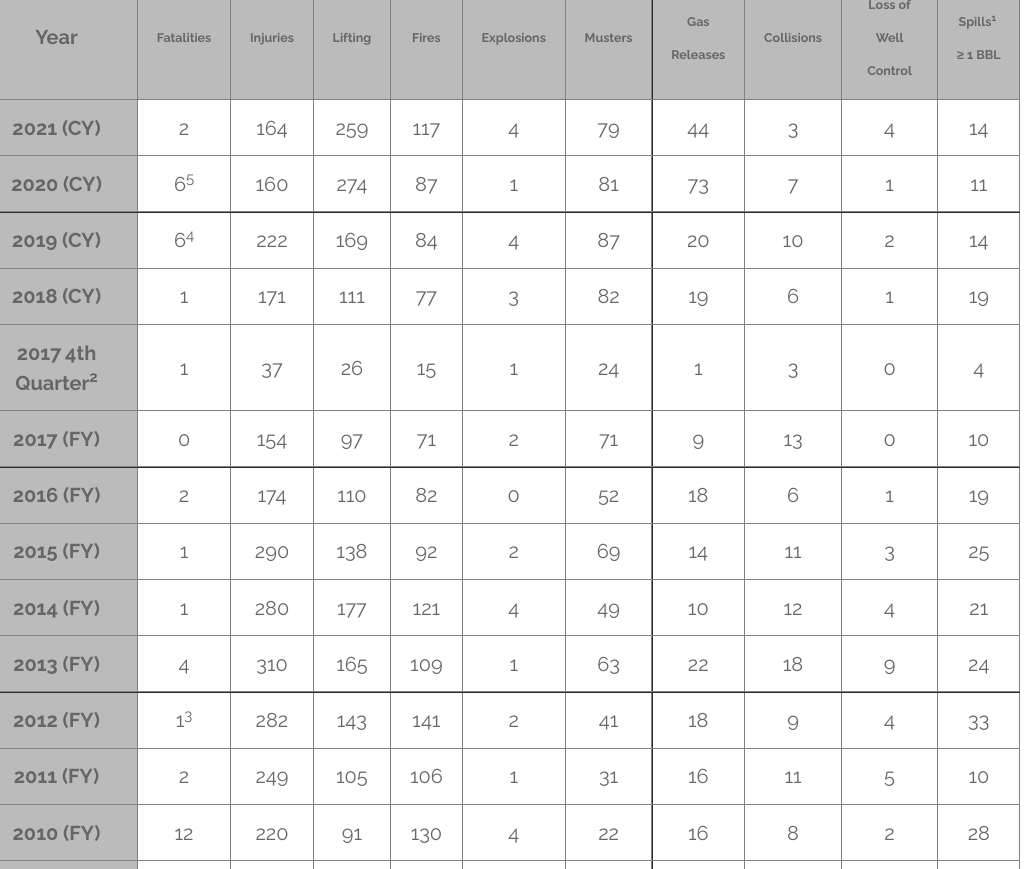
BSEE has posted the 2021 incident data for US OCS oil and gas operations. While the 13 month publishing lag is disappointing, the spreadsheet (below the table at this link and attached at the end of this post) appears to be comprehensive and complete.

Of the 8 fatalities in 2021, 6 are classified as “non-occupational” and are thus not included in the 2021 fatality count (see table below).

The 2 occupational fatalities are the result of falling metal plates on a drilling rig and the release of casing pressure on a production platform. These fatalities are still being investigated.

The 6 non-occupational fatalities on OCS facilities also merit further attention. While historical data on health-related OCS fatalities are not readily available, 6 such fatalities seems high relative to past experience, particularly given that the total number of hours worked has declined by more than 50% since 2011. Are these and other health related questions being considered?

  • Were covid or covid related health issues a factor?
  • Are health screening programs sufficient, particularly for contractors? Contractors are 80% of the workforce but accounted for 100% of the 2021 fatalities?
  • Are offshore medical care and evacuation capabilities sufficient?

Read Full Post »

ainonline:

  • This was the second crash for the operator (Rotorcraft) in two weeks, its second fatal for the year, and the third in the Gulf of Mexico since October.
  •  On December 15, a Rotorcraft Leasing Bell 206L-4 with three aboard crashed while taking off from a platform 35 miles south of Terrebonne Bay, Louisiana. In that accident, one of the helicopter’s skids caught under the helipad’s perimeter railing, and the aircraft fell into the water below. (We have concerns that yesterday’s incident may have had a similar cause.)
  • On October 26, a Westwind Helicopters Bell 407 with three aboard crashed into the Gulf 25 miles south of Morgan City, Louisiana after the pilot apparently experienced an in-flight medical emergency and told his front seat passenger he “was not going to make it” and then slumped over the controls. The front-seat passenger then attempted to gain control of the helicopter prior to the water impact. After several hours, both passengers were rescued with serious injuries, but the pilot died. (This is why I never liked single pilot aircraft.)
  •  Another of the company’s Bell 407s crashed on January 14 near Houma, Louisiana, killing both occupants. A witness to the accident said the helicopter appeared to dive nose-down into terrain. To date, investigators in that accident have not discovered any mechanical or structural failure that would account for that crash. 

Get to work HSAC, NTSB, BSEE, USCG, FAA, and all others who are involved with offshore helicopter safety.

Not a word about this tragedy on the Rotorcraft, Walter Oil & Gas, or BSEE websites, and no public statements can be found. At a minimum, one would have expected condolences to the families and a commitment to find out what happened and prevent recurrences.

Read Full Post »

Wall Street Journal: U.S. Wants More Oil From Canada but Not a New Pipeline to Bring It

WSJ

This WSJ report, if accurate, reflects the mindset that you can increase oil production on demand when absolutely necessary, and avoid committing to longer term oil and gas supplies. The goal of such thinking is to address supply crises without alienating the uncompromising climate ultras. You suspend lease sales, deny new pipelines, and demonize oil and gas and the people who produce it. When supplies tighten and prices spike, you tap the strategic reserve, appeal to OPEC, talk to Venezuela and Iran, and ask Canada to ship more oil in rail cars or trucks (but no new pipelines please!). .

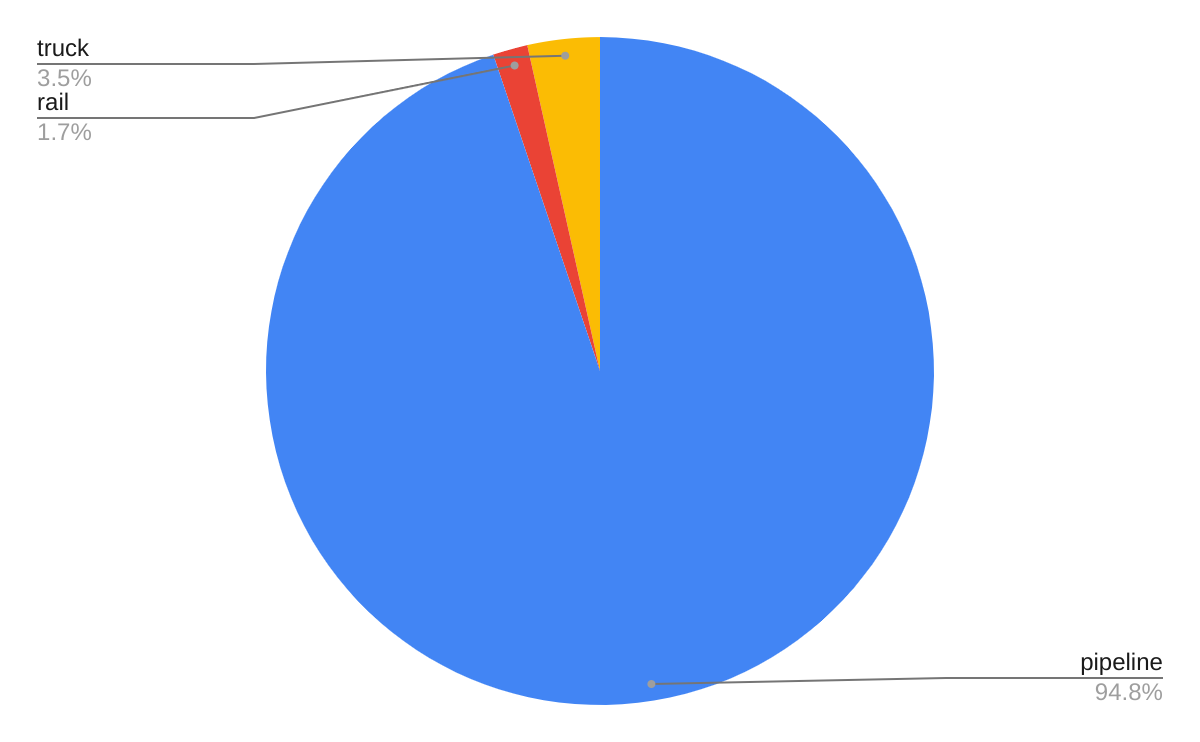
Below is a pie chart constructed using data from a 2018 DOT report to Congress. For logistical and economic reasons, pipelines are overwhelmingly the crude oil transport method of choice. Rail cars and trucks are called on where there are no pipeline options.

data from 2018 DOT report

Looking at the systems, one would assume that pipelines have safety and environmental advantages. Loading and unloading hundreds of tanks would seem to be inviting spills, although most would presumably be small. The DOT data bear this out. On a volume transported basis, spill incidents occurred nearly 15 times more frequently for rail cars and trucks than they did for pipelines.

For pipeline(s), an incident occurred approximately once every 720 million gallons of crude oil shipped. For rail, an incident occurred approximately once every 50 million gallons of crude oil shipped. For truck(s), an incident occurred approximately once every 55 million gallons of crude oil shipped.

Looking at the percentage spilled, pipelines also had a significant (7.6 times) advantage over rail, but only a slight advantage over trucks.

Volume of Crude Oil Shipped and Spilled by Pipeline, Rail, and Truck, 2007-2016

Pipeline
volume shipped (k gal)1,298,630,088
volume spilled (k gal)13,161
% spilled0.0010%
Rail
volume shipped (k gal)23,052,960
volume spilled (k gal)1,751
% spilled0.0076%
Truck
volume shipped (k gal)47,894,868
volume spilled (k gal)521
% spilled0.0011%

Because fatalities or hospitalizations were extremely rare, DOT chose not to normalize those data. There were a total of 3 fatalities associated with both pipeline and truck shipments. While no fatalities were associated with rail shipments, DOT noted that 47 deaths resulted from a crude oil derailment in Lac Megantic, Quebec in 2013. BOE further reminds readers that this train was transporting Bakken crude from North Dakota to a refinery in St. John, New Brunswick.

The bottom line is that you have to plan ahead to satisfy future supply needs. This is particularly true for the offshore sector where the lead times are longer, but the production volumes relative to the number of wells and facilities are higher (a good thing). The need for oil and gas is not going away, nor are threats to energy security. There are plenty of people in the U.S. Department of the Interior who understand this. Empower them to safely expedite leasing, exploration, and development!

Read Full Post »

This Nigerian source is now reporting that there are 3 confirmed deaths, and 11 workers declared missing. No other sources are reporting casualties at this time.

The latest AFP report indicates that the fire has been extinguished.

Read Full Post »