Feeds:
Posts
Comments

Posts Tagged ‘Deepwater Horizon’

A colleague sent a link to a Marathon Oil Company Macondo presentation that was posted by the Houston Chronicle. The presentation was intended for internal training and discussion purposes.

Firstly, I applaud Marathon for ensuring that the blowout is studied and debated within the company. Hopefully, they did the same thing for Montara, have a good internal system for studying accidents throughout the industry, and thoroughly investigate all of Marathon’s incidents and near misses.

I thought Marathon’s comments about safety culture were particularly interesting, including these on slide 58:

Although harder to define and measure, and even more difficult to regulate, we pointed to our culture as the single most important differentiating attribute when comparing us to BP.

In a recent meeting with an individual who has numerous dealings with BP, he observed that regardless of the purpose of the gathering (planning session to morning rig call), it is almost impossible to determine who is ultimately responsible and accountable for the operation being discussed. Evidence of this exists in the very report this presentation was derived from.
I wonder what convinces Marathon that their safety culture is superior. The above anecdote, while interesting, doesn’t tell us much. Prior to Macondo (and perhaps even after the blowout), I’ll bet most BP employees thought that they had a strong safety culture. Ditto for Transocean. Does Marathon have any better evidence demonstrating the strength of their safety culture? If not, what makes them so confident? Does Marathon have a process for assessing and monitoring the attitude and commitment of their employees? Have they conducted regular internal surveys to gauge safety culture? My sense is that they have not. If they had, they could make their case without the very subjective comparison with BP.

Read Full Post »

In addition to suing for damages, the Justice Department is seeking civil penalties.  The amount has not been specified.

In the complaint, the United States alleges violations of federal safety and operational regulations, including:

  • Failure to take necessary precautions to secure the Macondo Well prior to the April 20th explosion;
  • Failure to utilize the safest drilling technology to monitor the well’s condition;
  • Failure to maintain continuous surveillance of the well; and
  • Failure to utilize and maintain equipment and materials that were available and necessary to ensure the safety and protection of personnel, property, natural resources, and the environment.

Read Full Post »

Agenda

Live Webcast

Read Full Post »

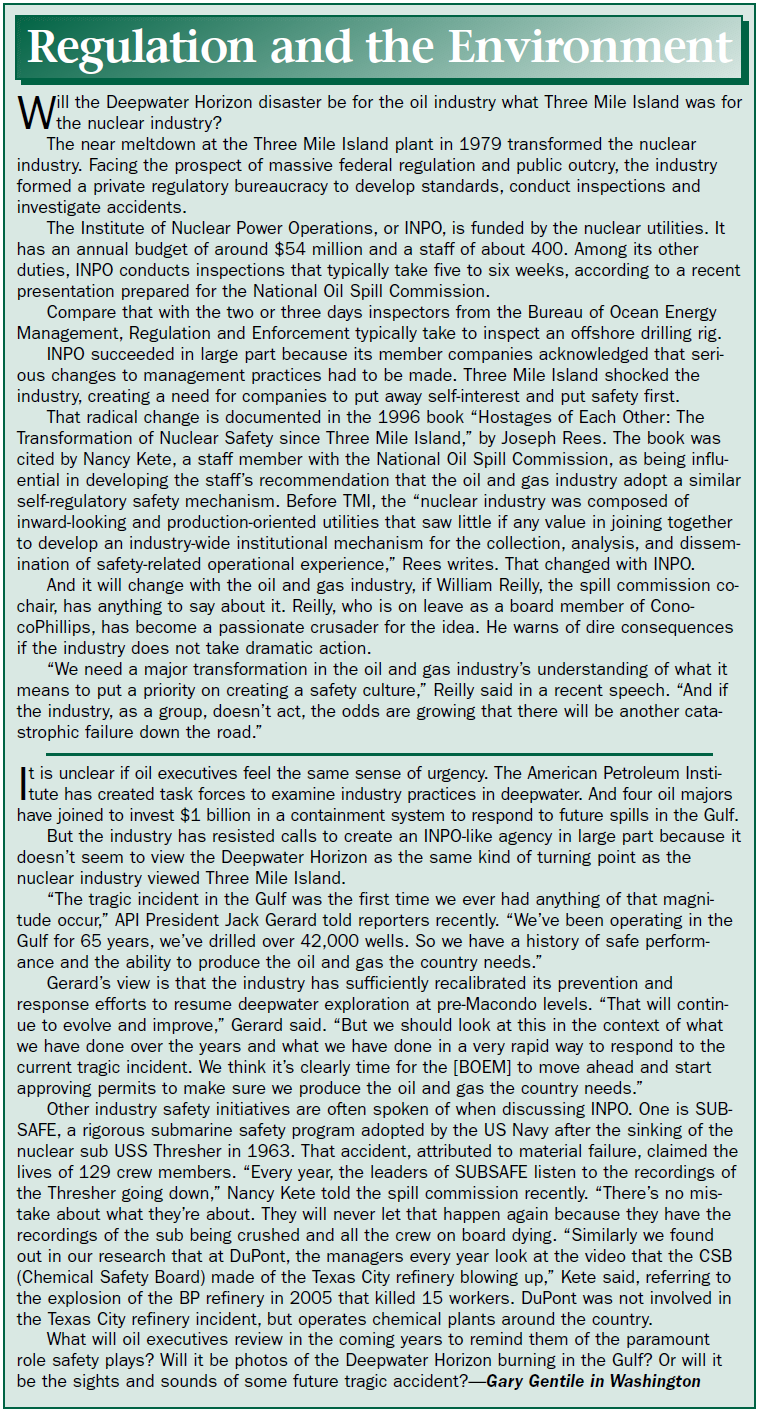
This is a very good column that we are posting with the permission of Gary Gentile, Platts Oilgram.

Read Full Post »

Transocean Ltd. (RIG, RIGN.VX) said Thursday that a Swiss administrative court ruled that the company cannot pay out about $1 billion to shareholders because of the numerous Deepwater Horizon-related lawsuits pending against the rig owner in the U.S. Wall Street Journal

The $40 billion question: How much will Macondo ultimately cost Transocean? Halliburton? Anadarko? Mitusi? Cameron?

Read Full Post »

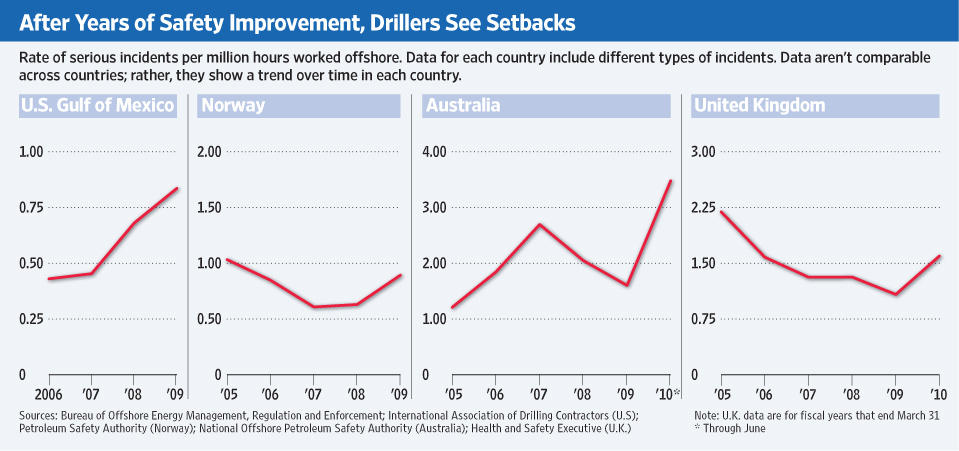
While the significance of these charts is debatable, the occurrence of two historic blowouts – Montara and Macondo – within an eight month period is a clear signal that we have problems. The disturbing similarities in these two blowouts tell us that well construction, monitoring, barrier verification, and personnel training practices are not where they should be.

Link to article

Read Full Post »

Washington Post report:

Workers on the doomed Gulf of Mexico oil rig were distracted by multiple activities going on simultaneously and didn’t try to shut the well until 49 minutes after potentially explosive gas particles began flowing in, a BP vice president told a federal investigative panel Wednesday.

Read Full Post »

Blowout: Is Canada Next?

Thursday, December 9, 2010 at 9 pm on CBC-TV

If the title and announcement for this CBC documentary are indicators, this won’t be a scholarly review of the risks associated with Canadian offshore exploration and development. Nonetheless, those of you who can view CBC programming may want to tune in and see what they have to say.

Read Full Post »

As presented this morning:
  • Core mission: achieve excellence in system safety across offshore oil and gas industryIndependent auditing function
  • Cannot lobby – cannot be the American Petroleum Institute
  • Company CEOs and boards of directors provide leadership and ensure engagement of employees with it
  • Institute is empowered to use real rewards and sanctions to help all industry players overcome the enemies of safety –ignorance, arrogance, and complacency.

Read Full Post »

This well-written draft report is fascinating reading for those who closely followed the various attempts to contain and kill the Macondo well.

A couple of concerns:

  1. The report relies heavily on anecdotes and qualitative judgments attributed to unnamed individuals. For example, twelve sources are cited in the footnotes on page 6, but only one is mentioned by name.  No information is provided about the qualifications or responsibilities of the unnamed sources, so it is difficult to assess the significance of their comments.
  2. The narrative ends rather abruptly without any discussion about the decision to continue with the relief well after the successful static kill operation.  The report simply states that BP proceeded with the relief well to finally kill Macondo.  As indicated previously on BOE, this is not entirely accurate. Macondo was already killed, and the well could have been secured through conventional plugging and abandonment procedures.  The relief well was presumably continued to verify that the annulus was sealed and provide information that might be useful as part of the investigation.  However, the relief well did not kill the well and the intercept was not necessary for that purpose.

Read Full Post »

« Newer Posts - Older Posts »