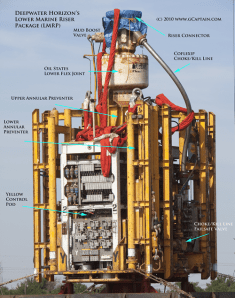
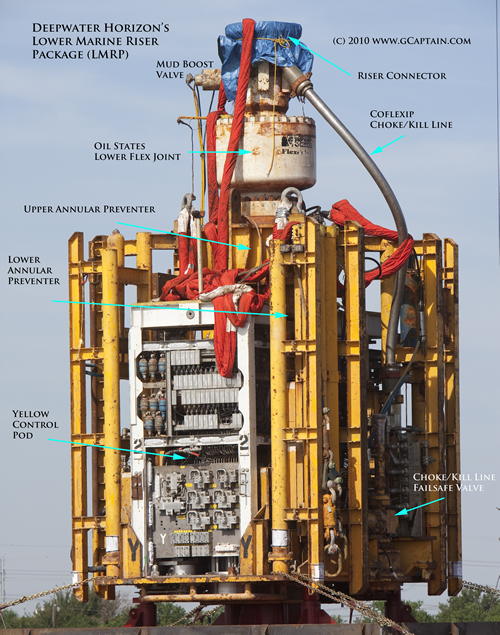
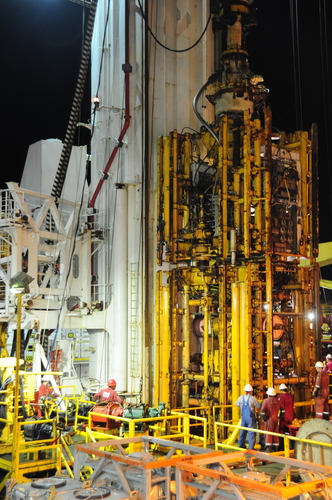
BOP stack awaiting post-Macondo inspection (from gCaptain.com)
In my 11 May 2010 testimony before the Senate Energy and Natural Resources Committee, I made ten recommendations. While many of the issues raised in that testimony are being addressed, one of the more important recommendations (no. 4) has received little or no attention. This recommendation calls for a public or private system for collecting and assessing failure date for blowout prevention equipment. To the best of my knowledge, the only publicly available performance data for BOPE were collected by MMS and SINTEF and pertain to failures during BOP pressure testing, not failures during other operations. How can we have a credible safety system without comprehensive failure data for such critical well control equipment?
Dr. Malcolm Sharples, an important BOE contributor, identified a number of BOP performance issues since Macondo. Here are a few examples:
- During routine tests on the device, the locking system of one of the rams jammed in a locked position. Sevan is working with Petrobras and the supplier, Cameron, to find a solution.
- Reliance suspended all drilling work in the block after the Transocean rig Deepwater Expedition developed technical problems in its BOP. Reliance was drilling the KGV-D3-W1 well in the contract area since April 2010.
- The rig was offshore Australia for Shell early last month when newly installed BOP components failed during operations. Following several unsuccessful attempts to rectify the problems in the field, the failing BOP component is currently undergoing repairs in Singapore.
How is this information not important to every operator, regulator, and drilling contractor? A comprehensive BOP failure reporting system should be a high and immediate priority for the offshore industry. The information should be verified and published so that all may learn and future performance improved. Requirements for providing such information should be included in contracts and, if necessary, regulations.
An other major void that I have been talking about for years, without much success, is the absence of a comprehensive and verified international incident reporting system. I assumed this would be universally recognized immediate necessity, and a critical element of the offshore industry’s initiatives agenda. Apparently that is not the case. More on this to follow.
Read Full Post »

 Bud's Offshore Energy (BOE)