Feeds:
Posts
Comments

Posts Tagged ‘BOP’

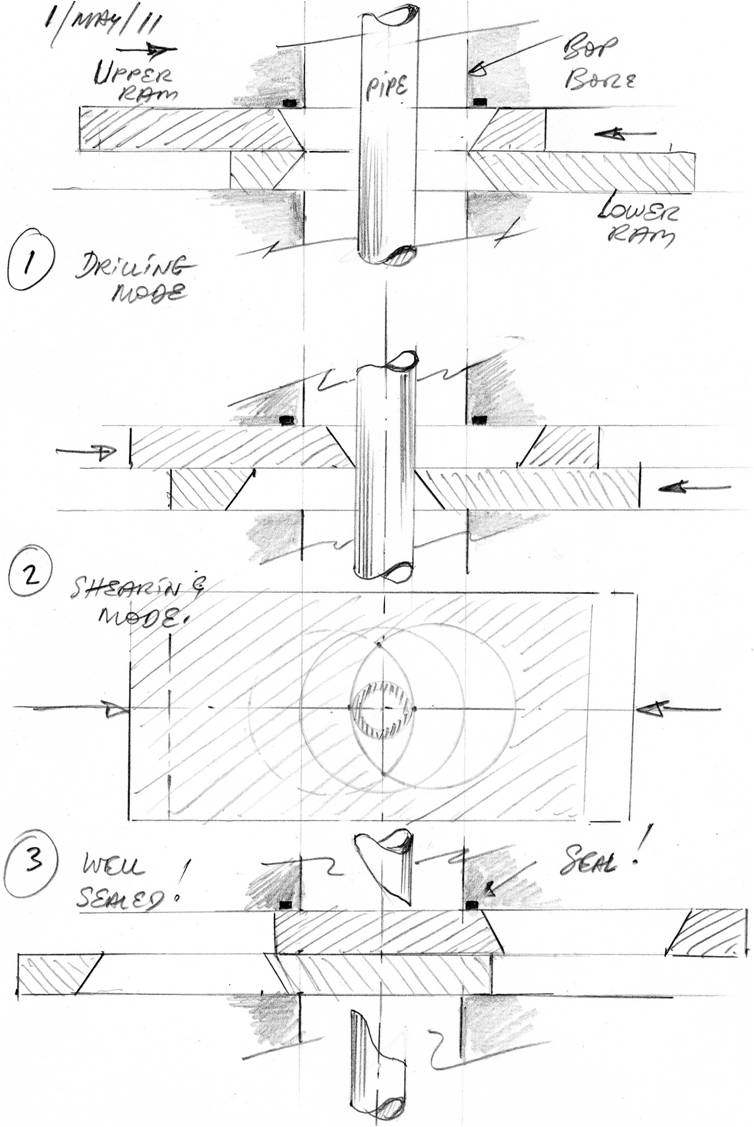
JL Daeschler, subsea engineer and inventor, sent me some preliminary drawings for a new BOP concept.

  • JL’s design concept is based on 2 slab gate valves, one above the other, that move in the opposite direction and are beveled for shearing.
  • The sealing element is fixed (solid, one-piece) to the main body of the BOP, does not move with the rams, and is fully protected in the drilling mode.
  • The hydraulic system would retract the gate rather than close it (fail-safe closed).
  • The upper and lower rams (gate valve type) are self-centered with a guiding system to minimize side movement and deflection.
  • Well pressure assists in forcing the upper ram against the sealing element.
  • JL is considering a similar concept (single shear) for xmas tree workover system.

Read Full Post »

AP report:

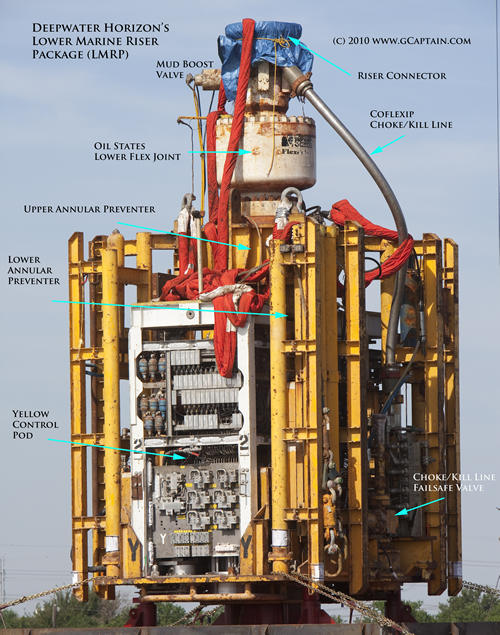
“The Deepwater Horizon BOP was unreasonably dangerous, and has caused and continues to cause harm, loss, injuries, and damages to BP (and others) stemming from the blowout of Macondo well, the resulting explosion and fire onboard the Deepwater Horizon, the efforts to regain control of the Macondo well, and the oil spill that ensued before control of the Macondo well could be regained,” BP said in the suit.

Read Full Post »

The following question is based on an interesting email message that I received from JL Daeschler, a pioneering subsea engineer:

One of the final acts on the Deepwater Horizon crew appears to have been the activation of the emergency disconnect sequence (EDS). The DNV report concludes that this emergency sequence was triggered, but never actually initiated, probably because of a loss of communication to the BOP stack after the initial explosion. Is it possible that the EDS sequence actually was initiated, but that the incomplete closure of the shear ram terminated that sequence?

Looking forward to next week’s hearings. Hopefully C-SPAN will televise the proceedings, because there is not indication that the Joint Investigation has arranged for live streaming.

Read Full Post »

Here is the court order. It doesn’t say that the upcoming BOP hearings will be delayed, so they will presumably begin on April 4th as scheduled.

Read Full Post »

While C-SPAN has broadcast some of the proceedings, the Deepwater Horizon Joint Investigation hearings have inexplicably not been streamed live by the Coast Guard (USCG) and Department of the Interior (DOI).  The National Commission and Chemical Safety Board streamed their hearings live, but the USCG and DOI have not done so.  Why? This is perhaps the most significant accident in the history of the US offshore oil and gas program, and the most notable worldwide offshore disaster since Piper Alpha in 1988. Eleven men died on the Deepwater Horizon.  Economic costs will total in the tens of $billions. Major regulatory changes, some of which don’t appear to address identified risks, are being imposed.

The upcoming hearings are particularly important because the BOP issues that will be discussed have enormous international significance. In this era, the world shouldn’t have to travel to New Orleans to observe the hearings, rely on sketchy press reports, or wait months for transcripts to be released. (And how is it that the Montara Inquiry Commission in Australia was able to post transcripts within hours after the conclusion of each day’s hearing?)

Accident prevention is dependent on complete and timely information.  Had more people paid attention to Montara, Macondo may have been prevented. The upcoming Deepwater Horizon BOP hearings are of critical importance, and should be streamed so that all interested parties can follow the proceedings.

Read Full Post »
Just released.

The DNV report will be discussed in the upcoming hearings:

The Bureau of Ocean Energy Management, Regulation and Enforcement (BOEMRE)/U.S. Coast Guard (USCG) Joint Investigation Team, which is examining the Deepwater Horizon explosion and resulting oil spill, today announced that it will hold a seventh session of public hearings the week of April 4, 2011. The hearings, which will focus specifically on the forensic examination of the Deepwater Horizon blowout preventer (BOP), are scheduled to take place at the Holiday Inn Metairie, New Orleans Airport, 2261 North Causeway Blvd., Metairie, La.

Read Full Post »

Per the Platts Oilgram report that we posted on 17 March, here is the complete court filing..

These are the additional tests recommended by BP’s consultant Ralph Linenberger:

  • Removal and forensic analysis of each annular element
  • Hydraulic signature testing of the annular preventer operator and ram preventers operators
  • Disassembly and inspection of the annular preventer and ram preventer bonnets
  • Laser scanning of (i) the entire BOP wellbore; (ii) the upper annular packer and upper annular cap; (iii) the inside of the riser kink; and (iv) the wellbore-facing surfaces of the casing shear ram bonnets
  • Hydraulic circuitry pressure test
  • ST lock circuit confirmation
  • Solenoid pie connector pin measurement and corresponding female receptacle analysis.

Is anyone else surprised that some (all?) of these tests hadn’t already been conducted? That would seem to be the biggest revelation from the BP court filing.

Read Full Post »

From Platts Oilgram News article by Gary Gentile:

The team examining the BOP in Louisiana conducted tests in January and February of this year that showed that with the proper amount of hydraulic fluid pressure, the rams on the BOP would close, according to Dan Tillema, an investigator with the US Chemical Safety Board.

Portions of drill pipe were found in the BOP and the pipe was cut, Tillema said—a sign that the rams did close at some point during the incident.

But Tillema cautions against making any assumptions based on the test results sofar. Some reports have suggested that rubber gaskets around the rams were worn awayby the massive flow of oil and gas gushing from the Macondo well, overcoming the BOP’s capacity. That is just one of several possibilities, Tillema said. “We haven’t made any conclusions yet,” he said.

Read Full Post »

Transocean Ltd., the world’s largest offshore oil driller, may attempt to recover some or all of the Deepwater Horizon rig that exploded and sank during last year’s Macondo well disaster. Bloomberg

U.S. Attorney Steve Overholt told District Judge Carl Barbier that testing of the failed blowout preventor (BOP) that led to the Deepwater Horizon oilrig explosion should be done by the end of this week. Louisiana Record


Read Full Post »

Giant metal shears successfully sliced and closed pipe full of runaway crude in the early moments of last April’s Deepwater Horizon disaster, but the oil blasted through rubber gaskets around the blades and unleashed the nation’s largest spill, according to sources familiar with an ongoing investigation. Houston Chronicle

That would be consistent with the video evidence recorded on the Q4000, but we still need a lot more information about the timing of the shear ram closure, the position of the ram and drill pipe before and after shearing, maintenance, and other important BOP issues.

Kudos to the Chronicle for their ongoing coverage of Macondo issues.

Read Full Post »

« Newer Posts - Older Posts »