The sale could be held sooner. However, since BOEM asked for 37 days, I’m assuming that the sale will be on December 21.
In the 70 year history of the oil and gas leasing program, this will be the sale date that is closest to Christmas. Yet another major milestone for the offshore program! 😀
IT IS ORDERED and ADJUDGED that the Intervenors’ appeal is DISMISSED. As for BOEM’s limited appeal as to the timing of the sale, we hereby AMEND the district court’s preliminary injunction only to the extent that the deadline for conducting Lease Sale 261 shall now be thirtyseven days from the date of the issuance of the mandate in this appeal. IT IS FURTHER ORDERED that each party bear its own costs on appeal.
Kudos to BOEM for sponsoring this important study which identifies the potential ecological effects of offshore wind farms on the endangered North Atlantic Right Whale.
BOEM must now consider, and presumably implement, the committee’s recommendations. This could prove to be especially challenging given BOEM’s prominent wind advocacy role.
All 9 of the study committee members are scientists with appropriate backgrounds and specialties (see Appendix A of the report).
As a rule, the NAS notes potential conflicts of interest in the biographical statements. Two possible conflicts were identified: one committee member was a “compensated member of a review panel for Ortsted’s Offshore Wind Research Plan in 2021,” and another works for a firm that “has been partially funded by offshore wind development companies.”
The panel recommends robust monitoring during all phases of wind development and operations in the North Atlantic region. Is that sufficient given that hundreds of turbines could be installed before the data have been acquired and analyzed?
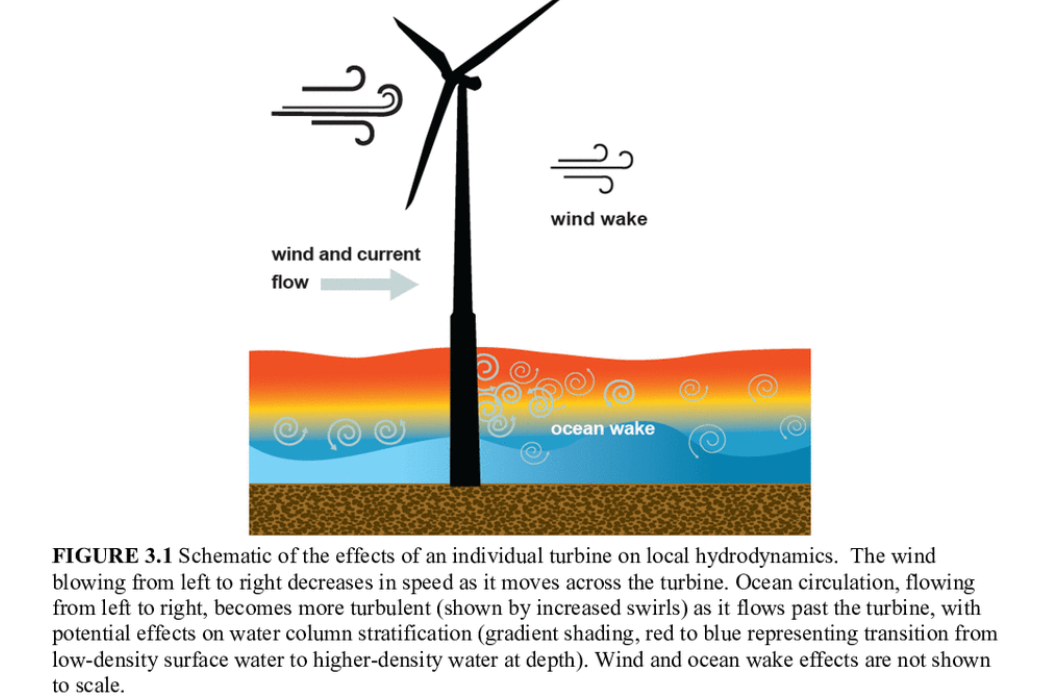
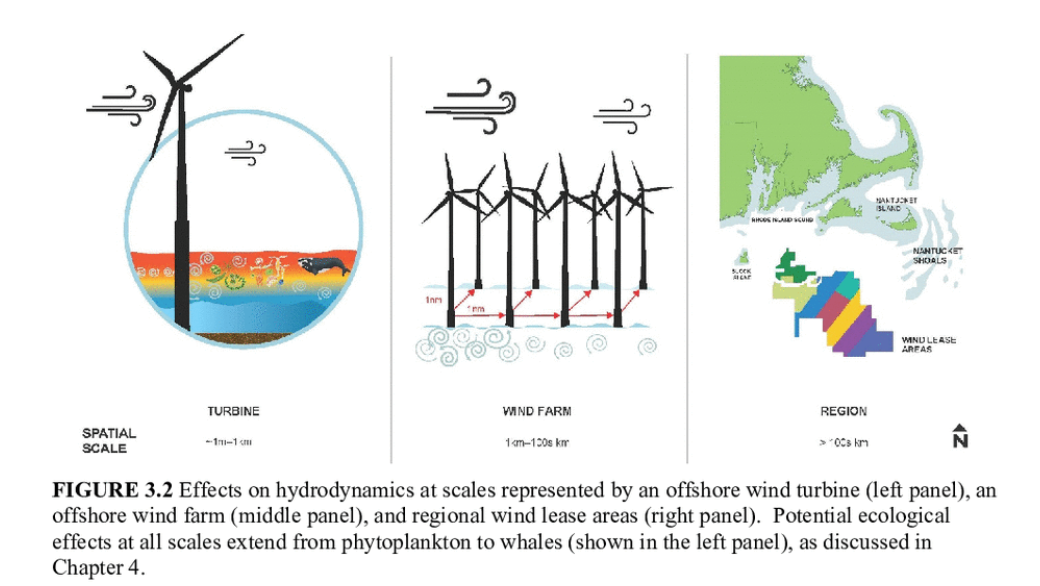
. Background graphics, excerpts, and recommendations are pasted below.
Important excerpts:
p.2: A single offshore wind turbine can alter local hydrodynamics by interrupting circulation processes through a wake effect and induce turbulence in the water column surrounding and downstream of the turbine supporting structure, the pile. Moving away from single turbine effects and looking at arrays of turbines in a wind farm or at multiple adjacent offshore wind farms, these effects become more complex with implications for both local and regional circulation.
p.4: At the wind farm scale, the potential impacts include reductions in ocean current speeds, stratification, ocean surface wind speed, and deflection of the pycnocline. At the regional scale, perturbations due to offshore wind turbines are difficult to quantify because of the natural processes that drive significant environmental variability across the region.
p.6: Recommendation: The Bureau of Ocean Energy Management, National Oceanic Atmospheric Administration, and others should support, and where possible require, the collection of oceanographic and ecological observations through robust integrated monitoring programs within the Nantucket Shoals region and in the region surrounding wind energy areas before and during all phases of wind energy development: surveying, construction, operation, and decommissioning. This is especially important as right whale use of the Nantucket Shoals region continues to evolve due to oceanographic changes and/or the activities and conditions relevant to offshore wind farms.
p.7: Recommendation: The Bureau of Ocean Energy Management, National Oceanic Atmospheric Administration, and others should support, and where possible require, oceanographic and ecological modeling of the Nantucket Shoals region before and during all phases of wind energy development: surveying, construction, operation, and decommissioning. This critical information will help guide regional policies that protect right whales and improve predictions of ecological impacts from wind development at other lease sites.
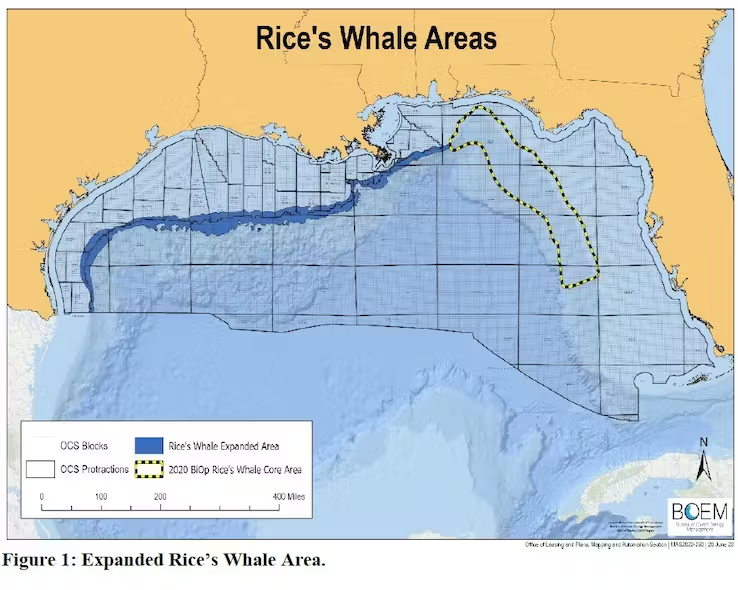
Today, the 5th Circuit Court of Appeals heard oral arguments in the appeal of the District Court’s injunction against the Rice’s whale tract deletions and operating stipulations for Sale 261.
If you want to listen to a recording of these arguments, you can do so at this link. The hearing was brief – only about 45 minutes.
Judging by the comments, it sounds like the Court will reach a decision soon. The Department of the Interior is asking for 37 days after the ruling to organize and hold the sales. The industry attorney seemed comfortable with that, so the sale should be prior to Christmas.
As a result of the order issued by the United States Court of Appeals for the Fifth Circuit on October 26, 2023, in Louisiana v. Haaland (Case No. 23-30666), the Bureau of Ocean Energy Management (BOEM) is postponing Lease Sale 261, which was originally scheduled for September 27, 2023, and later scheduled for November 8, 2023, in response to judicial orders. Until the court rules, BOEM cannot be certain of which areas or stipulations may be included in the sale notice.
Potential bidders in Lease Sale 261 should not submit bids until BOEM provides additional instruction. BOEM will hold any bids already received and will hold the sale after it receives further direction from the Court of Appeals.
The Polar Pioneer was once a good rig for sub-arctic operations, but is not at all similar to the modern drilling units that are used on the deepwater Gulf of Mexico leases that now account for 93% of OCS oil production and 76% of the natural gas. With the exception of the GoM shelf, which is laudably being gleaned by independent producers, the deepwater GoM blocks are all that is left of the once robust US offshore leasing program.
Unless the picture of the scrapped drilling rig is intended to be symbolic of the current state of the leasing program, the photo choice implies inattention to significant technical details. The document does not include a single picture of a deepwater drilling unit or production facility.
Tommy first served as Senior Advisor in the Bureau of Ocean Energy Management, Regulation, and Enforcement (BOEMRE), a transition bureau in the wake of the blowout, and was later named Director of the Bureau of Ocean Energy Management (BOEM), one of the two new bureaus that were established to manage the offshore program. He subsequently served as DOI Chief of Staff, and was appointed Deputy Secretary in 2021.
Tommy was a strong leader and an energy moderate. He was highly regarded by the rank and file in BOEMRE and BOEM.
The press release announcing his departure is very professional with appropriate quotes from Secretary Haaland and Tommy. No reasons for his resignation are provided. However, given his balanced perspective on energy development, it would not be wildly speculative to suggest that he might have been a bit uncomfortable working in the policy bubble that produced documents like the latest offshore leasing plan.
BOEM’s five year plan presented one of the few recent opportunities to “vote” solely on the issue of offshore oil and gas leasing. Advocates facilitated the voting process by providing form letters for and against leasing. Both opponents and supporters are quite good at these campaigns, so neither side had a significant organizational advantage.
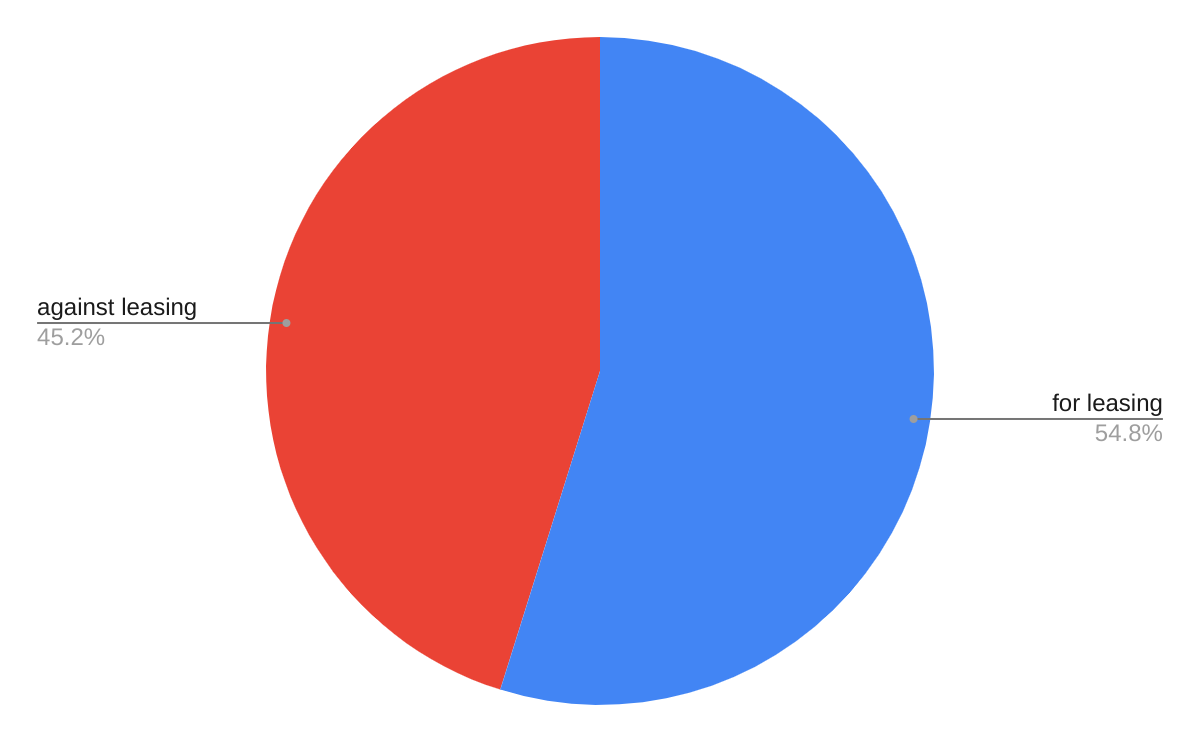
BOEM summarized (Table A-11 of the plan) the public comments, and I tabulated the 748,719 letters on the attached spreadsheet. The number of letters supporting oil and gas lease sales exceeded those opposed by 72,383 or 21.4%. The supporters campaign also had more breadth in that there were 49 separate campaigns vs. 45 for leasing opponents.
The NRDC demonstrated their organizational clout with the largest single campaign (107,355 letters). Denise Neal, a name that is unfamiliar to me, impressively organized the largest proponent campaign (61,122 letters).
Summary:
letters supporting offshore oil and gas leasing: 410,551
letters opposing offshore oil and gas leasing: 338,168
letter campaigns supporting leasing: 49
letter campaigns opposing leasing: 45
largest campaign: NRDC – 107,355 letters in opposition (32% of all such letters)
largest pro-leasing campaign: Denise Neal – 61,122 letters in support (15% of all letters in support)
reduce energy costs, farming costs, prices of gasoline and other goods
climate
jobs
environmental justice, local communities
energy independence
fisheries
intl competitiveness
marine environment
national security
marine mammals
GoM production is lower in carbon intensity, higher US environmental stds.
fossil fuel dependency, unnecessary to meet energy needs, oppose new fossil fuel investments, leasing “would not reduce gas prices”
domestic oil and gas preferable during transition
oil spill risks
help improve supply chain
air pollution
help address inflation
stockpiling ocean space, energy price gouging
Interesting contradiction: Opponents of Sale 257 argued in Federal Court that BOEM failed to consider the positive GHG effect that higher prices (the logical result of lower production) would have as a result of reduced demand. The judge agreed with that argument and vacated the sale. Some of the same groups have now commented (per the BOEM summary) that additional leasing “would not reduce gas prices.”
BOEM is allowed to delay the sale until Nov. 8, which is consistent with the Federal government’s request.
All other aspects of the Preliminary Injunction remain in place, but the 5th Cir. still needs to hear and decide the government’s appeal of the PI. Monday’s decision was on the emergency motion and not the merits of the Preliminary Injunction.
Assuming the Gulf of Mexico oil and gas lease sale proceeds tomorrow in accordance with Judge Cain’s order, some interesting questions and issues remain:
Will the lingering Rice’s whale issues affect bidding for deepwater leases? Friday’s court order is not a final resolution of those issues, either legally or administratively. While the Rice’s whale stipulation, at the direction of the Federal court, will not be included in the Sale 261 leases, BOEM’s Notice to Lessees and Operators (NTL) includes the same provisions and still stands pending further consultations with NOAA. Although the NTL is a “guidance document” (wink-wink), there are ways of making it stick through the exploration plan approval process. Even without binding requirements, companies might choose to fully comply to minimize legal risks.
When will the next GoM lease sale be held? Will the uncertainty spur or constrain bidding?




 Bud's Offshore Energy (BOE)