Feeds:
Posts
Comments

Posts Tagged ‘blowouts’

Like all swinging voters, Dirty Harry – a saltwater crocodile admired for his prediction prowess – took his time sniffing out the candidates in his enclosure at Crocosaurus Cove in Darwin today. Refusing to make a snap decision, Harry – reluctantly it seemed – chose the chicken carcass that was attached to a caricature of Prime Minister Julia Gillard.

Link

Should the croc be correct, BOE friend Martin Ferguson will presumably retain his cabinet position and release the Montara report as promised.  Why is the release of this report so important?

  1. While the transcripts of the Inquiry hearings do a pretty good job of identifying the well planning, cementing, barrier, and management issues that were contributing factors, the Commission’s confirmation of the specific root causes of the blowout is essential.
  2. Only a few BOE geeks and a handful of others have actually read all of the testimony and submissions.  The Macondo planners and Deepwater Horizon crew either were totally unaware of what happened at Montara or ignored what they had learned.  I suspect that the former was the case.
  3. Important emergency response issues, which received minimal attention during the Montara hearings, will likely be discussed in the report.  Montara demonstrated that capping and containment operations can be more difficult for a surface well than they are for a subsurface well.   For safety reasons, a surface capping operation was prohibited at Montara.  Even if the operation was allowed, it probably wouldn’t have been successful because of the way the well was suspended.  Should well suspension practices take into account the possibility of a surface capping operation?
  4. The decision to move a rig from Singapore to drill the Montara relief well, rather than use rigs that were operating off Australia, has broad industry and regulatory implications.  Will this decision be assessed in the report?
  5. Finally, the Montara Commission makes recommendations for Australia’s offshore regulatory regime. These recommendations will be of great importance to the US and other nations that are reorganizing or initiating their regulatory programs.  We expect the Commission to recommend that a single agency regulate operational safety offshore Australia.  This is consistent with the recommendation in my testimony before the Senate Committee on Energy and Natural Resources and the approach taken by Norway and other leading offshore regulators.  A regulatory regime that includes multiple agencies with overlapping or segmented jurisdiction guarantees conflict, confusion, gaps, and inefficiency.  Wells, platforms, and pipelines are integrated drilling and production systems, and must be regulated as such. Similarly, permitting, auditing, and inspection are integrated regulatory functions that cannot be effectively divided among multiple agencies.  One regulator must be responsible and accountable.

Read Full Post »

Not surprisingly, the television networks embraced the “Georgia Study,” which estimates that up to 79% of the Macondo spillage remains in the Gulf. Correspondents, bobbing from boats, rushed to report the news.  Does this mean that the networks will resume their courageous Key West oil-watch?  How about those damage projections for East Coast beaches?

Anyone who thinks that 79% of the oil remains hasn’t spent much time observing oil spills.  NOAA’s peer reviewed numbers are more credible.

The major newspapers, to their credit, seem to be providing balanced coverage of the new report.  The New York Times has a good article and this comment from Ed Overton seems to be pretty much on target:

Other marine scientists involved in evaluating the impact of the spill defended the government’s findings. “I generally agreed with the results,” said Edward Overton, a biologist at Louisiana State University who was one of several scientists who reviewed the federal study prior to its release. “I think it’s close to being on the mark.”

Read Full Post »

We are currently working with BP engineers and our science team to look at test results and do investigations to lead us to the best way to mitigate any risk of intercepting the annulus and increasing the pressure in the annulus. Admiral Allen

This insistence on drilling into a “killed well” reminds me of the Unified Command’s plan to end to end the “well integrity test” and vent the well after it had been successfully capped on July 15.  Fortunately, the Command showed good judgement and reversed that decision. Perhaps they should do the same with the relief well intercept, which no longer appears to be necessary and may be hazardous.

The obvious next step is to re-enter the well from the top, perforate the production casing and squeeze cement into the annulus, and proceed with the plugging and abandonment operation.  If the Command has reasons why this would not be the best approach, we’d like to hear what they are.

Despite the repeated “my way is the relief well” pronouncements, I trust that the Command will choose the option that accomplishes the objectives with the fewest risks to safety and the environment.

Read Full Post »

Letter from Admiral Allen to BP:

… in response to BP’s request to consider foregoing the relief well, the government scientific technical team has determined that the benefits of the bottom kill procedure outweighs the risks.

  1. Did BP really ask to forgo the relief well or was this just a point of discussion?  If so, it would be nice to hear BP’s side of this.
  2. Is BP confident the annulus is plugged?  If so, what is the basis for their confidence?
  3. If the annulus is plugged, what is the objective for the relief well?  To confirm that cement is in place?  Inject additional cement? Is there sufficient information to properly assess the risks associated with such an injection procedure?
  4. If not unprecedented, it is certainly unusual to drill a relief well into a well that has been killed.  Could measures taken during the abandonment operation (e.g. cut the production casing and set a plug over the production casing  stub) assure the Unified Command that the annulus is sealed?

Read Full Post »

Yesterday we were watching the evening news and the reporter raised concerns about a rise in well pressure.  I hadn’t heard anything about that, so I checked the transcript from Admiral Allen’s briefing, and he said no such thing.  Here is a direct quote from the transcript:

Finally, we have finished approximately 24 hour period of doing an ambient pressure test on the well head.  The pressure has not changed depreciably (must mean appreciably) over that time period.  So the one thing we can rule out right now that it has direct communication with the reservoir.  Had the pressure risen, we would have known that there were hydrocarbons being forced up from the reservoir.  So we know there’s some kind of a – something that is between the annulus and the reservoir that is not allowing the flow of hydrocarbons forward.

Given the absence of technical details and people to explain them (an ongoing issue), one can understand the reporter’s confusion.  Attempting to read between the lines, I would assume they conducted a negative pressure test (reduced pressure at the wellhead to ambient or that of a column of sea water), and that pressure readings remained constant for the duration of the test.  This would imply that there was no influx of oil and gas up the annulus.  Perhaps the annulus was sealed during the recent cementing operation or flow up the annulus is otherwise blocked.

Of course, we are still waiting for the Unified Command to comment on the well’s flow path.  While this information is fundamental to the root cause analysis of the blowout, there is no apparent political pressure (unlike with flow rates) to inform the public about the latest thinking in that regard.  This is interesting because some of the prescriptive responses to Macondo that are already in progress may be based on erroneous information about the cause of the blowout.

Read Full Post »

It may be winter in Australia, but the offshore debate is heating up.  I awoke to a stream of emails from Odd Finnestad who follows the Australian news very closely.  Odd noted that the Australian Petroleum Production and Exploration Association (APPEA) Safety Conference opened with a presentation on the industry response to Montara.  Further from Odd:

Then, Martin Ferguson, who was apparently also present, gave an address. Quotes of his speech appear in numerous articles, and the cat is now out of the bag: The Montara report will NOT be released before the election! And, should the Gillard Labour Party win the battle, Martin says there will be a shift to a national regulator in Australia from January 1, 2012.

See this article for a good summary of Minister Ferguson’s remarks.

Creating a new all-powerful national regulator for the offshore oil and gas industry would be a top priority of a re-elected Gillard Labor government, federal resources minister Martin Ferguson said today.

While the other states appear to be on board, the West Australia government is not happy.

The most colorful quote is from APPEA CEO Belinda Robinson:

Knee-jerk reactions such as calls for moratoriums on offshore exploration were not the answer and it was important not to “overdo the self-flagellation”, she said.

BOE comment: We’re not looking for “self-flagellation,” but a little humility would be nice. Ms. Robinson and industry leaders in Australia, the US, and elsewhere need to take a close look at the safety culture of the industry they represent. The reactive studies that are necessary to satisfy government authorities are not enough.   The goal should be participation by all offshore operators in organized programs that assess across-the-board risks and address problem areas before major accidents occur.

Read Full Post »

Weather: Hot and Sunny

Food: Wonderful

Water: Clear and Warm – Have disturbed fish and crabs!

Beach: White Sand – Clean

Folks need to come down, see and enjoy!

Colin notes that the resort is not nearly as busy as usual.  We all know why. The beach contamination scare spread much farther than the oil.  The Evening News in Norfolk warned viewers that Macondo oil was headed for Virginia Beach!  Should these fear-mongers contribute to BP’s compensation fund?

With regard to Macondo, Colin astutely offers the following:

the story is now quite complex with the flow on the inside, but the potential outside flow the heavy influence on the way forward…….I think that for future incidents we have to have a full and open set of information….suspect that this would have resulted in an easier, faster solution

Read Full Post »

We have heard plenty about Macondo’s real, imagined, and convenient villains, but very little about the heroes.  Let’s pay tribute to them:

  1. First and foremost the eleven men who lost their lives exploring for energy for our economy and security.  Sadly, were it not for the massive spill, their sacrifice would have received little public attention.
  2. The rescue crews who brought the other 115 workers safely to shore.
  3. The responders who worked under difficult conditions to minimize the environmental effects of the spilled oil.
  4. The relief well crews who demonstrated how complex drilling operations should be conducted.
  5. The ROV and well intervention teams.  The performance of the ROVs and subsea tools is perhaps the biggest Macondo success story.  Their pioneering work will be studied in developing the well intervention, capping, and collection plans that will be a part of future drilling programs.
  6. The people of Louisiana, who despite their personal adversity continue to believe that energy, fishing, and other offshore interests can and must co-exist.
  7. The MMS oil spill research program.  In the lean years following the Valdez oil spill research surge, MMS continued to conduct important burning, dispersant, remote sensing, and mechanical cleanup studies, while upgrading and expanding the use of the nation’s major oil spill response test facility – Ohmsett.
  8. The Unified Command scientists who are providing comprehensive scientific data about the effects of the spill, and refuse to be swayed by sensational media reports.
  9. Oil consuming bacteria!
  10. Others?

Read Full Post »

A newspaper says it has obtained an internal audit conducted by BP PLC on the Deepwater Horizon oil rig that details severe safety flaws months before the Gulf of Mexico spill.

link

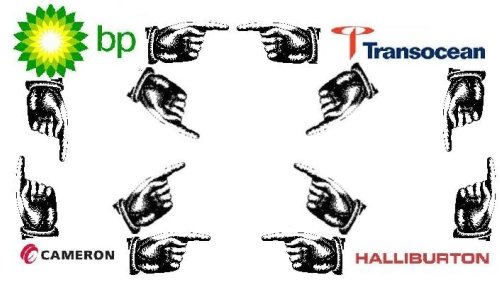
Comment: Was this a planned leak?  If so, how does this strengthen BP’s legal position?  The DWH had deficiencies (bad for Transoocean), but BP knew about the deficiencies and didn’t ensure that they were corrected (worse for BP?).  As indicated by the poster below (More “Mike Talk”), the poor working relationship between the operator and contractor may have been the real core problem.

Read Full Post »

G’Day Australia.  There are now only 2 weeks until the Federal election. Ironically, the election, which may have delayed the release of the Montara Inquiry report, will be held on the first anniversary of that blowout.

This report will play an important role in keeping our workers safe, protecting our environment and safeguarding our energy security. Minister Martin Ferguson

BOE fully agrees with Minister Ferguson’s statement about the importance of the Montara Inquiry report and hopes that he or his successor promptly releases the report after the election.  The lessons learned at Montara will not only prevent accidents in Australia, but elsewhere in the world. In light of the disturbing similarities between the two blowouts, it is possible that closer international attention to Montara might even have prevented the Macondo blowout.

Read Full Post »

« Newer Posts - Older Posts »