Feeds:
Posts
Comments

Posts Tagged ‘Alaska’

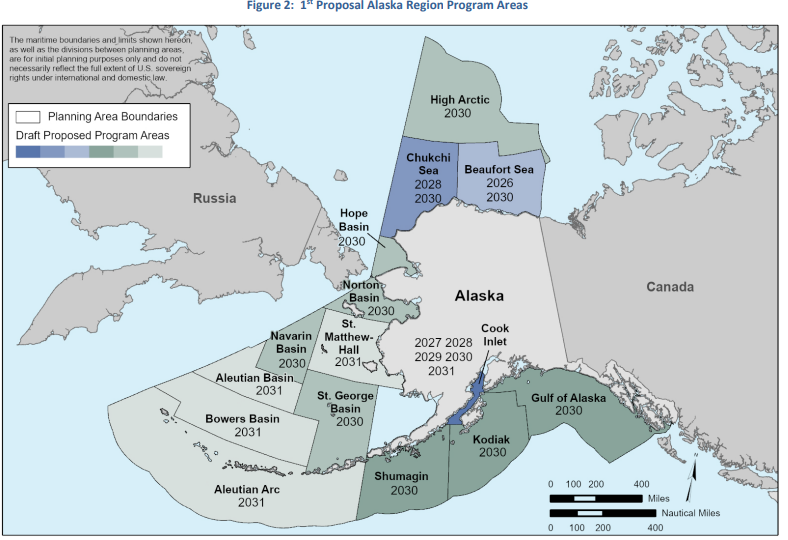
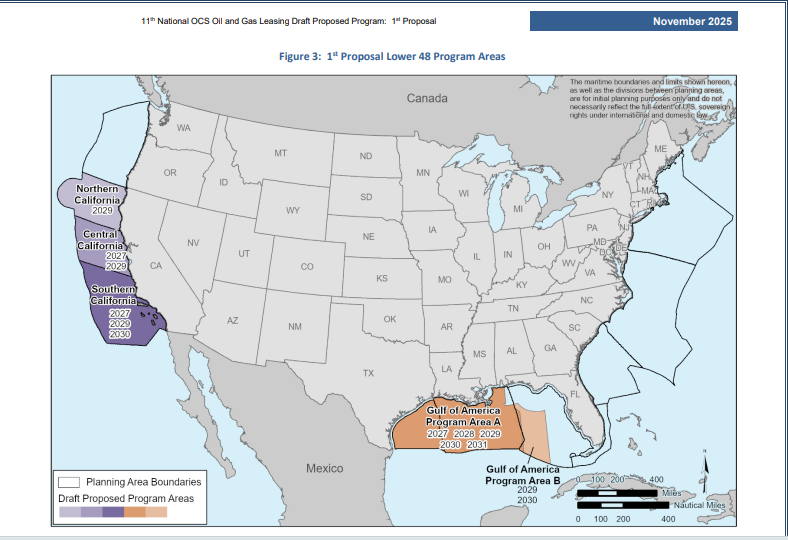
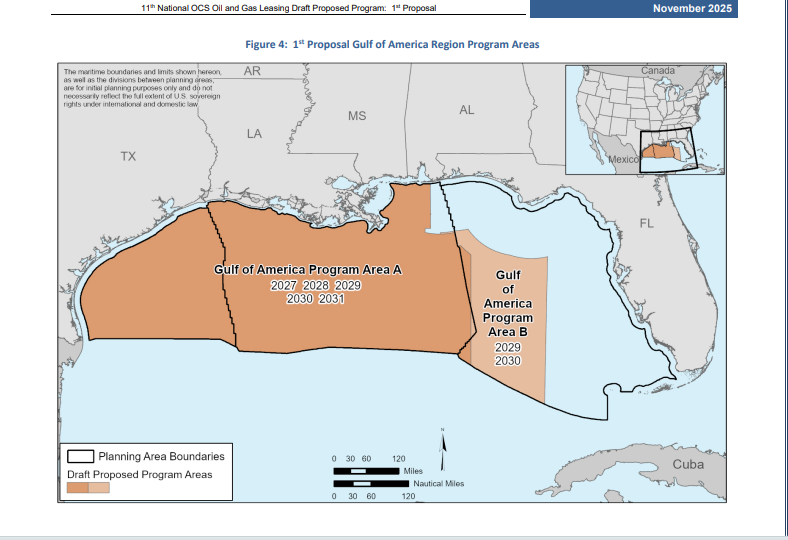
The press release and full program are linked. It looks like the most recent leaks were accurate. See the maps below with the locations and dates. This will stir the pot!

Read Full Post »

Per the Washington Post, the Administration’s 5 Year Oil & Gas leasing plan will include (in addition to the Central and Western Gulf):

  • Six offshore lease sales between 2027 and 2030 in areas along the California coast
  • Expansion of leasing into the Eastern Gulf of America (Gulf of Mexico per the Post)
  • 20 sales offshore Alaska through 2031 (presumably this includes the mandated Cook Inlet sales)

Previous post about 5 Year Plan speculation

Read Full Post »

Withdrawal from the Paris Climate Change Agreement:The US Ambassador to the UN shall immediately submit formal written notification of the US withdrawal from the Paris Agreement under the United Nations Framework Convention on Climate Change. 

Regulatory Freeze: Agencies may not propose or issue a rule until approved by a Presidential appointee. OMB may exempt emergency or urgent rules (déjà vu for regulators 😉).

Alaska: Withdraws a Secretarial Order intended to halt ANWR oil and gas leasing. Rescinds cancellation of ANWR leases.

Gulf of America: Renaming the Gulf of Mexico.

Unleashing American Energy (long, main items highlighted below):

  • Encourage energy exploration and production on Federal lands and waters, including on the Outer Continental Shelf.
  • Eliminate the electric vehicle (EV) mandate.
  • Requires immediate review of actions that could burden the development of energy resources.
  • Develop and begin implementing action plans to suspend, revise, or rescind all unduly burdensome agency actions.
  • Revoke climate change and “clean energy” EOs.
  • Terminate all activities, programs, and operations associated with the American Climate Corps (RIP 😉).
  • Expedite and simplify permitting processes.
  • Facilitate the permitting and construction of interstate energy transportation and other critical energy infrastructure, including pipelines.
  • Disband the Interagency Working Group on the Social Cost of Greenhouse Gases.
  • Terminate the Green New Deal.  All agencies must immediately pause the disbursement of funds appropriated through the Inflation Reduction Act of 2022 (Public Law 117-169) or the Infrastructure Investment and Jobs Act (Public Law 117-58).
  • The Secretary of Energy is directed to restart reviews of applications for LNG export projects as expeditiously as possible.

Offshore Wind

Read Full Post »

….as long as they are aligned with the preordained political decision. 😠

No where has this been more apparent over the years than in Alaska. Most recently, the North Slope Borough filed suit to challenge the Bureau of Land Management (BLM) rule making the National Petroleum Reserve in Alaska (NPR-A) off limits to oil and gas development.

Mayor Josiah Patkotak of the North Slope Borough

“The rule would significantly and irrevocably harm the North Slope’s right to self-determination and ability to provide essential services for residents. This suit is filed alongside the complaints of the Voice of the Arctic Inupiat and the State of Alaska, demonstrating the unity of North Slope communities and Alaskans in opposing the BLM’s unjust and unilateral action to harm the livelihoods of the residents of the North Slope,” the borough explained in a press statement.

“When I was sworn in as Mayor of the North Slope Borough, I made a solemn promise to protect and provide essential services for the people of the North Slope Borough. The BLM claims to act on our behalf but what they are truly doing is undermining my ability to fulfill that fiduciary obligation,” said Mayor Josiah Patkotak. “We on the North Slope don’t have the luxury of keeping quiet and waiting for a new industry to swoop in and replace our largest economic driver. We have to speak up for our future as a people.”

Other important points raised in the Must Read Alaska article:

  • NPR-A is entirely within the boundaries of the North Slope Borough (NSB).
  • The NSB represents the ancestral homelands of the Inupiat people.
  • The NSB is the largest employer in the region and provides the majority of essential services depended upon by residents.
  • Taxes on infrastructure account for 95% of the Borough’s revenue.
  • Members of the North Slope Inupiat Tribes, Village Corporations, Regional Corporations, and their elected leaders have been unanimous in their opposition to the rule.
  • The Supreme Court’s decision in Loper, which removed the Chevron Deference, restricts the authority of Federal agencies to take regulatory actions without clear legislative authority.
  • The State of Alaska also filed a lawsuit claiming that the Fed govt had not consulted with affected parties, and that the BLM had exceeded its congressional authorization.

This should be an easy win for Alaska and the NSB.

Read Full Post »

After the announcement of further restrictions on resource development in the National Petroleum Reserve of Alaska (NPR-A), Senator Sullivan (AK) called on the administration to stop sanctioning Alaska and to instead restore sanctions on Iran

The US OCS is being similarly sanctioned by its own government. The 5 year OCS “leasing plan” not only excludes all areas except the Gulf of Mexico, but authorizes a maximum of only 3 sales, the fewest ever for a 5 year program. The number of sales may well have been zero were it not for the requirement to hold an oil and gas sale during the year prior to the issuance of a lease for wind development.

2024–2029 Proposed Final Program Lease Sale Schedule
CountSale NumberSale YearOCS Region and Program Area
12622025Gulf of Mexico:  GOM Program Area
22632027Gulf of Mexico:  GOM Program Area
32642029Gulf of Mexico:  GOM Program Area
Most limited 5 year leasing program in history

Read Full Post »

15,531 of the 15,537 comments on the bid adequacy rule were from a single organization, Friends of the Earth. I have no problem with the Friends of the Earth campaign given that their comment letter is pertinent to the topic. Their main point is that the bid adequacy process fails “to factor in the climate and social costs of continued Outer Continental Shelf oil and gas lease sales into the bid process.” Although that may be a reasonable position, those issues are addressed in the programmatic and sale specific environmental reviews which factor into when and where sales are held, tract exclusions, special lease stipulations, and the comprehensive operating regulations. Once bids are submitted, the issue (and the sole purpose of the bid adequacy rule) is whether those bids represent fair market value for the oil and gas resource potential of the leases being offered.

Given that 96.3% of the US OCS is off-limits to oil and gas leasing, only 0.7% is currently open to exploration, and the new 5 year plan includes the fewest lease sales in OCS program history, it’s rather a stretch to argue that environmental concerns are not being prioritized.

The State of Alaska submitted very good comments (attached) that point to the historical differences in Gulf of Mexico and Alaska leasing. The State argues that a simpler approach to determining fair market value would encourage exploration and development on offshore lands that have seen little of either in recent years. Knowing BOEM’s expectations prior to the sale, perhaps through higher minimum bid requirements, would ensure that companies do not underbid and that tracts are successfully leased.

The Gulf of Mexico leasing program of today is looking more like the frontier area leasing of the past. As previously noted, the uncertainty regarding future sales changes the historic GoM leasing dynamic. The next opportunity for purchasing unleased GoM tracts is now a troubling unknown. This would seem to make it less prudent to reject bids based on uncertain prospect evaluations. Absent leasing and exploration, the true resource and revenue potential will never be known.

It was good to see the strong comments submitted by my former Minerals Management Service colleagues Dr. Marshall Rose and Ted Tupper. Marshall, who was our Chief Economist, commented that the proposed rule did not identify the problem and explain how the rule addressed that problem. Ted, a senior statistician, points to past failures of the bid adequacy process and proposes specific changes. It’s great to see the passion that our retired employees have for the program they were so instrumental in developing and managing.

The rule was finalized without any substantive changes.

Read Full Post »
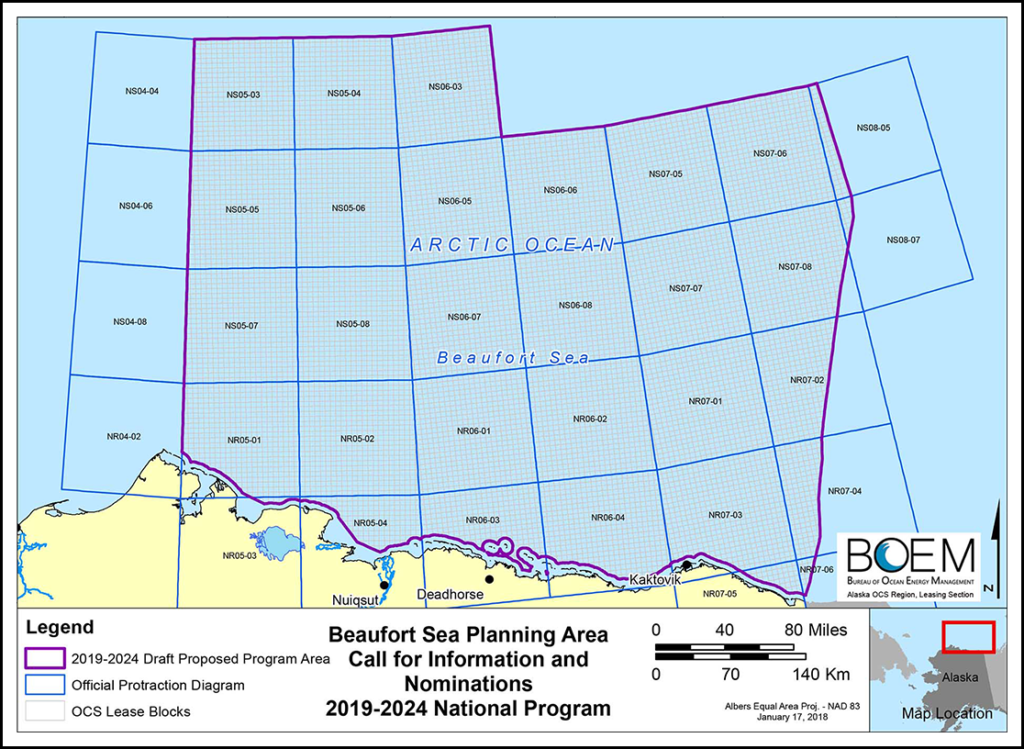
The shrinking of the OCS oil and gas program continues. In an attempt to placate opponents of the Willow project, the President has removed the entire Beaufort Sea from oil and gas leasing consideration. Unsurprisingly, the opponents of Willow are no less irate.

Under the authority granted to me in section 12(a) of the Outer Continental Shelf Lands Act, 43 U.S.C. 1341(a), I hereby withdraw from disposition by oil or gas leasing for a time period without specific expiration the areas designated by the Bureau of Ocean Energy Management as the Beaufort Planning Area of the Outer Continental Shelf that have not previously been withdrawn.  

White House directive

The 5 Hilcorp leases identified above (Northstar and Liberty projects) are all that remains of the once promising Beaufort Sea planning area.
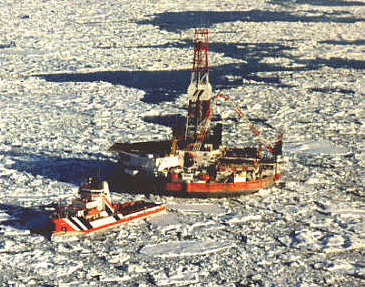
The Kulluk, pictured above, was a unique conical shaped and ice strengthened drilling vessel that operated in the US and Canadian Beaufort from 1983-1993.
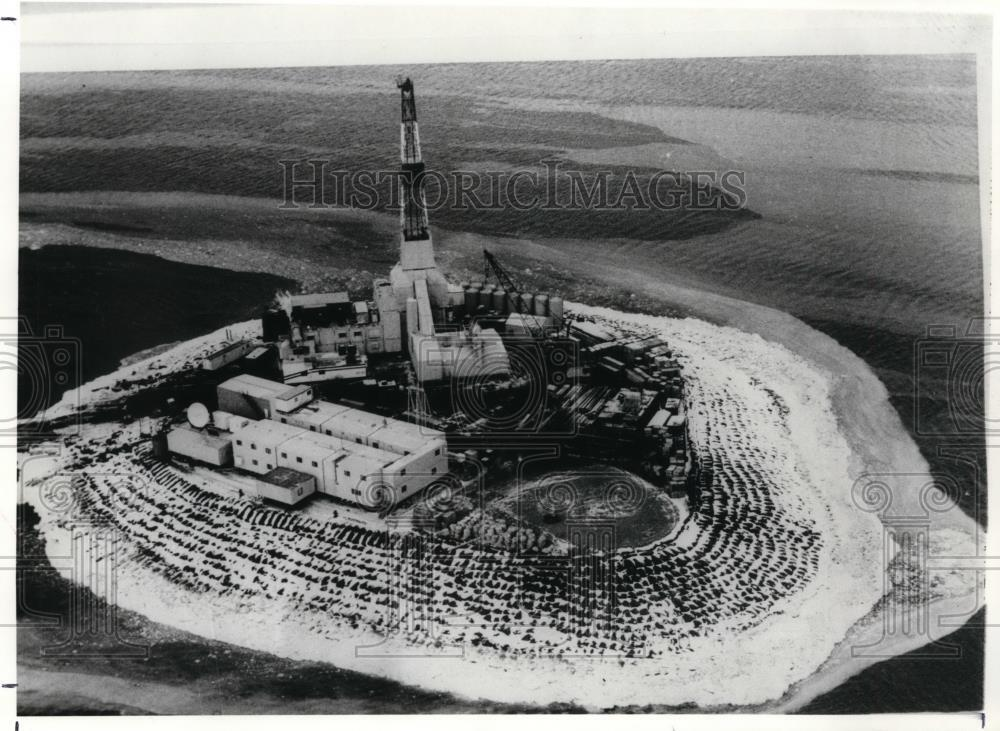
BP’s Mukluk well being drilled from an artificial island in the US Beaufort Sea in 1983. The $120 million exploratory well was the most expensive in history, but did not find commercial quantities of hydrocarbons.

Historical background

Read Full Post »

Senator Manchin and the Alaska delegation criticized the DOI decision memo for Sale 258. The memo implied that the highest allowable royalty rate was chosen to minimize bidder interest and limit future production. Unfortunately, the “Inflation Reduction Act,” which mandated these lease sales, was not particularly helpful in creating interest in the less attractive OCS tracts like those in the Cook Inlet and the shallower waters of the Gulf of Mexico.

Sec. 50261 of the IRA raised the minimum allowable royalty rate from 12 1/2% to 16 2/3%, while capping the maximum rate at 18 3/4%. This provision favors deepwater operators, typically majors and large independents, whose royalty rates were capped at 18 3/4%, the same rate as for previous OCS sales.

Conversely, the IRA royalty provisions penalize the smaller companies and gleaners who are critical to sustaining shallow water (shelf) operations, including environmentally favorable nonassociated (gas-well) natural gas production, by raising the minimum royalty rate to 16 2/3%. DOI exacerbated IRA’s impact by electing to charge the highest allowable royalty rate for Cook Inlet and GoM shelf leases. The net result was a 50% royalty rate increase from prior sales (12.5 to 18.75%).

The table below illustrates the royalty rate implications of the IRA language and the DOI decisions.

AreaSaleDate% royalty: <200m water depth% royalty: >200m water depth
Cook Inlet2446/21/201712.512.5
GoM25611/18/202012.518.75
GoM25711/17/202112.518.75
Cook Inlet25812/30/202218.7518.75
GoM2593/29/202318.7518.75

Notes:

  • The base primary term for GoM shelf leases is only 5 years vs. 10 years for leases in .>800 m of water.
  • In lease year 8 and beyond the rental rates are nearly double for shelf leases vs. deepwater leases ($40/ac vs. $22/ac).
  • While deepwater development typically requires more time, the higher rental penalty for delayed shelf production (which must be approved by BSEE) is not warranted. $40/acre or $240,000 per year (plus inspection and permitting fees) is a high cost for a marginal shelf lease.
  • Cook Inlet Sale 244 drew 14 high bids totaling more than $3 million. Sale 258 drew only 1 bid of $64,000. While many factors influence lease sale participation, the 50% increase in royalty rate certainly made the Cook Inlet leases less attractive.
  • Other than the increased royalty rate, the terms for both Cook Inlet sales were essentially the same. The primary lease term was 10 years and the minimum bonus bid was $25/hectare for both sales. The rental rate was increased by only $3/hectare ($13 to $16).

Read Full Post »

Northstar, Beaufort Sea

The only current Alaskan OCS production is from Northstar, a joint State-Federal Unit in the Beaufort Sea. The production island is in State waters, but 7 of the wells produce from the Federal sector. The field was originally developed by bp, but Hilcorp is the current operator. To date, BSEE has conducted 5 inspections of the facility in 2022, and no incidents of noncompliance (INCs) were identified.

Per BOEM records, 4 companies operate Pacific (California) OCS facilities that are currently producing. Three of those operators have superior 2022 inspection records. No INCs were issued to either Exxon (11 Santa Ynez Unit inspections) or Freeport-McMoRan (24 Platform Irene inspections). Only 2 warning INCs were issued during 12 inspections of Beta Operating Co. platforms Ellen, Elly, and Eureka in the Beta Unit offshore Long Beach.

Marine life on Platform Eureka, from this Hakai article

Read Full Post »

  • Secretary of the Interior Haaland committed to releasing the Proposed Program by June 30, 2022. Will that deadline be met? BOE’s guess is that the deadline will be met. However, the White House Climate Policy Office, which seems to control energy policy, may have other ideas.
  • Number of regions in which lease sales will be proposed: BOE thinks 2, the Gulf of Mexico and Alaska. There is no chance of >2. A GoM only proposed program is possible, but we doubt that Alaska will be eliminated at this early stage.
  • Number of lease sales proposed: BOE guesses a total of 7 sales, 5 in the GoM and 2 in Alaska. The “under” is probably a better bet than the “over,” unless they eschew area-wide GoM sales and propose an increased number of more targeted sales.

For comparison, the previous six 5-Year Programs have included 10-12 GoM sales (11.3 average), 1-8 Alaska sales (4.3 ave.), 0-1 Atlantic sales (0.3 ave.), and no Pacific sales.

Read Full Post »

Older Posts »