Feeds:
Posts
Comments

Posts Tagged ‘Ack for Whales’

ACK For Whales, the Wampanoag Tribe of Gay Head / Aquinnah, Green Oceans, a coalition of charter fishing groups and seven individuals filed suit in federal court asserting that the Departments of Interior and Commerce violated the law when they approved the Record of Decision (ROD) for the New England Wind 1 and 2 projects.

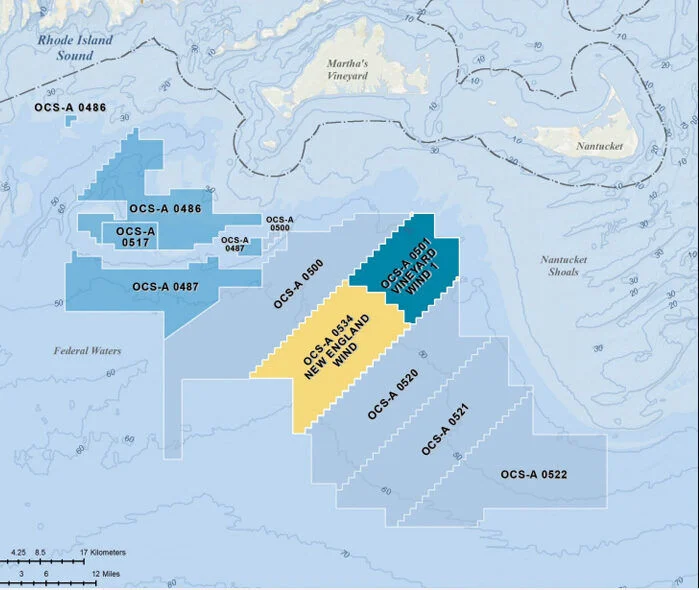
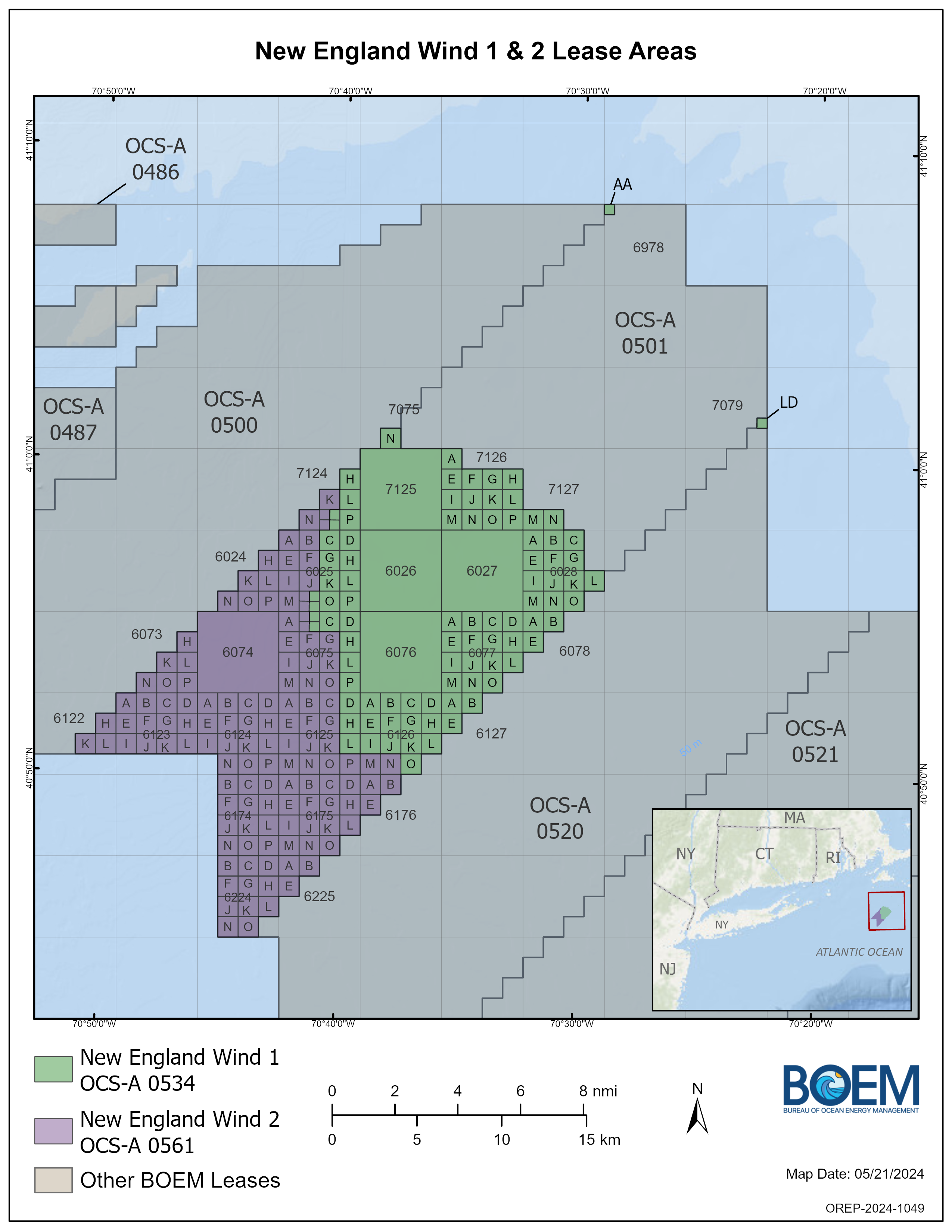
Construction has not yet begun on the New England Wind 1 and 2 projects. The leases abut Vineyard Wind’s troubled lease 0501 (see above map), site of last summer’s turbine blade failure.

Per ACK for Whales President Vallorie Oliver:

“In offshore wind project after offshore wind project, from Revolution Wind, Vineyard Wind and New England Wind to the others, the government was so desperate to rush these projects that it cut corners and violated the law,” Oliver said. “The government didn’t care if it trampled on the Wampanoag sacred beliefs and rites, hurt the charter boat, fishing and lobster industries or wiped out the Right whales. The only thing that mattered was to get these environmentally destructive turbines built, costs to the rest of us be damned.”

Court filing summary:

Plaintiff:ACK FOR WHALES, INC., VALLORIE OLIVER, AMY DISIBIO, VERONICA BONNET, DOUGLAS LINDLEY, STEVEN AND SHARYL KOHLER, DANNY PRONK, WILLIAM VANDERHOOP, GREEN OCEANS, RHODE ISLAND PARTY AND CHARTER BOAT ASSOCIATION, CAPE COD CHARTER BOAT ASSOCIATION, INC., CONNECTICUT CHARTER AND PARTY BOAT ASSOCIATION, INC., MONTAUK BOATMEN AND CAPTAINS ASSOCIATION, INC. and WAMPANOAG TRIBE OF GAY HEAD AQUINNAH
Defendant:UNITED STATES DEPARTMENT OF COMMERCE, NATIONAL MARINE FISHERIES SERVICE, BUREAU OF OCEAN ENERGY MANAGEMENT, UNITED STATES DEPARTMENT OF THE INTERIOR, DOUG BURGUM, in his official capacity as Secretary of the Interior, WALTER CRUICKSHANK, in his official capacity as the Director of the Bureau of Ocean Energy Management, HOWARD LUTNICK, in his official capacity as the Secretary of Commerce and EUGENIO PIEIRO SOLER, in his official capacity as the Assistant Administrator of the National Marine Fisheries Service
Case Number:1:2025cv01678
Filed:May 27, 2025
Court:U.S. District Court for the District of Columbia

Read Full Post »

In February, EPA Region 2 asked the agency’s Environmental Appeals Board to remand Atlantic Shores’ air emissions permit back to the Region for reconsideration. That remand (attached) was granted on 14 March over the objections of Atlantic Shores Offshore Wind.

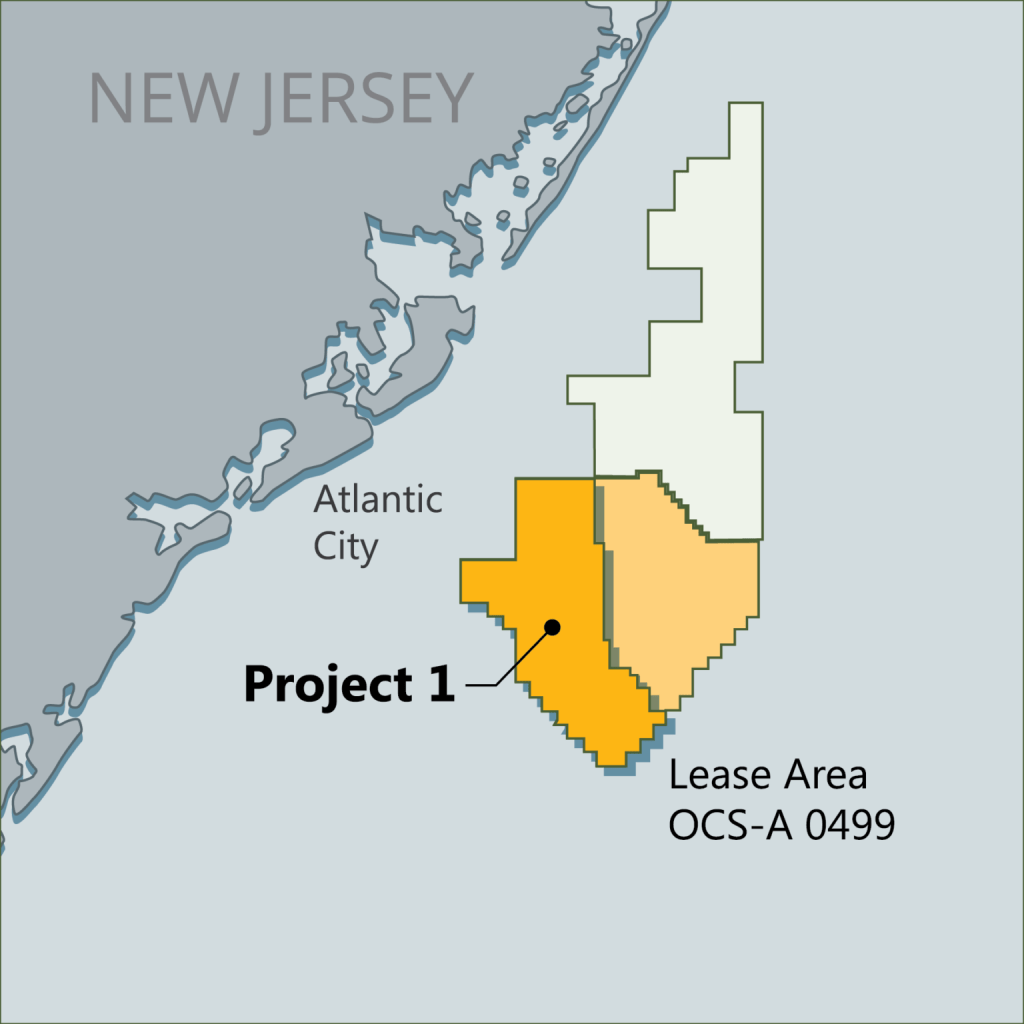
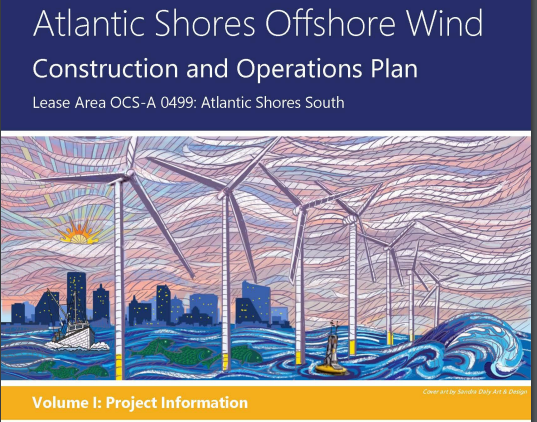
Atlantic Shores Offshore Wind still exists despite the exit of 50% partner Shell and a $940 million write down by the remaining owner EDF. The diagram depicts Atlantic Shores South (0499) and North (0549) lease areas.

EDF intends “to preserve the company and its future development.” Whether or not they can hold the leases indefinitely without pursuing development remains to be seen. BOEM’s diligence regulations for offshore wind projects are vague, and neither the Construction and Operations Plans nor BOEM’s Record of Decision (Atlantic Shores South) include work schedules.

Does EDF have the right to sit on the lease until the financial and regulatory environment is attractive? That is not allowed for oil and gas leases, and rightfully so. (See a related post on Total’s wind lease.)

Meanwhile, ACK for Whales has petitioned EPA Region 1 to reopen and reanalyze the air permits for permits for the New England Wind 1 and 2 projects asserting that:

  • The analysis does account for emissions related to and resulting from blade failures, which would warrant emergency repairs or replacement activities.
  • The decision to group Vineyard Wind 1, New England Wind 1 and New England Wind 2, as a single stationary source is both legally questionable and could have the effect of masking localized emission spikes.
  • Insufficient consideration of cumulative vessel emissions could lead to 1-hour NO₂ exceedances.
  • The emissions from pile driving are not adequately modeled in isolation or synergistically.

Read Full Post »

The U.S. Supreme Court has declined to hear the challenge of the Vineyard Wind project brought by the Nantucket-based nonprofit ACK For Whales. This is not surprising given that the odds of the SCOTUS hearing the case were extremely low, tantamount to the completion of a “Hail Mary” pass.

Perhaps Nantucket should have added Jayden Daniels to their team! 😉

Although the SCOTUS declined to hear their challenge, the Nantucket group may still achieve their objective, at least in part, given the looming changes in Federal policy and the financial and operational challenges facing the offshore wind industry.

Read Full Post »

The response by the Nantucket group’s attorneys is attached. Key excerpt:

NMFS absurdly argues that agency officials, in preparing a biological opinion for a project, must ignore information about impacts on endangered species from other offshore wind turbine projects that are planned and in various stages of development and governmental review. Perhaps even more bizarrely, NMFS contends that, in preparing a biological opinion for a project, it must consider the cumulative impacts of planned state and local projects but ignore the impacts of planned federal projects.

Background:

Read Full Post »

The Dept. of Justice (DOJ) has responded (attached) to the ACK for Whales petition (ACK is the FAA abbreviation for Nantucket) to the Supreme Court to review the First Circuit’s ruling on the Vineyard Wind project. (Also see the amicus brief filed by the Aquinnah Wampanoag Tribe of Gay Head).

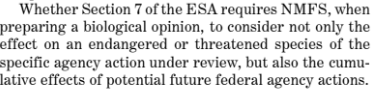
The question before the Supreme Court:

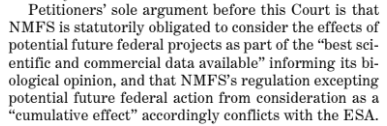
Excerpt from the DOJ filing:

The petitioners’ “sole argument” is rather compelling to this non-attorney. Given that multiple offshore wind projects are planned for Right whale habitat, how do you fulfill your endangered species responsibilities by only considering the first project (I.e. Vineyard Wind 1)?

(In light of Vineyard Wind’s performance to date, one could also argue that the Right whale is jeopardized by the Vineyard Wind project alone.)

Keep in mind that the Federal govt wanted to block all oil and gas leasing in a huge swath of the Gulf of Mexico because of far more speculative concerns about potential impacts to Rice’s whales.

Read Full Post »

The attached brief was filed in the Supreme Court today by the Aquinnah Wampanoag Tribe of Gay Head in support of the Nantucket group ACK for Whales petition that was previously posted.

Read Full Post »

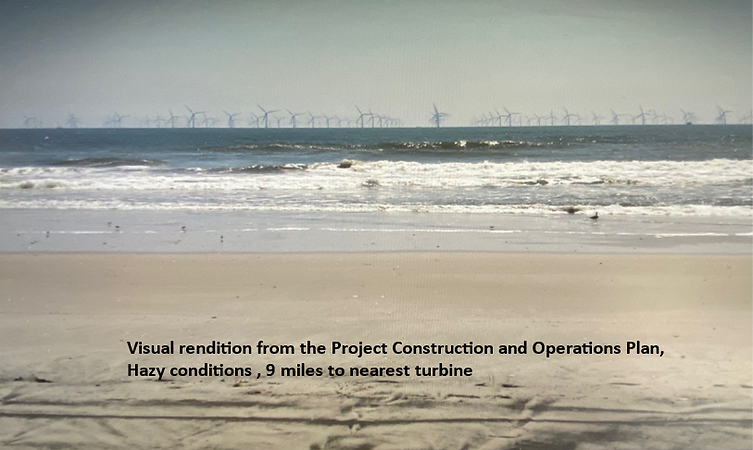
As a boy, my grandfather owned a home “down the shore” on Long Beach Island (LBI). From the beach, all we saw were swimmers, surf fishers, porpoises, and an occasional vessel on the horizon. The offshore wind industrialization will change the island dramatically.

Attached is the release announcing Save LBI’s intent to sue. Their issues are summarized below:

  • Constructing and operating hundreds of wind turbines directly in a prime migration path for the critically endangered North Atlantic right whale.
  • Operational noise from the larger and noisier turbines Atlantic Shores plans to build.
  • Cumulative impact of the East Coast wind-turbine projects on the right whale’s migration.
  • Interference with other uses of the ocean including fishing and national security.
  • No plan or capability, technically or monetarily, to remove turbines and other facilities at the end of their useful life, upon their failure during normal operation, or in the aftermath of a hurricane or other extreme storm event.
  • Failure to account for structural failures such as the Vineyard Wind turbine blade incident, the damage from such failures to the ocean and beaches, and how that damage will be remediated.
  • Excessive electric bill increases under the State’s Offshore Wind Energy Development Act.

The Endangered Species Act issues are similar to those that the Nantucket group ACK for Whales is trying to elevate to the Supreme Court.

Perhaps not the best choice of graphic if you want to sell the project as being environmentally benign and compatible with other uses.

Read Full Post »

The Nantucket non-profit ACK for Whales (ACK is the FAA abbreviation for Nantucket Airport) has petitioned the Supreme Court to review the 1st Circuit’s ruling on the Vineyard Wind project. Per the Supreme Court filing (full document attached):

Despite the agencies’ explicit statutory duty to consider all “best information available,” regarding the impacts its actions might have on an endangered or threatened species and those habitats, the National Marine Fisheries Service (NMFS) and the Bureau of Ocean Energy Management (BOEM), did not consider the cumulative impacts of other planned projects when they authorized and issued permits to construct the Vineyard Wind 1 Project.

Will the Supreme Court accept the case?

  • “Hail Mary:” Per the Nantucket Current, the odds that the Supreme Court justices will accept the case are exceedingly slim. Of the 7,000 cases that the Supreme Court is asked to review each year, only 100 to 150 of them – about 2 percent – are accepted.
  • “Really good chance:Per Val Oliver, ACK for Whales founding director, “In light of the recent Chevron decision, we think we have a really good chance. That was about government overreach and that is what this (Vineyard Wind) has felt like since the beginning: go, go, go, and we’ll figure it out as we go. That’s just not responsible.

Regardless of the outcome of this case, there is a profound inconsistency in the administration of the Endangered Species Act as evidenced by our comparison of the operating restrictions for the Right whale (Atlantic wind) and Rice’s whale (Gulf of Mexico oil and gas). Note that the more onerous Rice’s whale restrictions were removed by court order.

Read Full Post »

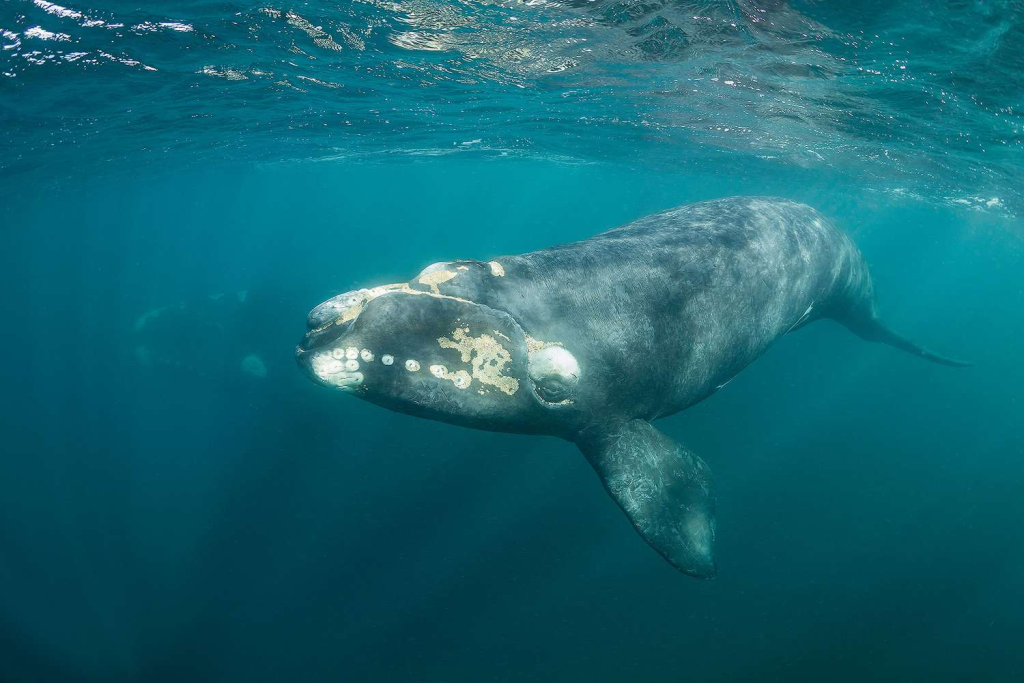
North Atlantic Right Whale

A new NOAA biological opinion finds that that pile-driving noise associated with the Vineyard Wind project is likely to adversely affect, but not likely to jeopardize, the continued existence of whales, fish or sea turtles listed under the Endangered Species Act (ESA).

This opinion was predictable. On the one hand, denying the adverse effects from extensive pile driving would have been unacceptable to NOAA scientists. On the other hand, a jeopardy finding would have been unacceptable to their political leadership.

If you are wondering how NOAA managed to thread that needle, you will have to wait until their report is publicly available. On Aug. 23, NOAA said the opinion would be available in their library in about 10 days, but the opinion has still not been posted. How do you announce such significant findings without, at the same time, releasing the report?

Understandably, the Nantucket environmental organization ACK for whales is not pleased with either NOAA’s announcement or their failure to release the report:

We are disappointed NOAA announced the conclusions of its bi-op on the Vineyard Wind 1 construction without releasing the report or the data on which it relied,” ACK For Whales stated. “NOAA’s own data show that in 2023, there were 151 marine mammal strandings in Massachusetts alone with 75 occurring from Jun 2023 to Dec 2023, the months that pile driving was active. This compares to 77 strandings for all of 2015, before OSW activity started – essentially a 100 percent increase. Most of those strandings in 2023 (n=55) occurred from Oct to Dec when VW was racing to get foundations installed. Out of the 47 bases installed in 2023, 68 percent were installed in the last three months of the year.”

In January, BOE raised concerns about the collaborative BOEM-NOAA-wind industry strategy to protect the right whale. Per that strategy, BOEM and NOAA view themselves as partners with the wind industry. Is this biological opinion an example of NOAA working with their partners in accordance with their joint strategy? While regulator-industry collaboration is essential for effective offshore development, be it wind or oil and gas, regulators and operating companies have distinctly different missions and responsibilities, and should not be viewed as partners.

The sharp contrasts between the operating restrictions for the right whale (Atlantic wind) and the Rice’s whale (Gulf of Mexico oil and gas) demonstrate the inconsistencies in ESA regulation. Are major energy companies partners when developing wind projects and adversaries when producing oil and gas?

Lastly, a letter from NOAA’s Lead Biologist that is attached to that post further points to a disconnect between scientific concerns and wind energy regulatory policy, and is thus germane to this discussion.

Read Full Post »