Feeds:
Posts
Comments

Posts Tagged ‘accidents’

The Federal Government is unnecessarily delaying the release of a report into last year’s Montara oil spill off Australia’s north coast, the Northern Territory Opposition says.

link

On a related note, it would be great if preliminary findings from the DOI/DHS Macondo investigation could be released as soon as possible.  There is much work to be done and all interested parties (in the US and elsewhere) need the best available information so that they can assess their programs.  Better to err on the side of releasing findings to soon with any necessary caveats and disclaimers.  In that regard, the House Committee on Energy and Commerce has done a good job of making their findings available without delay.

Read Full Post »

Regarding the relief wells, Development Driller III, which is the lead drilling rig for the relief wells is now at 17,780 feet measured depth, within a couple hundred feet of the proposed penetration point of the wellbore.

Admiral Allen: Thank you for reading BOE and responding to our request.  You even specified “measured depth!”

Relief Well Team:  Great work!  Time to finish the job!

Read Full Post »

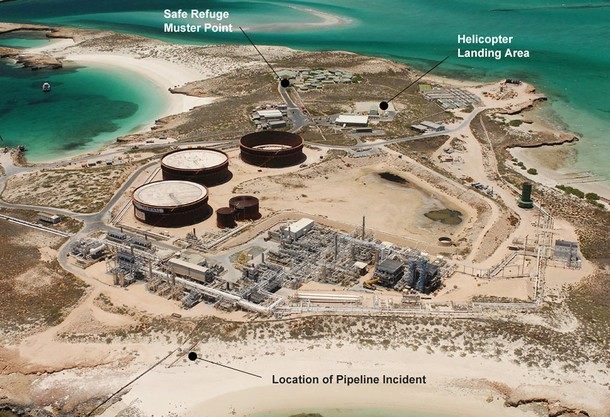
Varanus Island, Western Australia

Odd Finnestad, BOE’s Senior Vice-President for International Activities (note the recent promotion), and his talented, multi-lingual staff keep close tabs on investigations and accident reports worldwide.  Odd thinks we may be in for a long wait for the Montara report, so the BOE cyber vigil will not include any rash measures like hunger strikes.

While Australia does a great job of investigating, holding hearings, and preparing reports, they seem to struggle with the simple step of releasing those reports.  Odd reminds us that the report on the 2008 Varanus Island gas plant explosion has still not been released.  This important accident reduced Western Australia’s gas supply by one-third, and thus had major economic consequences. The Veranus report was finalized in June 2009, but maneuvering by the responsible party and legal reviews within the Western Australia Ministry for Mines and Petroleum have kept this report under wraps.  Now we are getting the same uncomfortable feeling about the Montara report.  Perhaps, Minister Ferguson will prove us wrong and release the Montara report without further delay.  We hope so!

Read Full Post »

While the Norwegian model is built on trust, cooperation, and sharing of experience and information,” asserts Dr Lindøe, “the situation in the USA is nearly the opposite.”

When an accident happens on the Norwegian continental shelf, the parties convene to uncover any weaknesses in systems or routines that contributed to workers making a mistake. There is agreement that this is how to achieve better results, rather than spending resources on finding scapegoats and not bothering to change the systems.

In the aftermath of Deepwater Horizon, MMS has been criticised for having too cozy a relationship with the companies and for having reduced the number of inspections,” says Researcher Helge Ryggvik of the University of Oslo. “Yet its inspection activities are more comprehensive than on the Norwegian continental shelf. And unlike the Petroleum Safety Authority Norway, MMS has its own helicopters and can conduct unannounced inspections.”

This excellent Research Council of Norway article, which discusses some of the differences between the US and Norwegian systems, should be mandatory reading for regulators and operators. Ironically, I made some similar comments to a wind turbine safety committee last week.  In assessing the root causes of accidents and the associated equipment and procedural issues, we must not lose sight of the fundamental regulatory objectives and how they can best be achieved.

Read Full Post »

bottom of the flowing Macondo well

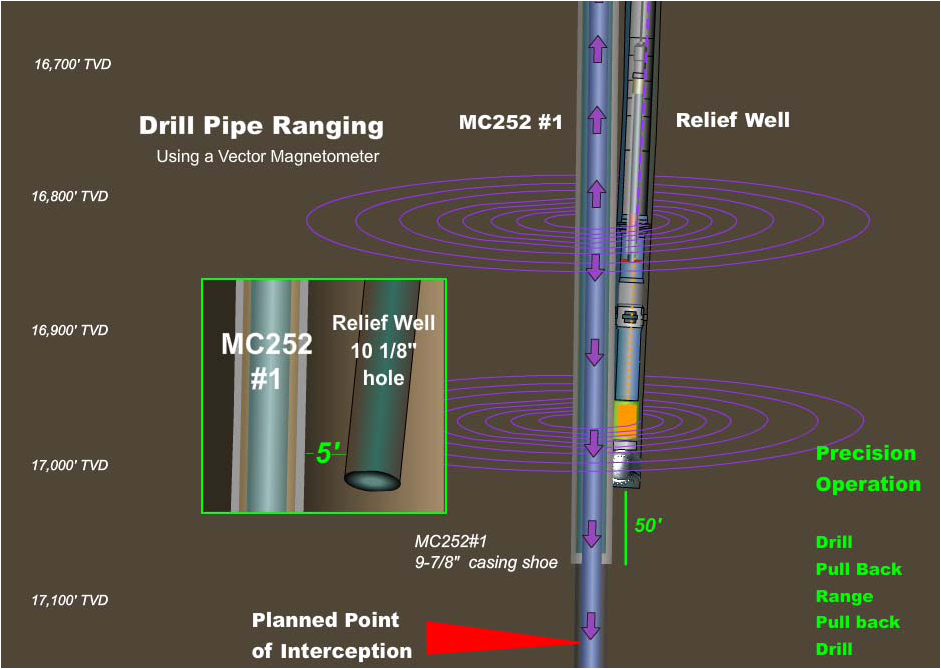
Based on the latest information provided by Admiral Allen, the relief well has reached 11817′ below the sea floor and is thus only 273′ above the 9 7/8″ casing shoe on the flowing Macondo well.  After drilling another 200+ feet, they will open (enlarge) the relief well and install a 9 7/8″ liner.  They will then drill a few hundred feet beneath the liner and intercept the flowing well.  They will presumably kill the flow in the annulus outside the casing (assuming that is a flow path) with heavy mud before milling into the 7″ casing, killing any flow inside that casing, and plugging the well bore with cement.  Stay tuned.

Read Full Post »

Per Admiral Allen:

Regarding the relief wells, Development Driller III now is at a distance of 11,641 feet below the seafloor.  As you know, they’re going through a series of operations which we call ranging.  They’re into their fourth cycle of this.  In ranging, they withdraw the drill pipe and put down an electrical cable and actually try and sense the magnetic field around the wellbore.  They are within around 15 feet of the wellbore at this point.  They will continue down 700, 800 more feet, slowly close into the wellbore, and when they know they’ve got it exactly in range, know exactly where the drill pipe is in relation to the wellbore, then they will attempt to move in and drill through the wellbore and then the casing as well.  At that point they’ll be in a position to be able to try the bottom kill or to be able to insert the mud, and hopefully after that, put a cement plug in that will kill the well.

Read Full Post »

DD3

BOE doesn’t really care about where LeBron James chooses to play basketball, but we are big fans of the team on the Development Driller III or DD3. The DD3 crew, some of whom are Deepwater Horizon survivors, is ahead of schedule and predictions for an early intercept and well kill are approaching irrational exuberance levels. This may be the most important well in history, and crew has responded to the challenge.

After the DD3 crew finishes the job, we owe them a victory parade in New Orleans.  “Throw me somethin’ mista! 🙂

Read Full Post »

Interesting comments from Jane Cutler, CEO of Australia’s National Offshore Safety Petroleum Safety Authority, in NOPSA’s excellent newsletter:

The incidents in the Gulf of Mexico (Deepwater Horizon) and at the Montara wellhead platform are different in many respects, particularly in technical matters. However, they share some common factors prompting regulatory action.

I agree entirely with Ms. Cutler.  International regulators and operators must work in concert to address and resolve these issues.

Read Full Post »

BP has released a slide presentation and animation on the relief wells showing the intercept point below the 9 7/8″ casing shoe.   The exact sequence of operations once they reach the intercept point will be interesting to observe. They should encounter flow when they reach the 7″ casing annulus (assuming that is a flow path; there still seems to be some uncertainty in that regard).  Will they attempt to kill the flow in the annulus before milling into the 7″ casing?  Is there flow inside the 7″ casing via channels in the casing shoe? Is there drill pipe inside the casing?

Read Full Post »

The House Energy and Commerce Committee has posted a discussion draft of the Blowout Prevention Act of 2010.   A hearing is scheduled for 30 June.

Read Full Post »

« Newer Posts - Older Posts »