Feeds:
Posts
Comments

Posts Tagged ‘5 year leasing plan’

Given the differences in our views on energy policy, particularly with regard to oil and gas, this WP opinion piece is pretty reasonable. The Post acknowledges the continued need for oil and gas, and the importance of domestic production. That said, two statements in the paragraph pasted below warrant immediate comment.

In reality, neither argument is convincing. The Biden administration’s proposal — which opens the door to up to 11 potential lease sales, 10 in the Gulf of Mexico and one off the coast of Alaska — would have little impact on current energy prices. It would take between five and 10 years to produce oil after a new offshore lease issuance, according to the Interior Department, while more than three-quarters of already-leased offshore federal waters are not in production.”

WP Opinion

Comments:

  1. The purpose of the 5 year leasing plan is to minimize future energy supply and security risks, not to reduce current prices. However, acknowledgement of the importance of offshore production and support for regular lease sales could influence market psychology.
  2. The old and tired arguments about non-producing leases have been frequently addressed on this blog. When you purchase leases, you are not buying oil and gas. You are buying only the opportunity, for a limited period of time, to explore for these commodities. The current percentage of producing leases is actually rather high by historical standards. For more on this topic, see this and this.
Read Full Post »

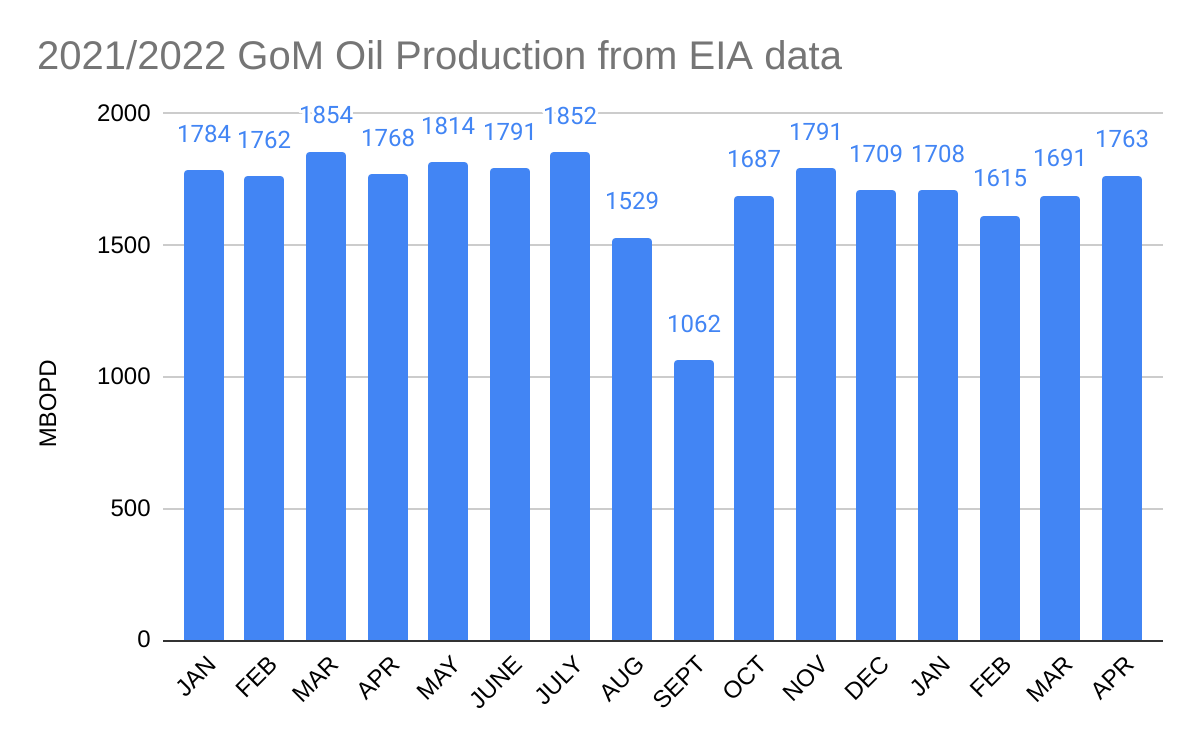
April production increased from March by 72,000 BOPD to 1.763 million BOPD. The increase is associated, at least in part, with Murphy’s King’s Quay field which began producing in early April. 2022 GoM production remains below the levels reached in the first 7 months (pre-Hurricane Ida) of 2021, and is well below BOEM’s forecasted 2022 production rate of 1892 MBOPD. Perhaps BOEM was assuming earlier startup dates for other projects that will begin production later this year or next year. The 2022 YTD dip in production points to the importance of sustained exploration and development.

BOEM’s short-term production forecast is considerably more optimistic than EIA’s. This optimistic forecast, along with unrealistic expectations regarding the “energy transition” are reasons for proposing so few lease sales in the new 5 year leasing program. The logic for this minimalist leasing program seems to be that future production is neither necessary nor desirable. Indeed the program implies that the long-term nature of offshore production is a liability and is justification for limiting OCS oil and gas leasing:

BOEM’s short-term (20-year) production forecast for existing leases shows steady growth from 2022 through 2024 and declining thereafter (see Section 5.2.1). The long-term nature of OCS oil and gas development, such that production on a lease can continue for decades makes consideration of future climate pathways relevant to the Secretary’s determinations with respect to how the OCS leasing program best meets the Nation’s energy needs.

5 Year Leasing Program, p.3

Basing leasing decisions on “future climate pathways” would seem to be a considerable stretch of the Secretary’s authority under the OCS Lands Act and may be inconsistent with the recent SCOTUS decision in West Virginia vs. EPA. A strategic shutdown of the offshore oil and gas program would dramatically increase energy supply and security risks going forward, and should be authorized by Congress.

Read Full Post »

EIA

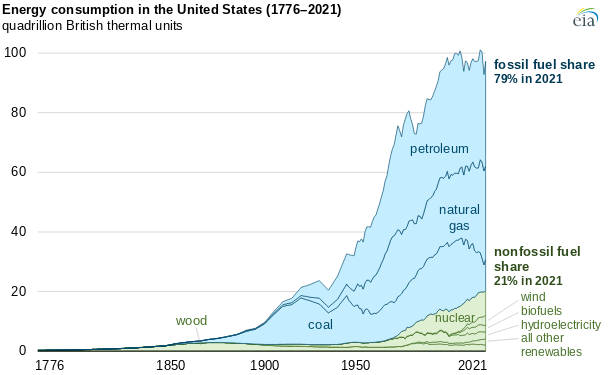
Yet the proposed 5 Year OCS leasing program (p. 3) tells us that long term offshore production is not needed because the IEA’s “roadmap to net-zero emissions by 2050 for the global energy sector would require no new investment in fossil fuel supply projects (IEA 2021).”

Does the IEA dictate US energy policy? Dan Yergin has a far better grasp on the realities of energy consumption and transitions.

Oil, discovered in 1859, did not surpass coal as the world’s primary energy source until the 1960s, yet today the world uses almost three times as much coal as it did in the ’60s.

Read Full Post »

Read Full Post »

WASHINGTON (May 19, 2022) — During testimony before the U.S Senate Committee on Energy and Natural Resources today, Secretary of the Interior Deb Haaland confirmed that, despite delays in implementation from the previous Administration, the Interior Department will release the Proposed Program – the next step in the five-year offshore energy planning process – by June 30, 2022, which is the expiration of the current program. A Proposed Program is not a decision to issue specific leases or to authorize any drilling or development.

DOI

Read Full Post »

Leasing shutdowns have consequences. See the IER article, and the post below regarding the importance of new production, which is dependent on consistent leasing and exploration programs. Will the proposed leasing plan be issued today as promised?

According to EIA, declining production from existing Gulf of Mexico fields will largely offset the increases in oil production from the new fields, with natural gas production in the Gulf of Mexico continuing its three-year decline. During 2021, 15 percent of U.S. oil production and 2 percent of U.S. natural gas production was produced in the Gulf of Mexico.”

IER

Read Full Post »

Per their court filing, Montana, Alabama, Alaska, Arizona, Arkansas, Georgia, Kentucky, Mississippi, Missouri, Nebraska, Oklahoma, Texas, Utah, and West Virginia seek to protect oil and gas production in the Gulf of Mexico and throughout the United States. The States’ brief is rather political, which is not surprising given their support for offshore leasing and the apparent alignment of the Federal defendants and the plaintiffs in support of the decision by Judge Contreras to vacate the sale.

As was expected at the time of the ruling, the court decision on Sale 257 shut down offshore leasing for the remainder of the 2017-22 Five Year Plan. Secretary of the Interior Haaland has promised that a new proposed leasing plan will be released by 6/30/2022, but that is just the start of the lengthy planning process.

Interesting NEPA data from the States’ brief:

  • In 2018 CEQ found that, across the federal government, the average EIS completion time and issuance of a Record of Decision was over 4.5 years and the median was 3.6 years.
  • On average, Interior takes five years and the Department of Transportation 6.5 years to complete an EIS—and that’s not including the usual years of resulting litigation.
  • CEQ found that “across all Federal agencies, draft EISs averaged 586 pages in total, with a median document length of 403 pages.” As a result, “[t]he entire original purpose of doing NEPA analysis has been lost along the way to creating mountains of data and information in the hopes of successfully defending against inevitable litigation.”

Many thanks to the Texas AG for making the States’ brief readily available online. Unfortunately, that is not the case for the other briefs filed in support of the sale.

Read Full Post »

  • Secretary of the Interior Haaland committed to releasing the Proposed Program by June 30, 2022. Will that deadline be met? BOE’s guess is that the deadline will be met. However, the White House Climate Policy Office, which seems to control energy policy, may have other ideas.
  • Number of regions in which lease sales will be proposed: BOE thinks 2, the Gulf of Mexico and Alaska. There is no chance of >2. A GoM only proposed program is possible, but we doubt that Alaska will be eliminated at this early stage.
  • Number of lease sales proposed: BOE guesses a total of 7 sales, 5 in the GoM and 2 in Alaska. The “under” is probably a better bet than the “over,” unless they eschew area-wide GoM sales and propose an increased number of more targeted sales.

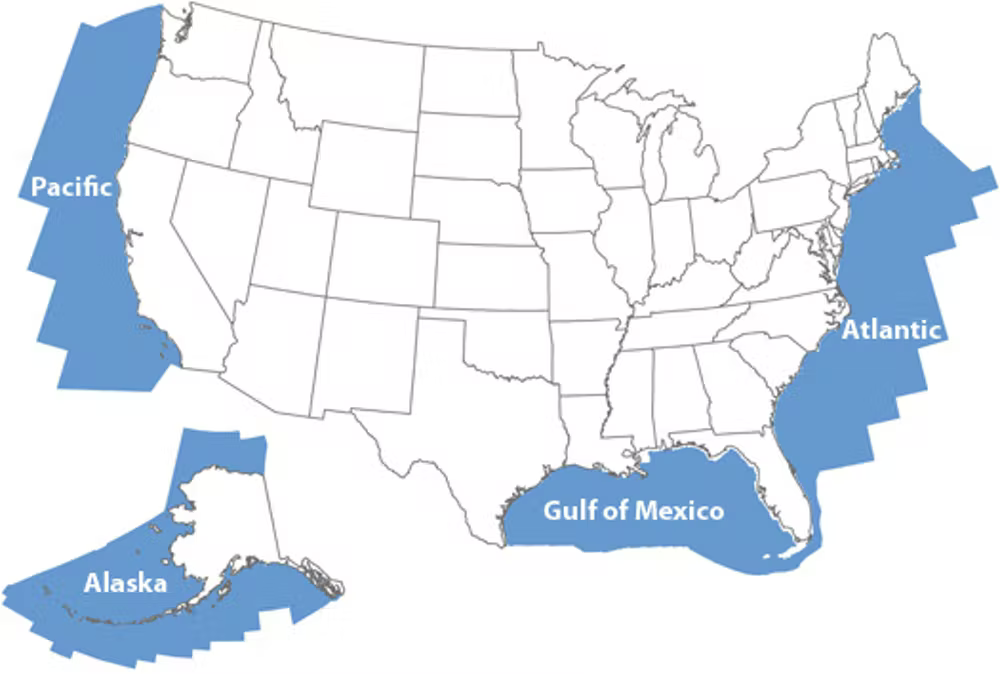
For comparison, the previous six 5-Year Programs have included 10-12 GoM sales (11.3 average), 1-8 Alaska sales (4.3 ave.), 0-1 Atlantic sales (0.3 ave.), and no Pacific sales.

Read Full Post »

Per Politico:

Several Democrats both in and out of the administration laid out their discontent with the office, led by National Climate Adviser Gina McCarthy, over its involvement in other agencies’ work, saying it slowed down several high-profile agenda items.

The Democrats said the office has gotten in the way of agency rulemakings. A Democratic Hill staffer told Zack the office edited and chose the day after Thanksgiving to release last year’s long-awaited Interior Department report on the federal oil and gas leasing program.

More on the leasing report cited in the above quote.

I guess we can assume that the Climate Office is currently reviewing the Proposed 5 Year Leasing Program that the Department of the Interior has promised to release by June 30. Is DOI subordinate to the Climate Office?

Read Full Post »

WASHINGTON — During testimony before the U.S Senate Committee on Energy and Natural Resources today, Secretary of the Interior Deb Haaland confirmed that, despite delays in implementation from the previous Administration, the Interior Department will release the Proposed Program – the next step in the five-year offshore energy planning process – by June 30, 2022, which is the expiration of the current program. A Proposed Program is not a decision to issue specific leases or to authorize any drilling or development.

DOI

Here is the timeline for the 5 Year Leasing Program (light blue).

A sale this year under the new program is thus highly unlikely. The process will no doubt be delayed even further by litigation. As we have said previously, the only hopes for a sale this year are a successful appeal of Judge Contreras’s Sale 257 ruling or successful congressional action (unlikely but possible under the circumstances).

Read Full Post »

« Newer Posts - Older Posts »