IT IS ORDERED that appellants’ opposed motion for partial stay pending appeal is GRANTED in part. The preliminary injunction that was entered by the Memorandum Order of September 21, 2023, is hereby AMENDED only in that the sale that was set for September 27, 2023, is ORDERED to take place by November 8, 2023. No extension will be granted. That is to say: Insofar as the preliminary injunction is concerned, the final paragraph of the Memorandum Order remains in effect, pending appeal of the preliminary injunction, with the exception that “September 30, 2023,” is changed to “November 8, 2023.”
BOEM is allowed to delay the sale until Nov. 8, which is consistent with the Federal government’s request.
All other aspects of the Preliminary Injunction remain in place, but the 5th Cir. still needs to hear and decide the government’s appeal of the PI. Monday’s decision was on the emergency motion and not the merits of the Preliminary Injunction.
Assuming the Gulf of Mexico oil and gas lease sale proceeds tomorrow in accordance with Judge Cain’s order, some interesting questions and issues remain:
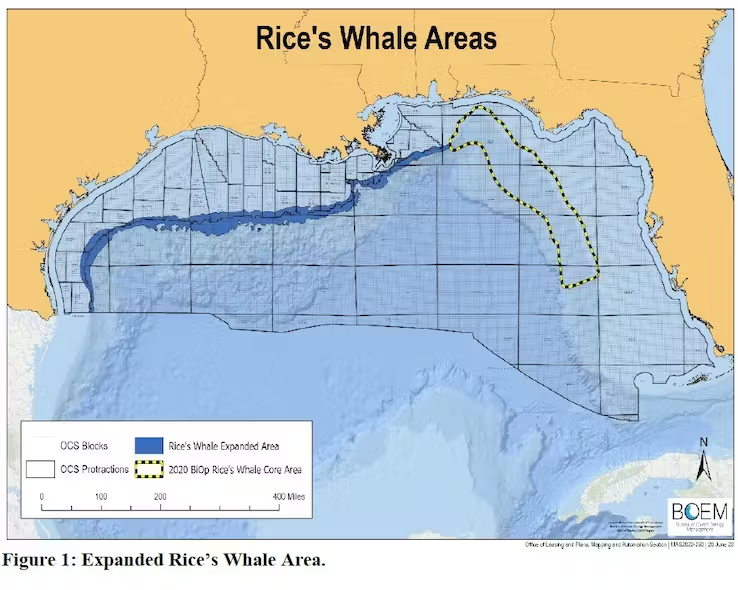
Will the lingering Rice’s whale issues affect bidding for deepwater leases? Friday’s court order is not a final resolution of those issues, either legally or administratively. While the Rice’s whale stipulation, at the direction of the Federal court, will not be included in the Sale 261 leases, BOEM’s Notice to Lessees and Operators (NTL) includes the same provisions and still stands pending further consultations with NOAA. Although the NTL is a “guidance document” (wink-wink), there are ways of making it stick through the exploration plan approval process. Even without binding requirements, companies might choose to fully comply to minimize legal risks.
When will the next GoM lease sale be held? Will the uncertainty spur or constrain bidding?
Not only have no official findings been released, but there has been little new speculation since our June 2023 update. Given the political stakes, it is increasingly unlikely that the responsible parties will be identified.
BOEM is taking steps to comply with an order issued on September 21, 2023, by the U.S. District Court for the Western District of Louisiana regarding Gulf of Mexico Outer Continental Shelf Oil and Gas Lease Sale 261.
Lease Sale 261 will be conducted on September 27, 2023. In accordance with the court’s order, BOEM will include lease blocks in Lease Sale 261 that were previously excluded due to concerns regarding potential impacts to the Rice’s whale distribution in the Gulf of Mexico.
BOEM is also extending the bid submission period to 3 p.m. CST on September 26, 2023.
The challenged lease term for the expanded Rice’s whale area only arose in a July 2023 district court filing and then appeared in the FNOS for Lease Sale 261 on August 25, 2023—one month before the statutory deadline for the sale. BOEM failed to follow its own procedures by making significant changes to the FNOS, thereby depriving both affected states and the public the opportunity for meaningful review and comment. The procedural error is particularly grave here, because of both the compressed timeline and BOEM’s inexplicable about-face on the scientific record it had previously developed. (p.19)
The challenged provisions inserted into these leases at the eleventh hour, and the acreage withdrawal, are based only on an unexplained change in position by BOEM on a single study a few months after that supplemental EIS. The process followed here looks more like a weaponization of the Endangered Species Act than the collaborative, reasoned approach prescribed by the applicable laws and regulations. (p.22).
According to an affidavit from Shell’s commercial manager, the new restrictions on vessel traffic apply to an area of the northern Gulf that separates Shell’s existing offshore leases from the onshore infrastructure that supports them. Shell Offshore Inc., No. 2:23-cv-1167, at doc. 4, att. 2, ¶¶ 23–27. (p. 23).
Given the shaky justification offered by BOEM, the court cannot find that the challenged provisions are so necessary that withholding them even on a preliminary basis will outweigh the risk of irreparable economic harm shown by plaintiffs. Additionally, “there is generally no public interest in the perpetuation of unlawful agency action.” (p. 26)
For the reasons stated above, the court hereby ORDERS that the Motions for Preliminary Injunction be GRANTED. Accordingly, the government defendants are enjoined from implementing the acreage withdrawal and Stipulation 4(B)(4) as described in the Final Notice of Sale and Record of Decision for Lease Sale 261. Government defendants are ordered to proceed with Lease Sale 261, absent the challenged terms, by September 30, 2023.
As has been previously discussed on this blog, the renewable energy source that shows the greatest promise for generating the power needed to support economic growth is ultradeep geothermal.
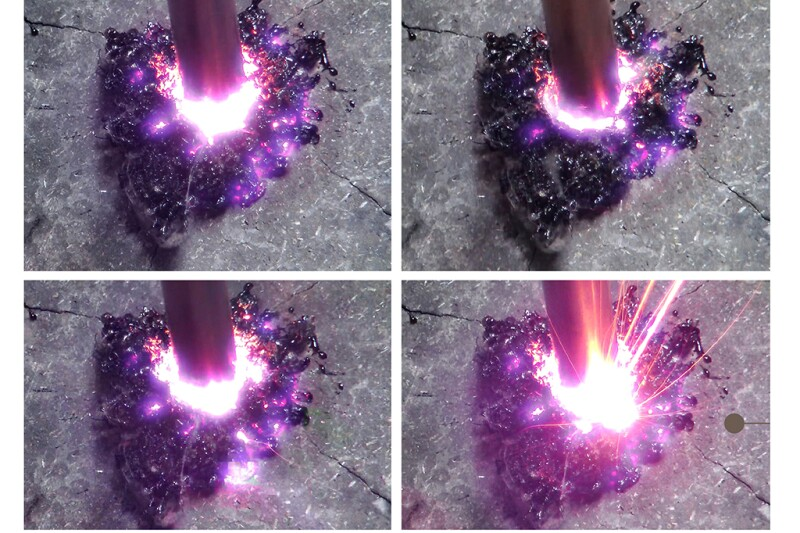
This JPT article nicely describes the opportunities and challenges
Microwave drilling test. Source JPT/Quaise Energy
Good comparison of drilling into hard basement rock with conventional and millimeter wave (microwave) technologies:
The technical readiness level (TRL) for microwave drilling reflects that it has yet to be field tested. The drilling rate includes an estimated amount of flat time. The levelized cost of energy (LCOE) is an all-in estimate of the cost per megawatt-hour (MWh). Source: JPT/Quaise Energy.
Quaise Energy’s first full-scale testing of a hybrid drilling rig combining conventional rotary drilling and millimeter wave drilling capabilities is scheduled for 2024.
Some northeast states and their public utilities may be in a bit of a bind. Either they accept higher electric rates and the likely public backlash, or they deviate from their staunch anti-gas, anti-nuclear orthodoxy. Similarly, oil companies that have invested heavily in offshore wind may find that they are not just less profitable, but (even) less popular.




 Bud's Offshore Energy (BOE)