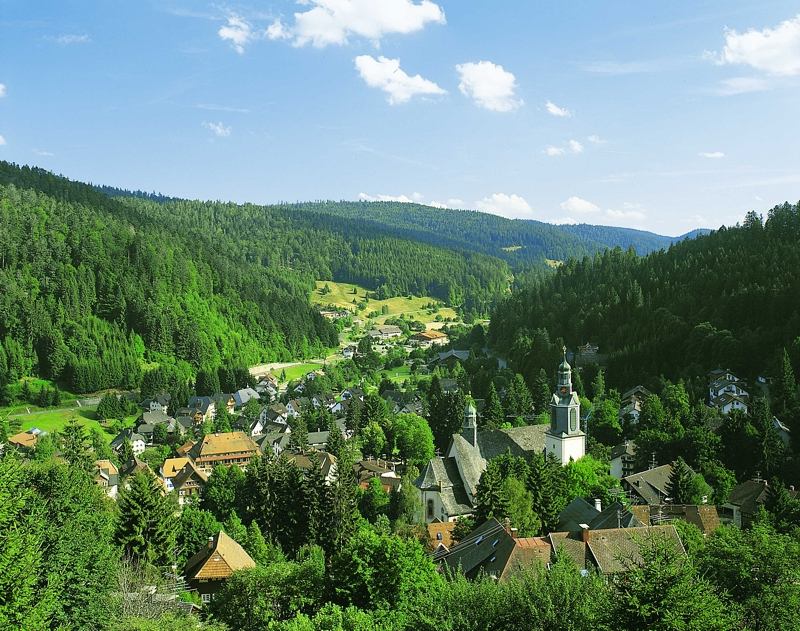
Todtmoos im Schwarzwald
Now that the US has been eliminated, BOE is rooting for Germany and the Netherlands to reach the World Cup final. My great-grandfather, Johann Dannenberger (one “n” got dropped in the new country) emigrated to Pennsylvania from the beautiful village of Todtmoos in the Black Forest region of Germany. In his honor, we are pulling for Germany. Karen and I also have many wonderful Dutch friends including Jan, Jos, Roel, Michael, and others at the State Supervision of Mines, so the Netherlands is another big BOE favorite. We would be happy to see either side take home the cup.

Adios Diego!
Posted in Uncategorized | Tagged Hup Holland Hup, Schwarzwald, SSM, Todtmoos | 3 Comments »

bottom of the flowing Macondo well
Based on the latest information provided by Admiral Allen, the relief well has reached 11817′ below the sea floor and is thus only 273′ above the 9 7/8″ casing shoe on the flowing Macondo well. After drilling another 200+ feet, they will open (enlarge) the relief well and install a 9 7/8″ liner. They will then drill a few hundred feet beneath the liner and intercept the flowing well. They will presumably kill the flow in the annulus outside the casing (assuming that is a flow path) with heavy mud before milling into the 7″ casing, killing any flow inside that casing, and plugging the well bore with cement. Stay tuned.
Posted in accidents, well control incidents | Tagged accidents, blowouts, Deepwater Horizon, drilling, Gulf of Mexico, macondo, relief well, safety, well control | Leave a Comment »
Regarding the relief wells, Development Driller III now is at a distance of 11,641 feet below the seafloor. As you know, they’re going through a series of operations which we call ranging. They’re into their fourth cycle of this. In ranging, they withdraw the drill pipe and put down an electrical cable and actually try and sense the magnetic field around the wellbore. They are within around 15 feet of the wellbore at this point. They will continue down 700, 800 more feet, slowly close into the wellbore, and when they know they’ve got it exactly in range, know exactly where the drill pipe is in relation to the wellbore, then they will attempt to move in and drill through the wellbore and then the casing as well. At that point they’ll be in a position to be able to try the bottom kill or to be able to insert the mud, and hopefully after that, put a cement plug in that will kill the well.
Posted in accidents, well control incidents | Tagged accidents, blowouts, DD3, Gulf of Mexico, macondo, oil spill, relief well, safety, well control | 1 Comment »

DD3
BOE doesn’t really care about where LeBron James chooses to play basketball, but we are big fans of the team on the Development Driller III or DD3. The DD3 crew, some of whom are Deepwater Horizon survivors, is ahead of schedule and predictions for an early intercept and well kill are approaching irrational exuberance levels. This may be the most important well in history, and crew has responded to the challenge.
 After the DD3 crew finishes the job, we owe them a victory parade in New Orleans. “Throw me somethin’ mista! 🙂
Posted in accidents, well control incidents | Tagged accidents, blowouts, DD3, Deepwater Horizon, Gulf of Mexico, macondo, relief well, well control | Leave a Comment »
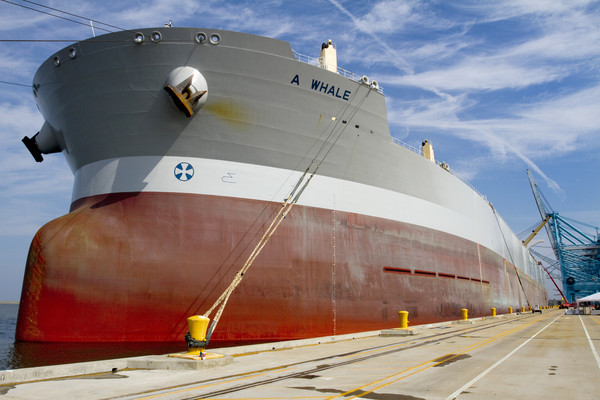
If bigger is better, this 1100′ tanker turned skimmer will be enormously effective. EPA discharge and Jones Act issues?
The ship looks like a typical tanker, but it takes in contaminated water through 12 vents on either side of the bow. The oil is then supposed to be separated from the water and transferred to another vessel. The water is channeled back into the sea.
Posted in Uncategorized | 2 Comments »
Quote from a Financial Post article:
The voracious Dutch vessels, for example, continuously suck up vast quantities of oily water, extract most of the oil and then spit overboard vast quantities of nearly oil-free water. Nearly oil-free isn’t good enough for the U.S. regulators, who have a standard of 15 parts per million — if water isn’t at least 99.9985% pure, it may not be returned to the Gulf of Mexico.
Is (was?) this EPA discharge standard being applied to water that is collected during the oil spill response operation? If so, the author’s harsh criticism is justified. Why haul mixtures that are 90% water to shore when you can separate the oil and discharge relatively clean water? Why make all those trips to shore delivering cargoes that are mostly water? A lot of the reporting on the spill has been inaccurate, so we don’t want to jump to conclusions. Can anyone confirm or refute the author’s charge?
Posted in Uncategorized | Tagged discharge standards, EPA, macondo, oil spill | 2 Comments »
Interesting comments from Jane Cutler, CEO of Australia’s National Offshore Safety Petroleum Safety Authority, in NOPSA’s excellent newsletter:
The incidents in the Gulf of Mexico (Deepwater Horizon) and at the Montara wellhead platform are different in many respects, particularly in technical matters. However, they share some common factors prompting regulatory action.
I agree entirely with Ms. Cutler. International regulators and operators must work in concert to address and resolve these issues.
Posted in accidents, well control incidents | Tagged accidents, blowouts, Deepwater Horizon, international, Jane Cutler, macondo, Montara, NOPSA, offshore oil, safety, well control | Leave a Comment »
Take a break from your stressful and complex lives and enjoy this brilliant and comical classical performance forwarded by our friend Malcolm Sharples.
Posted in Uncategorized | Leave a Comment »
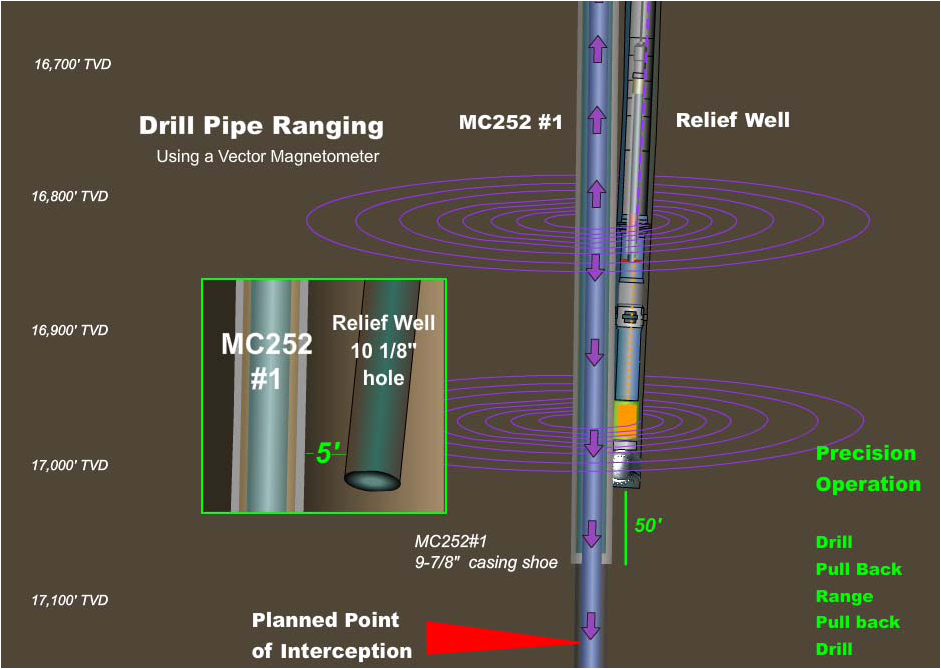
BP has released a slide presentation and animation on the relief wells showing the intercept point below the 9 7/8″ casing shoe. The exact sequence of operations once they reach the intercept point will be interesting to observe. They should encounter flow when they reach the 7″ casing annulus (assuming that is a flow path; there still seems to be some uncertainty in that regard). Will they attempt to kill the flow in the annulus before milling into the 7″ casing? Is there flow inside the 7″ casing via channels in the casing shoe? Is there drill pipe inside the casing?
Posted in accidents, well control incidents | Tagged accidents, blowouts, Deepwater Horizon, drilling, Gulf of Mexico, macondo, offshore oil, oil spill, relief well, safety, well control | Leave a Comment »

