The April oil production figure for the Gulf of Mexico has thus not yet been released.
These ongoing issues must be rather embarrassing for a data driven agency.
The April oil production figure for the Gulf of Mexico has thus not yet been released.
These ongoing issues must be rather embarrassing for a data driven agency.
Posted in energy, Gulf of Mexico, Offshore Energy - General | Tagged EIA, Gulf of Mexico production, systems issues | Leave a Comment »
Posted in Alaska, energy policy, Gulf of Mexico, Offshore Energy - General | Tagged 5 year leasing plan, BOEM, Cook Inlet, DOI, Gulf of Mexico | Leave a Comment »
… especially those in Newfoundland where the only offshore oil and gas operations in the N. American Atlantic are being conducted.
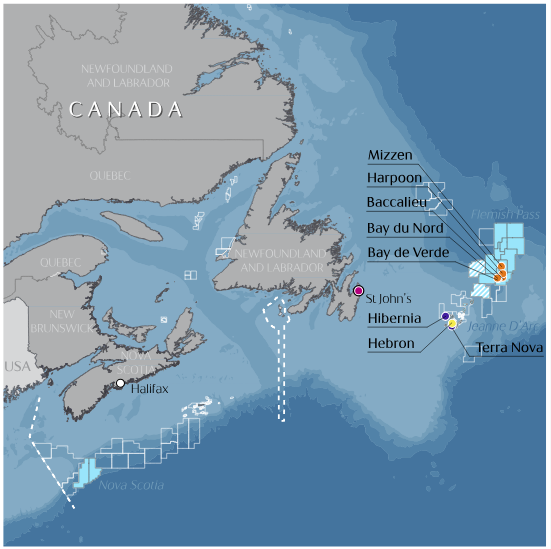
Posted in Canada, Offshore Energy - General, Uncategorized | Tagged Canada Day, Newfoundland, offshore oil | Leave a Comment »
WASHINGTON (May 19, 2022) — During testimony before the U.S Senate Committee on Energy and Natural Resources today, Secretary of the Interior Deb Haaland confirmed that, despite delays in implementation from the previous Administration, the Interior Department will release the Proposed Program – the next step in the five-year offshore energy planning process – by June 30, 2022, which is the expiration of the current program. A Proposed Program is not a decision to issue specific leases or to authorize any drilling or development.
DOI
Posted in energy policy, Gulf of Mexico, Offshore Energy - General | Tagged 5 year leasing plan, DOI, offshore oil and gas | Leave a Comment »
When Congress seems slow to solve problems, it may be only natural that those in the Executive Branch might seek to take matters into their own hands. But the Constitution does not authorize agencies to use pen-and-phone regulations as substitutes for laws passed by the people’s representatives.
Justice Gorsuch in concurrence
Capping carbon dioxide emissions at a level that will force a nationwide transition away from the use of coal to generate electricity may be a sensible “solution to the crisis of the day.” New York v. United States, 505 U. S. 144, 187 (1992). But it is not plausible that Congress gave EPA the authority to adopt on its own such a regulatory scheme in Section 111(d). A decision of such magnitude and consequence rests with Congress itself, or an agency acting pursuant to a clear delegation from that representative body.
Justice Roberts for the majority
At first glance, the SCOTUS decision would seem to affect the regulation of GHG emissions on the OCS and possibly the Lease Sale 257 decision (now being appeal), which was based on BOEM’s failure to estimate the effect of reduced OCS production on GHG emissions outside the US.
Posted in climate, energy policy, Gulf of Mexico, Offshore Energy - General, Regulation | Tagged climate, GHG emissions, Justice Gorsuch, Lease Sale 257, SCOTUS, West Virginia vs. EPA | Leave a Comment »
Leasing shutdowns have consequences. See the IER article, and the post below regarding the importance of new production, which is dependent on consistent leasing and exploration programs. Will the proposed leasing plan be issued today as promised?
“According to EIA, declining production from existing Gulf of Mexico fields will largely offset the increases in oil production from the new fields, with natural gas production in the Gulf of Mexico continuing its three-year decline. During 2021, 15 percent of U.S. oil production and 2 percent of U.S. natural gas production was produced in the Gulf of Mexico.”
IER
Posted in energy policy, Gulf of Mexico, Offshore Energy - General | Tagged 5 year leasing plan, EIA, Gulf of Mexico production, IER | Leave a Comment »
“The two-well subsea development is producing, in combination, approximately 16,000 barrels of oil per day and 13 million cubic feet of gas per day via a 14-mile subsea tieback to the EnVen-operated Lobster platform in EW 873. First production was achieved less than three years after the initial exploratory discovery well was drilled.”
LLOG
The project owners (below) are all independent producers and private equity firms. Houston Energy, LLOG, Red Willow, EnVen, and Beacon were also among the high bidders in Lease Sale 257, which was vacated by a questionable court decision that the Federal government chose not to appeal.

The companies responsible for these important projects (see “simpler, safer, greener”) that have or will soon initiate production were also active bidders at Lease Sale 257. The absence of leasing has thus seriously handicapped the companies most responsible for the production surge to over 2 million BOPD in 2019 and for sustaining the current Gulf production rate of 1.7 million BOPD.
Posted in energy policy, Gulf of Mexico, Offshore Energy - General | Tagged Gulf of Mexico, LLOG, new production, Sale 257, simpler safer greener, Spruance | Leave a Comment »
Posted in energy policy | Tagged 500 million barrels, DOE, inventory, SPR | Leave a Comment »
Related posts: Falls are NOT trivial and Important reading for offshore safety leaders
Posted in accidents, Gulf of Mexico | Tagged BSEE, fall prevention, injury, Safety Alert | Leave a Comment »

For others who are fascinated by ultradeep geothermal energy, MIT News has posted an update on Quaise Energy. Quaise wants to use x-rays to drill ultradeep geothermal wells at old coal and gas power plants.
“The company plans to vaporize enough rock to create the world’s deepest holes and harvest geothermal energy at a scale that could satisfy human energy consumption for millions of years. They haven’t yet solved all the related engineering challenges, but Quaise’s founders have set an ambitious timeline to begin harvesting energy from a pilot well by 2026.”
Quaise will use conventional rotary drilling technology to reach basement formations before switching to high-power millimeter waves that vaporize boreholes through rock and provide access to deep geothermal heat. See our previous post on this exciting concept.
Posted in climate, drilling, energy, Uncategorized | Tagged MIT, Quaise Energy, ultradeep geothermal | Leave a Comment »

 Bud's Offshore Energy (BOE)