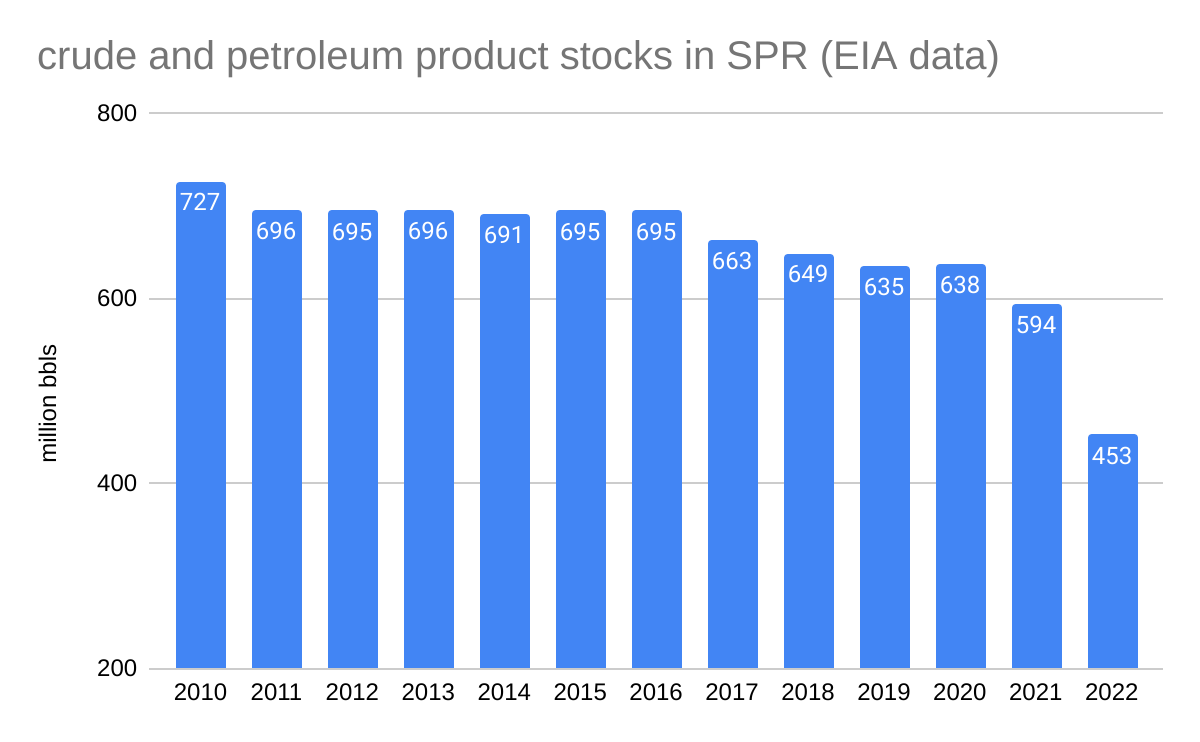
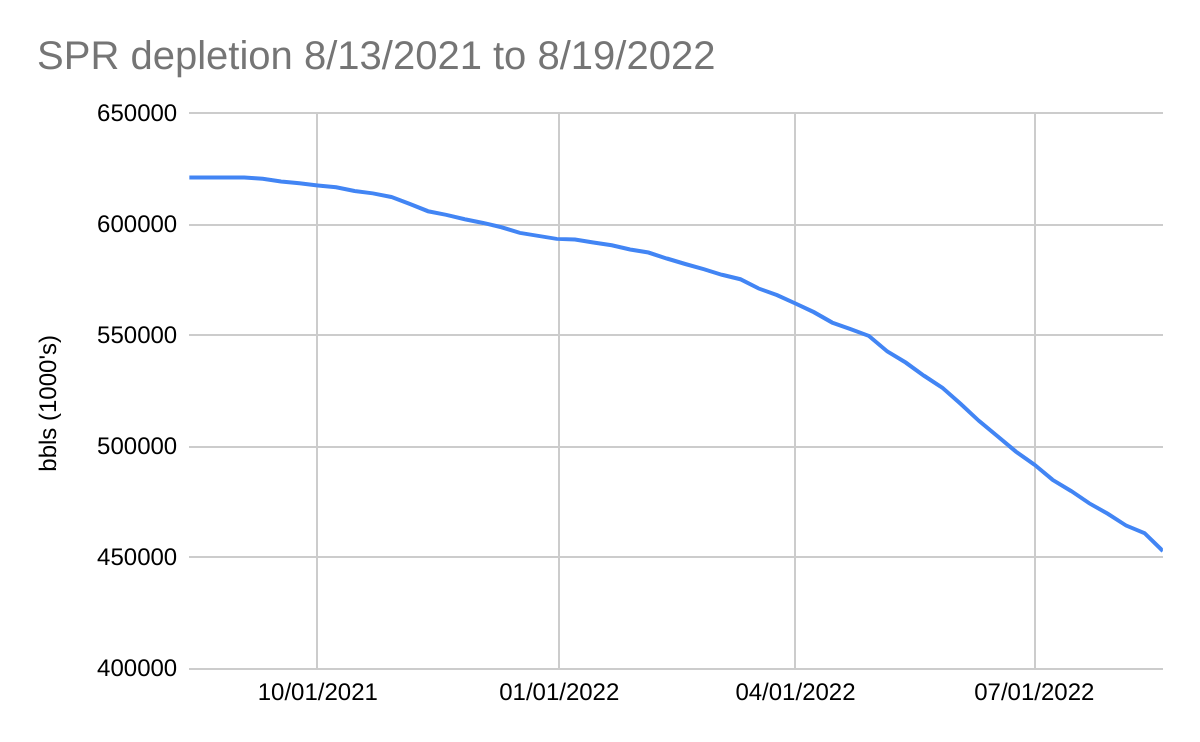
The SPR withdrawals are scheduled to end just prior to the mid-term elections. What happens if oil markets tighten further, perhaps with OPEC assistance?
After devastating South Florida during August 25, 1992, Hurricane Andrew struck Gulf of Mexico facilities the following day. Sustained winds were 140 mph with gusts to 160 mph, and significant wave heights were 35-40 feet. About 700 platforms were exposed to hurricane force winds. 241 platforms and 83 pipeline segments incurred substantial damage.
All workers had been evacuated from the offshore facilities without incident. Surface and subsurface safety systems performed as intended, and there were no uncontrolled flows from production wells. According to respondents to a JP Kenny survey for MMS, 2698 valves were closed during the storm as follows:
valve type
activated
failed
subsurface safety valves
716
0
master surface safety valves
729
5
wing surface safety valves
460
0
pipeline shutdown valve
415
0
pipeline check valve
378
0
The five MSSV failures were at facilities directly in the path of the eye in an area where the storm damage was most severe.
The valve performance reporting was associated with a research project and was thus voluntary. It’s therefore important to give credit to the companies that participated (a number of which no longer exist): Amoco, Aquila Energy, BP, Chevron, Four Star O&G, Gulfstream, Houston Expl., Kerr-McGee, Mobil, Pennzoil, Samedan, Shell, Sonat, Stone, Tennessee Gas PL, Texaco, and Unocal.
Also, in reviewing the survey responses it’s clear that there was some confusion about what to report. Most facilities were completely shut-in well ahead of the storm’s arrival and the survey requests information on valves that were shut-in (presumably automatically) during the hurricane. Reporting was therefore inconsistent, and the total number of shut-in valves was under-reported.
It was revealed on Friday that Warren Buffett’s Berkshire Hathaway (NYSE: BRK-A) has received Federal Energy Regulatory Commission approval to acquire up to 50% of Occidental Petroleum’s (NYSE: OXY) common stock.
Energy security will be a featured topic at the conference. Note the lineup for the Zelenskyy session:
President Zelenskyy will be introduced by the Norwegian Prime Minister Jonas Gahr Støre, and will be followed on stage by Elon Musk, Ben Van Beurden (CEO, Shell), Patrick Pouyanné (CEO, TotalEnergies) and Anders Opedal (CEO, Equinor) among others.
China also has boosted annual coal production by 490 million tonnes since last year, enough to meet demand from Germany and Russia combined, the coal mine safety bureau said this month, describing coal as “still our country’s most important source of power”.
The country has continued to develop new coal-fired plants, with construction on the second phase of the Zheneng Liuheng coal-fired power station in eastern China’s Zhejiang province beginning at the start of this month. New coal-fired power construction was at its highest since 2016 last year.
Contrary to some media reports and industry comments, the Inflation Reduction Act does NOT require the Department of the Interior (DOI) to award leases to the high bidder on each Sale 257 tract. The legislation requires DOI to accept the highest valid bid for each tract.
As BOE has previously explained, the 94 carbon sequestration bids were clearly not valid, and leases should not be awarded. These bids accounted for 30.5% of the entire sale in terms of the number of tracts receiving bids. (More on the CCS bids.)
There is also the matter of fair market value. Only 9 of the 214 (non-CCS) tracts received more than one bid and none received more than 2 bids. DOI/BOEM may determine that some of the bids did not pass the fair market value test. Are such bids “valid” under the terms of the IRA legislation? Note that 7 of the 93 high bids submitted at the previous sale (Lease Sale 256, November 2020) were rejected on fair market value grounds. All 7 were single bid tracts.
Lastly, there is the unresolved matter of the decision by Judge Contreras to vacate Sale 257. While the legislation seems to clearly supersede that decision, who knows what might happen next on the litigation front.
Quaise Energy’s ultradeep geothermal energy concept is most intriguing and media interest continues to build. Ultradeep geothermal has a big advantage over other renewable concepts which have much greater space and aesthetic challenges and suffer from intermittency. As is very well explained in the quote below, it’s now up to Quaise to demonstrate gyrotron drilling and the associated technology in pilot projects.
“A lot of the technology advances [needed] are coming into that proof step where you’ll have physical proof that they work. So I would say we are ready to launch, if we can just bring together the right utility, the right contract and engineering expertise, and the right site to launch the proofs to show that this can be done,” said Ken Wisian, a geothermal geophysicist and associate director of the Bureau of Economic Geology at the University of Texas, Austin. “The picture could be accelerating dramatically over the next few years. We just need the proof projects to land.”






 Bud's Offshore Energy (BOE)