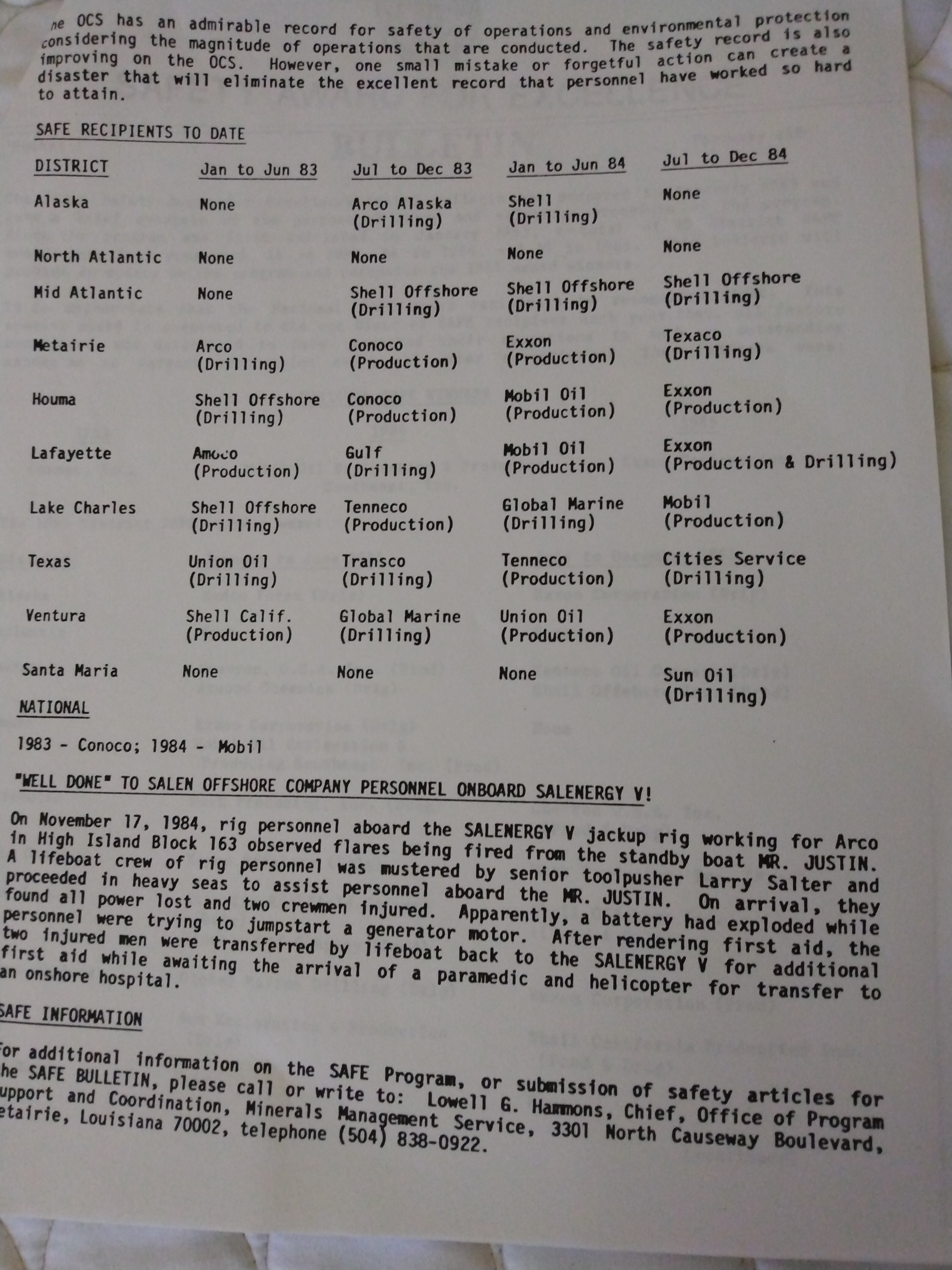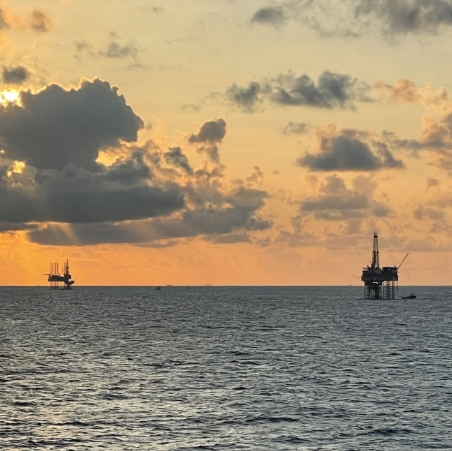
Despite continuous legal and policy headwinds, and the absence of some historically important US companies, technological innovation is sustaining US offshore production at about 1.7 to 1.8 million BOPD. BOE will continue to monitor drilling, production, and safety performance and draw attention to the leading companies.
Think about where we would be today without the shale revolution and onshore production on private lands. Grateful!
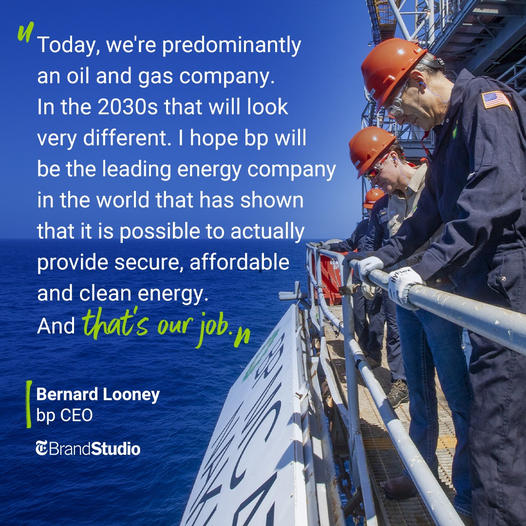
bp ad showing workers on their Na Kika floating production platform in the Gulf of Mexico (6340′ water depth)
Is bp apologizing for the pictured workers and platform? With the demand for oil and gas expected to increase through 2050, and worldwide concerns about energy supply and security, ads like this make neither good business nor good social sense.
Moving away from oil and gas and becoming a “very different” company in the 2030’s won’t make bp the “leading energy company in the world.” On the contrary, a “very different” bp will likely be less influential, less profitable, and more dependent on government mandates and subsidies.
Contrary to the ad (and to the company’s credit), bp seems committed to Gulf of Mexico production well beyond the 2030’s. They are the number 2 oil producer in the Gulf (behind Shell), continue to drill exploration and development wells, and were the most active participant at Lease Sale 257. Bp was the high bidder on 46 tracts, 12 more than no. 2 Chevron. The Department of the Interior has been legislatively directed to award Sale 257 leases by 9/15/2022, but has yet to comment publicly on the matter.
To the extent that these numbers are honored and adhered to, attached is the OPEC+ production table (1000’s of BOPD). Note that Russia and Saudi Arabia have identical quotas – 11,004,000 BOPD.
An important figure in the history of the US offshore program passed away last week. Gerry Rhodes was a petroleum engineer with an attorney’s gift for understanding laws and regulations. Among other leadership roles in the offshore regulatory program, Gerry was Chief of the Minerals Management Service’s Branch of Rules, Orders, and Standards in the 1990’s.
Gerry was among the first in the Federal government to fully understand the financial responsibility risks associated with the decommissioning of offshore facilities and the urgent need to update requirements for the plugging of wells and removal of platforms. The enormity of this challenge is described in the 1991 Forbes article pasted below. Despite sharp divisions within the offshore industry and the resulting political pressure, Gerry succeeded in finalizing regulations (including this 1995 rule) that are the basis for the current financial responsibility programs in BOEM and BSEE. Without Gerry’s resolve, subsequent financial assurance challenges and government outlays would have been far greater.
RIP Gerry. You were a true gentleman, a dedicated father and grandfather, and a diligent and highly accomplished colleague.
Even those of us who are fully vaxed acknowledge the vaccines’ uncertain efficacy and risks, and the many issues with the CDC guidance and Covid protocols. Military personnel must comply with orders, but questionable orders should be revised as new information becomes available.
Regulators know that regulations, policies, and practices cannot be static. As we learn, we update and improve. Enforcing outdated guidance is just a power play, and demonstrates rigidity not competence. The Coast Guard understands all of this, so their decision to evict the cadets is especially disappointing.
It was revealed on Friday that Warren Buffett’s Berkshire Hathaway (NYSE: BRK-A) has received Federal Energy Regulatory Commission approval to acquire up to 50% of Occidental Petroleum’s (NYSE: OXY) common stock.