Feeds:
Posts
Comments

Archive for the ‘pipelines’ Category

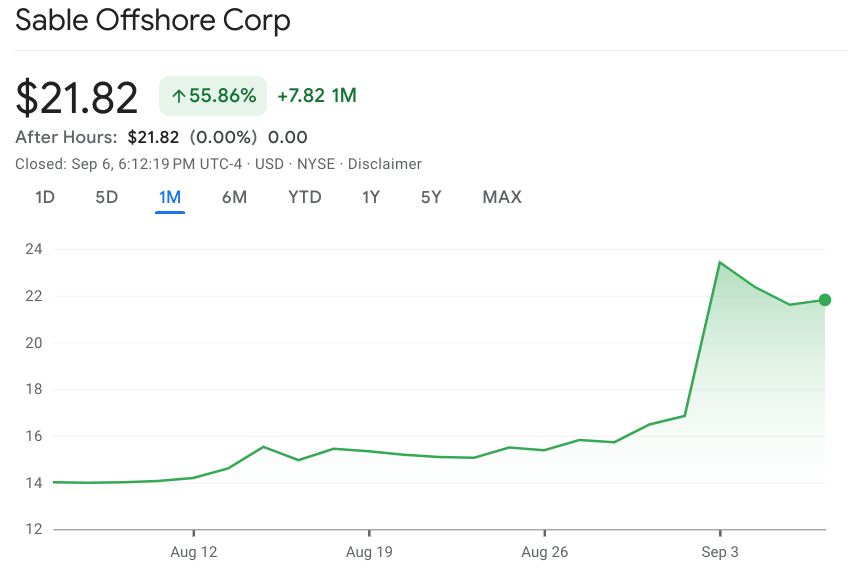
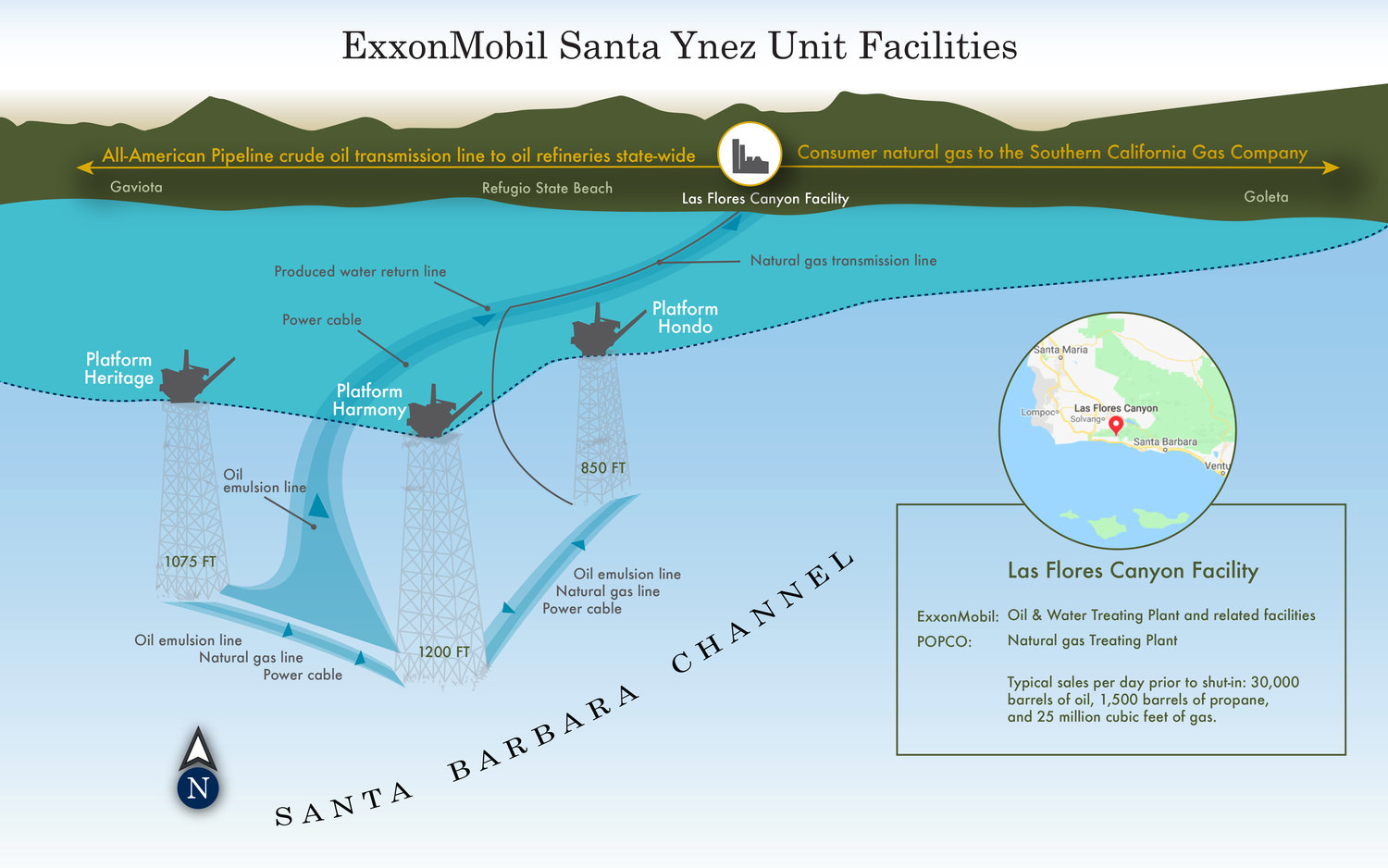
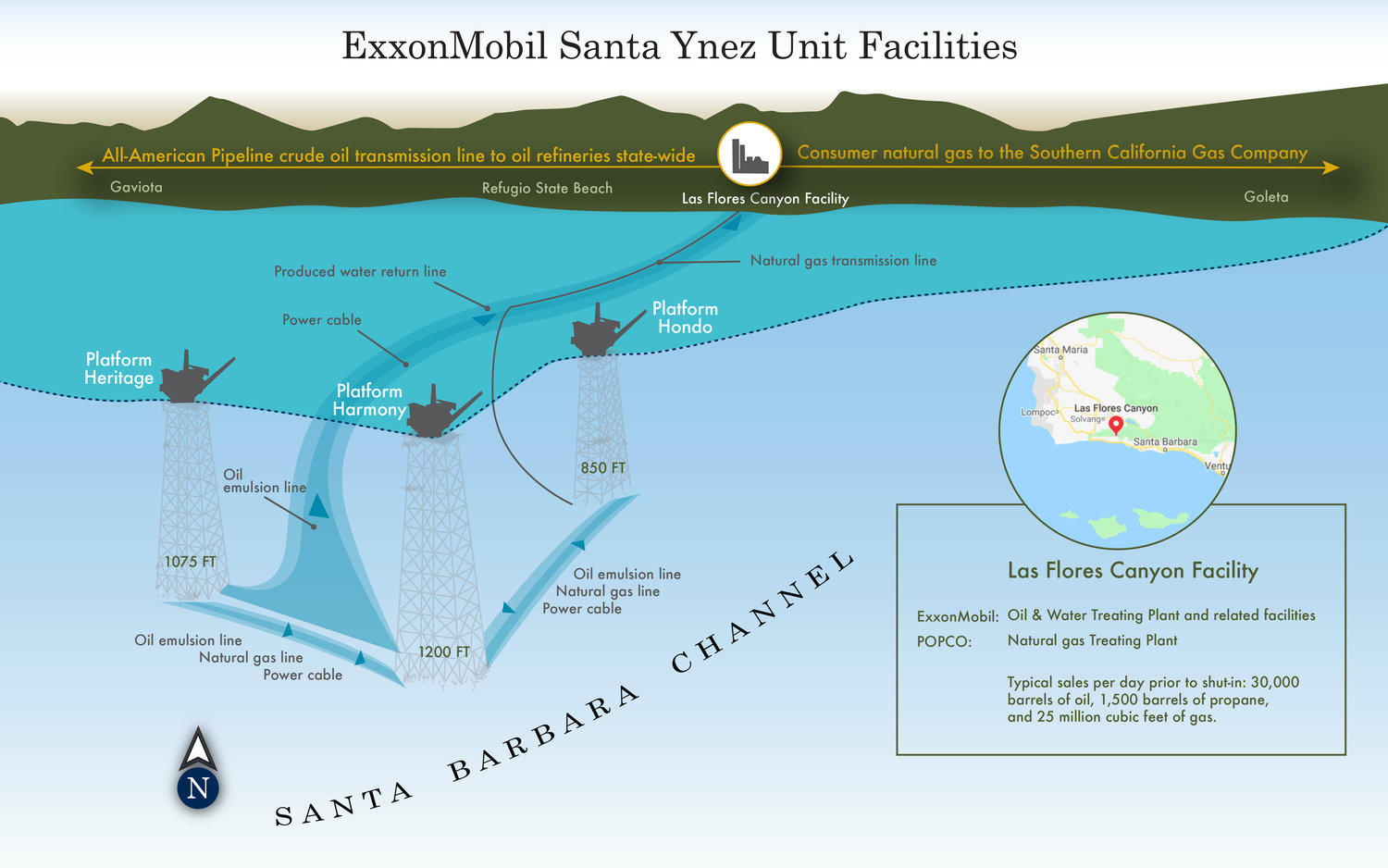
Sable’s stock price soared after the company reached an agreement with Santa Barbara County that will allow them to comply with the California Fire Marshall’s requirement to install shutdown valves on the onshore pipeline that failed in 2015. That pipeline is necessary to transport production from the Santa Ynez Unit, which is currently operated by Sable.
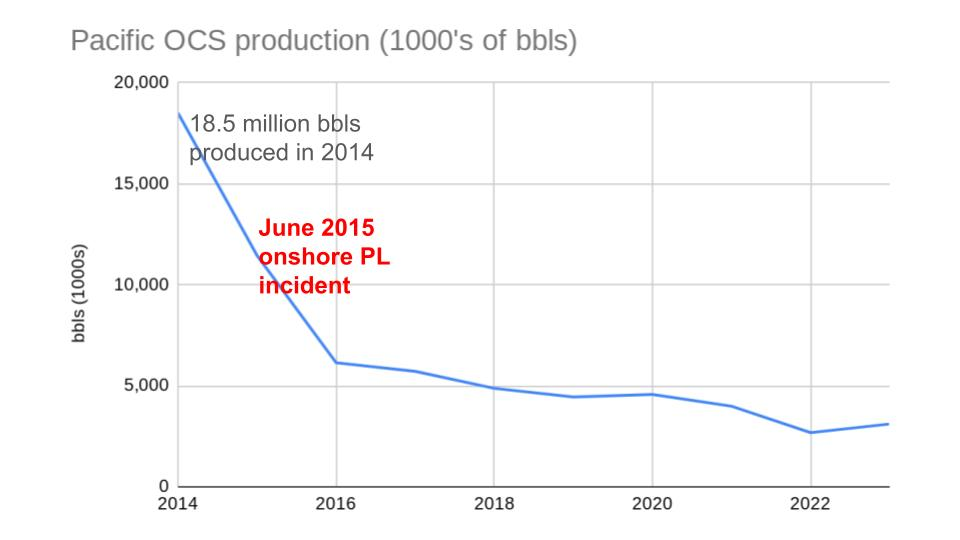
The significance of a resumption of SYU production is illustrated in the chart below. The 3 SYU platforms accounted for more than 2/3 of Pacific OCS production before the Refugio pipeline spill in June 2015.
This agreement with the County is a major step forward, but there are still regulatory and legal hurdles to clear before production resumes.

In the SEC filing that announces the agreement with Santa Barbara County, Sable affirms their 2024 restart expectations. However, a resumption of production in 2024 is highly unlikely given the administrative challenges that remain. A restart in 2025 would be a major accomplishment and a very good outcome for Sable.

Pasted below is the full text of the SEC filing (emphasis added):

Santa Barbara County (the “County”), on August 30, 2024, acknowledged that the County does not have jurisdiction over Pacific Pipeline Company’s (“PPC”) installation of 16 new safety valves in the County along PPC’s Las Flores Pipeline System (the “Pipeline”) in accordance with Assembly Bill 864. The County’s acknowledgement was delivered in the form of a conditional settlement agreement dated August 30, 2024 (the “Safety Valve Settlement Agreement”) among the County, PPC and PPC’s parent company Sable Offshore Corp. (“Sable”), and a subsequent acknowledgement by the County’s planning and development staff.

The Safety Valve Settlement Agreement is predicated upon a prior settlement agreement between PPC’s predecessor in interest, Celeron Pipeline Company, and the County in a federal case styled Celeron Pipeline Company of California v. County of Santa Barbara (Case No. CV 87-02188), which was executed in 1988.

Pursuant to the Safety Valve Settlement Agreement, PPC agreed to the following additional surveillance and response enhancements in the County:

i. PPC will create a Santa Barbara County-based Surveillance and Response Team, trained in PPC’s Tactical Response Plan, which will be responsible for timely initial incident response and equipped with key resources to deploy in early containment, particularly for those regions of the Pipeline between Gaviota and Las Flores Canyon;

ii. PC will provide Santa Barbara first responders with additional training and equipment to assist in PPC’s incident response efforts; and

iii. PPC will undertake the following Pipeline system enhancements: (1) install and operate and maintain primary and secondary Operations Control Centers in Santa Barbara County, and (2) refurbish the Gaviota pump in its existing station.

PPC, Sable and the County have further agreed, in the Safety Valve Settlement Agreement, to file a stipulation to dismiss the pending lawsuit, Pacific Pipeline Company and Sable Offshore Corp. v. Santa Barbara County Planning Commission and Board of Supervisors (Case No. 2:23-cv-09218-DMG-MRW) within 15 days of final installation of all 16 underground safety valves in the County.

Sable affirms that initial restart of production from Sable’s Santa Ynez Unit is expected in fourth quarter 2024.
Read Full Post »

Earlier this year John Smith correctly commented that a Santa Ynez Unit (SYU) production restart in 2024 was not possible. Last month, BOE reported on the regulatory “catch 22” facing Sable Offshore, the current operator under an agreement with Exxon.

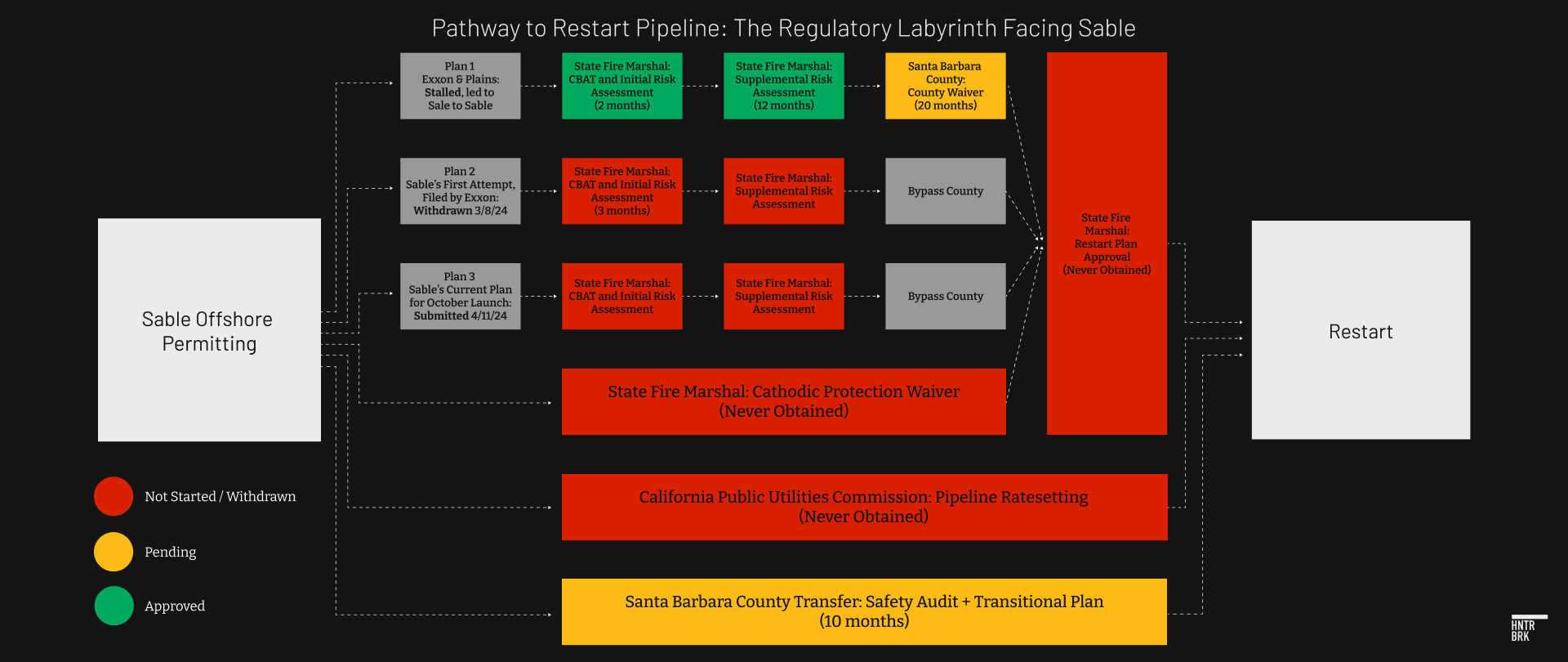
An assessment prepared for Hunterbrook Capital draws the same conclusions regarding the prospects for production, calling the restart “a pipe dream” (presumably the pun was intended given the pipeline permitting quagmire). Hunterbrook’s chart (pasted below) illustrates the regulatory labyrinth facing Sable.

Hunterbrook has also flagged Sable’s ability to continue as a “going concern.” That may be a valid concern, but Sable’s success is very much in Exxon’s best interest. Exxon must have evaluated Sable and been comfortable with their management. Otherwise, they wouldn’t have made the deal.

Does Exxon want the massive SYU headache to revert back to their portfolio, as provided for in their agreement with Sable, if production doesn’t restart by January 1, 2026? Unless Exxon thinks they have a better option than Sable, they will presumably be flexible about the deadline.

Meanwhile, a judge denied the temporary restraining order requested by Sable to prohibit release of redacted portions of their oil spill contingency plan. Sable had argued that revealing “trade secrets” and specific locations and vulnerabilities of the pipelines could pose a “threat to national security.”

The Santa Barbara Independent also alludes to “pending litigation with Santa Barbara County over automatic shut-off valve permits.” Although litigation would seem likely if the County continues to deny permits for valves required by the Fire Marshall, BOE was unable to confirm any such litigation plans.

Read Full Post »

Read Full Post »

Skepticism about these charges is running high given the apparent political convenience of the “private Ukrainian citizens” sabotage scenario. The German govt has been under pressure to identify the responsible party following the decisions by Denmark and Sweden to drop their investigations.

Many of us are waiting for responses from the insurers, Seymour Hersh, Erik Andersson, and other private parties who have been actively investigating the Nord Stream sabotage.

Read Full Post »

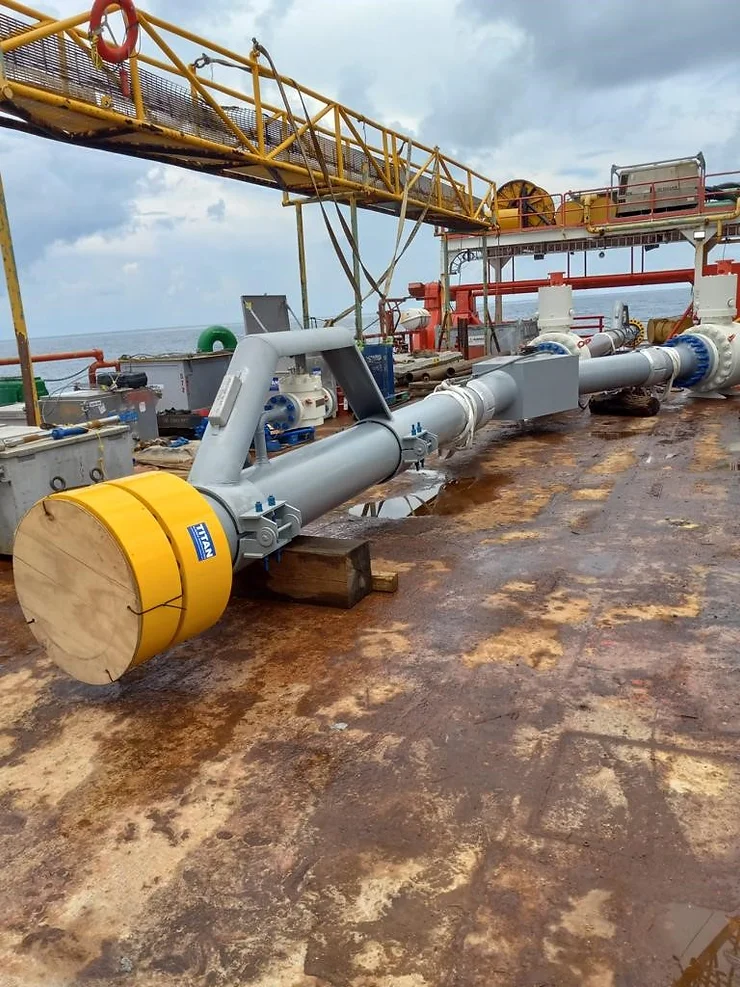
Above: Pigable Y connector for the 6.5-mile 18-inch pipeline extending from a subsea connection in MP289 to a subsea connection with MPOG in MP268 with a capacity of up to 80,000 barrels per day.

A colleague shared his research on the November 2023 Main Pass Oil Gathering (MPOG) connector leak in the Gulf of Mexico. Given the extraordinary amount of time it takes to produce accident reports these days, it may be a while before we see the NTSB report. (Keep in mind that we are still waiting for their final report on the December 2022 helicopter crash at the West Delta 106 A platform.)

The pipeline associated with the leak is BSEE Segment No. 11015, an 18” oil line permitted under Panther Operating Company, LLC . MPOG and Panther are owned by Third Coast ( MAIN PASS OIL GATHERING PROJECT COMPLETION (third-coast.com) . Information on this company website shows that a project was completed for the installation of a new segment 20793 and the new line placed in service on August 20, 2022.

The picture shown in the website for this project (pasted above) shows what looks like a subsea pigable Y connection, which means the main line had to be cut for this connector to be installed. The location of this subsea tie-in for the new segment is in MP 268 and the approximate distance from the Mississippi River delta is 44 miles.

As for other subsea connections, the nearest to shore is in MP 144 about 27 miles from the delta. The report on the leak says that it occurred 19 miles from delta, so not sure if there are any connectors. This distance from the delta would be in the vicinity of MP 72 and mapping information shows no connections in this area, only pipeline crossings. See attached map for PSN 11015.

Read Full Post »

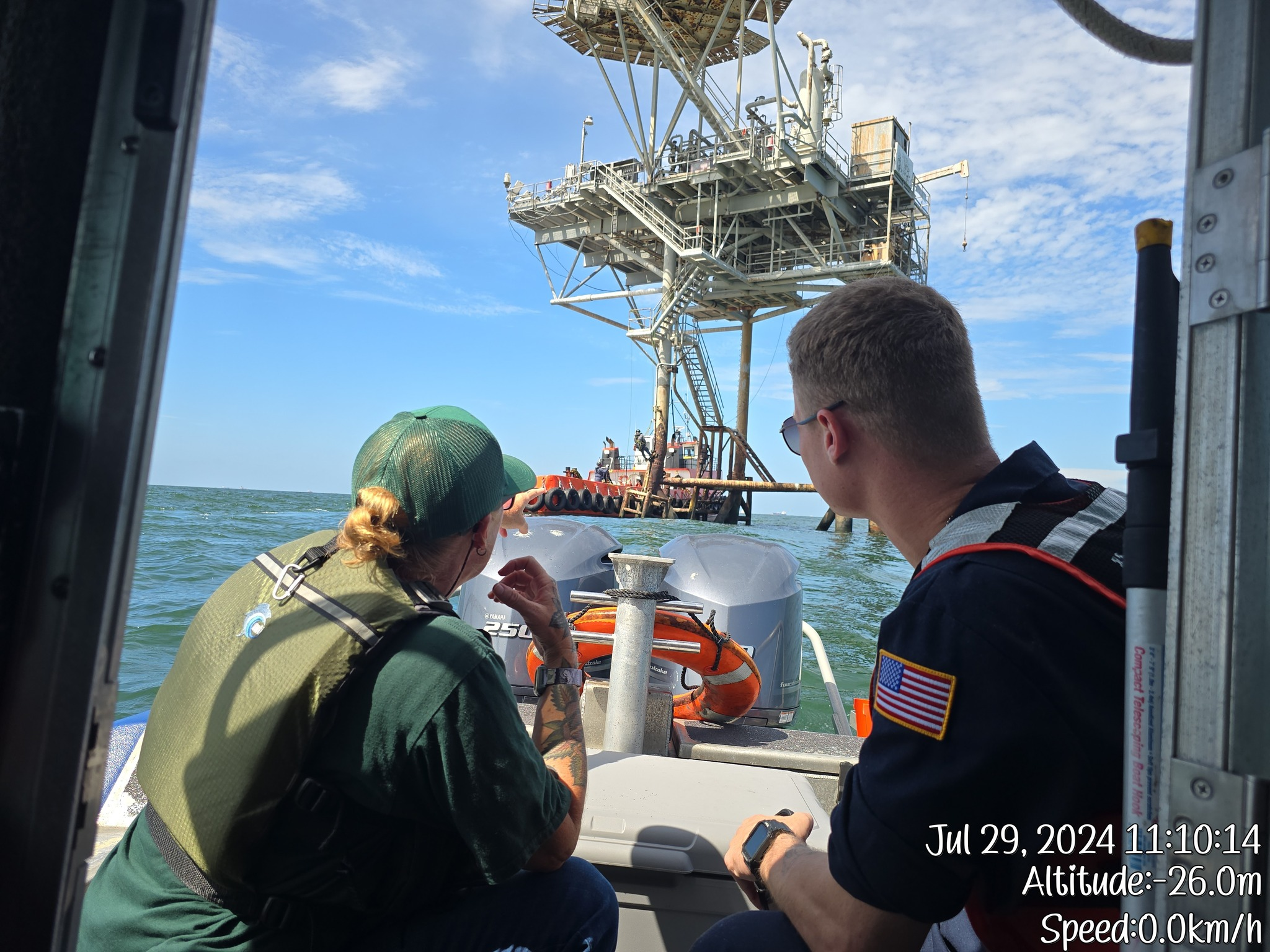
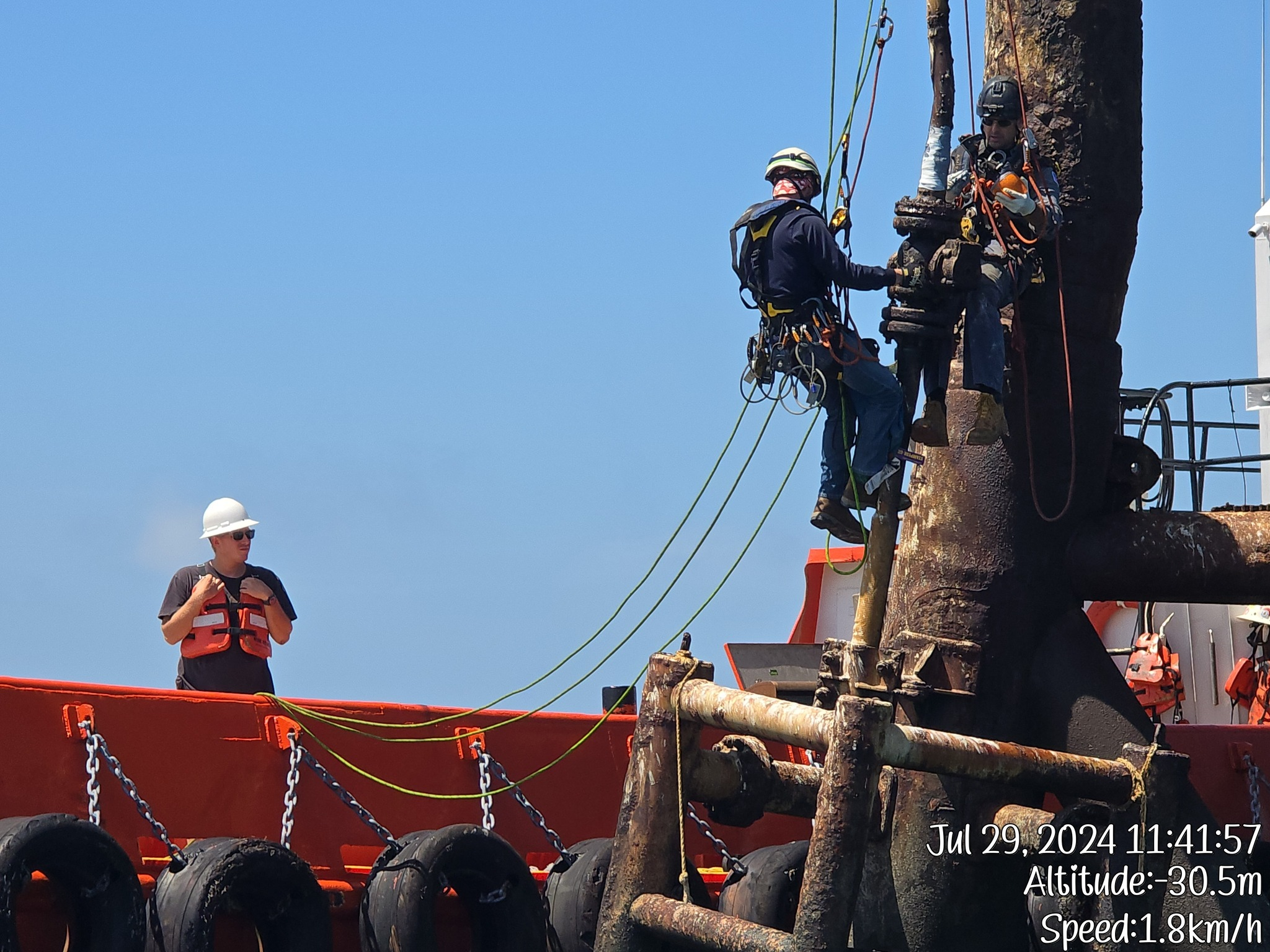
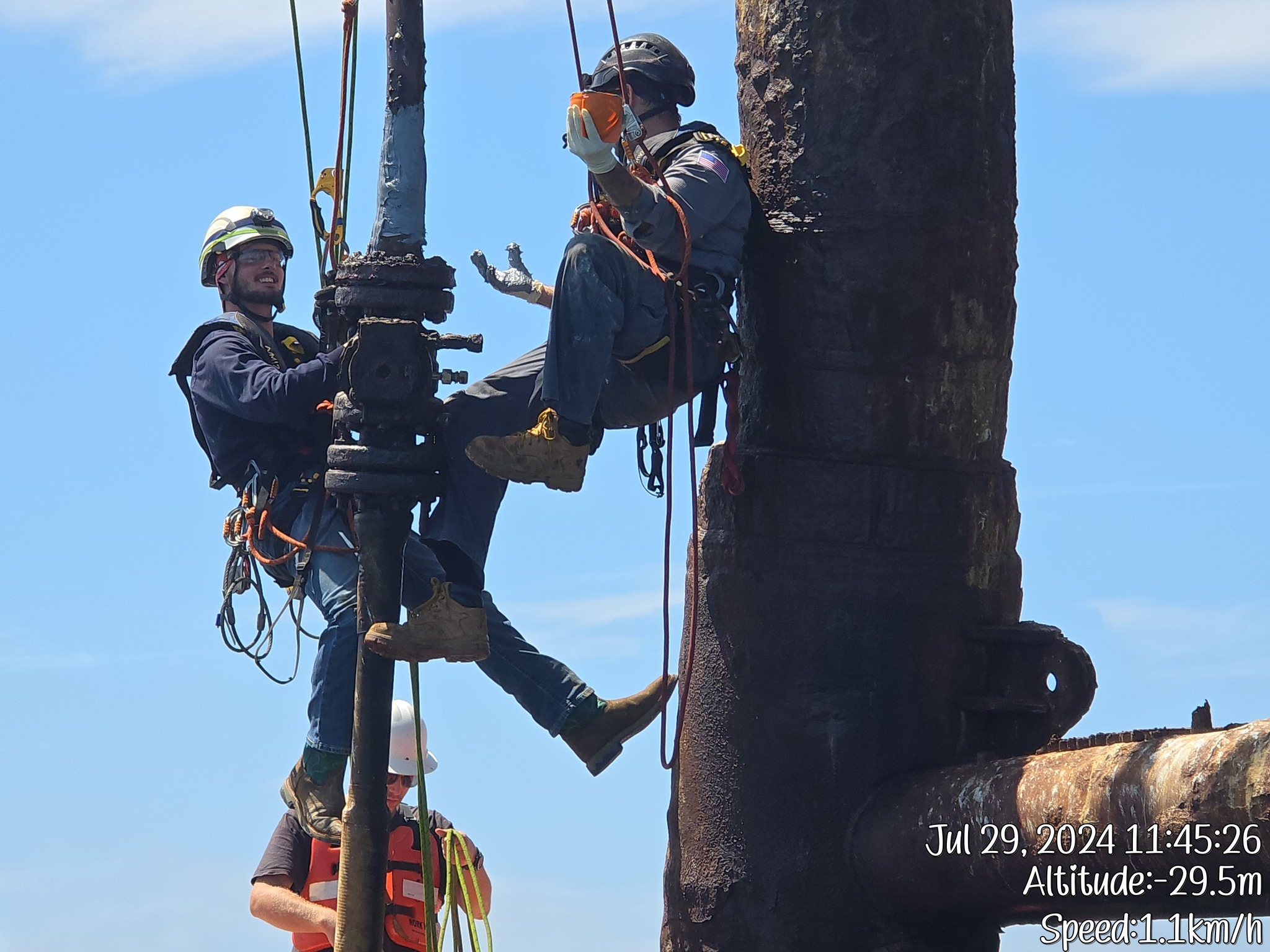
According to the Texas General Lands Office, which provided the above photos, a patch has been applied to the leaking pipeline riser on an abandoned platform in High Island Block 98-L. The gas condensate spray has been stopped.

Crews from the U.S. Coast Guard, Texas General Land Office, and the Texas Railroad Commission monitored the operation. It’s unclear who the responsible party is and who funded and performed the work.

Read Full Post »

Danish Tax Minister Jeppe Bruus boasts that other countries will be inspired by the world’s first tax on livestock emissions. Are you inspired?

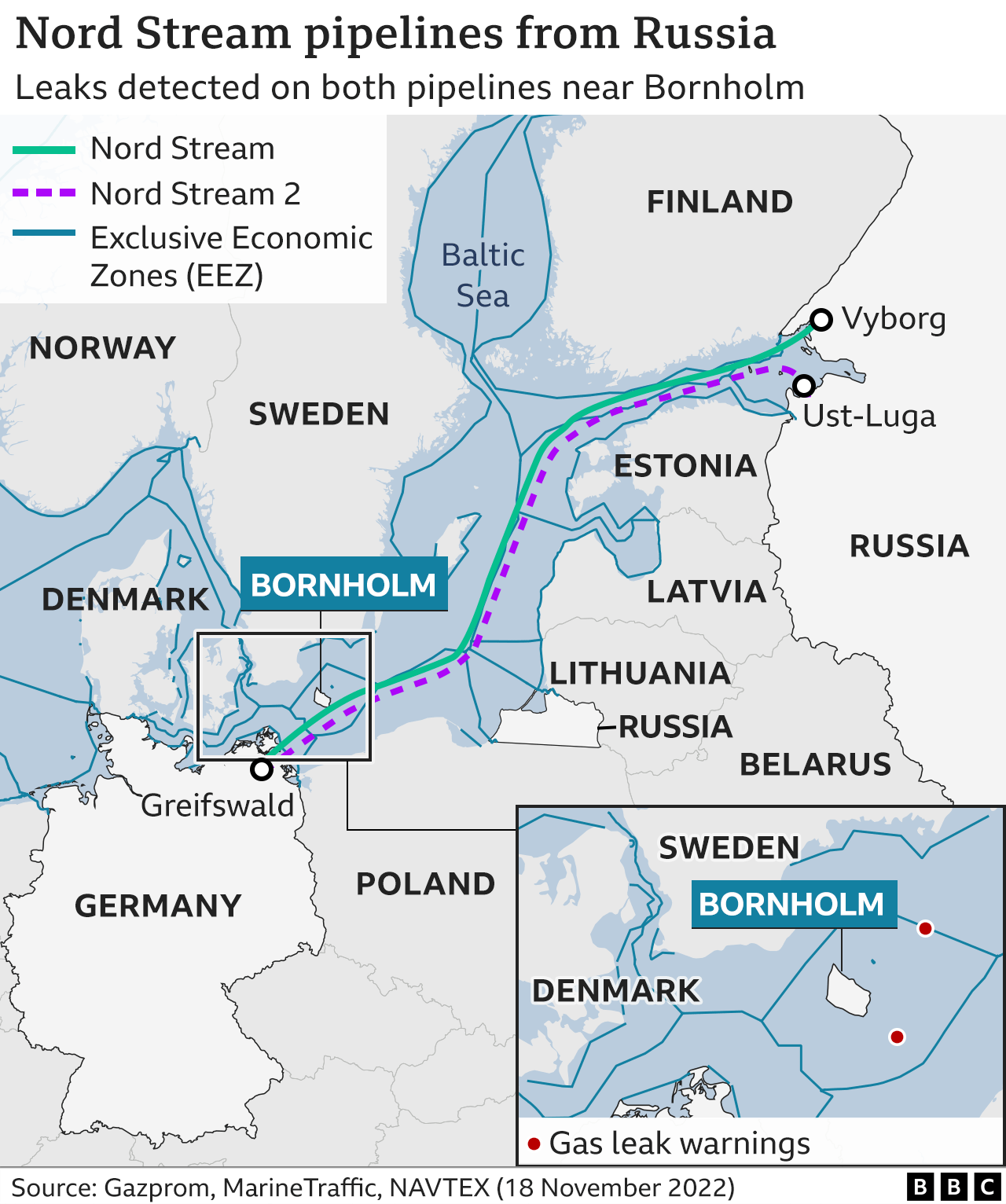
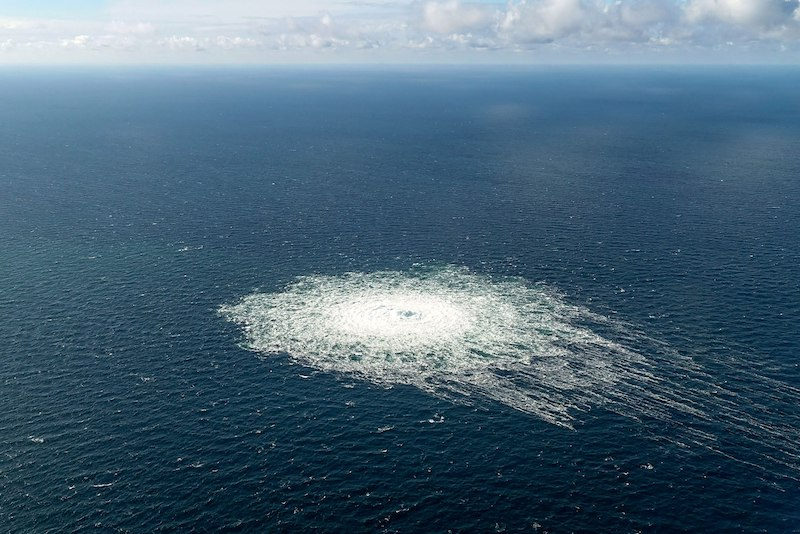
Not at all inspiring was Denmark’s weak-kneed response to the sabotage of the Nord Stream pipelines near the Danish island of Bornholm. After 17 months of investigation, Denmark meekly declined to pursue criminal charges or even to release a report on their findings. How does the “world’s climate leader” simply shrug its shoulders after investigating a massive methane release in their waters?

A recent professional paper concludes that 478,000 tons of methane were released to the atmosphere as a result of the Nord Stream sabotage, making this “the world’s largest natural gas leak.” The Nord Stream sabotage thus released 3.6 times the amount of methane (133,000 tons) contributed by Danish livestock in an entire year. The total amount of methane released by the Nord Stream pipelines is also 2.5 times the entire amount attributed by EPA to all Gulf of Mexico producers in 2020.

Denmark and Sweden have concluded that “there was deliberate sabotage of the gas pipelines.” The Nord Stream insurers claim that “a government did it.” So which government was it? Why are sovereign governments of affected nations afraid or otherwise unwilling to comment on such a consequential attack?

Read Full Post »

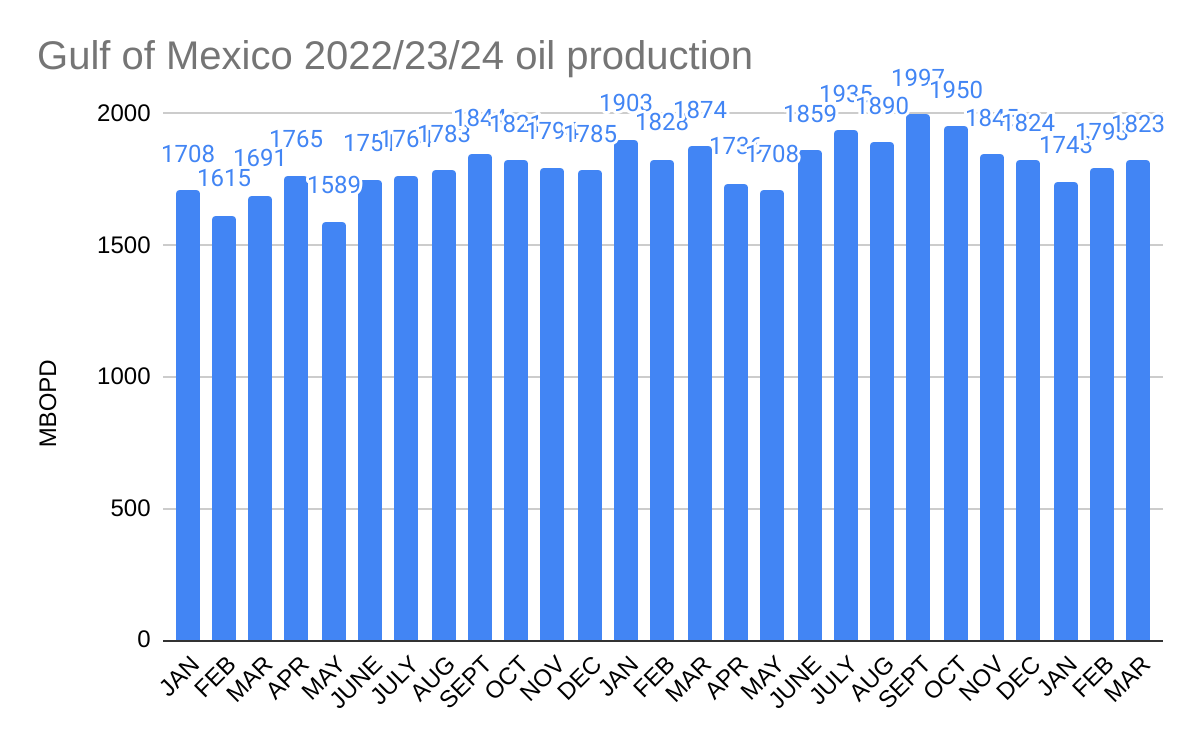
March production (1823 MBOPD) has been added to the GoM summary chart (below).

The Main Pass Oil Gathering (MPOG) system reportedly remained shut-in until early April. We should learn more about the impact of that shut-in when the EIA releases the April production figure at the end of June. Meanwhile, we are still waiting for information from the NTSB on the MPOG incident. To date, the NTSB has only posted a short summary

Note that BOEM’s 2024 forecast called for production to average 2,013 MBOPD, which is above the 2023 peak of 1,997 MBOPD in September.

Most forecasts call for an active 2024 hurricane season, so interruptions in production are likely. There were no production shut-ins from tropical storms in 2023.

Read Full Post »

Nord Stream AG has responded to their insurers’ a goverment did it, so we don’t have to pay” defense. Nord Stream’s full response, courtesy of Swedish engineer Erik Andersson, a leader in seeking the truth about the the pipeline sabotage, is linked.

Key excerpts from the Nord Stream AG filing (p.5):

(a) On their proper construction, in the context of Exclusion 2.i as a whole, the words “destruction of or damage to property by or under the order of any government or public or local authority” relate only to destruction or damage that arises out of or is related to the confiscation, nationalisation or requisition of therelevant property (and/or attempts thereat). In the premises, those words do not apply to the Damage.

(b) Alternatively, in the event that the Defendants establish that the Damage does constitute destruction of or damage to property by or under the order of any government, then it is therefore covered by the Deliberate Damage clause because it would have been “loss, damage, liability, cost or expense caused or inflicted by order of any governmental or regulatory body or agency” and Exclusion 2(i) to Section I does not apply: paragraphs 8 and 9.2 above are repeated.

If the insurers contend that one or more governments were responsible, shouldn’t they have to identify the government(s)? That would be nice. However, Erik doesn’t think the Nord Stream AG response puts the insurers in that politically difficult position. I agree. This case is about getting the insurers to pay for the damages, not identifying the responsible parties, something that the Swedes, Danes, and Germans have shied away from.

Read Full Post »

To what extent was the Main Pass Oil Gathering (MPOG) system shut-in responsible for the Nov. to Feb. production decline (chart below)? The MPOG wasn’t cleared for production until earlier this month, so we may not know until the investigation report is published and the EIA posts April 2024 production data (2 month lag).

The NTSB is leading the investigation on the MPOG spill. This short summary is all they have posted so far, but we should see a preliminary report soon. The NTSB’s final reports are frequently delayed. They still haven’t finalized their report on the Dec. 2022 Gulf of Mexico helicopter crash.

Read Full Post »

« Newer Posts - Older Posts »