Feeds:
Posts
Comments

Archive for the ‘Offshore Energy – General’ Category

The OCS Orders were the foundation for the current operating regulations in the US and many states and other countries. They were logically organized, easily updated, and published for public comment prior to being finalized.

I have an email message indicating that the first OCS Order No. 1 (Identification of Wells, Platforms, and Structures) was signed on 1/31/1957 and the first OCS Order No. 2 (Drilling) dates back to 2/3/1958! (If anyone has access to the actual documents, please let me know.) The orders were developed much further in the 1970s and 1980s.

Contents of the 1/1980 Atlantic Orders:

  • OCS Order No. 1: Identification of Wells, Platforms, Structures, Mobile Drilling Units, and Subsea Objects
  • OCS Order No. 2: Drilling Operations
  • OCS Order No. 3: Plugging and Abandonment of Wells
  • OCS Order No. 4: Determination of Well Producibility
  • OCS Order No. 5: Production Safety Systems
  • OCS Order No. 6: Well Completions and Workover Operations
  • OCS Order No. 7: Pollution Prevention and Control
  • OCS Order No. 8: Platforms and Structures
  • OCS Order No. 9: Oil and Gas Pipelines
  • OCS Order No. 10 (reserved)
  • OCS Order No. 11: Oil and Gas Production Rates, Prevention of Waste, and Protection of Correlative Rights
  • OCS Order No. 12: Public Inspection of Records
  • OCS Order No. 13: Production Measurement and Commingling

You can view the full set of 1977 Gulf of Mexico OCS Orders here

There has been much discussion, particularly since the 1988 Piper Alpha tragedy, regarding the optimal approach to offshore safety regulation be it prescription, goal setting, safety cases, management systems, or some combination, and how to best influence facility, company, and industry safety culture.

My personal view is that the quality and type of regulations are not nearly as important as the people implementing them. My take:

  • Good regulators are more important than good regulations and are the key to a successful regulatory program. 
  • Regulators must understand and be committed to their organization’s mission and the strategy for achieving that mission. 
  • While they should have a good understanding of the activities that they regulate, their focus is on challenging operators, not directing them. 
  • Regulators should audit operator activities and carefully review incident and performance data.  They should identify problems and concerns, but should not direct solutions. 
  • Safety leaders should be applauded and poor performers should be penalized. 
  • The quality of regulators is more important than the quantity. 
  • Internal and external communication and collaboration are critical to their success.
  • Management should ensure that regulators are able to focus on their mission and that organizational distractions are minimized.  
Read Full Post »

Last week, my colleague Keith Meekins attended a presentation by petroleum geologist Samuel Epstein. Like the late Paul Post, a leading expert on the petroleum geology of the Atlantic OCS, Epstein believes the US Atlantic has major resource potential. Per Epstein:

Untested ultra-deep potential hydrocarbon resources are located in the BOEM play area 8, termed the BCT Structural Belt Jurassic-Cretaceous Interior Shelf. Thus, significantly more risked recoverable reserves, due to 1) Two salt ridges penetrating Middle Jurassic age sediments identified in seismic records located to the north of the Schlee Dome, analogous to the ultra-deep salt related Norphlet Formation, offshore Gulf of Mexico and the onshore East Texas, Pearsall Field and 2) stratigraphic plays including below a 60 m thick and 7500 km square evaporitic feature in Early Jurassic rocks flanking the Schlee Dome.

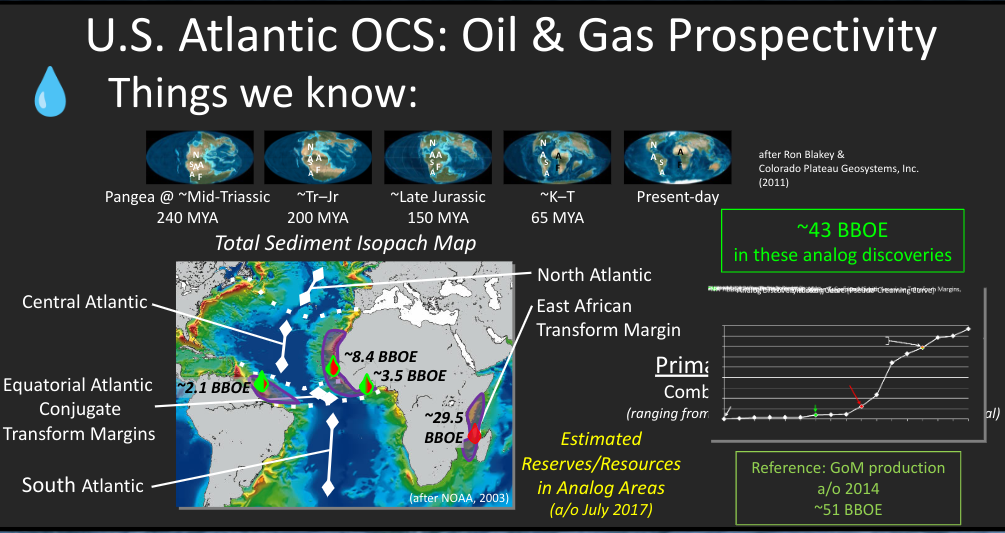
Looking more broadly at Atlantic resource potential, Paul Post had estimated that the US Atlantic could contain 21.4 billion BOE with the major caveat that the presence of a working petroleum system was required and that could only be determined through drilling. Per Paul:

The US Atlantic stands out. It has not been explored in paleo deep- and  ultra-deepwater using exploration concepts proven successful in similar settings.

Paul Post slide

Also, see “Opportunity Lost

Read Full Post »

Relax; just kidding about the California part (or am I? 😉).

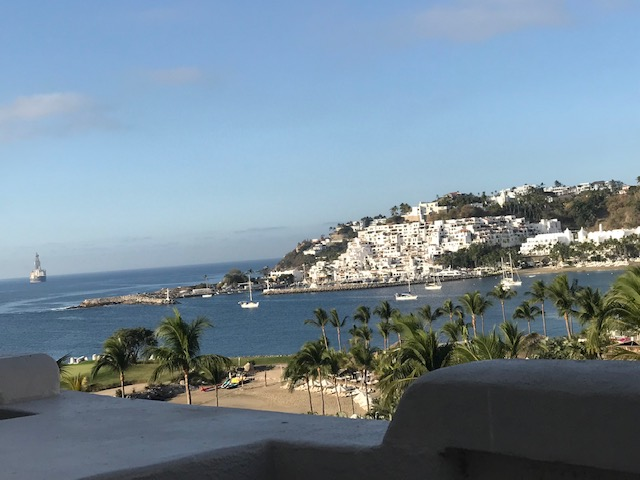
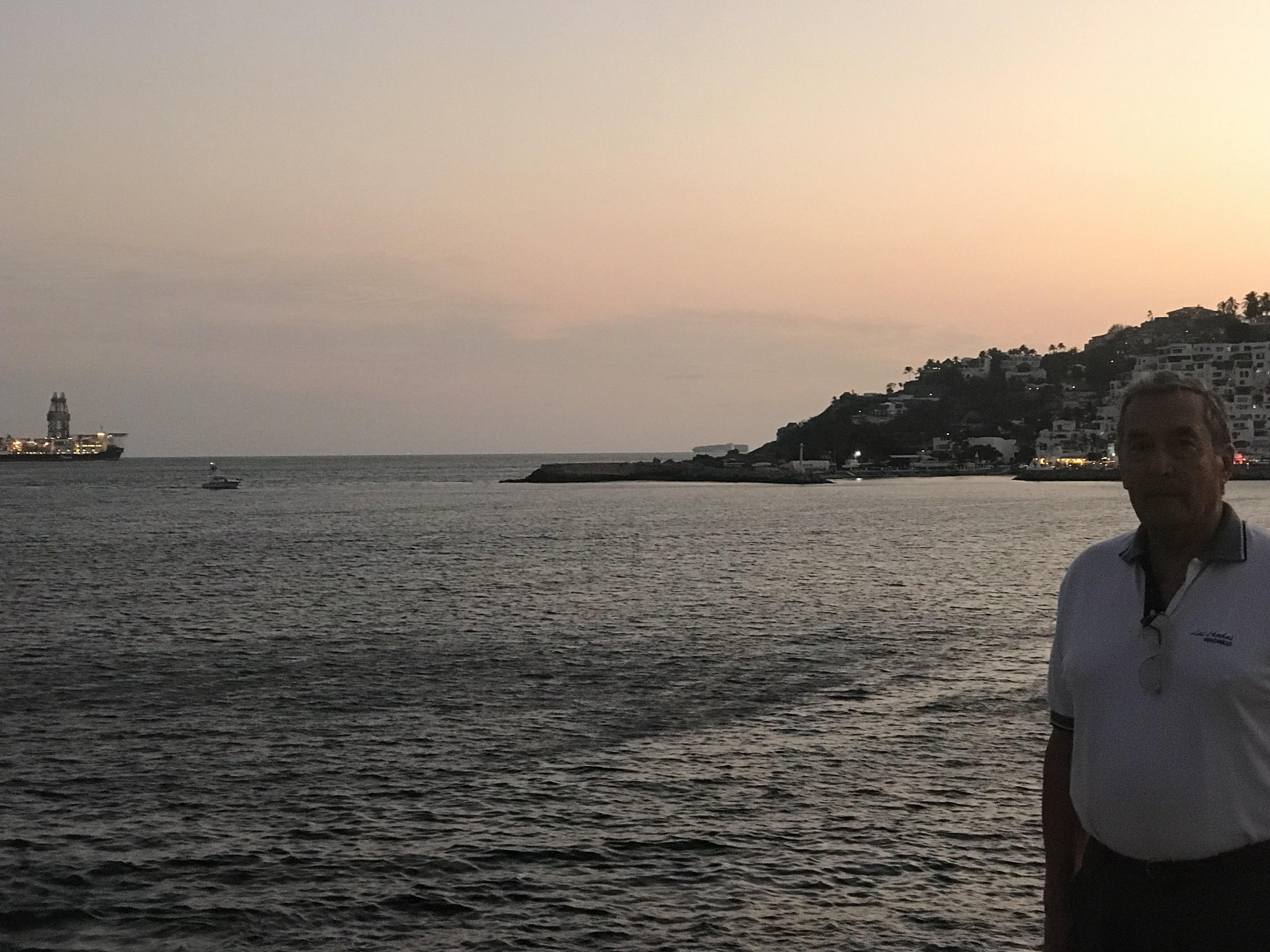
BOE’s Mexican correspondent, Andrew Konczvald, took pictures of what looks like a deepwater drillship parked near the beautiful Pacific coast resort town of Manzanillo. Upon further review, our crack investigators determined that the rig is the Hidden Gem, a deepsea mining vessel, owned by The Metals Company (TMC). Last year, TMC conducted a pilot nodule collection program in the Clarion Clipperton Zone between Hawaii and Mexico.

Read Full Post »

The terms for congressionally mandated Gulf of Mexico Sale 261 have been proposed. As is also the case for Sale 259, the royalty for leases in <200 m or water is 50% higher than for prior sales. This is partly because of the royalty floor (16 2/3%) established in the Inflation Reduction Act, and partly because the Dept. of the Interior opted for the highest royalty allowed (18 3/4%). The royalty for shelf leases is thus the same as for deepwater leases with much greater production potential.

Rental terms for leases in <200 meters of water are higher and more punitive (for delayed development) than for previous sales and for deepwater leases.

Minimum bid requirements are unchanged from sales 256 and 257, and are higher for deepwater leases ($25/acre for <400m and $100/acre for >400m).

Bottom line: While the terms for deepwater leases are unchanged from Sales 256 and 257, that is far from the case for shelf leases where royalty rates were increased by 50% and rentals were increased by 43% for all lease years.

SaleDate% royalty
(<200m)
year 1-5/6/7/8+ rentals
($/acre, <200m)
year 8+ rentals for
leases in 400m+ ($/acre)
25611/18/202012.57/14/21/2816
25711/17/202112.57/14/21/2816
2593/29/202318.7510/20/30/4022
2619/27/202318.7510/20/30/4022

Read Full Post »

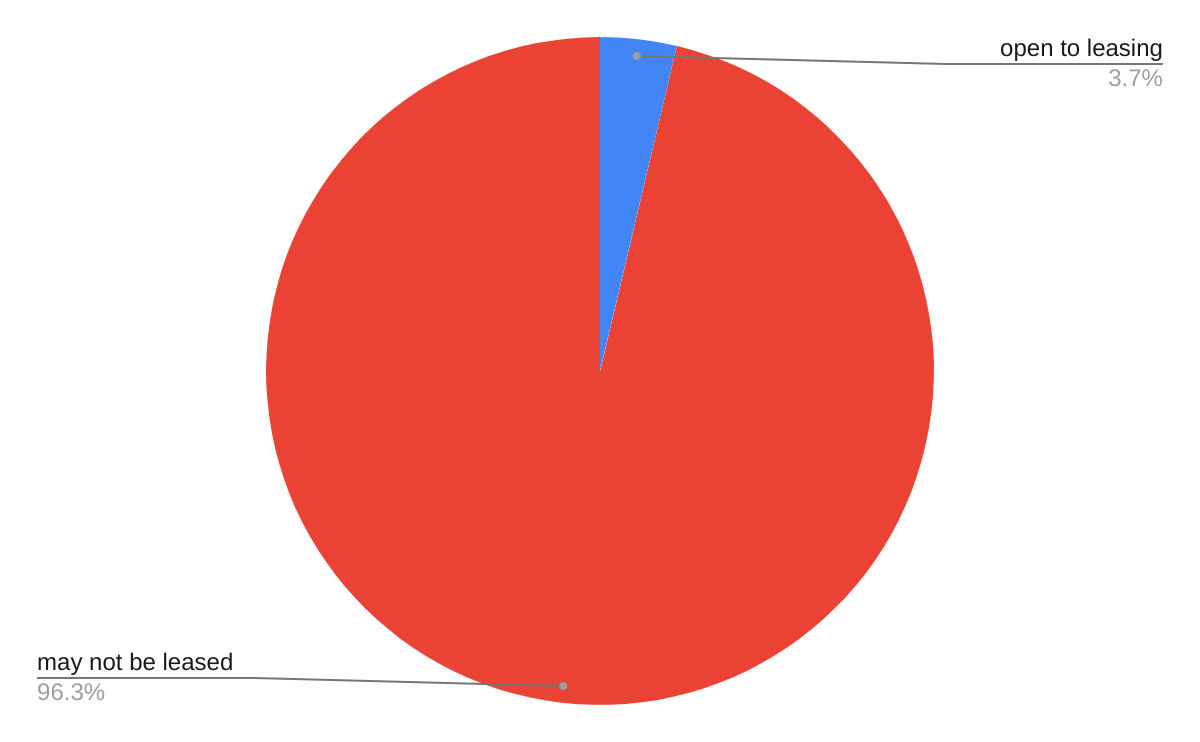
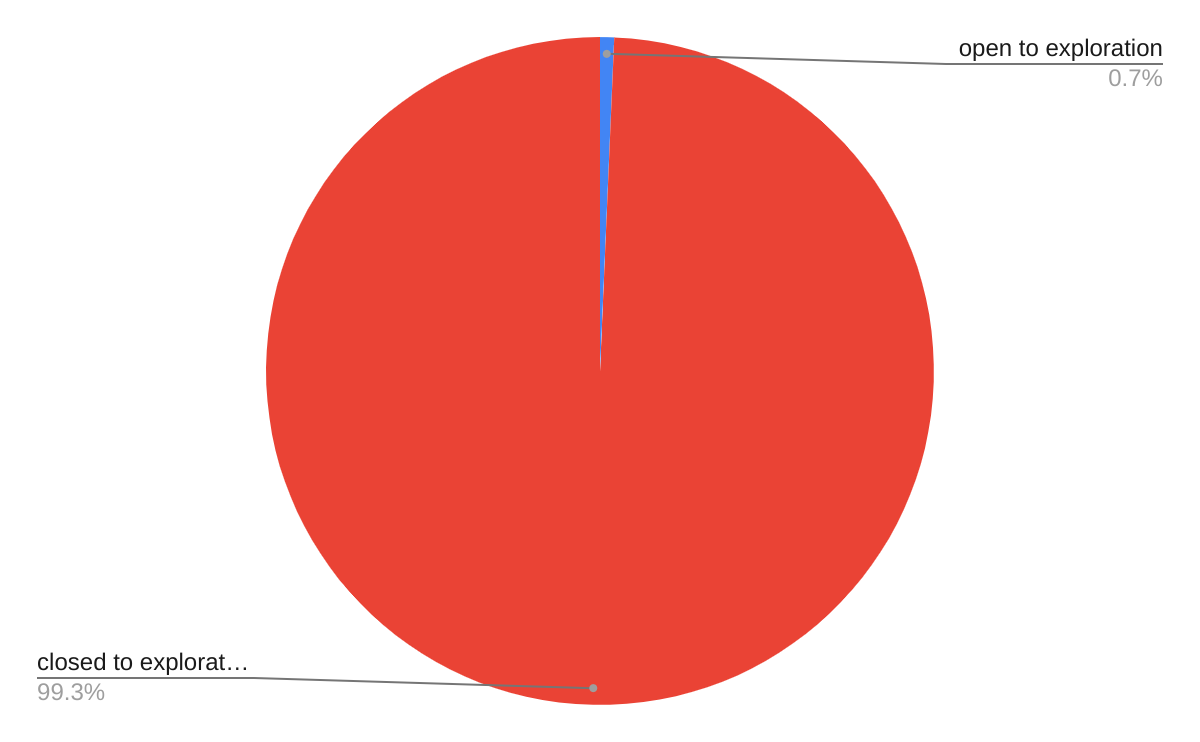
Of the 1.7 billion acres of Federal land on the US Outer Continental Shelf, only about 73 million acres in the Gulf of Mexico and 1 million acres in the Cook Inlet may be offered for oil and gas leasing. Official or de facto exclusions prohibit leasing in the entire US Atlantic, the entire US Pacific, all Alaska areas except the Cook Inlet, and most of the Eastern Gulf of Mexico. No other coastal nation has restricted access to oil and gas resources to this extent.

As demonstrated in recent sales, many of the tracts being offered have little or no production potential. Only 308 tracts (1.7 million acres) received bids in GoM Sale 257. 94 of the high bids were for sequestration purposes and were arguably invalid. Sale 258 in the Cook Inlet only received a single bid.

The number of active leases, currently 2153, has been at a historically low level for the past 2 years. Only 0.7% of our OCS is leased and thus open to exploration. 26% (552) of these leases are already producing, leaving a historically low number of nonproducing leases.

Oil is where you find it, not where you wish it was or want it to be. Denying access to all but a small portion of the OCS limits exploration strategies and prevents publicly owned resources from supporting our economy in the manner intended by the OCS Lands Act.

Read Full Post »

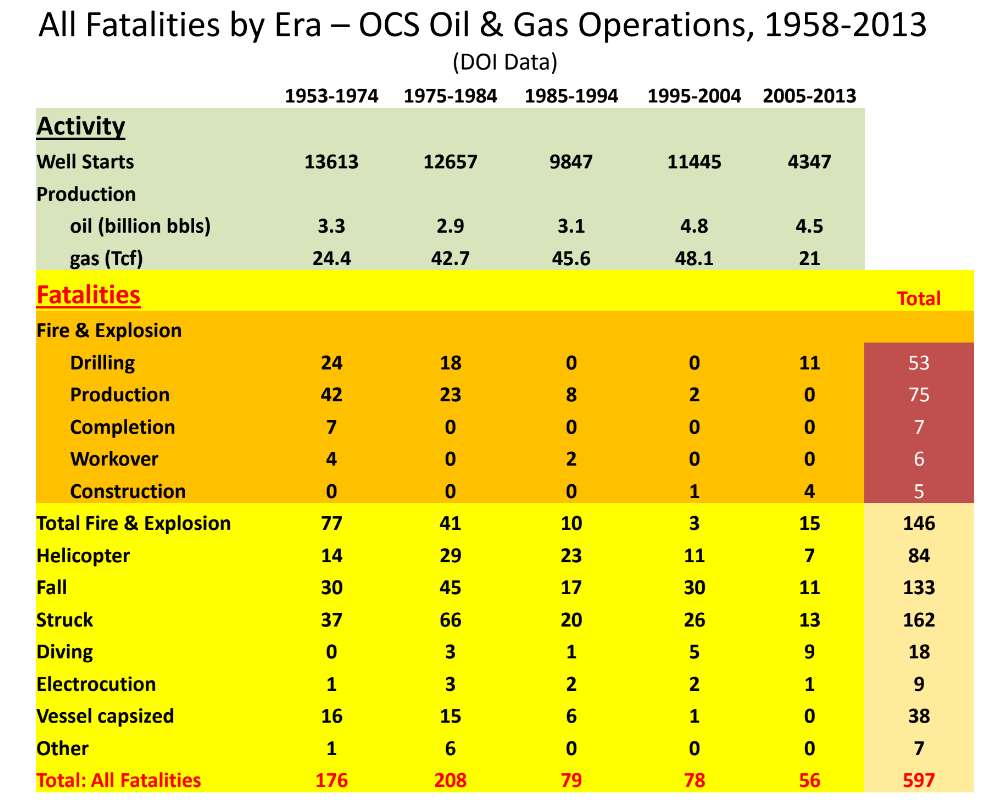
Per yesterday’s post, below are US OCS fatality data from a 2014 presentation. Ten year intervals were selected for 1975-2004. The longer 1953-1974 era was selected so the activity indicators (well starts and production) would be comparable with the next 3 intervals. The last interval (2005-2013) was limited because the presentation was prepared in 2014.

Fire/explosion fatalities exceeded fall/struck fatalities only in the first interval (1953-1974). As one would expect, the fire/explosion deaths were associated with a limited number of better known incidents (e.g. Main Pass 41, Bay Marchand, Macondo). While the overall trend is favorable, fall/struck incidents and helicopter fatalities at offshore platforms have proven to be more chronic.

I hope to update these data in the not too distant future.


Read Full Post »

The most common causes of offshore fatalities and serious injuries, falls and being struck by equipment, receive little media attention because there is no blowout, oil spill, or fire. However, these are often the most difficult types of incidents to understand and prevent. Human and organizational factors predominate, and prevention is dependent on a strong culture that emphasizes worker engagement, awareness, teamwork and mutual support, effective training and employee development, risk assessment at the job, facility, company, and industry levels, stop-work authority, innovation, and continuous improvement.

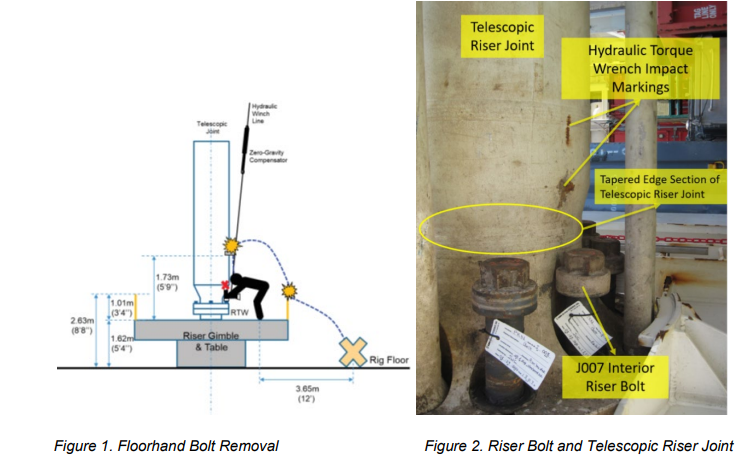
This new BSEE Safety Alert addresses such a fatal incident on the Pacific Khamsin drilling rig, and makes recommendations that have widespread applicability.

Incident summary:

While unlatching the lower Marine Riser Package from the Blowout Preventor in preparation for ship relocation, a crewmember was lifted into the air after being struck by a hydraulic torque wrench (HTW), hitting a riser clamp approximately six feet above the elevated work deck before falling to the rig floor. The crew member was given first aid and transported to the drillship’s hospital, where he was later pronounced deceased.

In an upcoming post, BOE will provide historical fatality data by cause and operations category.

Read Full Post »

HOUSTON — Oil and gas industry leaders say they’ve seen a big shift in tone from the Biden administration over the past year, helping to smooth over one of the president’s rockiest relationships.

Washington Post

Perhaps the Washington Post reporter is correct, but the “big shift in tone” is not apparent in the offshore sector. The only lease sales have been mandated by Congress, the 5 year plan is still 9 months from completion, the lease sale terms have been less than favorable, and language in the draft 5 year plan does in fact express the intent to phase out oil and gas.

Read Full Post »

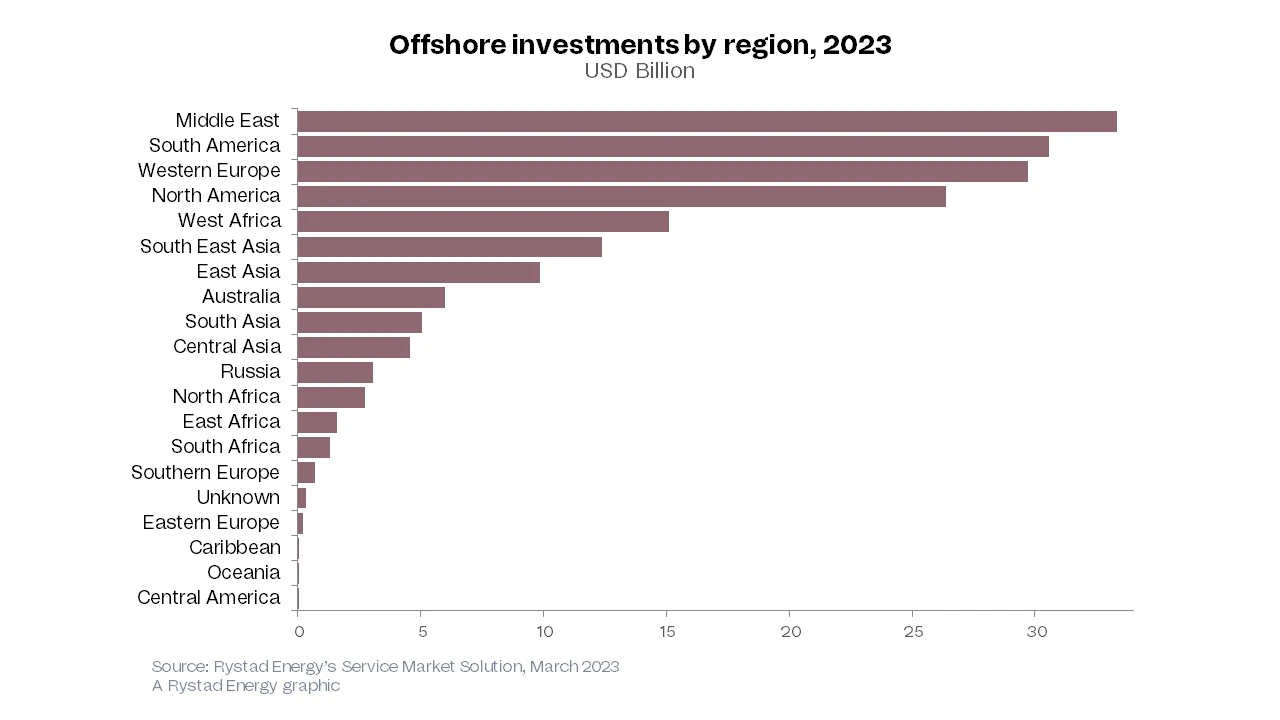
The offshore oil and gas (O&G) sector is set for the highest growth in a decade in the next two years, with $214 billion of new project investments lined up. Rystad Energy research shows that annual greenfield capital expenditure (capex) broke the $100 billion threshold in 2022 and will break it again in 2023 – the first breach for two straight years since 2012 and 2013.

Offshore activity is expected to account for 68% of all sanctioned conventional hydrocarbons in 2023 and 2024, up from 40% between 2015-2018.

Rystad

Comments:

  • Middle East investment continues to be strong
  • Good for South America thanks to Brazil (16 new FPSOs by the end of the decade) and the Guyana success story.
  • Strong forecast for Norway and the UK boosts Europe.
  • North America could do far better with less obstructive access policies.

Read Full Post »

Washington, DC — Today, U.S. Senator Joe Manchin (D-WV), Chairman of the Senate Energy and Natural Resources Committee, released the following statement on the Department of the Interior’s (DOI) unprecedented delay in releasing a five-year leasing plan. 

“Monday night, the Department of the Interior made it painfully clear – again – that they are putting their radical climate agenda ahead of our nation’s energy security, and they are willing to go to great lengths to do it. The earliest that Interior will release a legally required program for 2023-2028 offshore oil and gas leasing will be the end of this year. That’s 18 months late. This is the first time in our nation’s history that we haven’t had a 5-year leasing program released before the old plan expired. Every other Administration, Democrat and Republican, has managed to follow the law in a timely fashion.

“Let me be clear – this is not optional. The Outer Continental Shelf Lands Act mandates that the Secretary of the Interior “shall prepare” this program to “best meet national energy needs.”

“What is even more terrifying is that on top of this disturbing timeline, Interior refuses to confirm if they intend to actually include any lease sales in the final plan, which is an issue I sounded the alarm about when Secretary Haaland appeared before the Senate Energy and Natural Resource Committee on May 19, 2022. I will remind the Administration that the Inflation Reduction Act also prevents them from issuing any leases for renewables, like offshore wind or onshore solar unless there are first reasonable lease sales for oil and gas that actually result in leases being awarded. And I will hold their feet to the fire on this.” 

Senator Manchin

Plain English; no need for interpretation 😉

Read Full Post »

« Newer Posts - Older Posts »