The sale could be held sooner. However, since BOEM asked for 37 days, I’m assuming that the sale will be on December 21.
In the 70 year history of the oil and gas leasing program, this will be the sale date that is closest to Christmas. Yet another major milestone for the offshore program! 😀
IT IS ORDERED and ADJUDGED that the Intervenors’ appeal is DISMISSED. As for BOEM’s limited appeal as to the timing of the sale, we hereby AMEND the district court’s preliminary injunction only to the extent that the deadline for conducting Lease Sale 261 shall now be thirtyseven days from the date of the issuance of the mandate in this appeal. IT IS FURTHER ORDERED that each party bear its own costs on appeal.
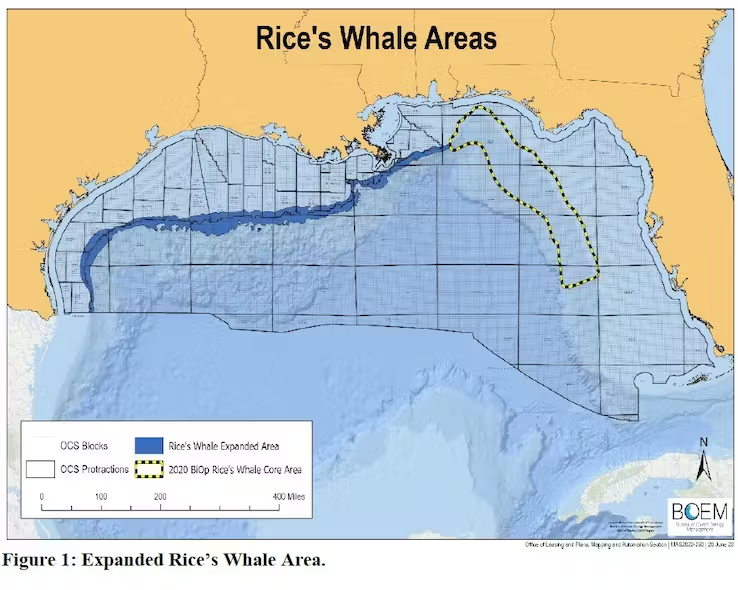
Today, the 5th Circuit Court of Appeals heard oral arguments in the appeal of the District Court’s injunction against the Rice’s whale tract deletions and operating stipulations for Sale 261.
If you want to listen to a recording of these arguments, you can do so at this link. The hearing was brief – only about 45 minutes.
Judging by the comments, it sounds like the Court will reach a decision soon. The Department of the Interior is asking for 37 days after the ruling to organize and hold the sales. The industry attorney seemed comfortable with that, so the sale should be prior to Christmas.
Per the most recent update (below), United announces that they have identified a “preferred potential partner” and are seeking an extension on their license. So far, we have only heard from United. As the expiration date of the license approaches, an update from the Jamaican government’s perspective would seem to be appropriate.
The Company is currently engaged in discussions with a preferred potential partner that has been identified through the farmout process, to participate alongside United in the Walton Morant Licence in Jamaica. Furthermore, the Company is engaging with the Jamaican authorities to secure an extension to the current licence periodwhich expires at the end of January 2024, so as to provide sufficient time to progress additional technical work on the block to support the drilling of an exploration well. Additional updates on both the farmout process and licence extension will be provided in due course.
We are encouraged by the continued progress in relation to the farmout process in Jamaica, as we look to unlock the material value contained in this block and deliver value to our stakeholders, including the people of Jamaica. We are entering a critical stage in the farm-out process and will provide an update to the market as this progresses.
converted semi-submersible initiates production at the Argyll field
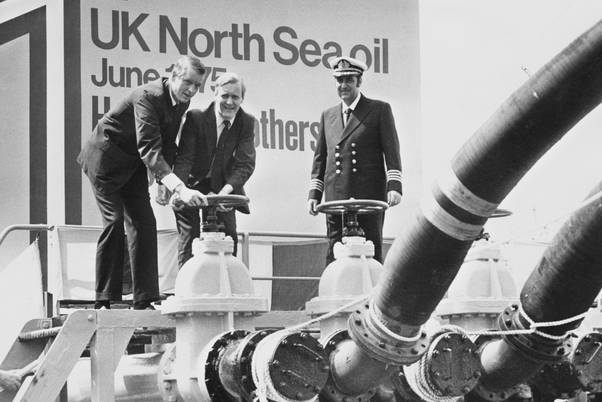
JL Daeschler, a pioneering subsea engineer who lives in Scotland, has fond memories of his interactions with Fred and Ferris Hamilton, the brothers whose company was the first to produce oil in the UK sector of the North Sea (1975). Their small company aced the super-majors by initiating production at the Argyll Field with subsea wells and the Transworld 58, a converted semi-submersible drilling rig. Their rig conversion was an early predecessor to the modern floating production units that have become the surface facilities of choice for deepwater development.
JL recalls that Ferris and Fred took time to discuss any problem with any employee. Should there be arguments, they were often followed by more relaxed discussions about sailing, cars, cooking, and other topics of mutual interest. The brothers would travel from Denver for the annual Christmas dinner in Aberdeen, and invited everyone from the warehouse crew to the production manager. There was a great sense of community among the employees and contractors.
As JL notes, there were no satellite positioning systems, and real time communications with the rig were short and limited to the normal marine radio channels. This was a remarkable era of achievement for the North Sea and the offshore industry, as operations expanded and technology advanced to support them. I have much respect for these offshore pioneers and their contributions to societies around the world.
British Secretary of State for Energy Tony Benn, center, with Frederic Hamilton and Captain Harry Koutsoukos opening a valve to release the first oil from the North Sea into the BP refinery on the Isle of Grain in 1975.
Each annual licensing round will only take place if key tests are met that support the transition to net zero. The first test is that the UK must be projected to import more oil and gas from other countries than it produces at home.
The second is that the carbon emissions associated with the production of UK gas are lower than the equivalent emissions from imported liquefied natural gas.
If both these tests are met, the NSTA will be required to invite applications for new licences annually.
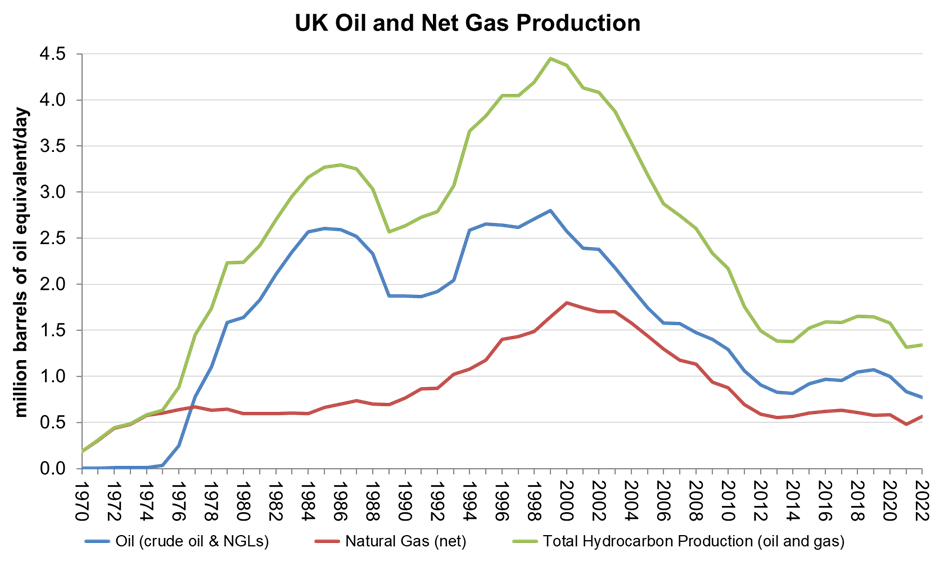
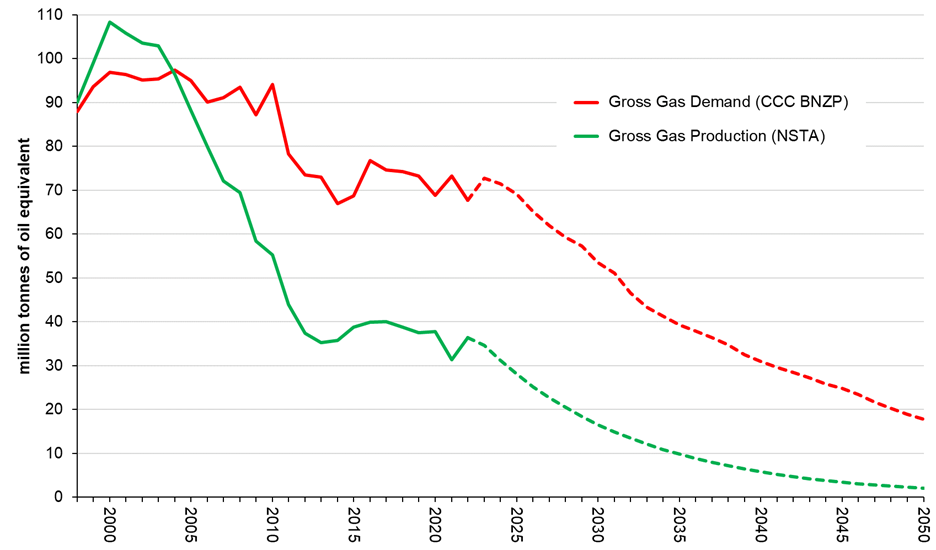
The “key tests” would seem to ensure annual licensing rounds for the foreseeable future. The charts below are from UK EiTi. The first chart illustrates the sharp decline in UK production over the past 20 years. The second and third charts illustrate the large projected gaps between supply and demand, particularly for natural gas.
In 2050, total production of oil and gas is estimated at ~10 million tonnes of oil equivalent. The projected 2050 demand is estimated at ~35 tonnes. For domestic production to exceed imports over the next 20-30 years, resource licensing and field development would have to be very successful and efficient.
Projections of UK Gas Demand and ProductionProjections of UK Gas Demand and Production
With regard to the second test, carbon emissions from the production of UK gas should maintain their advantage over imported LNG given the energy required to liquefy and transport that gas.
It would have perhaps been more transparent to simply stipulate annual licensing rounds, but that would probably not have been politically acceptable.
“Encouraged by the Guyana Suriname finds, several other regional bloc member nations, including Barbados and Jamaica, have been ramping up efforts to attract companies to explore offshore acreages. The most determined of them seems to be Grenada, which is just north of oil and gas producers Trinidad and Venezuela.”
“Officials there say they are preparing to put out bids to attract some of the world’s largest exploration companies, but the 14-month new administration has said the previous government secreted away all the documents and data obtained from a 2018 exploration campaign by a little-known Russian firm, the Global Petroleum Group (GPG).”
“The group had told the previous administration that it had found commercial quantities of oil and gas in a well labeled Nutmeg 2, in about 400 feet of water, and that there were other promising prospects right nearby. But as the current Dickon Mitchell government gets ready to assess the island’s prospects, it has said there is nothing to work with.”
Grenada will no doubt be more careful about whom they issue future exploration licenses to and how they manage the data.
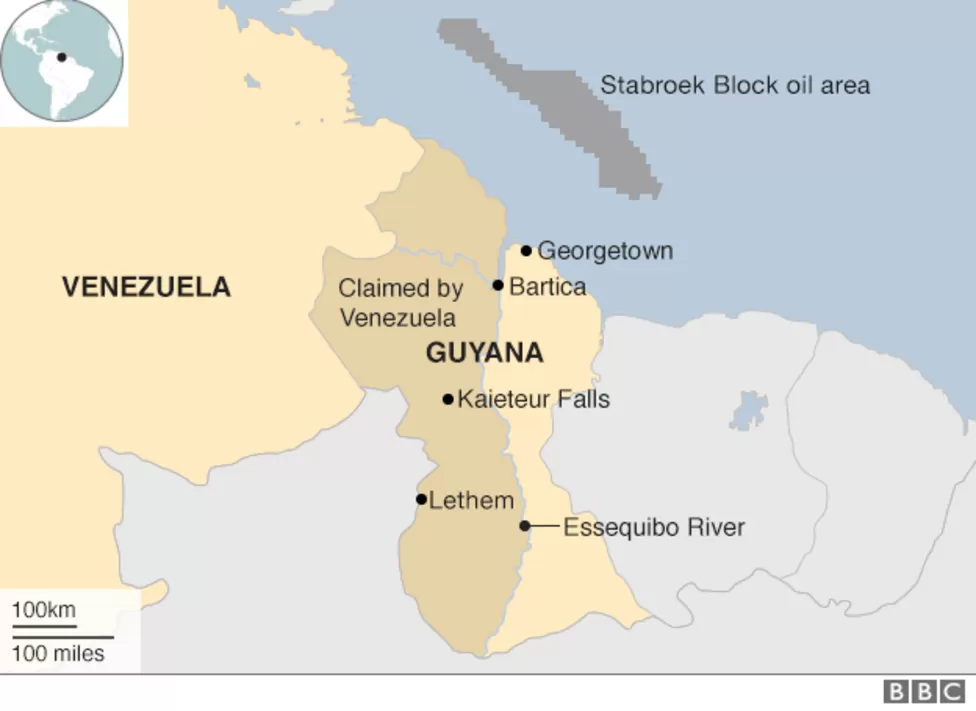
Having severely damaged their own oil industry, the government of Venezuela is intent on taking control of Guyana’s offshore resources. Venezuela seeks to annex 2/3 of Guyana and the adjacent offshore territory. The existing boundary was settled in accordance with international law in 1899.
“Question 5 proposes the creation of Venezuelan state of Guyana Essequibo and an accelerated plan for giving Venezuelan citizenship and identity cards to the Guyanese population.”
I suspect that very few Guyanese are interested in Venezuelan citizenship.
Ambassador Brian A. Nichols, Assistant Secretary for Western Hemisphere Affairs at the U.S. Department of State, emphasized that “efforts to infringe upon Guyana’s sovereignty are unacceptable.”
Venezuela’s referendum is scheduled for December 3.
In light of the 5th Circuit’s order, holding the sale on 11/8 would have been messy for all sides in the Rice’s whale dispute. Seemingly, the only option for holding the sale prior to the Court’s decision on the injunction would have been the following:
Allow, but not accept, bids on the tracts in the Rice’s whale expanded area.
Add the Rice’s whale stipulations while providing notice that they might subsequently be removed.
Because the RIce’s whale stipulations would affect the value of all deepwater leases, bidders would be rolling the dice on the outcome of the case.
Also, absent legislative action, there will be no lease sale in 2024. This adds to the importance of Sale 261, and making sure the terms are understood.






 Bud's Offshore Energy (BOE)