Feeds:
Posts
Comments

Archive for the ‘Norway’ Category

Children's Parade in Oslo, Stortinget (Parliament) in Background

This is the second Syttende Mai for the BOE blog. Best wishes to our many Norwegian friends on their National Day, which celebrates the signing of their Constitution on May 17, 1814.

Read Full Post »

PSA has posted the Gullfaks B gas release report in English.  Also posted is the report on a lifting incident at Njord A.  The reports are comprehensive and timely.

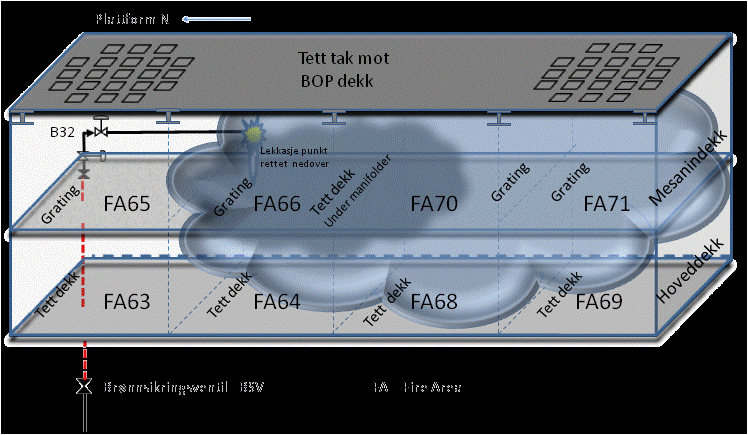
The gas leak occurred during leak testing after maintenance work on a production well. The gas derived from a volume trapped between the downhole safety valve and the Xmas tree. It proved impossible to operate the emergency shutdown valves on the well. The leak lasted about an hour, with an initial rate of 1.3 kilograms of gas per second. The volume of gas released is estimated at about 800 kilograms.
No people were injured in the incident, but the leak created a serious position on the installation.

Gas Cloud - Gullfaks B


Read Full Post »

The HSE has told Shell to submit a revised safety case for the Brent Charlie platform after gas was detected on its topsides following leaks on 12 January this year and 27 September 2010, Upstream can reveal.

Shell, which took the decision itself to close the platform after the January incident, has been battling for some time to resolve technically complex issues related to the venting of gas from inside one the platform’s huge concrete legs — Column 1 (C1) — and dispersing it effectively away from the platform.

The operator now expects the ageing Brent field to remain shut down for several more months.

Read Full Post »

Surprisingly, the post-Macondo discussion about regulatory approaches has been largely devoid of value and cost-benefit assessments. While PSA has been praised for Norway’s outstanding offshore safety record, little attention has been paid to their relatively low regulatory costs.

According to data in the 2010 Annual Report, PSA has 161 employees, and had total operating expenses of NOK 202,762,689  ($US 38.1 million) for 2010. These modest cost and staffing numbers are particularly impressive when the magnitude and complexity of Norwegian offshore operations are considered. In March 2011, Norwegian oil production averaged 2.017 million barrels per day (no. 2 offshore oil producer slightly behind Brazil) and gas production averaged 11.6 billion cubic feet per day (world offshore leader). PSA is also responsible for onshore processing facilities.

PSA’s costs are relatively modest for the same reason that their regulatory program is successful. They hold companies responsible for managing their operations and conducting inspections. They don’t approve every detail of every operation, but focus on ensuring that the company management systems are effectively implemented.  They identify risks and insist that industry address them. As Magne Ognedal said in his interview with BOE: 

Our regulatory philosophy is indeed firmly based on the legislated expectation that those who conduct petroleum activities are responsible for complying with the requirements of our acts and regulations. Furthermore, our regulations require that they employ a management system that systematically probes and ensures such compliance at any time.  The approach to achieving this should be risk-based.  So, ensuring compliance with rules and regulations is the operator’s job – not ours.

Read Full Post »

link

In the 21st licensing round, additional requirements have been introduced with regard to the qualifications of the licensees that will undertake particularly demanding deep-water drilling operations or drill in areas in which high temperature/high pressure (HTHP) conditions are expected. Under these licences, there must be at least one competent partner in addition to the operator. The partner must have drilled at least one well as an operator on the Norwegian Continental Shelf, or have similar relevant experience from another offshore petroleum province.

I had never thought about a requiring a partner, and specifying the qualifications that the partner must have. This makes some sense in that the operator will not only have internal oversight, but also oversight by the partner(s). The result is a verification program administered by competent partners who have an incentive to ensure safe operations.  Interesting approach.

Read Full Post »

John Milne Book Launch

John C Milne

“Dubs” is a term used in Aberdeen and northeast Scotland to describe all varieties of mud. That is the first thing I learned in reading John Milne’s excellent book “DUBS, How the Oil Came North.”  John’s first job in the offshore industry was with a drilling mud supplier back in 1969 when he was still a college student.  John presents a series of amusing and informative anecdotes about hie work experiences between 1969 and 1973 during the early years of North Sea offshore exploration. The book is available through the publisher, PlashMill Press. Good read!

I also recommend Bjørn Vidar Lerøen’s excellent book “Drops of Black Gold,” which

Drops of Black Gold - Statoil

chronicles the history of Statoil and Norwegian offshore oil and gas development. The book includes a now famous 1962 letter from Phillips Petroleum to the Norwegian government. In the letter, Phillips seeks exclusive rights to the entire Norwegian continental shelf in return for conducting a seismic survey program. Hey, nothing wrong with asking! 🙂

Read Full Post »

The Petroleum Safety Authority Norway (PSA) has initiated an investigation following an incident in connection with a lifting operation on the Gullfaks A facility on 28 February 2011.

See the full PSA announcement

Comment: PSA is applauded for their transparency in reporting accidents. When every regulator, operator, and contractor routinely posts accident information on their home page, we will have made a major step forward in collectively improving the safety culture and preventing future incidents.

Read Full Post »

Magne Ognedal

It’s impossible to inspect quality into the petroleum industry.  The latter must itself ensure quality. Magne Ognedal, Director General, Petroleum Safety Authority Norway

More thoughts from Magne:

Understanding risk is central here. We must all recognise first and foremost that the petroleum industry involves risk – just like any other activity.

However, accepting risk does not mean accepting accidents, he emphasises. “Quite the contrary. But we must constantly remind ourselves that accidents have happened – and can happen again.

“The risk of a major accident is present, in Norway and in all other nations with an oil and gas industry. This means that incidents will occur.

“Risk must accordingly be managed, with clear management responsibility, at every level and in every company which participates in the industry.”

Preventive measures can be a challenge, Mr Ognedal concedes, because they require that action is taken – often at a cost – without a disaster or other accident having occurred.

“However, history offers many examples where extensive measures are adopted after disasters. Companies in the petroleum business should consciously ask whether it would not be far better to have an established system which means that preventive measures based on learning, new technology and so forth are implemented, in order to be able to prevent accidents and disasters.

PSA Announcement

Safety – Status and Signals: This is a great publication – highly creative,  easy to read and understand, very current, and loaded with good information. Check it out!

Read Full Post »

Noise Matters

In addition to managing the catastrophic risks associated with fires, explosions, and structural failures, chronic health and safety risks must also be effectively managed.  Hearing loss is one such risk, and PSA Norway has challenged industry to minimize the effects of noise on the health of offshore workers.

The risk level in the Norwegian petroleum activities (RNNP) shows a relatively high number of noise injuries. These are chronic injuries that will worsen with age. The RNNP questionnaire survey shows that 37 per cent state that they quite often/very often/always suffer from a high noise level. Five per cent state that they suffer some or quite a lot from impaired hearing, and 45 per cent of them believe noise in the working environment is the reason for their impaired hearing.

Click here to view the article, presentation, and recorded seminar.

Read Full Post »

Valhall Field with new PH facility (from psa.no)

The Petroleum Safety Authority Norway has consented to BP Norge’s use of the new Valhall PH platform as a living quarters facility.

BP will use the living quarters module on Valhall PH until the entire facility is ready for start-up/use. This will provide greater bed capacity and flexibility during the preparations for start-up.

Read Full Post »

« Newer Posts - Older Posts »