Feeds:
Posts
Comments

Archive for the ‘drilling’ Category

from SeabedRig.com

Advances in drilling technology tend to be evolutionary, not revolutionary. Floating rigs, dynamic positioning, top-drive systems, measurement-while-drilling, automated rig floors, and other important advances were logical next steps, not radical makeovers.

Many of us have long been fascinated by the possibility of locating drilling equipment on the seafloor, particularly for deepwater wells. Why operate from a massive floating vessel that requires a sophisticated stationkeeping system and a long riser to connect to the wellhead? Why link surface personnel to seafloor risks? Why increase the complexity of balancing well pressures (without fracturing formations) by adding thousands of feet to the mud column? Why heave and roll on the surface when you can operate from the seafloor?

It’s not that easy, of course, and there are many questions and issues. While fully automated drilling systems are no longer a reach, what about reliability and repairs?  How will casing be set and cemented? How will downhole measurements be transmitted to the control center? Cuttings samples? Coring? Well testing? The list of challenges is daunting.

At least one company, Seabed Rig, is committed to developing and demonstrating seafloor drilling technology. Earlier this month, Seabed Rig reached agreement with NASA to create the first autonomous drilling rig. While a lot of work remains, Seabed Rig and other pioneering companies are applauded for their innovative thinking and willingness to challenge conventional practices and wisdom.


Read Full Post »

2010-2011 Trend: Americans' Support for U.S. Offshore Drilling

Comments:

  1. The most remarkable figure is the 50% support for increased drilling during the Macondo blowout when oil was flowing into the Gulf live on national television
  2. The second most remarkable result is the very low percentage of people who have no opinion.
  3. The percentage in support would likely have been higher if they had not included the words “in US coastal areas” at the end of the question. Most new drilling would not be in what people think of as coastal areas, but far far from shore.

Other interesting Gallup findings:

  1. 49% of Americans support opening ANWR to exploration, a record high.
  2. The wisest Americans (i.e. those over 55 :)) are the strongest supporters (66% in favor).
  3. The youngest age group polled (18-34) also supports increased offshore drilling (52% in favor)
  4. A majority of both sexes support increased offshore drilling.
  5. Even in the East, where we are very comfortable consuming oil but not so keen on producing it, 49% of Americans support increased offshore production.
  6. 49% of Americans also support opening ANWR to exploration, a record high


Read Full Post »

Former President Bill Clinton said Friday that delays in offshore oil and gas drilling permits are “ridiculous” at a time when the economy is still rebuilding, according to attendees at the IHS CERAWeek conference. Politico.com

Read Full Post »

The tragedy in Japan has added yet more uncertainty to nervous energy markets:
Japan will likely need more imported oil and natural gas due to closures of nuclear reactors caused by Friday’s earthquake and tsunami, but volumes can’t be calculated accurately as it is unclear how much industrial output has been affected by the disaster and how long power nuclear and thermal power plants will remain closed. Wall Street Journal
It’s much too early to gauge how the nuclear power industry, which some have touted as a model for safety achievement, will be affected.
    Standards news and discussion:
    Offshore Safety Institute?
    The CEOs of major oil and gascompanies will meet March 18 to decide how to proceed with the formation of a US offshore drilling safety institute, William Reilly, the co-chair of the National Oil Spill Commission, said March 8. Platts Oilgram News
    New twist in Cuban drilling drama – Petrobras relinquishes interest
    Marco Aurelio Garcia, foreign policy adviser to President Dilma Rousseff, told reporters in Havana exploratory work off Cuba’s northern coast had not shown good results and that Brazil wanted to concentrate on its own oil fields.
    Since BP’s disastrous Deepwater Horizon accident in the Gulf of Mexico last April, the risks of offshore oil drilling have been a hot topic. One place it isn’t questioned much is Brazil, whose oil production industry is one of the fastest-growing in the world because of vast new deepwater oil reservoirs discovered in the past five years.
    Mexican Deepwater Update (Platts Oilgram News)
    Pemex has just begun to explore in Mexico’s Gulf of Mexico waters deeper than 1,000 feet, but 28 billion undiscovered barrels of oilequivalent are thought to exist in that area, some of which borders US territorial waters. Pemex officials said the company is forging a development plan for its first deepwater field, Lakach, located northeast of the state of Veracruz in about 3,200 feet of water. First production is expected in 2015.
    Environmentalists are furious at a proposal by the petroleum company Shell to start exploration drilling off one of Western Australia’s most treasured reefs. Ningaloo Reef off the north-west coast, has been nominated for World Heritage listing.

Read Full Post »

Rep. Tim Murphy’s (R-Pa.) bill states that companies with drilling permits approved before early May 2010 can proceed with exploration or production “without further review” by the Interior Department, and “without further review or delay” under various environmental laws. The Hill.com

Read Full Post »

From Platts Oilgram News:

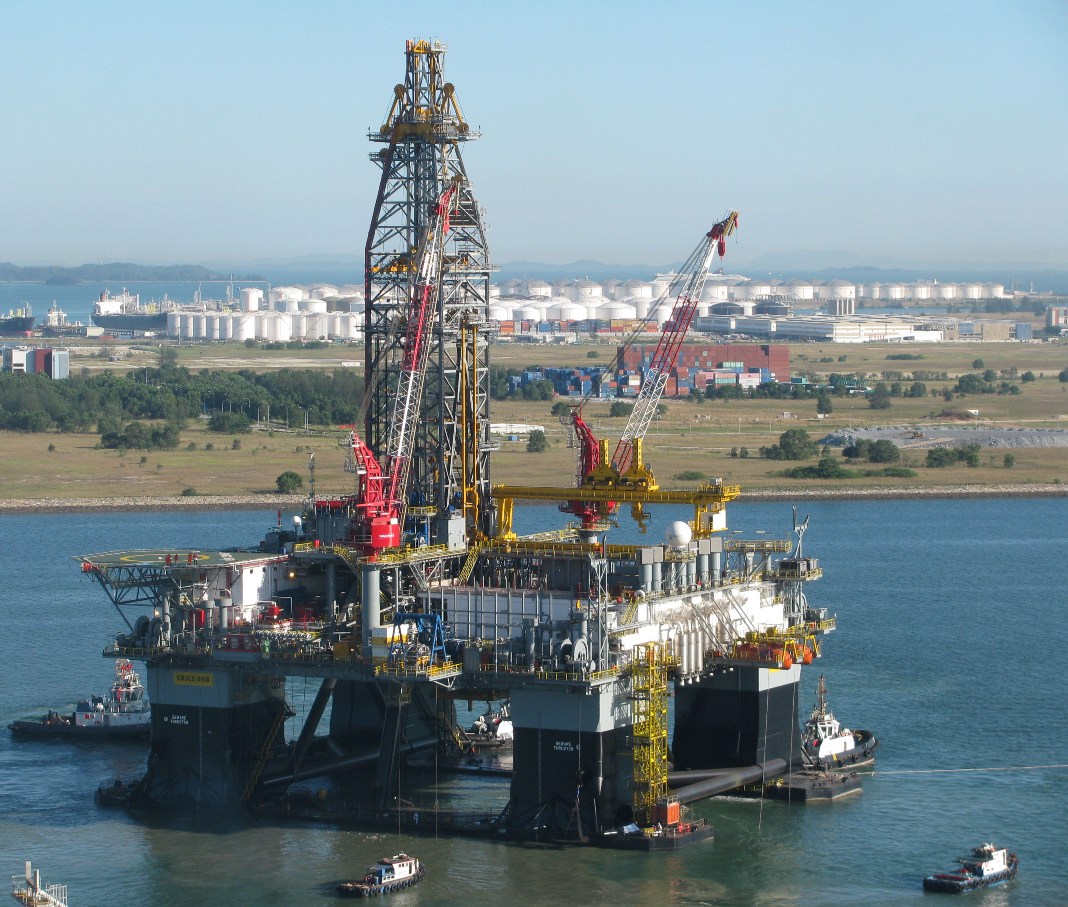
The well had previously been drilled to a depth of 13,585 feet at the time of the moratorium, Noble said. Drilling is expected to resume in late March, targeting total drilling depth of about 19,000 feet, Noble said. Results are expected by the end of May. Noble said it will use the Ensco 8501 rig for the project.

Ensco 8501

Read Full Post »

Secretary Salazar will appear before the Senate Energy and Natural Resources Committee on Wednesday (2 March) at 10:00 am ET and the House Natural Resources on Thursday (3 March) at 10:00 am ET. Expect deepwater drilling and other offshore energy questions.  Both hearings will be streamed live at the respective websites.

Read Full Post »


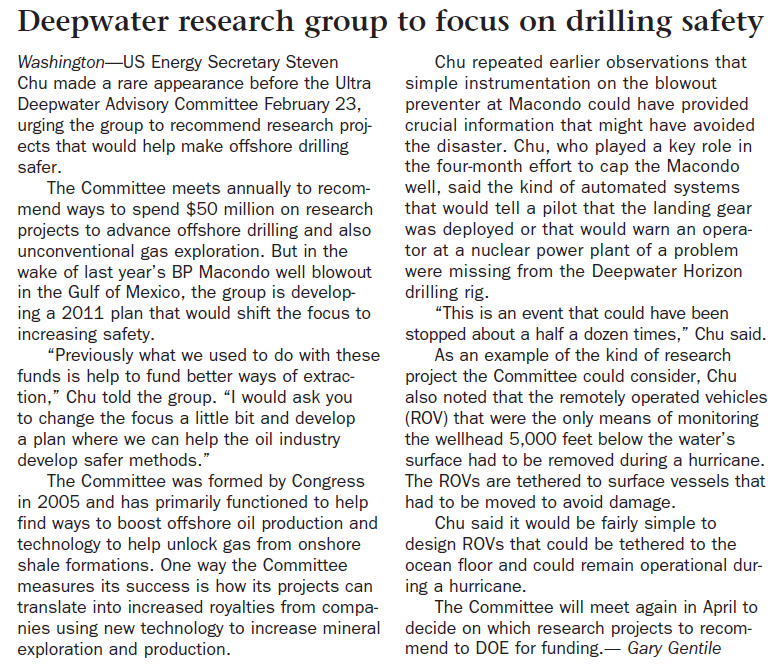
Few Cabinet Secretaries are scientists or engineers, and none has been a Nobel Prize winner. We expect Secretary Chu to be different and yesterday’s meeting with DOE’s Ultra-Deepwater Advisory Committee was not your typical Washington “hit and run” performance. Rather than making a quick speech and running along to his next appointment, Secretary Chu engaged in technical dialogue with our committee for a full hour, offering insights and responding to questions. Among the topics discussed were BOP instrumentation and monitoring, well integrity, ROV/AUV issues, and Macondo findings.

Kudos to Secretary Chu for his commitment to offshore safety.

Gary Gentile published this report on the meeting in Platts Oilgram News. (click on the story to enlarge)

Read Full Post »

link

Bahamas Petroleum, the oil and gas exploration company with licences in The Bahamas, is pleased to announce that the company has completed the acquisition of 1120 km of long-cable (8km) 2D seismic in its southern licences.  The new seismic survey has confirmed the presence of multiple prospects, some of which are 4-way closure in nature and some of which are combination stratigraphic-structural traps.

I’ll defer to the geologists regarding the significance of this announcement, but the results would seem to provide further encouragement for the island nation’s exploratory drilling plans. Will Florida politicians try to bully the Bahamas the way they have been bullying Cuba?

Read Full Post »

From NPR:

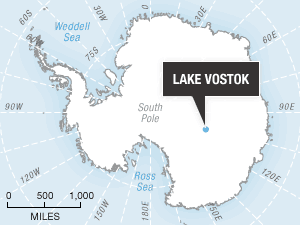
Russian scientists are on the verge of punching a hole into a vast Antarctic lake that’s buried under more than two miles of ice. If the Russians break through, they may tap into and disturb a primitive and pristine ecosystem has been untouched for millions of years.

One major concern is the Russians have filled the hole they’re drilling with more than 14,000 gallons of kerosene and Freon to prevent it from freezing shut. The Russians have engineered their system so that when they break through into the lake, water pressure from below is supposed to push the drilling fluids up the hole, rather than letting them pour into the lake and contaminate it.

Read Full Post »

« Newer Posts - Older Posts »