Feeds:
Posts
Comments

Archive for the ‘well control incidents’ Category

-11 crew members are still missing.  Chances of finding survivors are very slim.
-The inevitable happened – the Deepwater Horizon sank.
-In light of the rig sinking, I’m now using the prospect name – Macondo – for this incident.
-The Coast Guard reports (NBC news clip) that the well is not leaking at the seafloor and that all flow is through the riser.  A high percentage of that oil is burning at the surface.  This is the optimal scenario from a pollution standpoint, but how long will the riser hold up?
-Comment: The official website updates need to be improved.  Most of us can’t attend the news conferences (or dial-in).  There is no information about the ongoing attempts to actuate the BOPE with the ROV  (what problems have emerged?, next steps?), relief well planning (rig identified? estimated spud date?), spill response equipment, trajectory analyses, and other important aspects of the response.
-Rating the evening news coverage:
  1. NBC – Decent job; no major mistakes; good clip on the absence of seafloor leakage
  2. ABC – About what you expect from network news; not entirely accurate, but in the ballpark
  3. CBS – What event were they talking about?  Who prepared the rig, well diagram?
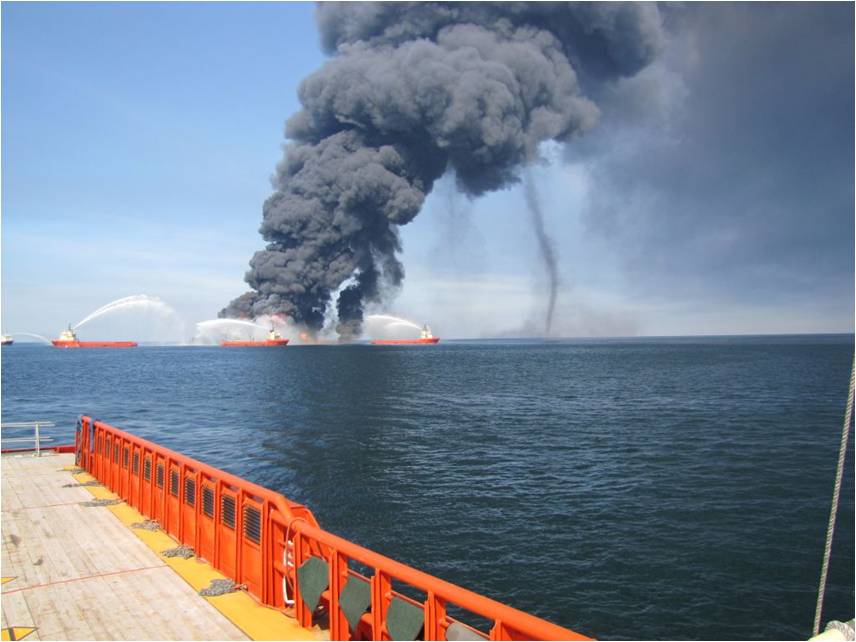
Funnel Cloud?
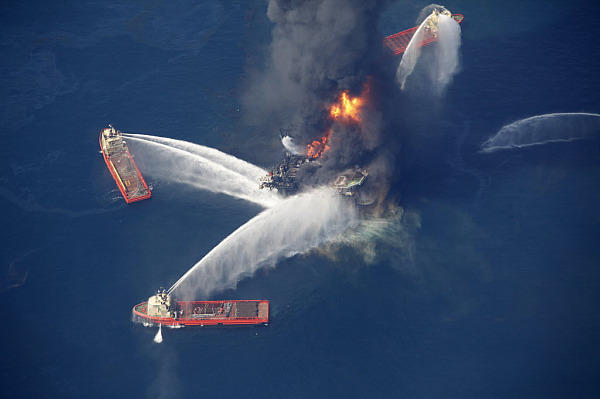
More good pictures

Read Full Post »

A NOAA report indicates the following (not good):

  1. Rig is listing 15 degrees
  2. Most of the oil is burning but there is a slick approximately 2 miles in length. Updated NOAA trajectory analyses suggest that the Northern GOM coast would be at risk, but that it would take more than three days for oil to threaten the shorelines.  Weather and current forecast and could of course change.
  3. Initial attempts to actuate BOPE with the ROV failed.
  4. A strengthening of winds and seas is predicted by Friday evening. Such weather would put even greater stress of both the vessel and the riser.

Read Full Post »

This is the nightmare scenario that we supporters of offshore oil and gas development dreaded and worked so hard to prevent – workers missing, fire raging, and oil flowing.  Santa Barbara, Ixtoc, and most recently Montara were horrible drilling blowouts, but no lives were lost.  Barring an Earth Day miracle, or series of miracles, that will not be the case this time.

BP and Transocean are not rogue companies.  BP had a near flawless safety and compliance record in US waters over the past 2 years.  Transocean is a respected drilling contractor.  The Deepwater Horizon is a modern mobile drilling unit, and was staffed with a skilled and competent crew.  So what went wrong?  Is the challenge of drilling deep beneath the earth from a floating facility in thousands of feet of water too great to achieve the level of perfection that is necessary and expected?  I don’t think so, but we clearly have a lot of soul searching to do.

For now, the focus must be on the search for the missing workers and regaining control of the well.  We can count on the Coast Guard, which is once again providing outstanding leadership during a crisis, to do everything possible to find the workers.  With regard to the well, an ROV must successfully actuate a ram on a BOP stack located on the ocean floor.  If that doesn’t work, we are in for a long siege.

Read Full Post »

Photo from Christian Science Monitor site

Good video here.

Also, click here for satellite imagery.

Read Full Post »

Upstream report on today’s press conference.
Observations:

  1. The listing DP rig  is apparently being held on location solely by the marine riser.
  2. It sounds like they were  cementing (or had cemented) production casing at the time of the incident, and that the surface plug had not yet been set prior to temporarily abandoning the well.  Flow could be inside the casing or in the annulus.
  3. Apparently most of the oil is being released at the top of the riser (estimated rate of 300 bbl/hr) and being ignited.  If the riser fails, oil will be released at the seafloor and the spill response will be much more challenging.
  4. They will attempt to actuate the BOPE with an ROV.  This implies that they either were unable to actuate BOPE prior to evacuating or that the actuation was unsuccessful (e.g. shear ram was unable to cut pipe in well bore).

Read Full Post »

11 workers still not accounted for.

According to the latest US Coast Guard release:

Updated reports indicate that there were 126 people on board the MODU at the time of the explosion.

One-hundred-fifteen crewmembers have been accounted for.  Of those accounted for:

  • Seventeen crewmembers were medevaced from the scene
  • Ninety-four crewmembers are being transferred to shore at Port Fourchon aboard the Damien Baxton, an offshore supply vessel.  There are no major injuries reported for these members.
  • Four crewmembers have been transferred to another vessel

Read Full Post »

Contrary to an earlier report (see below),  the Coast Guard has told Upstream that the 11 workers are still missing and the search continues.

Read Full Post »

Correction from nola.com

Read Full Post »

Coast Guard Photo

“It’s burning pretty good and there’s no estimate on when the fire will be put out.”  Mike O’Berry, US Coast Guard

The Coast Guard is hoping to locate the missing in an escape capsule or life raft. link

All BP personnel are reported to be safe.

Read Full Post »

My experience is that you unfortunately often need a major accident or even a disaster to engender political support for streamlining regulatory regimes.   Moreover, history shows that major accidents apparently must happen in your own jurisdiction to have such an effect on political support. Magne Ognedal

Magne’s astute comment repeatedly came to mind while I was reading the Montara testimony.  Our political systems are good at reacting, but are not so good at making tough decisions when the spotlight is elsewhere.  Crises provide the political capital needed to make major changes, but seldom yield the best solutions.

Will the Montara blowout provide the impetus needed for other countries to review and improve their offshore regulatory regimes?  These Montara issues should be of concern to all of us:

  1. Multiple regulators with unclear divisions of responsibility
  2. Regulatory gaps and overlap
  3. Ineffective use of standards and best practices
  4. Lack of clarity regarding operator and contractor responsibility and accountability
  5. Balancing goal-setting with prescription
  6. Monitoring operations effectively without taking “ownership”
  7. Applying regulatory resources efficiently and where the risk is greatest
  8. Absence of meaningful performance measures for operators and regulators
  9. Authority to remove rogue operators
  10. Ability to update standards and regulations in a timely manner
  11. Weaknesses in training programs for operators, contractors, and regulators

I’ll stop at ten (now eleven :)).

Many of these issues will be discussed at the International Regulators’ Offshore Safety Conference in Vancouver (18-20 October). I hope you plan to attend!

Read Full Post »

« Newer Posts - Older Posts »