Archive for 2022
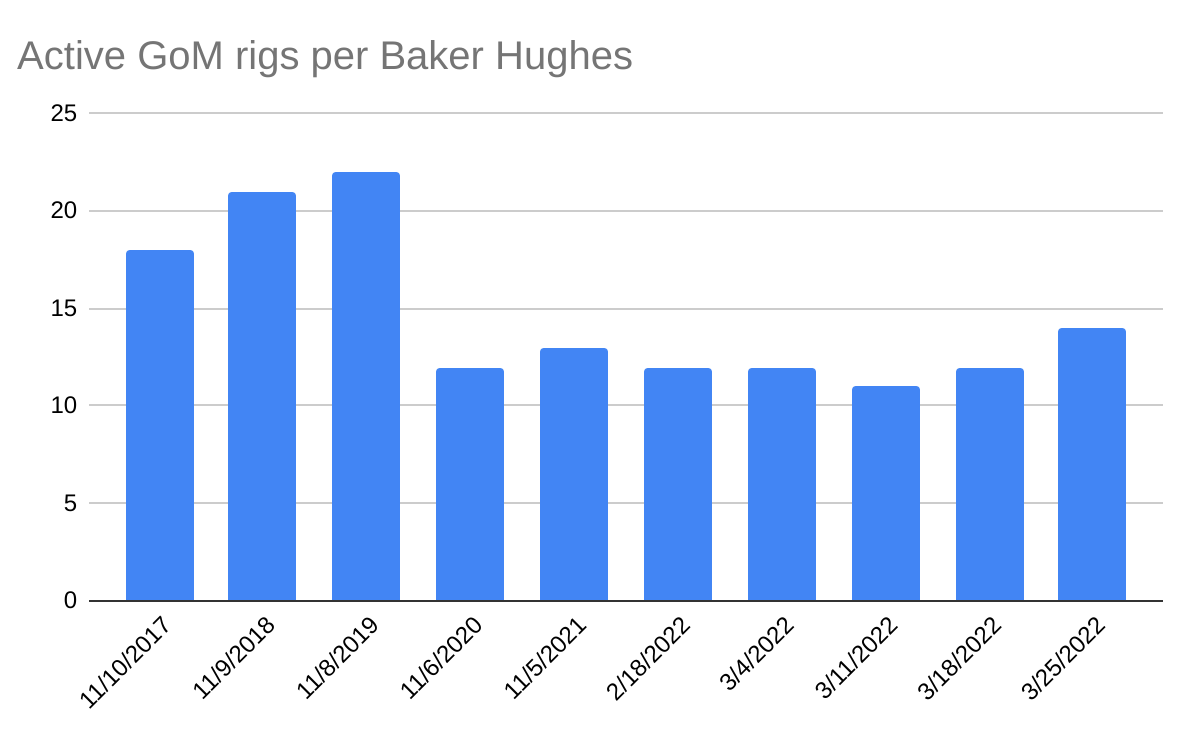
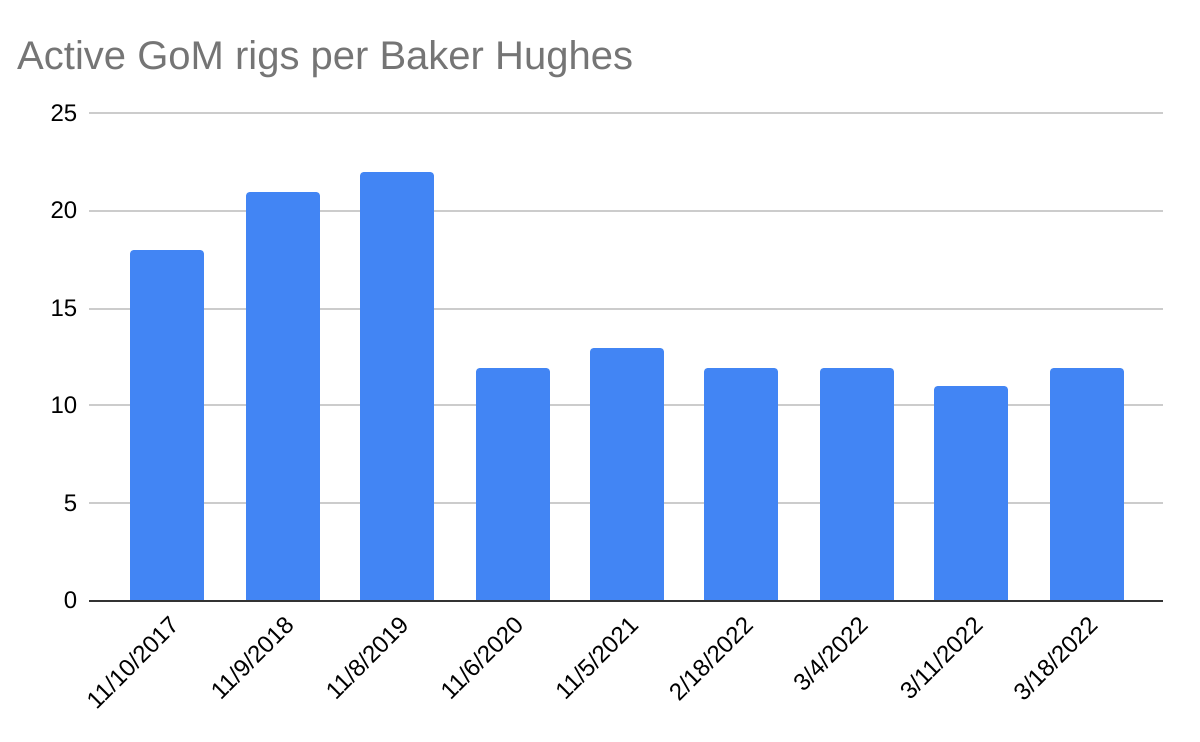
A bit of encouragement, Gulf of Mexico rig count up by 2 to 14
Posted in drilling, Gulf of Mexico, Offshore Energy - General, tagged Baker Hughes rig count, Gulf of Mexico on March 25, 2022| Leave a Comment »
Kevin Sligh named BSEE Director
Posted in energy policy, Offshore Energy - General, tagged BSEE Director, DOI, Kevin Sligh on March 25, 2022| Leave a Comment »

“I am deeply honored to join the Interior Department and continue my public service career on behalf of the American people. I’ve dedicated my life to keeping the public safe, and I look forward to continuing that service alongside the Bureau of Safety and Environmental Enforcement’s incredible career employees,” said Director Sligh.
DOI Press Release
Excellent opening comment. Best wishes to Director Sligh in this very important position. BSEE is critical to our economic future and energy security.
Deepwater development trend: simpler, safer, greener
Posted in Gulf of Mexico, Offshore Energy - General, tagged Anchor, Argos, deepwater production, GHG intensity, Vito, Whale on March 25, 2022| Leave a Comment »



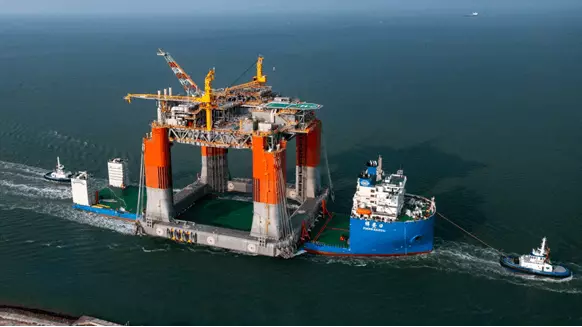
After a several year lag in deepwater Gulf of Mexico development, a new generation of projects is moving toward first production. Shell’s Vito and Whale, BP’s Argos, Chevron’s Anchor, and Murphy’s King’s Quay are similar in many ways including the following:
- Floating production units
- Lighter, smaller semisubmersible designs
- Excellent structural integrity and storm performance characteristics
- Lower project costs, shorter cycle times
- 4000 to 8600′ water depth
- Subsea wells, small surface footprint
- High production rates anticipated: 100,000 – 150,000 BOE/D
- Standardized equipment
- Energy efficient gas turbines
- Advanced remote monitoring, fewer onboard staff
- Simpler = safer (assuming equivalent well and production safety system integrity)
- Limited number of wells + high production rates/well + efficient power generation and processing equipment + restricted flaring + pipeline transportation = low GHG intensity production
4 leading offshore programs, 5 years of safety performance data
Posted in accidents, Gulf of Mexico, Norway, UK, tagged ANP Brazil, BSEE, IRF, offshore safety, PSA Norway, UK HSE on March 24, 2022| Leave a Comment »
The International Regulators’ Forum (IRF) does a good job of compiling safety performance data for offshore oil and gas operations in member countries. Because these data are collected by the respective regulators and compiled in accordance with established guidelines, we consider the IRF compilations to be the most credible international incident summary data for the offshore industry.
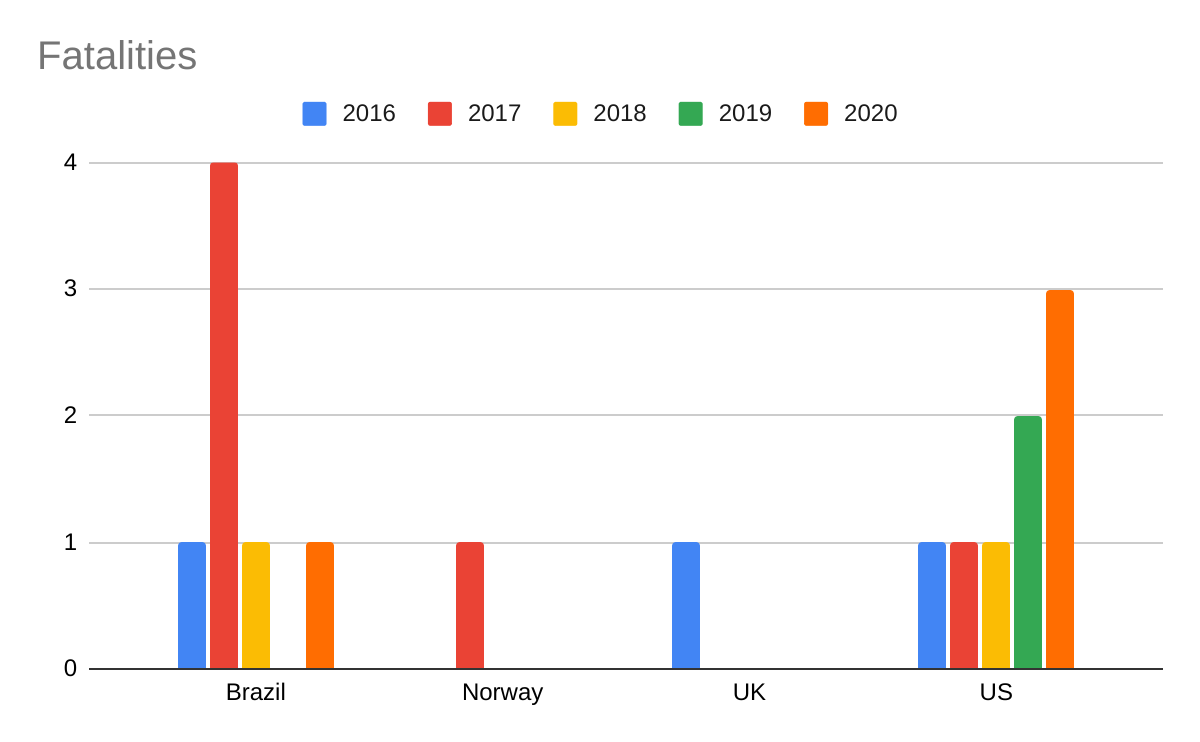
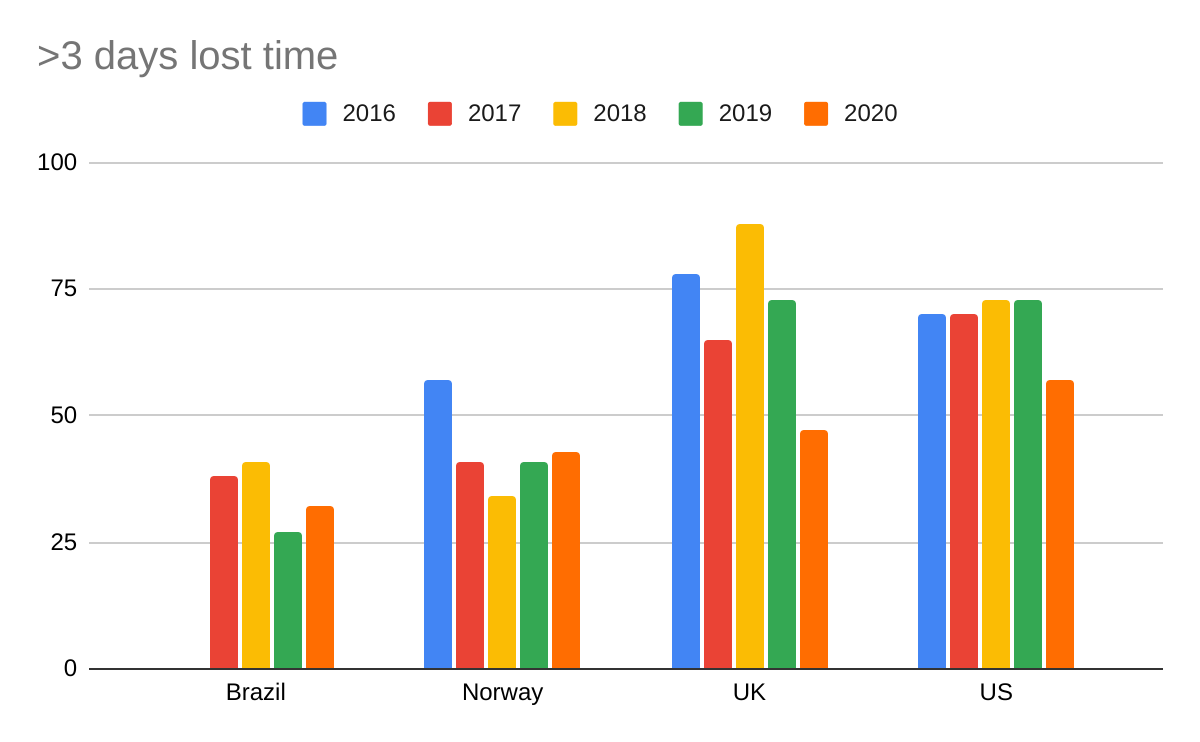
BOE looked at the numbers for the IRF countries with the highest level of activity in terms of hours worked – Brazil, Norway, UK, and US. These countries accounted for 90% of the total hours worked in 2020, the last year for which data are available. The 2020 hours worked (millions) were also relatively similar for the 4 countries: Norway – 41.2, UK – 42.4, US – 50.4, Brazil – 50.7. The differences in hours worked were somewhat greater in the prior years, but not dramatically so.
We charted the fatality and lost-time (>3 days) data (below). Our intent at this point is to draw attention to the IRF data sets, not to assess and compare performance. We do think the overall safety performance in these and other IRF countries, while far from perfect, is quite good given the hundreds of millions of hours worked, complexity of operations, logistical challenges, and difficult operating environments. We recommend that the IRF prioritize the timely posting of these data, and begin providing causation information so that companies and other interested parties can better identify performance issues and safety trends.

Gulf of Mexico rig count still sluggish, but back up to 12
Posted in drilling, Gulf of Mexico, Offshore Energy - General, tagged drilling activity, Gulf of Mexico, rig count on March 22, 2022| Leave a Comment »
If only the energy transition was this simple – the UK Oil and Gas Authority has a new name
Posted in energy policy, Offshore Energy - General, UK, tagged Daniel Yergin, energy transition, North Sea Transition Authority on March 22, 2022| Leave a Comment »
- While the text of the announcement implies otherwise, the new name prioritizes the “transition” over concerns about energy supply, security, and reliability. In that regard, the timing seems questionable.
- Why not the North Sea Energy Authority (NSEA) or UK Offshore Energy Authority (UKOEA)?
- Will OPEC+ be impressed? Perhaps China will add a few coal-fired power plants in honor of the name change.
- Dan Yergin understands that energy transitions are complicated. Quoting Yergin’s outstanding article in the Atlantic:
The term energy transition somehow sounds like it is a well-lubricated slide from one reality to another. In fact, it will be far more complex: Throughout history, energy transitions have been difficult, and this one is even more challenging than any previous shift.
The 19th century is known as the “century of coal,” but, as the technology scholar Vaclav Smil has noted, not until the beginning of the 20th century did coal actually overtake wood as the world’s No. 1 energy source. Moreover, past energy transitions have also been “energy additions”—one source atop another. Oil, discovered in 1859, did not surpass coal as the world’s primary energy source until the 1960s, yet today the world uses almost three times as much coal as it did in the ’60s.
Norwegians should not feel guilty
Posted in energy policy, Norway, Offshore Energy - General, tagged Dagbladet, energy policy, Norway, oil and gas prices on March 21, 2022| Leave a Comment »
“Norway cannot escape the unpleasant fact: this is a form of war profit”, daily paper Dagbladet wrote in an editorial. “While Ukraine is being destroyed, and most other countries are mainly feeling the negative effects of the war, such as higher energy prices, higher food prices and general inflation, we are making a gain”, it said.
thelocal.no
While such introspection is commendable, energy supply issues in Europe would be far worse were it not for Norway’s actions including:
- easing the tax burden to sustain exploration and production during the pandemic when oil prices crashed.
- predictable and consistent issuance of exploration rights to facilitate effective exploration programs and increase oil and gas recovery.
- safety leadership that reduces supply disruption risks as well as worker safety and environmental risks.
Posted in Uncategorized on March 20, 2022| Leave a Comment »


EIA projections point to need for increased upstream oil and gas investment
Posted in energy policy, Offshore Energy - General, tagged EIA consumption forecast, oil and gas investment, World Oil Congress on March 18, 2022| Leave a Comment »
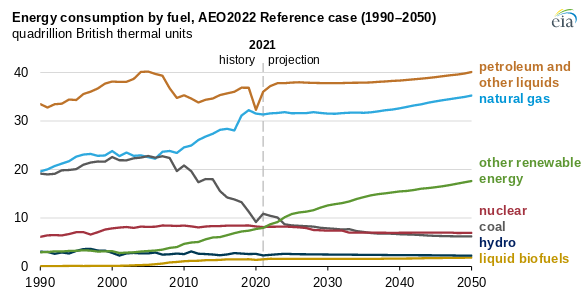
While demand will remain strong, supply is a concern:
“Capex cuts by international oil companies and national oil companies in 2020 was about 35%,” he said. “We’re now showing another 23% reduction in capex levels” from pre-pandemic levels this year. In 2019, E&P companies spent $525 billion, an amount which plummeted to $341 billion in 2021, he added. “We have to get back to $525 billion over several years until 2030 to restore market balance,” McMonigle said. “I’m afraid what we’re seeing with the energy crisis is on our doorstep.”
Joseph McMonigle, World Oil Congress
 Bud's Offshore Energy (BOE)