The Unleashing American Energy Act requires a minimum of two oil and gas lease sales to be held annually in available federal waters in the Central and Western Gulf of Mexico Planning Area, and in the Alaska Region of the Outer Continental Shelf.
The Securing American Energy and Investing in Resiliency Act requires the Department of the Interior to conduct all remaining offshore oil and gas lease sales in the current leasing plan and issue leases won as a result of Lease Sale 257.
The Strategy to Secure Offshore Energy Act requires the publications of the 2022-27 plan for offshore oil and gas lease sales by the time the current plan expires on June 30, 2022.
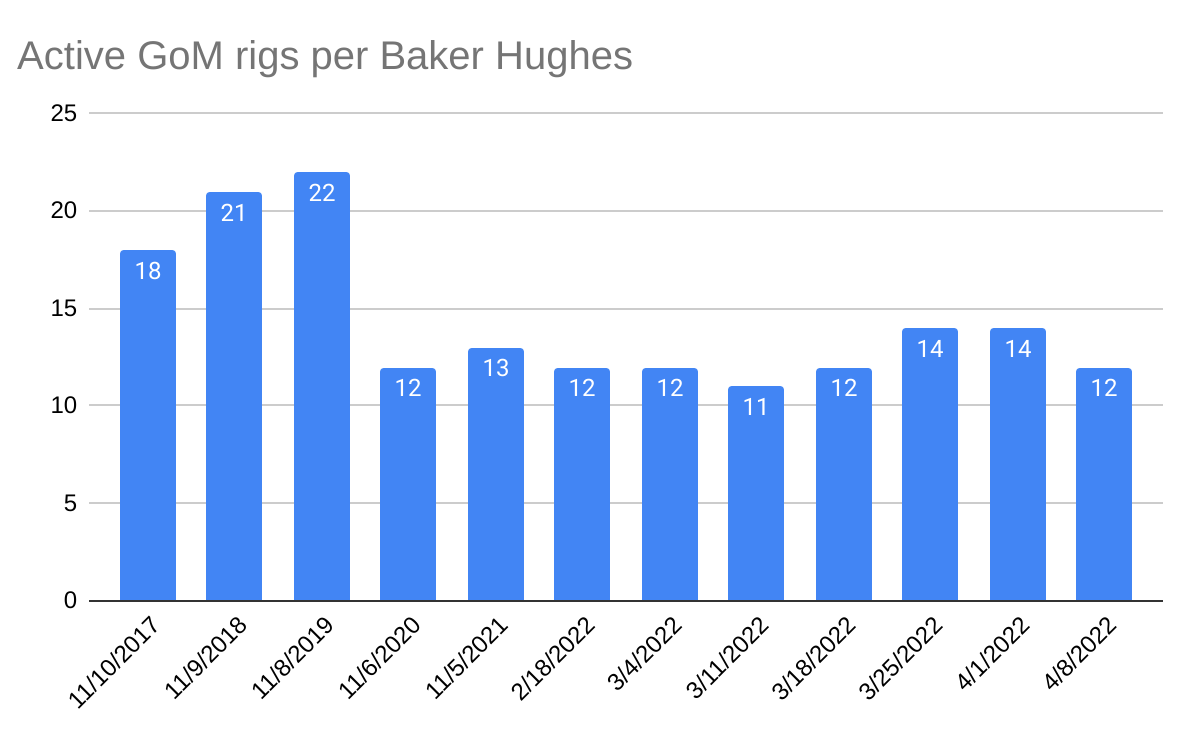
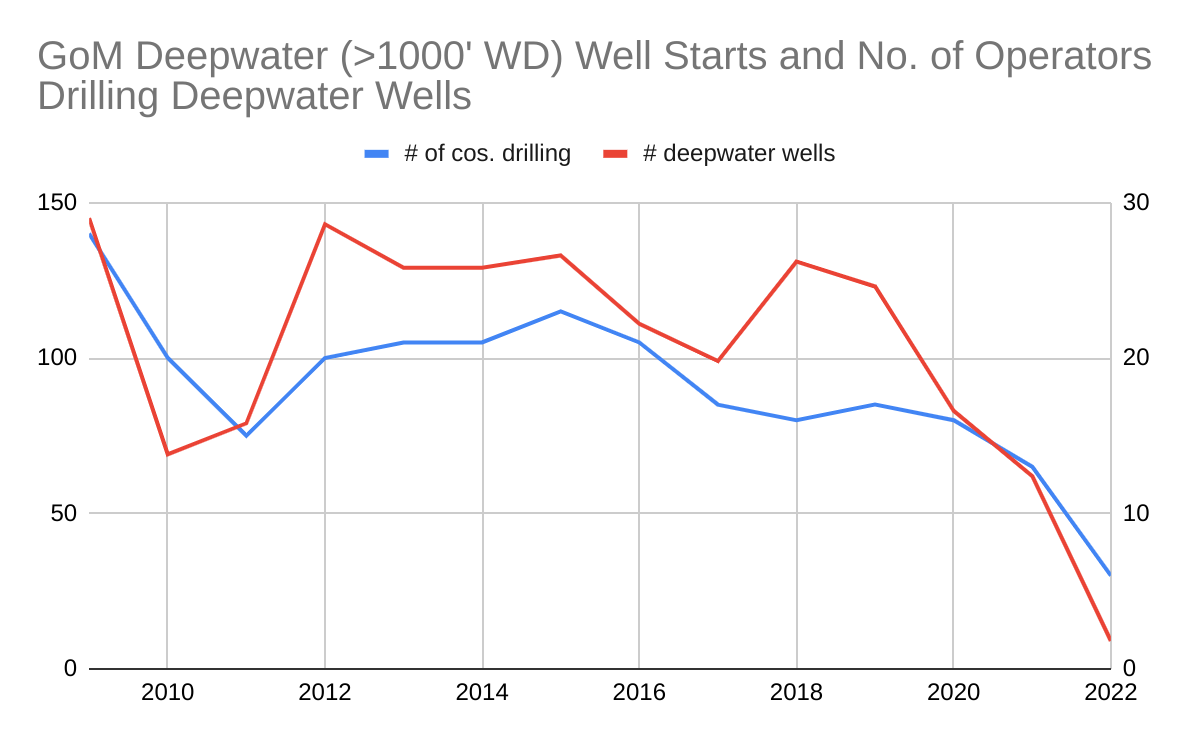
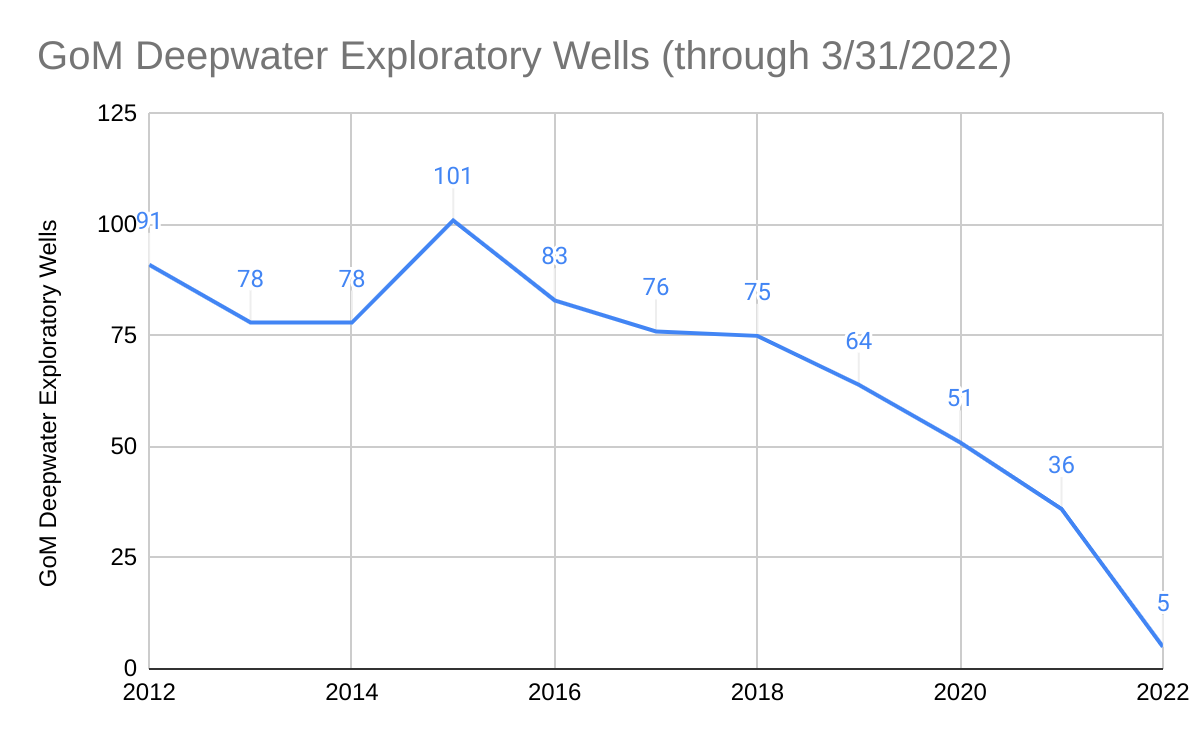
Deepwater production is noteworthy for widely dispersed surface structures supplemented with subsea systems. In the past 30 years, the total number of Gulf of Mexico platforms declined by 50% while the oil production doubled. Of course, this level of production is not sustainable without regular lease sales and increased exploration. In that regard, the signs are not good.
435 GoM shelf platforms have been removed in just the last 5 years (2017-2021). The loss of platforms is accompanied by a loss of marine habitat that the rigs-to-reefs program has partially compensated for. There have been a number of other interesting proposals for the use of old platforms, some more serious than others.
Current number of Gulf of Mexico platforms by water depth:
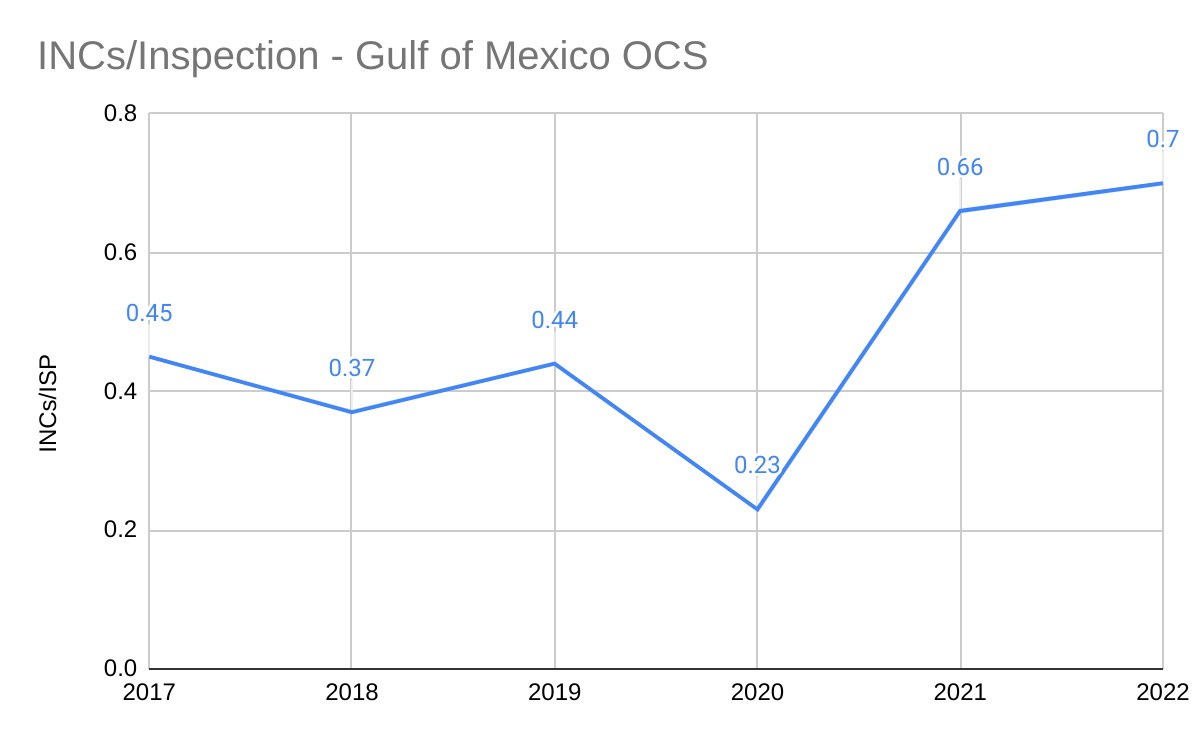
Per BSEE’s online Incident of Non-Compliance (INC) data, 4 operating companies accounted for 64% of the INCs during Q1 of 2022 (see chart below). Fieldwood was once again cited for the most INCs (132), but GOM Shelf LLC had the highest INC/inspection ratio (1.53). All 55 of the Whitney Oil & Gas INCs resulted in Facility Shut-In orders. Whitney was cited for failing to comply with damage inspection and records requirements following Hurricane Ida.
The overall violations rate during Q1 of 2022 was essentially unchanged from 2021. A number of companies had outstanding records. We’ll comment on them later in the year.
This WSJ report, if accurate, reflects the mindset that you can increase oil production on demand when absolutely necessary, and avoid committing to longer term oil and gas supplies. The goal of such thinking is to address supply crises without alienating the uncompromising climate ultras. You suspend lease sales, deny new pipelines, and demonize oil and gas and the people who produce it. When supplies tighten and prices spike, you tap the strategic reserve, appeal to OPEC, talk to Venezuela and Iran, and ask Canada to ship more oil in rail cars or trucks (but no new pipelines please!). .
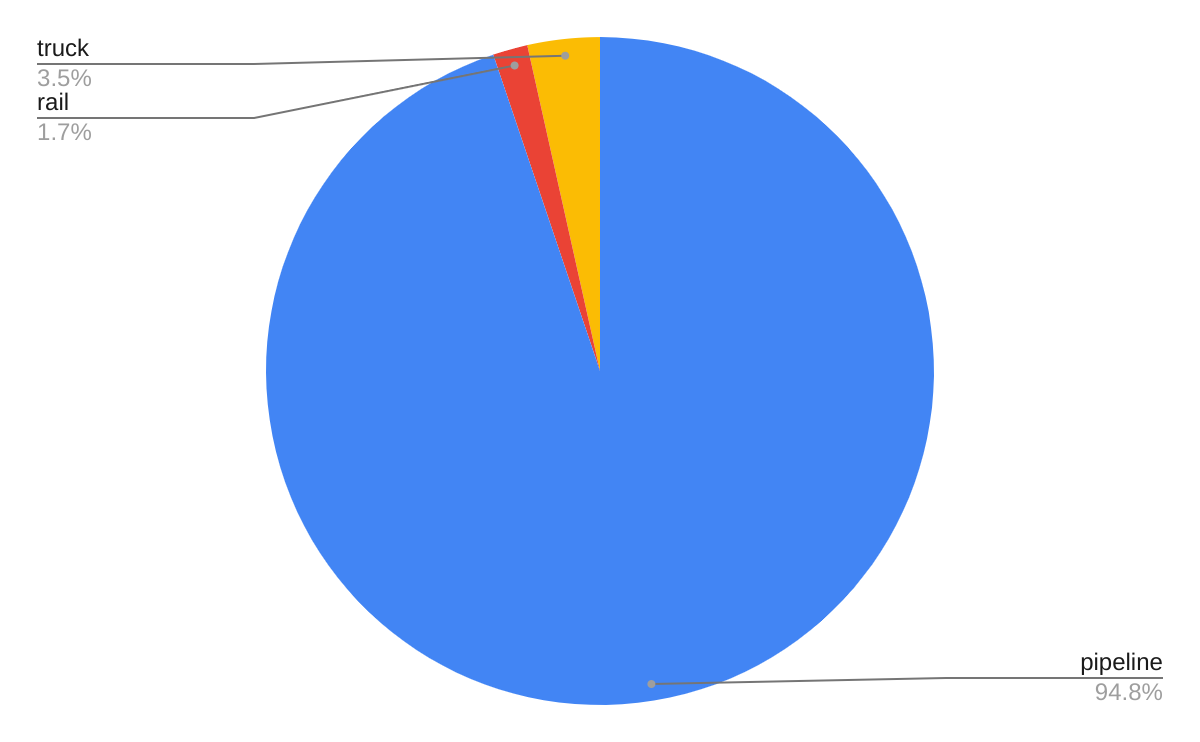
Below is a pie chart constructed using data from a 2018 DOT report to Congress. For logistical and economic reasons, pipelines are overwhelmingly the crude oil transport method of choice. Rail cars and trucks are called on where there are no pipeline options.
Looking at the systems, one would assume that pipelines have safety and environmental advantages. Loading and unloading hundreds of tanks would seem to be inviting spills, although most would presumably be small. The DOT data bear this out. On a volume transported basis, spill incidents occurred nearly 15 times more frequently for rail cars and trucks than they did for pipelines.
For pipeline(s), an incident occurred approximately once every 720 million gallons of crude oil shipped. For rail, an incident occurred approximately once every 50 million gallons of crude oil shipped. For truck(s), an incident occurred approximately once every 55 million gallons of crude oil shipped.
Looking at the percentage spilled, pipelines also had a significant (7.6 times) advantage over rail, but only a slight advantage over trucks.
Volume of Crude Oil Shipped and Spilled by Pipeline, Rail, and Truck, 2007-2016
Pipeline
volume shipped (k gal)
1,298,630,088
volume spilled (k gal)
13,161
% spilled
0.0010%
Rail
volume shipped (k gal)
23,052,960
volume spilled (k gal)
1,751
% spilled
0.0076%
Truck
volume shipped (k gal)
47,894,868
volume spilled (k gal)
521
% spilled
0.0011%
Because fatalities or hospitalizations were extremely rare, DOT chose not to normalize those data. There were a total of 3 fatalities associated with both pipeline and truck shipments. While no fatalities were associated with rail shipments, DOT noted that 47 deaths resulted from a crude oil derailment in Lac Megantic, Quebec in 2013. BOE further reminds readers that this train was transporting Bakken crude from North Dakota to a refinery in St. John, New Brunswick.
The bottom line is that you have to plan ahead to satisfy future supply needs. This is particularly true for the offshore sector where the lead times are longer, but the production volumes relative to the number of wells and facilities are higher (a good thing). The need for oil and gas is not going away, nor are threats to energy security. There are plenty of people in the U.S. Department of the Interior who understand this. Empower them to safely expedite leasing, exploration, and development!
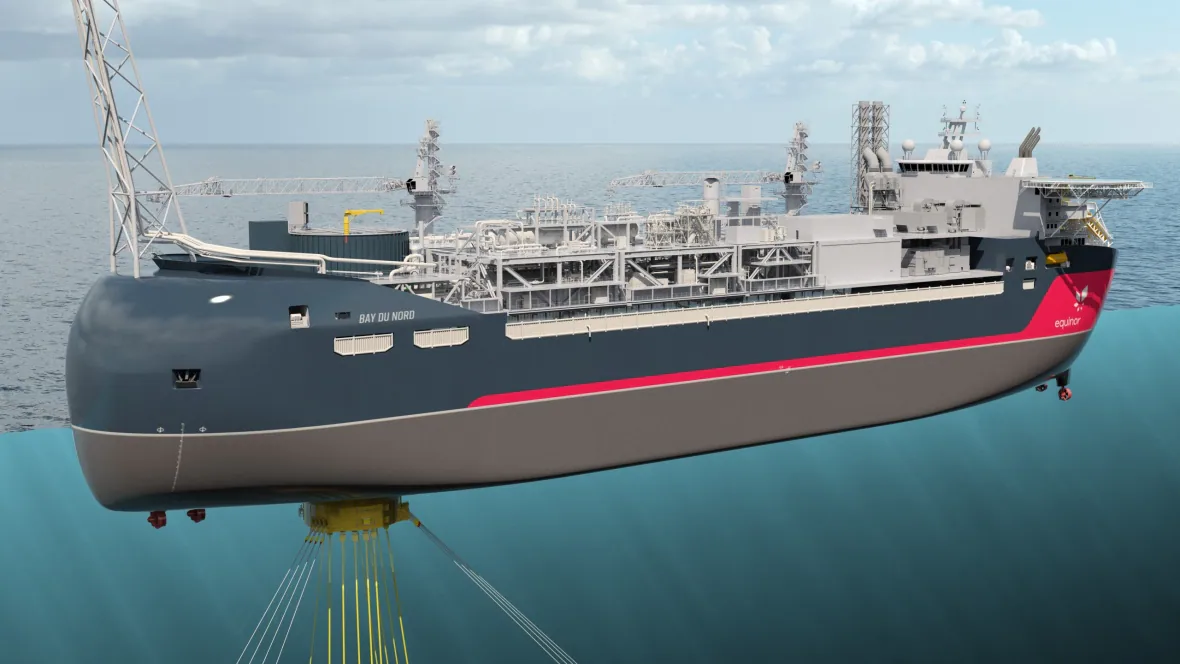
Bay du Nord FPSO planned for 500 km offshore St. John’s in 1200 m water depth
Federal Environment Minister Steven Guilbeault formally approved the Bay du Nord offshore oil megaproject Wednesday, making a decision that will infuriate environmentalists but boost the Newfoundland and Labrador economy.
MMS, the National Institute of Standards and Technology, and Environment Canada were leaders in developing and testing in situ burn spill response capabilities in the 1990’s. Tests at the MMS (now BSEE) Ohmsett facility and at sea offshore Newfoundland demonstrated this important spill response option.
BSEE has continued to advance the MMS spill response research program, and recently announced an exciting enhancement to in situ burn capabilities. BSEE and the Naval Research Laboratory invented a low-emissions atomizer burner designed to cleanly and quickly burn spilled oil, even after oil has been emulsified with water. See the video below.
The atomizer works by converting a stream of liquid, in this case, neat or emulsified crude oil, into a fine spray. The combustible spray is then able to completely burn without the plume of black smoke or residue, leaving the area safer for people, wildlife, and the environment. The burner interfaces with off-the-shelf pumps and air compressor equipment, so the collected fuel can be pumped to the burner. It can be mounted on a floating platform to stand freely in the water and has been successfully tested on waves.
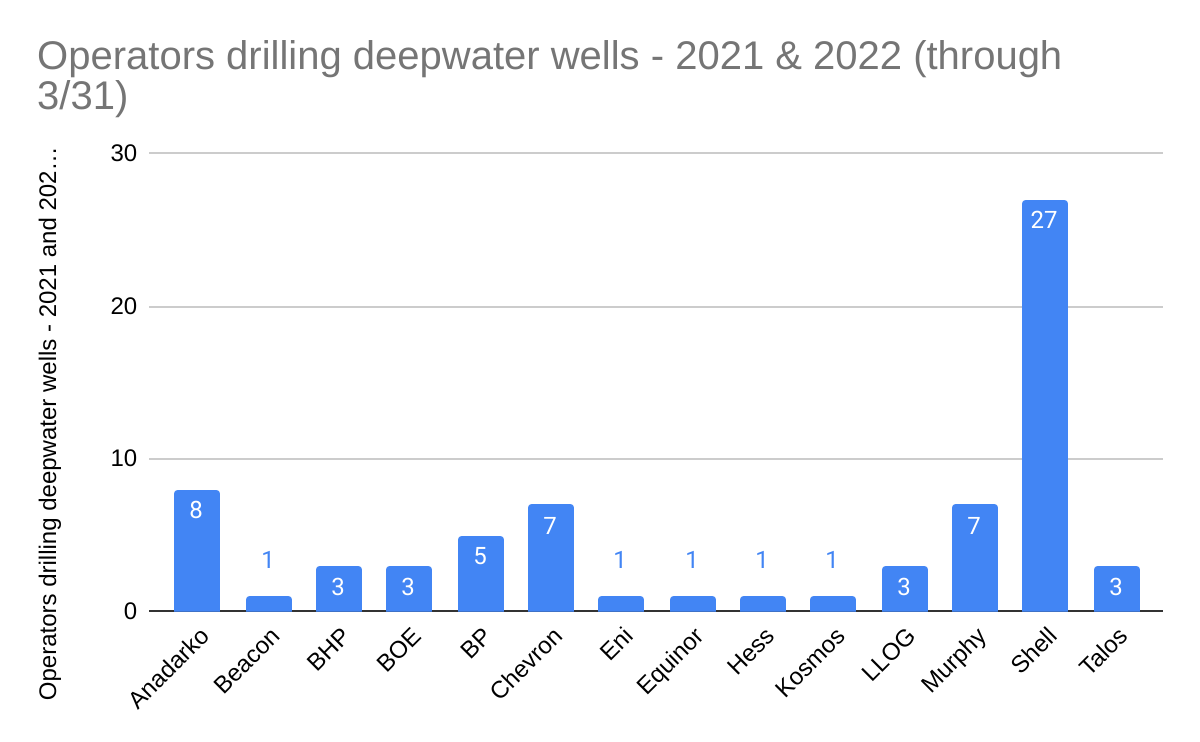
With regard to shelf drilling activity (<1000′ water depth), a total of 55 wells were started in 2021 and 2022 (first quarter). Only 2 of these wells, both by Walter Oil and Gas, were classified as exploratory. The most active drillers (by far) were Arena Offshore (30 well starts) and Cantium LLC (16 well starts). Ankor, EnVen, and Talos were the only other operators with drilling activity.
9/30/2021 – BOEM announces Lease Sale 257 as necessary to comply with the order of the Louisiana Federal Court. DOI will “continue its comprehensive review of the deficiencies associated with its offshore and onshore oil and gas leasing programs.”
11/15/2021 – Press Secretary Psaki: “We believe the (Louisiana court) decision is wrong, and the Justice Department is appealing it. So it’s in the courts; it’s in a legal process. We’re required to comply with the injunction. It’s a legal case and legal process, but it’s important for advocates and other people out there who are following this to understand that it’s not aligned with our view, the President’s policies, or the executive order that he signed.”WTI = $80.85/bbl
11/17/2021: Sale 257 bids opened and announced despite pending litigation. In a surprising twist, Exxon was the sole bidder on 94 carbon sequestration tracts offshore Texas. Neither the Notice of Sale nor the environmental review announced or assessed carbon sequestration operations in Federal offshore waters. BOEM/DOI have not commented publicly on the CCS bidding.
1/27/2022: Judge Contreras, DC Federal Court, vacates Sale 257. The Judge agreed with the plaintiffs’ assertion that BOEM failed to consider the effect that reduced production (and thus higher prices) would have on foreign consumption and the associated GHG emissions. The judge not only decided in favor of the plaintiffs, but ruled that BOEM’s omission was so serious that the lease sale had to be vacated. The judge reached this decision even though (1) the five year leasing plan expires in June leaving the timing of any future sale very much in doubt and (2) all of the sale 257 bids, which are based on proprietary assessments, are now public information, thus compromising the integrity of the leasing process at the next sale (if and when that occurs). WTI= $87.61/bbl
2/8/2022: API and the State of Louisiana appeal the Sale 257 decision.
2/24/2022: Russia invades Ukraine
2/28/2022: The Administration announces that it will not appeal the Sale 257 decision. WTI = $96.13
3/8/2022: WTI peaks at $123.70/bbl
3/30/2022: EIAP Report for API and NOIA estimates economic impacts from leasing program delays noting: In most cases, additional leases are required to produce an existing field fully or to underpin the economics of processing and transportation infrastructure. It is thus important for the industry to have continued opportunities to secure leases through a predictable leasing program. (US lease blocks are too small for optimal development in deepwater and frontier areas, increasing the importance of regular lease sales.)
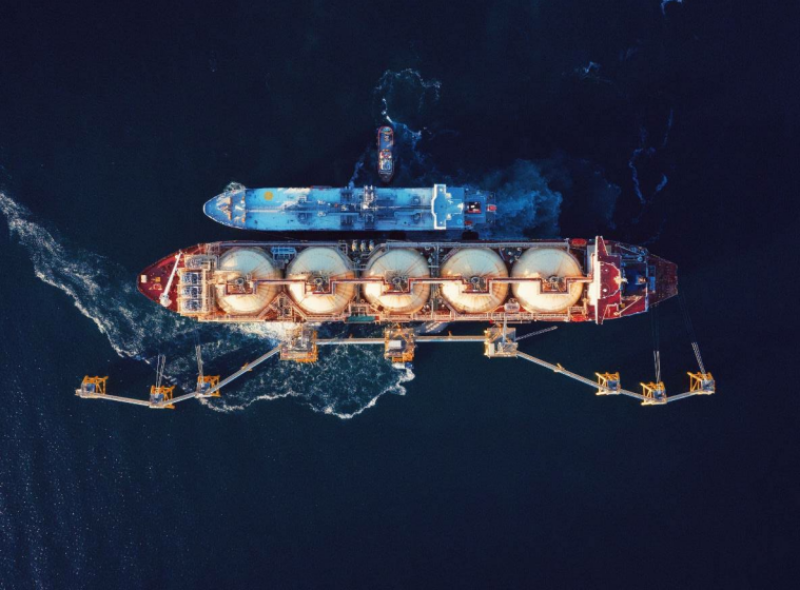
New Fortress Energy Inc. (NASDAQ: NFE) (together with its affiliates, “NFE”) today announced that it has concurrently filed applications with the U.S. Maritime Administration, the U.S. Coast Guard and U.S. Department of Energy to request all necessary permits and regulatory approvals to site, construct and operate a new offshore LNG liquefaction terminal off the coast of Louisiana (“the Project”) with a capacity of exporting approximately 145 billion cubic feet of natural gas per year, equivalent to approximately 2.8 million tons per annum (MTPA) of LNG.
The Project will be located in federal waters approximately 16 miles off the southeast coast of Grand Isle, Louisiana, and will access abundant U.S. gas supply by leveraging existing infrastructure. Procurement of all long-lead materials is complete and modular assembly of equipment is underway. Subject to the receipt of all required permits and approvals, NFE targets beginning operations in the first quarter of 2023.

 Bud's Offshore Energy (BOE)