Feeds:
Posts
Comments

Archive for August, 2021

Jim Lane, who inspired our NMJA program many years ago, has submitted this nominee from the Texas Hill Country where he now resides. The metal stake in the picture was used to support a sapling that was planted in a county park. However, neither the employee who planted the young tree nor any of his colleagues saw fit to remove the stake. Not their job? The end result is pictured below.

Read Full Post »

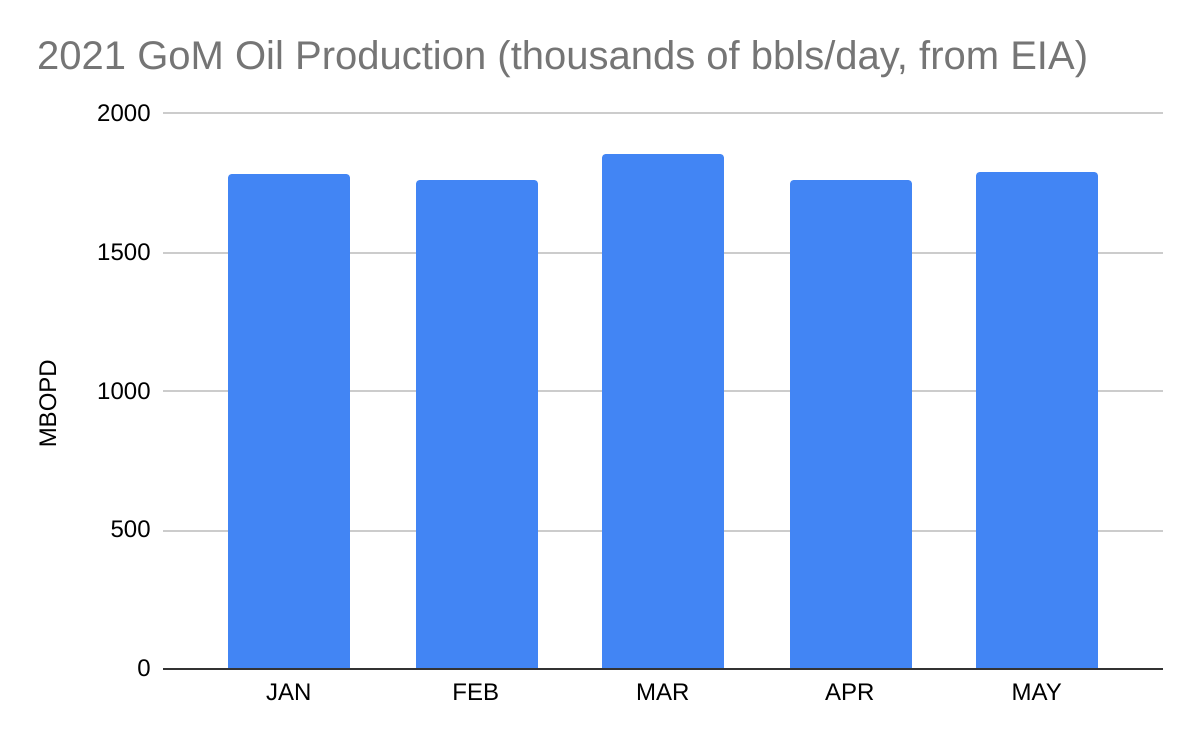
A previous BOE post estimated that current stabilized GoM oil production rates were 1.7 – 1.8 million BOPD. EIA recently announced that May production was 1.791 million BOPD, which is consistent with our estimate. Per the chart below, GoM production was essentially unchanged from the beginning of the year despite a 37% increase in the price of oil (WTI) from 1 January to 31 May. This suggests that stabilized GoM production may have peaked pending first oil from several new projects.

Key production questions:

  • Will new production from Mad Dog 2, Vito, PowerNap, Thunder Horse South 2, and the recently sanctioned Whale project offset high depletion rates elsewhere in the deepwater GoM?
  • Looking further ahead, is deepwater GoM production sustainable without increased drilling activity? Per BSEE data, only 33 deepwater wells were started in 2021 YTD, just 18 of which are classified as exploratory. Drilling is thus at historic low levels. For reference, there were 477 wells started in 2001, 149 of which were exploratory. This level of activity facilitated a 30% growth in oil production, peaking at 2 million BOPD in 2019.

Regardless of one’s views on the urgency and timing of the “energy transition,” is there any doubt that oil and gas will continue to be important to our economy and security for years to come? If not, should deepwater GoM production, with its relatively low carbon intensity, be a core element of our energy strategy? To better understand the trade-offs, I suggest that BOEM’s Environmental Studies Program conduct a peer reviewed assessment of the carbon intensity of domestic and international supply alternatives. Product transportation considerations should be included in this assessment.

Read Full Post »

Continuous improvement has to be the primary objective of offshore safety leaders, and this independent blog is committed to recognizing initiatives that further reduce safety and environmental risks. Australia’s collaborative mental survey project is an interesting such initiative in its early stages. Two other important initiatives are noted below.

BSEE’s Dropped Object Risk-Based Inspection initiative: As has been the case for 50 years, most offshore fatalities and serious injuries are associated with falls or falling and moving objects/equipment. BSEE’s Dropped Objects initiative, as described in a presentation by Jason Mathews during a recent Center for Offshore Safety (COS) webinar is intended to draw further attention to and better manage these risks. In addition to BSEE’s focused inspections, the “Good Practices” being followed by some operators and contractors, as described on pages 40-50 of the presentation, are encouraging. These types of initiatives are necessary if we are to achieve the elusive “zero fatality” year on the US OCS.

IOGP process safety guidance, Report 456 v.2 : Contrary to some post-Macondo narratives, process safety and well control were always the primary focus of the US OCS regulatory program. In 1974, my boss Richard Krahl (known as “Mr. OCS” for his commitment to offshore safety) dropped a copy of the first edition of API RP 14C (Analysis, Design, Installation, and Testing of Safety Systems for Offshore Production Facilities) on my desk and told me it was an excellent document that I should read. RP 14 C and other process safety standards were incorporated into the USGS OCS Orders (regulations) in the 1970’s. For decades, the USGS and MMS were leaders in well control and production safety research and training. That said, better indicators and improved approaches to offshore facility process safety were needed, and the International Association of Oil and Gas Producers report has provided an excellent framework. Report 456 is comprehensive and technically sound, and provides excellent guidance and examples. Very well done!

Read Full Post »

« Newer Posts