Feeds:
Posts
Comments

Archive for July, 2011

The oil is most likely from natural seeps, but the Coast Guard is investigating.  Link provided by Cheryl Anderson:

An MH-65 helicopter flew over the area Wednesday evening just before sunset but did not spot any spill or sheen, or any other oiled birds. Coast Guard officials tell KEY News they have contacted the owners of the oil platforms in the channel but none of them have reported a spill or had transferred any fuel or oil in the past day.

Read Full Post »

Per Upstream:

A fire at BP’s Valhall oil platform off Norway in the southern part of the North Sea forced the UK supermajor to halt production and evacuate the facility today. 

Valhall Complex (www.mfox.nl)

Read Full Post »

Good find by Cheryl Anderson:

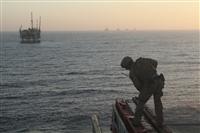
Platform Hogan, Santa Barbara Channel

A Marine with the 11th Marine Expeditionary Unit’s maritime raid force searches the oil platform Hogan for threats during an exercise July 10. The MRF, along with a section of the unit’s aviation combat element, Marine Medium Helicopter Squadron 268 (Reinforced), and command element, are taking part in a large-scale exercise with ocean and urban-based scenarios.

Read Full Post »

BOE’s Cheryl Anderson picked up this AP report.  Helicopter accidents continue to be a leading cause of offshore casualties.

A helicopter carrying crew from an offshore drilling rig crashed into the sea off Myanmar, killing three people on board. Eight were rescued.

The aircraft was carrying staff of the Malaysian oil company Petronas from the Yetagun offshore gas field in the Andaman Sea.

The oil field is operated by Petronas Carigali of Malaysia, PTTEP of Thailand and Japan’s Nippon Oil company. Petronas also operates a cross-border gas pipeline to transport gas from Yetagun to Thailand.

Read Full Post »

If someone had asked me a few years ago what the highest risk offshore system was, I certainly would not have said a fully cased well in the process of being suspended. Yet that was the scenario for both of the recent mega-incidents, Montara and Macondo.

I would have instead suggested that dynamic production risers were the highest risk offshore system. The combination of relatively new technology, movement,  fatigue potential, exposure in the splash zone, and continuous hydrocarbon flow poses risks that must be carefully managed.  That is why investigations of incidents like the Visund gas leak are so important. In that regard, PSA does an excellent job and prominently posts all of their reports so that we all may benefit. I recommend that you take a look at this one.

In connection with the planned shutdown on Visund on 9 April 2011, a hydrocarbon leak occurred from well A21’s 6” flexible riser UK-18-0009. The Petroleum Safety Authority Norway (PSA) has carried out an investigation of certain aspects of the incident.

 We have identified three nonconformities within the areas of establishment and follow-up of preconditions for safe operation of dynamic risers, training and expertise and governing documentation.

Read Full Post »

The Commonwealth of Virginia, home of BOE headquarters, continues to provide national leadership on energy issues, most notably offshore oil and gas exploration.  The Governor (Republican), both US Senators (Democrats), and both candidates for the US Senate support offshore leasing.

“Opening up and expanding Virginia’s offshore resources to responsible natural gas and oil exploration holds significant promise for boosting needed domestic energy production while bolstering the commonwealth’s economy.” Quote from Senator Jim Webb in the Richmond Times Dispatch


Read Full Post »

From the West Australian:

A new system to regulate the offshore gas and oil industry – a direct response to the 2009 Montara north of the Kimberley – has been approved by the Federal Parliament’s lower house.

Under the changes, the seven state and territory authorities will be replaced by a single Commonwealth body, the National Offshore Petroleum Safety and Environmental Management Authority.

It will regulate all safety issues from exploration to well decommissioning.

In the US, the jurisdictional conflicts (offshore) differ in that they typically involve multiple Federal regulators with overlapping jurisdiction and different priorities. Since most of the necessary streamlining would only involve Federal agencies, one would think that regulatory reform would be achievable, especially after a major blowout that killed eleven. Unfortunately, meaningful US reform appears to be highly unlikely.

Read Full Post »

From Bloomberg.com:

A force majeure notice was delivered to the government of Ghana and Ghana National Petroleum Corp. after an anchor- handling accident damaged the rig, Dallas-based Kosmos said today in a statement. The Marianas was scheduled to arrive July 10 for drilling, Kosmos said.

Kosmos said it anticipates that either the Marianas or a substitute rig will be “available soon” to drill the Cedrela-1 well in the West Cape Three Points Block. Transocean, based in Vernier, Switzerland, reported yesterday it evacuated 108 of 121 workers on the rig after it took on water while preparing to leave an Eni SpA drilling site off Ghana.

The market for deep-water rigs in that part of the world is so tight that Kosmos will likely have to wait at least a month for a comparable drilling vessel, said Brian Uhlmer, an analyst at Global Hunter Securities in Houston. Moving an unused rig from the Gulf of Mexico could take about 45 days.

Read Full Post »

  1. Will Transocean be releasing any details on yesterday’s “water ingress?” Will the results of their internal investigation ever be made public? (We are still waiting for their report on the fatal crane incident last August offshore Nigeria.)
  2. Will an independent investigation be conducted? Will the authorities in Ghana participate?
  3. Did the damage that the Marianas incurred during Hurricane Ike (2008) or Tropical Storm Ida (2009) in any way contribute to yesterday’s apparent structural failure?
  4. When will we have an international system that ensures (a) prompt, independent, and complete investigations of all significant accidents, and (b) the timely release of findings?

Read Full Post »

Per Platts:

Deepwater driller Transocean confirmed that its semisubmersible rig Transocean Marianas operating off the coast of West Africa had taken on water early Wednesday, forcing the evacuation of some crew members.  “A water ingress was noticed onboard the Transocean Marianas during operations offshore Ghana” for Italian major Eni, Transocean spokesman Guy Cantwell said. “The rig is stable at this time. There are no injuries, and all non-essential personnel are being evacuated.” 

Read Full Post »

« Newer Posts - Older Posts »