Feeds:
Posts
Comments

Archive for March, 2011

Quebec and Ottawa have struck a “historic” deal to allow the province to draw oil and natural gas royalties from the disputed Old Harry area of the Gulf of St. Lawrence, says Quebec Premier Jean Charest.

…The new deal is expected to give Quebec 100 per cent of the royalties from offshore resources. CBC News

Read Full Post »

Courtroom Humor

Judge and attorneys find humor in BOP and cement testing

I guess you had to be there …….


Read Full Post »

The American Academy for Microbiology has published an excellent summary document about microbial degradation of oil spills. Take a look; the report is concise and understandable.

Read Full Post »

The recent departure by Petrobras from Cuba should not be taken as a final verdict on Cuba’s oil and gas potential, or as a signal on possible strained political relations between the governments of Cuba and Brazil.

It was simply an economic and strategic decision by Petrobras, following their long term-vision of focusing resources on developing its recently found 10 billion barrels of deepwater offshore oil and natural gas at the Santos and Campos basins, along the Atlantic coast. As Petrobras CFO Almhir Guilherme Barbassa recently stated in a Forbes interview: “…Petrobras has more to gain from organically growing its position in Brazil than going abroad to expand production.” Cuba Headlines


Read Full Post »

Here is the court order. It doesn’t say that the upcoming BOP hearings will be delayed, so they will presumably begin on April 4th as scheduled.

Read Full Post »

Everyone agrees that a series of failures and mistakes leading to the use of containment systems is totally unacceptable. Capping stacks and containment devices, while necessary and important, should never have to be used in the post-Macondo offshore world.

The same cannot be said for blowout preventers. BOPs will be used and will have to work when needed. No matter how carefully drilling programs are planned and executed, there will be hydrocarbon influxes into well bores. While most of these influxes will be “routine kicks,” the equipment must work and the personnel must be trained to use it properly and to function effectively as a team.

The DNV report on the Deepwater Horizon BOP failure included some unexpected findings. These findings will be discussed at the Joint Investigation hearings which begin on 4 April, and will hopefully be televised or streamed live. While attention will focus on specific components, BOPs must be evaluated as complete systems. What new risks have been identified? What are the options for addressing these risks? What risks are posed by the solutions? What other risks, related and unrelated, need to be addressed?

I doubt that there will be any argument with the DNV recommendations.  These include studies on elastic buckling, shear blade surfaces, the effectiveness of ROV intervention, and well control procedures (including the sequencing of annular preventer and pipe ram closures); revised testing procedures for backup control systems; improved capabilities for monitoring of the status of BOP functions; and requirements for backup control system performance.

BOP stacks with redundant blind shear rams are becoming more common, and would generally seem to be appropriate for subsea wells. However, attention must be paid to the entire stack with the goal of optimizing overall performance and most effectively managing risks for the type of well that is being drilled and the site-specific conditions.

Read Full Post »

When an investigation has been completed and corrective action is necessary, the PSA (Norway) approach is to make the operator take ownership of the problem. The operator is directed to develop solutions and implementation schedules that are acceptable to the regulator. See the PSA directive to Statoil below following the investigation of the Gullfaks B gas release.

In contrast, there is a tendency in the US for the regulator to take ownership of the problem and thus assume responsibility for developing solutions. The regulator dictates these solutions to the operator (and perhaps the entire industry), sometimes without sufficient discussion or analysis. Of course, US regulators may not have a choice in the matter as the political system often demands that the regulator take action, perhaps before the investigation is even completed (or started!).

Which approach presents the greater opportunity for success? Most regulators would say the former, and that was the consensus view at the International Regulators’ Offshore Safety Conference in Vancouver.


Read Full Post »

From Cheryl Anderson based on Coast Guard information:

  • Anglo-Suisse WD 117 well samples match samples from the beach
  • Anglo-Suisse responsible for paying cleanup costs
  • USCG & BOEMRE investigating cause of spill
  • No new oil on shore since Monday
  • Substantial resources still on water: 8,400 feet boom. 2 MARCO skimmers, 4 drum skimmers, and 5 barge boats.


Read Full Post »

While C-SPAN has broadcast some of the proceedings, the Deepwater Horizon Joint Investigation hearings have inexplicably not been streamed live by the Coast Guard (USCG) and Department of the Interior (DOI).  The National Commission and Chemical Safety Board streamed their hearings live, but the USCG and DOI have not done so.  Why? This is perhaps the most significant accident in the history of the US offshore oil and gas program, and the most notable worldwide offshore disaster since Piper Alpha in 1988. Eleven men died on the Deepwater Horizon.  Economic costs will total in the tens of $billions. Major regulatory changes, some of which don’t appear to address identified risks, are being imposed.

The upcoming hearings are particularly important because the BOP issues that will be discussed have enormous international significance. In this era, the world shouldn’t have to travel to New Orleans to observe the hearings, rely on sketchy press reports, or wait months for transcripts to be released. (And how is it that the Montara Inquiry Commission in Australia was able to post transcripts within hours after the conclusion of each day’s hearing?)

Accident prevention is dependent on complete and timely information.  Had more people paid attention to Montara, Macondo may have been prevented. The upcoming Deepwater Horizon BOP hearings are of critical importance, and should be streamed so that all interested parties can follow the proceedings.

Read Full Post »

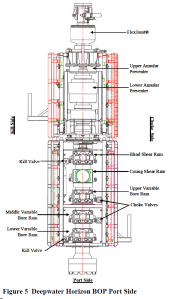
A shortened and simplified summary from information provided in the DNV report:

  1. The Upper Variable Bore Rams (VBRs) were closed prior to the Emergency Disconnect Sequence (EDS) activation at 21:56 on April 20, 2010.
  2. A drill pipe tool joint was located between the Upper Annular Preventer (closed) and the Upper VBRs (also closed). Forces from the flow of the well pushed the tool joint into the Upper Annular element. Because the tool joint was trapped beneath the closed annular preventer (and could not move upward), forces from the flowing well caused the pipe to push upward and buckle.
  3. The drill pipe deflected until it contacted the wellbore just above the Blind Shear Ram (BSR).  The portion of the drill pipe located between the shearing blade surfaces of the BSR was off center and held in this position by buckling forces.
  4. A portion of the pipe cross section was outside of the intended BSR shearing surfaces and did not shear as intended.
  5. As the BSR closed, a portion of the drill pipe cross section became trapped between the ram block faces, preventing the blocks from fully closing and sealing.
  6. Since the deflection of the drill pipe occurred from the moment the well began flowing, trapping of the drill pipe would have occurred regardless of which means initiated the closure of the BSR.
  7. In the partially closed position, flow continued through the drill pipe trapped between the ram block faces and subsequently through the gaps between the ram blocks.
  8. When the drill pipe was sheared on April 29, 2010, using the Casing Shear Ram (CSR), the flow expanded through the open drill pipe at the CSR and up the entire wellbore to the BSR and through the gaps along the entire length of the block faces and around the side packers. The CSR was designed to cut tubulars, not seal the well bore.

sheared off-center drill pipe

Read Full Post »

« Newer Posts - Older Posts »