Feeds:
Posts
Comments

Archive for December, 2010

Happy New Year!

Memories of 2010 will not soon be washed away, nor should they be. These memories will help guide us into the future.

Obviously, big challenges lie ahead for the offshore oil and gas sector.  Open and honest communication will be especially critical in 2011. No company or agency can resolve the issues independently, and everyone must be willing to participate.

As always, I’ll celebrate at midnight GMT, and will be fast asleep when the new year officially arrives at BOE World Headquarters :).  Here’s to a successful and fulfilling 2011!

Read Full Post »

Good article on the oil and gas industry safety institute proposal.

Read Full Post »

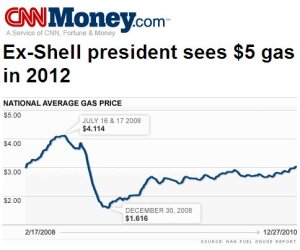
John Hofmeister sure knows how to make headlines. I suspect he may be right on this one.

If we stay on our present course there is no question but that prices will rise to the $5.00 gallon level by 2012 in my opinion. CNN Interview

Conflicting fears will shape the offshore energy policy debate in 2011 – fear of another Macondo vs. fear of soaring oil prices. Industry and government need to make the necessary changes in safety programs and move ahead. We can’t afford to embargo ourselves.

Read Full Post »

A colleague sent a link to a Marathon Oil Company Macondo presentation that was posted by the Houston Chronicle. The presentation was intended for internal training and discussion purposes.

Firstly, I applaud Marathon for ensuring that the blowout is studied and debated within the company. Hopefully, they did the same thing for Montara, have a good internal system for studying accidents throughout the industry, and thoroughly investigate all of Marathon’s incidents and near misses.

I thought Marathon’s comments about safety culture were particularly interesting, including these on slide 58:

Although harder to define and measure, and even more difficult to regulate, we pointed to our culture as the single most important differentiating attribute when comparing us to BP.

In a recent meeting with an individual who has numerous dealings with BP, he observed that regardless of the purpose of the gathering (planning session to morning rig call), it is almost impossible to determine who is ultimately responsible and accountable for the operation being discussed. Evidence of this exists in the very report this presentation was derived from.
I wonder what convinces Marathon that their safety culture is superior. The above anecdote, while interesting, doesn’t tell us much. Prior to Macondo (and perhaps even after the blowout), I’ll bet most BP employees thought that they had a strong safety culture. Ditto for Transocean. Does Marathon have any better evidence demonstrating the strength of their safety culture? If not, what makes them so confident? Does Marathon have a process for assessing and monitoring the attitude and commitment of their employees? Have they conducted regular internal surveys to gauge safety culture? My sense is that they have not. If they had, they could make their case without the very subjective comparison with BP.

Read Full Post »

Posted with the approval of the Rig at Sunset Foundation

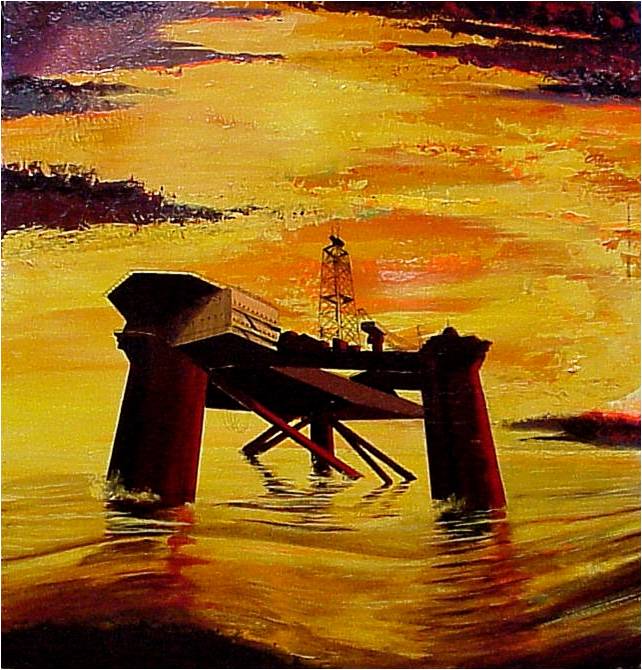
As a holiday gift to our readers, BOE has obtained exclusive rights to post this picture of the masterpiece “Rig at Sunset,” the world’s most famous and artistically significant painting of an offshore drilling rig.

“Rig at Sunset” was painted 45 years ago by a US Geological Survey (USGS) employee who has chosen to remain anonymous.  Initially, the masterpiece was presented to  USGS (later MMS)  engineers and scientists who had made important contributions to the offshore oil and gas program.   Understandably, the intended recipients were so humbled by the magnificence of the painting that they could not accept it.  As the painting grew in value and international prominence, framed copies were presented to retirees and the original painting was kept at an undisclosed location.

Great museums have an eye for artwork that is bold and unique, and curators soon lined up for an opportunity to exhibit “Rig at Sunset.” The masterpiece has now appeared at the world’s top art museums including the Louvre, the National Gallery, the Tate in London, the Rijksmuseum in Amsterdam, the Norwegian Petroleum Museum in Stavanger, and the Jo Ann Rose Gallery at the Reston Community Center.  While the permanent home of the painting is a well kept secret, it is rumored to be a maximum security facility in historic (and heavenly) Herndon, Virginia, the gateway to Dulles International Airport.

At a later date, BOE will explore the painting’s symbolism and artistic significance, but for now we just want you to appreciate its stunning beauty. Enjoy the holidays!

Read Full Post »
BOE applauds retired offshore regulators Ian Whewell (UK HSE) and John Clegg (NOPSA Australia) for their excellent participation in yesterday’s hearings. No one is wiser than a retired regulator. 😉

Also, Magne Ognedal overcame technical glitches to make an important long-distance contribution from Norway.  Those who have not yet read our interview with Magne should take the time to do so.  In this interview, which was conducted before Macondo, Magne concisely answers most of the questions about the Norwegian regime and regulatory philosophy that have arisen since the blowout.

Read Full Post »

In addition to suing for damages, the Justice Department is seeking civil penalties.  The amount has not been specified.

In the complaint, the United States alleges violations of federal safety and operational regulations, including:

  • Failure to take necessary precautions to secure the Macondo Well prior to the April 20th explosion;
  • Failure to utilize the safest drilling technology to monitor the well’s condition;
  • Failure to maintain continuous surveillance of the well; and
  • Failure to utilize and maintain equipment and materials that were available and necessary to ensure the safety and protection of personnel, property, natural resources, and the environment.

Read Full Post »

President-elect Dilma joked recently that the oil discoveries were just the latest proof that God is Brazilian. And economists from Goldman Sachs no less are predicting that Brazil — along with Russia, China and India — will dominate the world economy in the 21st century.

If you didn’t see the 60 Minutes story on Brazil, you can view it here. With regard to the significance of Brazil’s recent deepwater discoveries, OGX owner Eike Batista offered the following:

Oh, it, it means we should be producing in excess of six million barrels a day. So it’ll put us in among the third, fourth largest producer in the world. Massive exporting.

According to this blog entry, Batista forecasts this 6 million bopd production rate (more than double the current output) by 2020!

Like other offshore producers, Brazil has experienced its tragedies, most notably the sinking of the P-36 production platform that resulted in 11 fatalities. Petrobras and Brazil have recovered nicely from that disaster, but outstanding safety performance is critical if they are to sustain their offshore success.

Read Full Post »

Agenda

Live Webcast

Read Full Post »

Globe and Mail report:

“I will be contacting the federal government to begin discussions about the setup of a stand-alone regulator,” Premier Kathy Dunderdale said to applause in the House of Assembly Monday.

The province’s action is in response to a recommendation in Judge Wells’ report on last year’s helicopter crash that killed 17.

Read Full Post »

Older Posts »