Feeds:
Posts
Comments

Archive for August, 2010

Jim Magill with unidentified official

After an outstanding 22-year career, Jim Magill is retiring from the US Coast Guard on 27 August.  Among other important responsibilities, Jim worked closely with the Minerals Management Service on OCS oil and gas issues, served as  Executive Director of the National Offshore Safety Advisory Committee, and developed regulations for offshore rigs and platforms.

For most of his career, Jim worked on the Coast Guard’s epic Subchapter N rule for offshore facilities.  For reasons beyond Jim’s control, completion of this rule was excruciatingly slow, even by Federal rulemaking standards.  To give you a sense of how slow this process has been, we annotated the timeline on this geologic time chart! 🙂

Timeline for the Coast Guard's Subchapter N Rule (click on figure to enlarge)

We know Jim will enjoy his new home, golf, consulting, and all of his “retirement” endeavors; and Subchapter N will now be someone else’s problem!

Read Full Post »

The Canadian Senate has decided that the facts do not justify banning Canada’s offshore drilling operations.  The full report is linked.

The Senate also showed support for the International Regulators’ Forum.  Canada will be hosting a major international conference in Vancouver in October.

The committee heard sufficient evidence to make it comfortable with Canada’s (federal and provincial) approach to striking this risk/reward balance andwith its new judgment-based and goal-oriented regulatory approach. Canada is a leading participantin the International Regulators Forum, a group of offshore industry regulators from the most activeoffshore drilling nations, including Norway, the United Kingdom, the United States, Australia, NewZealand, the Netherlands and Brazil. Interestingly, none of these nations have called for or imposedbans on current offshore drilling operations within their jurisdictions following the BP incident.

Read Full Post »

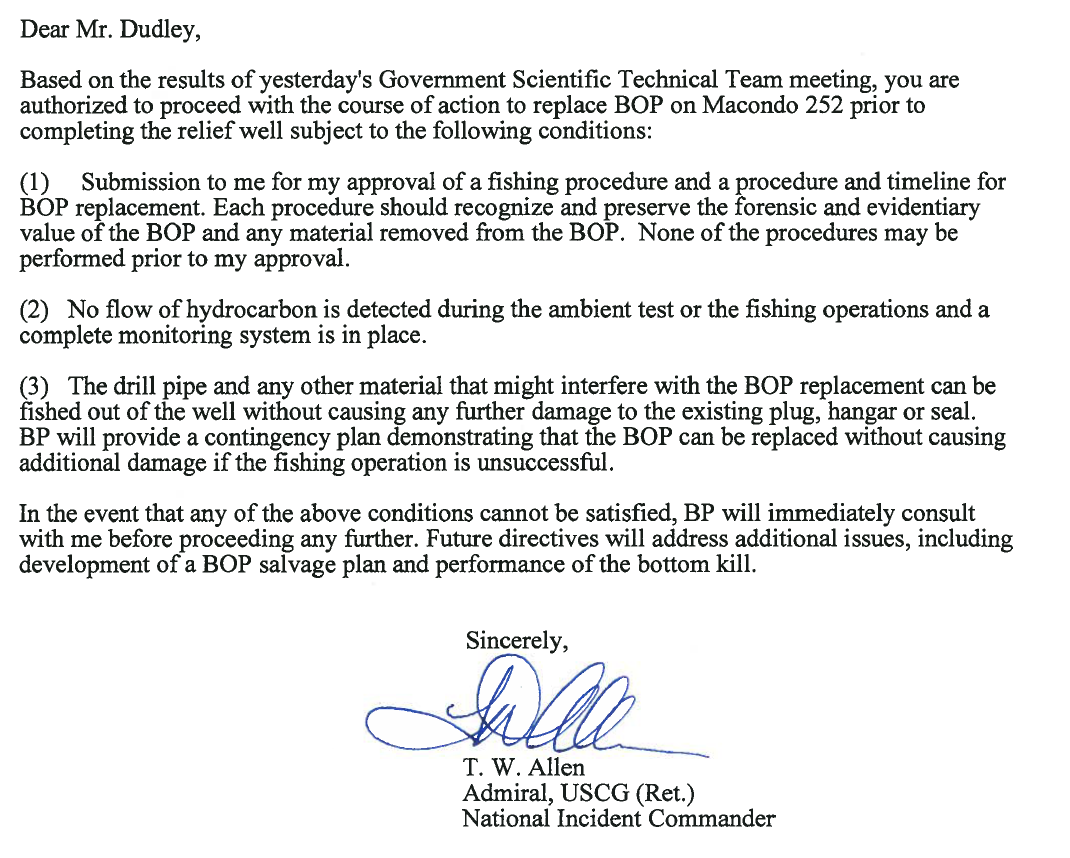
Aug. 19, 2010 letter, click to enlarge

With the new BOP in place, and the capability to enter the well from the top, squeeze cement into the annulus, and set and test plugs, the relief well intercept appears to add nothing but risk.  Is the relief well being finished because of the repeated “read my lips” statements about its necessity or is there a valid reason that we are missing?

Also, with the well killed, should the Incident Commander be directing and approving operations that seem to fall under the plugging and abandonment category?  Those operations are under the purview of the Bureau of Offshore Energy Management, Regulation, and Enforcement (BOEMRE) in the Department of the Interior.  (Actually, according to the applicable MOU, (see section 10), BOEMRE should have had the lead on well control and flow abatement since the well blew out on April 20.)

Read Full Post »

Like all swinging voters, Dirty Harry – a saltwater crocodile admired for his prediction prowess – took his time sniffing out the candidates in his enclosure at Crocosaurus Cove in Darwin today. Refusing to make a snap decision, Harry – reluctantly it seemed – chose the chicken carcass that was attached to a caricature of Prime Minister Julia Gillard.

Link

Should the croc be correct, BOE friend Martin Ferguson will presumably retain his cabinet position and release the Montara report as promised.  Why is the release of this report so important?

  1. While the transcripts of the Inquiry hearings do a pretty good job of identifying the well planning, cementing, barrier, and management issues that were contributing factors, the Commission’s confirmation of the specific root causes of the blowout is essential.
  2. Only a few BOE geeks and a handful of others have actually read all of the testimony and submissions.  The Macondo planners and Deepwater Horizon crew either were totally unaware of what happened at Montara or ignored what they had learned.  I suspect that the former was the case.
  3. Important emergency response issues, which received minimal attention during the Montara hearings, will likely be discussed in the report.  Montara demonstrated that capping and containment operations can be more difficult for a surface well than they are for a subsurface well.   For safety reasons, a surface capping operation was prohibited at Montara.  Even if the operation was allowed, it probably wouldn’t have been successful because of the way the well was suspended.  Should well suspension practices take into account the possibility of a surface capping operation?
  4. The decision to move a rig from Singapore to drill the Montara relief well, rather than use rigs that were operating off Australia, has broad industry and regulatory implications.  Will this decision be assessed in the report?
  5. Finally, the Montara Commission makes recommendations for Australia’s offshore regulatory regime. These recommendations will be of great importance to the US and other nations that are reorganizing or initiating their regulatory programs.  We expect the Commission to recommend that a single agency regulate operational safety offshore Australia.  This is consistent with the recommendation in my testimony before the Senate Committee on Energy and Natural Resources and the approach taken by Norway and other leading offshore regulators.  A regulatory regime that includes multiple agencies with overlapping or segmented jurisdiction guarantees conflict, confusion, gaps, and inefficiency.  Wells, platforms, and pipelines are integrated drilling and production systems, and must be regulated as such. Similarly, permitting, auditing, and inspection are integrated regulatory functions that cannot be effectively divided among multiple agencies.  One regulator must be responsible and accountable.

Read Full Post »

Not surprisingly, the television networks embraced the “Georgia Study,” which estimates that up to 79% of the Macondo spillage remains in the Gulf. Correspondents, bobbing from boats, rushed to report the news.  Does this mean that the networks will resume their courageous Key West oil-watch?  How about those damage projections for East Coast beaches?

Anyone who thinks that 79% of the oil remains hasn’t spent much time observing oil spills.  NOAA’s peer reviewed numbers are more credible.

The major newspapers, to their credit, seem to be providing balanced coverage of the new report.  The New York Times has a good article and this comment from Ed Overton seems to be pretty much on target:

Other marine scientists involved in evaluating the impact of the spill defended the government’s findings. “I generally agreed with the results,” said Edward Overton, a biologist at Louisiana State University who was one of several scientists who reviewed the federal study prior to its release. “I think it’s close to being on the mark.”

Read Full Post »

We are currently working with BP engineers and our science team to look at test results and do investigations to lead us to the best way to mitigate any risk of intercepting the annulus and increasing the pressure in the annulus. Admiral Allen

This insistence on drilling into a “killed well” reminds me of the Unified Command’s plan to end to end the “well integrity test” and vent the well after it had been successfully capped on July 15.  Fortunately, the Command showed good judgement and reversed that decision. Perhaps they should do the same with the relief well intercept, which no longer appears to be necessary and may be hazardous.

The obvious next step is to re-enter the well from the top, perforate the production casing and squeeze cement into the annulus, and proceed with the plugging and abandonment operation.  If the Command has reasons why this would not be the best approach, we’d like to hear what they are.

Despite the repeated “my way is the relief well” pronouncements, I trust that the Command will choose the option that accomplishes the objectives with the fewest risks to safety and the environment.

Read Full Post »

The filing of claims from far away “gives you some idea of the creativity of the claimant population.” Kenneth Feinberg, Administrator of BP Spill Fund

Link

Hopefully, Feinberg will be able to weed out most of the scammers.  Sadly, some of the people who are most deserving will be too proud to submit a claim.

Read Full Post »

While the author was apparently unaware of the recent crane failure and fatality on Transocean’s Jack Ryan, that and other offshore crane incidents (not only on Transocean rigs) came immediately to mind in reading this Washington Post article.  Readers should also be aware of the crane safety program of the International Regulators’ Forum.  From the  Washington Post article:

Case in point: In April, the company that owned the rig gave parts of two cranes (on the Deepwater Horizon) its worst rating, indicating that they did not work or should be removed from service.

Were the cranes removed from service pending corrective action?

Read Full Post »

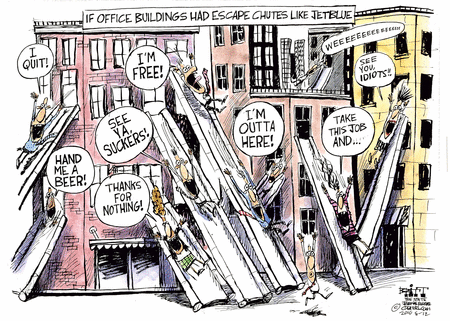
by Chris Britt, Creators Syndicate

Offshore worker escapes to new life!

Read Full Post »

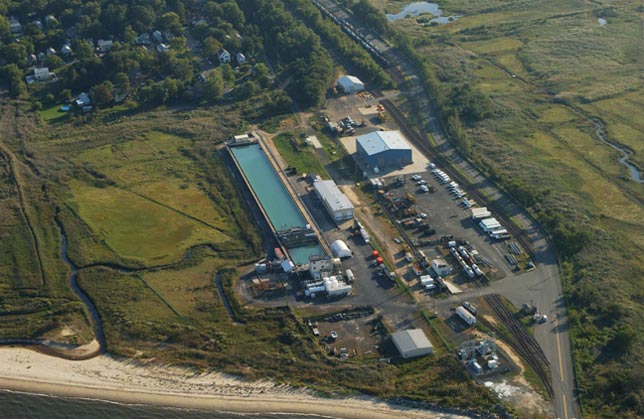
Ohmsett

The top team that demonstrates the ability to recover oil on the seawater surface at the highest oil recovery rate (ORR) and recovery efficiency (RE) will win the $1 million Grand Purse. Second place will win $300,000 and third place will win $100,000 in purses

Are you confident that your innovative oil skimmer is better than the rest?  Now is the chance to prove it.  Amaze the world, win a million bucks, and put yourself in position for some major contracts.  Skimmer vs. skimmer in a challenging test tank competition.

Show us what ‘ya got!  We’ll be watching!

Link for more information.

Read Full Post »

« Newer Posts - Older Posts »