Feeds:
Posts
Comments

Archive for April, 2010

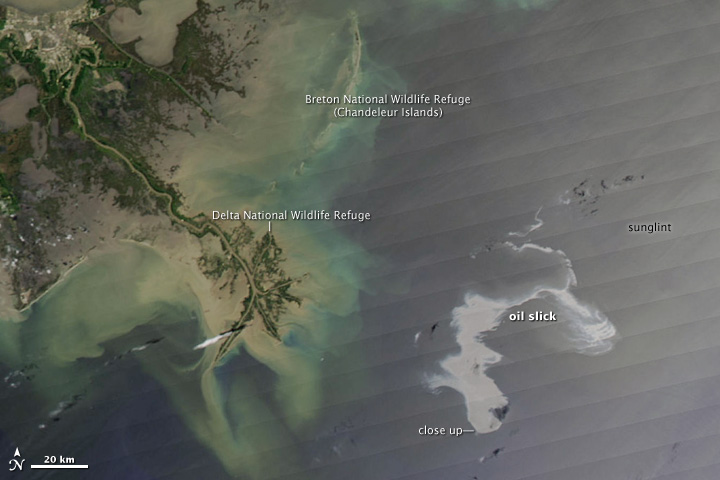
NASA Image

Unified Command News Conference highlights:

  1. Attempts to actuate the BOPE have not been successful.  New options are being developed and applied.  4 ROVs are working around the BOP stack.  They are connecting to the stack, but have not been able to successfully actuate rams.
  2. The shear ram on the BOP stack should have actuated when the rig lost power and when the riser was separated from the stack by ROV.
  3. The responders are still estimating a 1000 bopd spill rate.  This is thought to be the deepest water ever (5000′) for a significant seafloor spill.
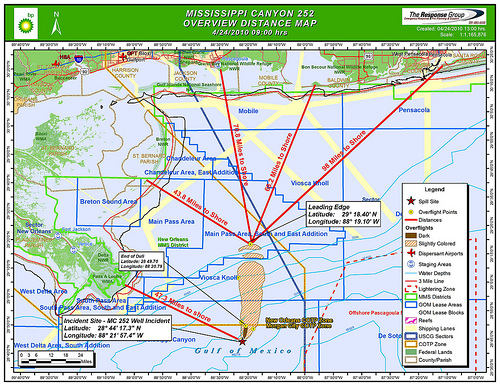
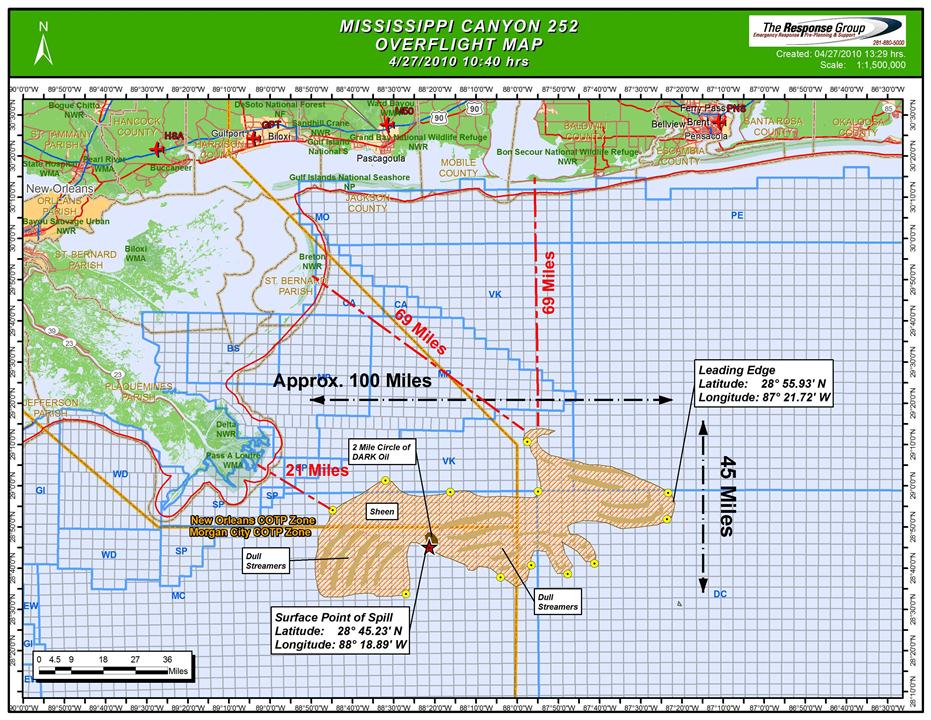
  4. The leading edge of spill is 20 miles south of Venice, LA.  No landfall is suggested in the next 3 days.  3740 barrels of oil water mixture have been recovered.  Comment: No information has been provided on the estimated percentage of the mixture that is oil.
  5. The responders are prepared to remove oil from the water by burning  the oil in situ within a fire boom.  Comment: Good call.  Burning can quickly and completely remove oil from the water if the slick is sufficiently thick.  Kudos to my former colleague Ed Tennyson who was the scientific and inspirational leader in developing this response capability.
  6. The subsurface containment system (seafloor dome) will be ready in 2-4 weeks.  Construction is underway.  The recovered fluids will be transported to a production system on the Enterprise drill ship.
  7. The relief well permits will be approved today.  The Deepwater Driller III is on location 0.5 miles from the flowing well.  The plan is to intercept the 7-inch casing near total depth.  Comment: This implies that BP believes the well is flowing inside the production casing and not in the annulus.
  8. The current cost for the response is more than $6 million per day.  Comment: This could easily become the most expensive spill response operation in history.
Read Full Post »

Unified Command News Conference update:

  1. Efforts to actuate the BOPE continue, but no details were provided.  In my opinion, the Unified Command could be more transparent about the BOP actuation program and results.  This is a critical aspect of the response.  At a minimum,  a brief summary of the work that has been performed and the outcomes should be provided.
  2. Preparations for drilling 2 relief wells continue.  The decision to initiate 2 wells is applauded, and increases the likelihood of a timely and favorable outcome.
  3. To date, there have been no shoreline impacts from the spill.
  4. 3 whales were observed in the area.
  5. The Ocean Endeavor has been evacuated for precautionary reasons (see below).

Read Full Post »

Upstream reports that Diamond Offshore has evacuated the Ocean Endeavor as a safety precaution because the Macondo slick may be moving in the direction of the rig.

Read Full Post »

Benton F. Baugh, who holds numerous patents for blowout preventer parts, said the subs should be able to do the job.

“If they can’t get it closed off, something really unusual happened,” said Baugh, president of Radoil Inc. in Houston and a National Academy of Engineering member.

Comment: I agree, and think they will be successful.  However, it looks like drill pipe will have to be sheared and this is not a slam dunk.  Remote BOP activation capability, which will surely be a major issue in the aftermath of this incident, will be an exponentially bigger issue if the ROV actuation is unsuccessful.  The importance of this ROV effort cannot be overstated.

Kenneth E. Arnold, an offshore production facility expert and another member of the engineering academy, said drilling a relief well is not an easy task.

“You have to intersect the well,” he said. “Sometimes you have to drill through the steel, and that’s what happened in Australia. It took them three times before they were successful.”

Comment: Ken is on target as usual, although it actually took five attempts to intercept the Montara well.  BP has mentioned “relief wells” so they may be using more than one rig to accelerate the drilling and maximize the chance of success.  Hopefully, relief wells will not be necessary.

link

Read Full Post »

While the tragic loss of life cannot be reversed, the responders appear to be making every effort to secure the well and minimize environmental damage.  Plans are moving ahead on several fronts as highlighted below:

  1. ROVs are being deployed to actuate BOP rams and halt the flow.  For the spill is to be stopped quickly, this plan must be successful.  This picture indicates that there is drill pipe in the well and some flow inside the drill pipe.  The drill pipe will have to be cut with a shear ram to fully seal the well.  One or more other rams may be closed around the drill pipe.   I am sure the top subsea engineers in the world are working on this plan.  Unless there is damage to the BOP stack or other complications that haven’t been reported, I like their chances.
  2. The Deepwater Driller 3 will be on location on Monday to prepare to drill a relief well.
  3. Of great interest to scientists and engineers is the plan to install a collection dome on the seafloor and transport the oil and gas to the surface where it could be burned.  This would be an extraordinary feat given the water depth and flow rates.  One of the first such collection systems was Brown and Root’s famous “Sombrero” that was deployed during the Ixtoc blowout in 1981.  The Sombrero was considered a failure, but important lessons were learned.  A good MMS study of deepwater containment systems is linked.

Read Full Post »

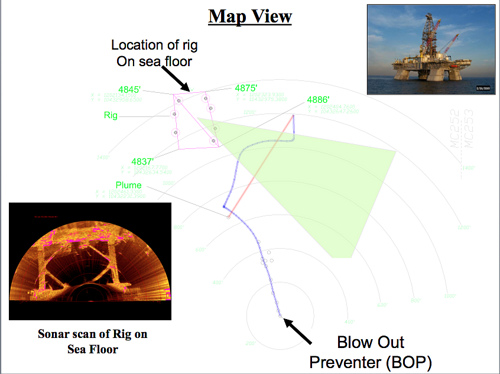
Map View

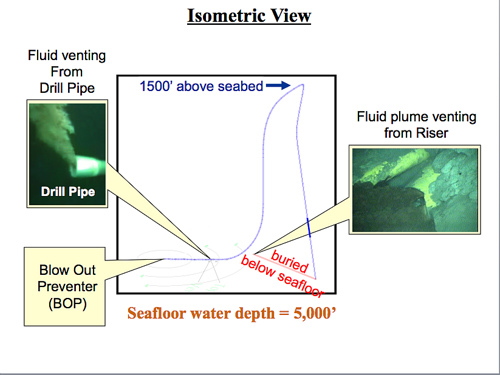
Isometric View

Link

Read Full Post »

Per Admiral Landry: The well is still flowing

  1. The estimated flow rate is 1000 BOPD.  This is a very rough estimate.
  2. Apparently the flow never stopped and oil is leaking from the end of the riser which is strewn just above the seafloor.  The flow was detected during an ROV search over the length of the riser.
  3. The Deepwater Horizon is on the seafloor 1300 feet NW of the well site.
  4. The oil is relatively light which should facilitate natural evaporation and dispersion.

Thoughts:  Given the absence of confirmation that BOPE have been actuated, yesterday’s “no flow” announcement was more surprising than today’s “still flowing” announcement.  While the new flow rate figure is a very rough estimate, the Admiral seems confident that flow is substantially reduced.  This could be attributable to the head (about 0.465 psi/fit)  imposed by 5000′ of seawater and the crimping of the riser pipe.  Also, given the apparent uncertainty about the BOPE, it is also possible that a BOP ram has been actuated but the well bore has not been completely sealed.

Read Full Post »

BOE on CNN

News segment

Read Full Post »

Volcano Ash Solution

Volcanic Ash Solution

While we have been intently focused on the Macondo well, BOE Europe Chief Odd Finnestad has been addressing the air transport issues associated with that really big blowout in Iceland!  Odd must miss his boss, who has been stranded in Rio (a likely story :))

Read Full Post »

Senior Chief Petty Officer Mike O’Berry said remote controlled submarines have been unable to shut the valves on equipment at the wellhead on the sea floor, but it appears the flow of oil from subsurface reservoirs has stopped on its own.  Houston Chronicle

It’s surprising that the flow would stop on its own.  They were reported to have just set production casing, so the well was fully cased.  Perhaps the flow emanated from the production casing annulus, and sediments bridged or plugged the annulus?  It will be interesting to see what the next steps are.  An attempt to reconnect to the well with a new rig and riser would seem unlikely unless they can confirm that the BOPE is functioning properly.  It seems likely that the relief well will continue.

Read Full Post »

« Newer Posts - Older Posts »