Feeds:
Posts
Comments

Posts Tagged ‘Strategic Petroleum Reserve’

Read Full Post »

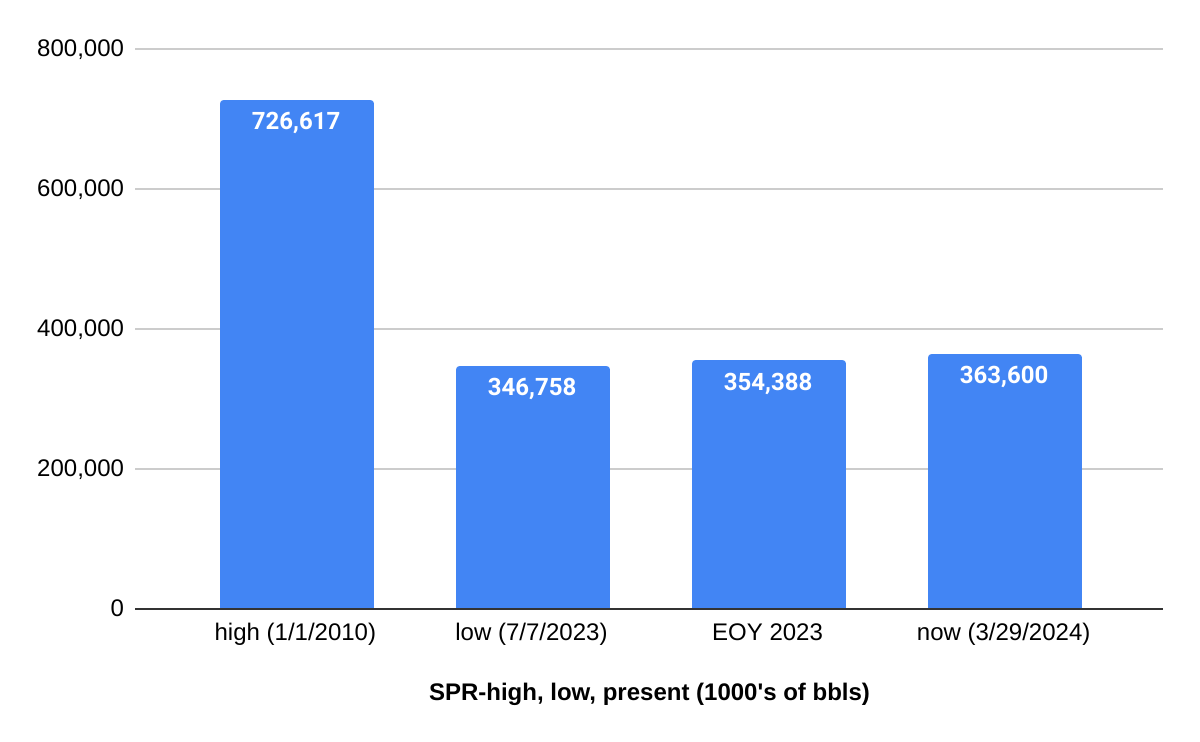
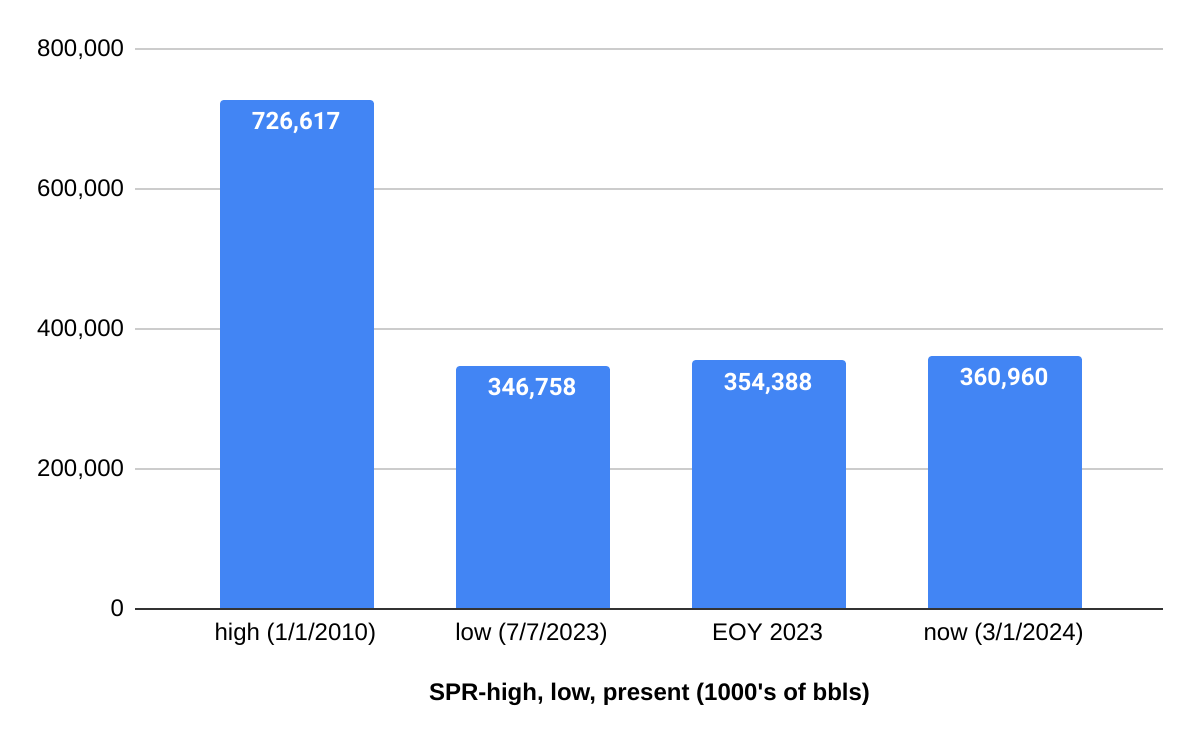
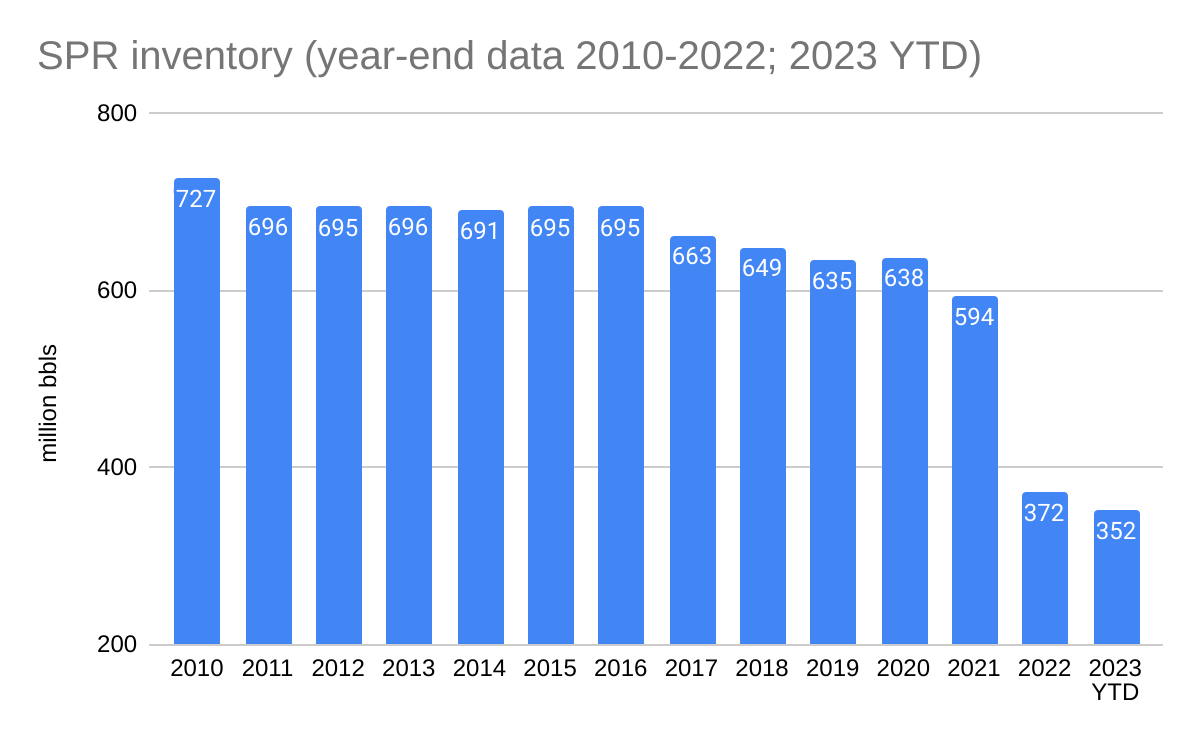
Huh? Since 9/1/2023, the SPR has increased from 350.34 million bbls to 351.9 million bbs, a total of only 1.56 million bbls. From the historic low of 346.76 bbls on 7/7/2023, the SPR has increased by just 5.14 million bbls, and remains at only 48% full. The total refill since the 2023 low amounts to only 0.7% of capacity.

DOE knew that refilling the SPR would be a very slow process given the significant acquisition, operational, and maintenance challenges. Nonetheless, political concerns about oil prices were prioritized and the reserve was recklessly depleted.

Prediction: The SPR will still be <400 million bbls at the end of 2024.

Read Full Post »

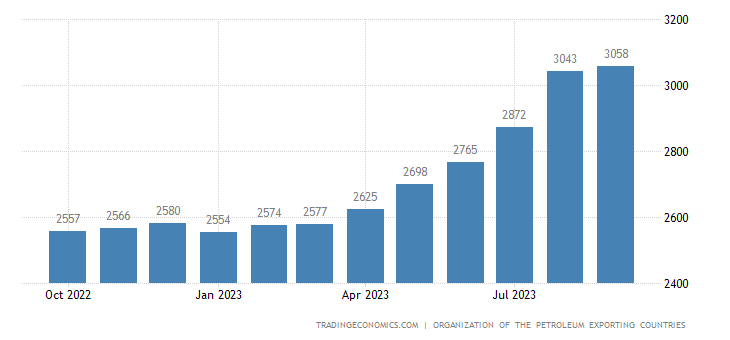
Consistent with analysts suggestions that the US is reluctant to tighten sanctions on Iran because of concerns about oil markets, note that Iranian crude oil production began ramping up in early 2023 (see chart below) shortly after the massive Strategic Petroleum Reserve withdrawals had ceased. The increase in Iranian production in 2023 of ~500,000 bopd is comparable to the SPR withdrawal rate for 2022 (averaged 608,000 bopd).

Given that further depletion of the SPR was no longer politically acceptable, a cynic might suggest that oil market considerations associated with the end of SPR withdrawals and OPEC tightening (Iran is currently exempt from OPEC quotas) factored into decisions regarding the relaxation of sanctions on Iran.

crude oil production: Iran

The US is also prepared to ease sanctions on Venezuelan oil production. Why is production from Iran and Venezuela preferable to US offshore production? Why is the US sanctioning itself by enacting a controversial and punitive 5 year offshore leasing plan?

Read Full Post »

WASHINGTON, Aug 1 (Reuters) – The Biden administration has pulled an offer to buy 6 million barrels of oil for the Strategic Petroleum Reserve, an Energy Department spokesperson said on Tuesday, as oil prices are expected to keep rising after a output cut from Saudi Arabia.

So much for adding a few drops to the SPR bucket. When your reserve is down 380 million barrels in a seller’s market, you don’t have a lot of purchasing leverage. Don’t expect much of an SPR refill anytime soon. It’s easy to deplete strategic assets; much more difficult to replace them.

Read Full Post »

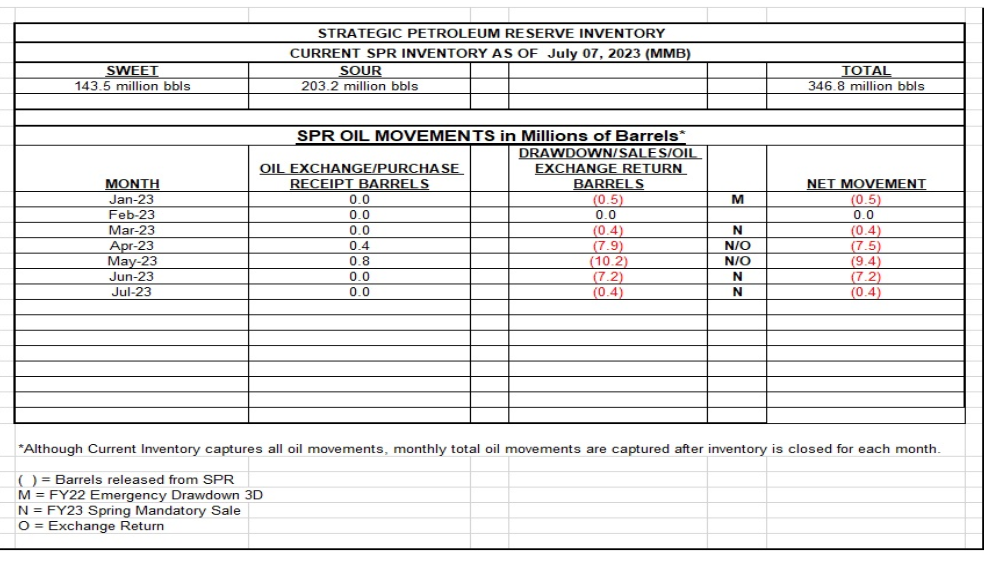
The Strategic Petroleum Reserve has held steady at 346.8 million bbls for the past 3 weeks. DOE’s latest update is as of 7/28/2023.

Previous SPR post

Read Full Post »

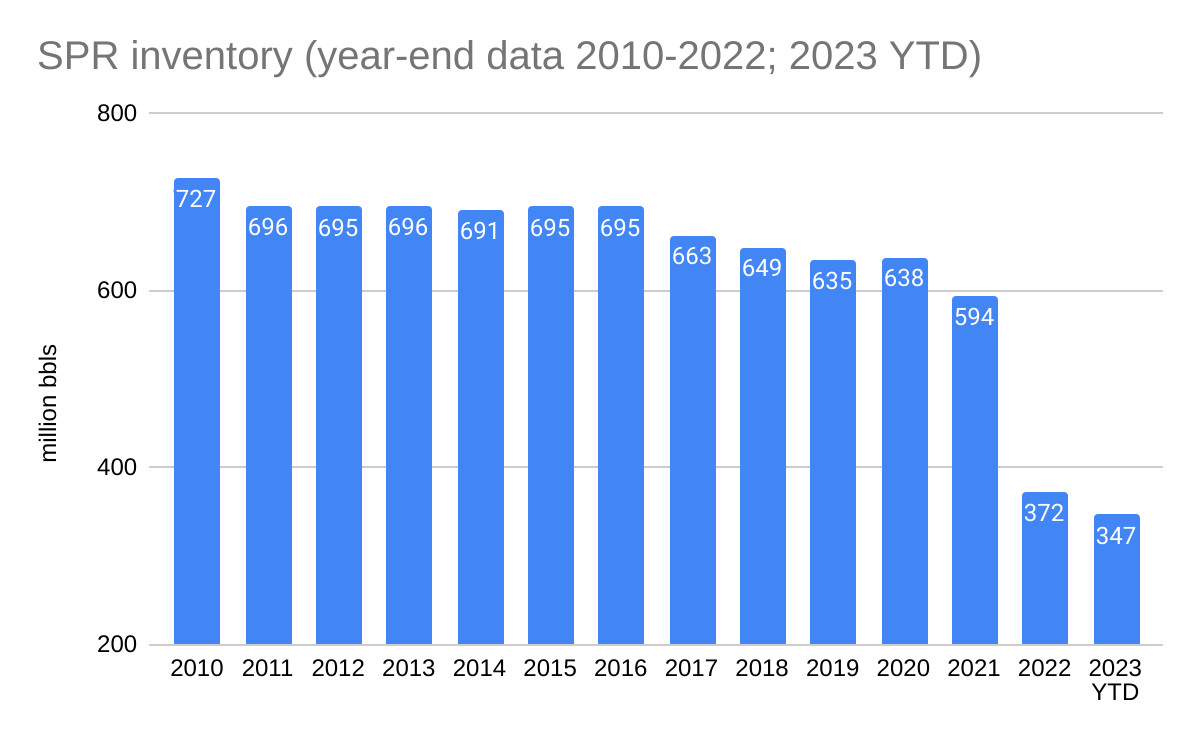
The Strategic Petroleum Reserve is ⬇ to 346.8 million barrels, the lowest volume since August 19, 1983, when the SPR was still being filled.

But fear not, 6 million barrels, which is less than 1/4 of the amount withdrawn just in 2023 YTD, are to be added in the fall, and Secretary Granholm assures us that the SPR will be refilled (but not completely and maybe not until the Administration’s second term 😀).

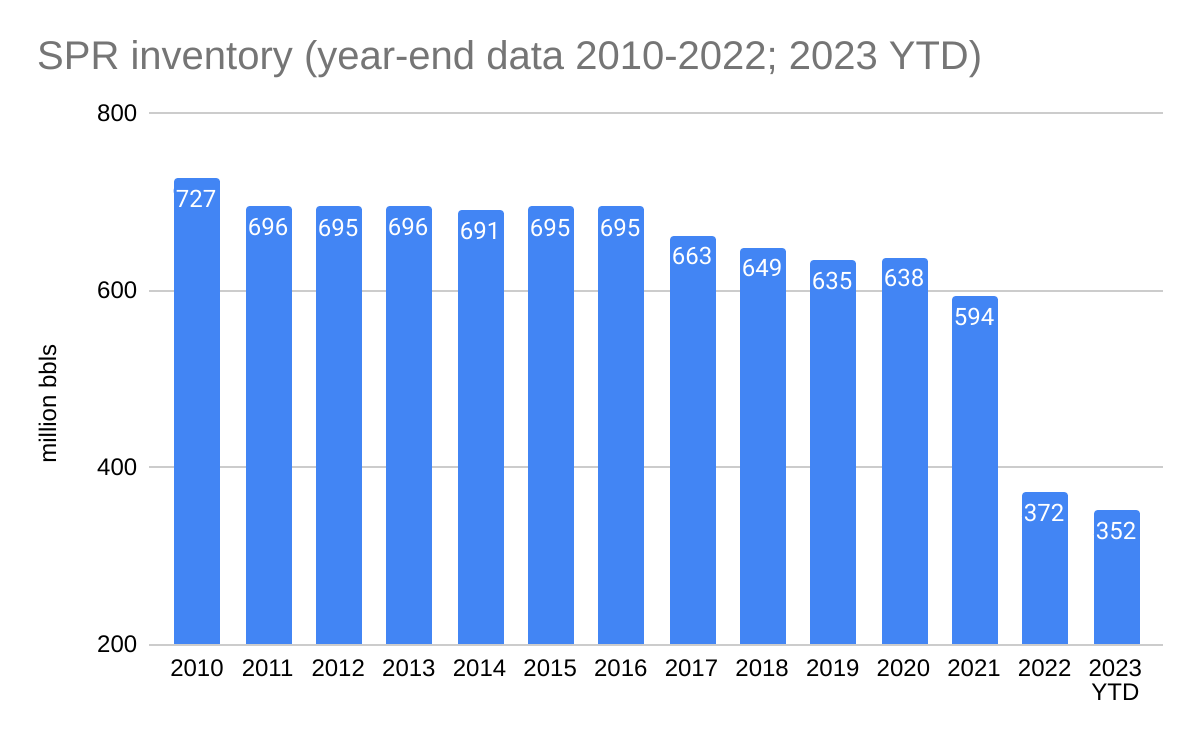
Keep in mind that DOE only intends to buy when prices are <$72/bbl, that the maximum refill rate is 685,000 bopd, and that acquisition, operational, and maintenance delays are to be expected .Filling the reserve to its 727 million barrel capacity was a 28 year process.

Read Full Post »

Meanwhile, the Strategic Petroleum Reserve is down to 348.6 million barrels as of June 23, but 6 million barrels, a relative drop in the bucket, are to be added in the fall.

Read Full Post »

WASHINGTON, D.C. — Today, the U.S. Department of Energy’s (DOE) Office of Petroleum Reserves announced that contracts have been awarded for the acquisition of 3 million barrels of U.S. produced crude oil for the Strategic Petroleum Reserve (SPR).  These contracts follow the Request for Proposal that was announced on May 15, 2023. Furthering the Biden-Harris Administration’s three-part replenishment plan, DOE also announced a new Notice of Solicitation to purchase approximately 3.1 million additional barrels of crude oil to the Big Hill SPR site this September.

DOE (6/9/2023)

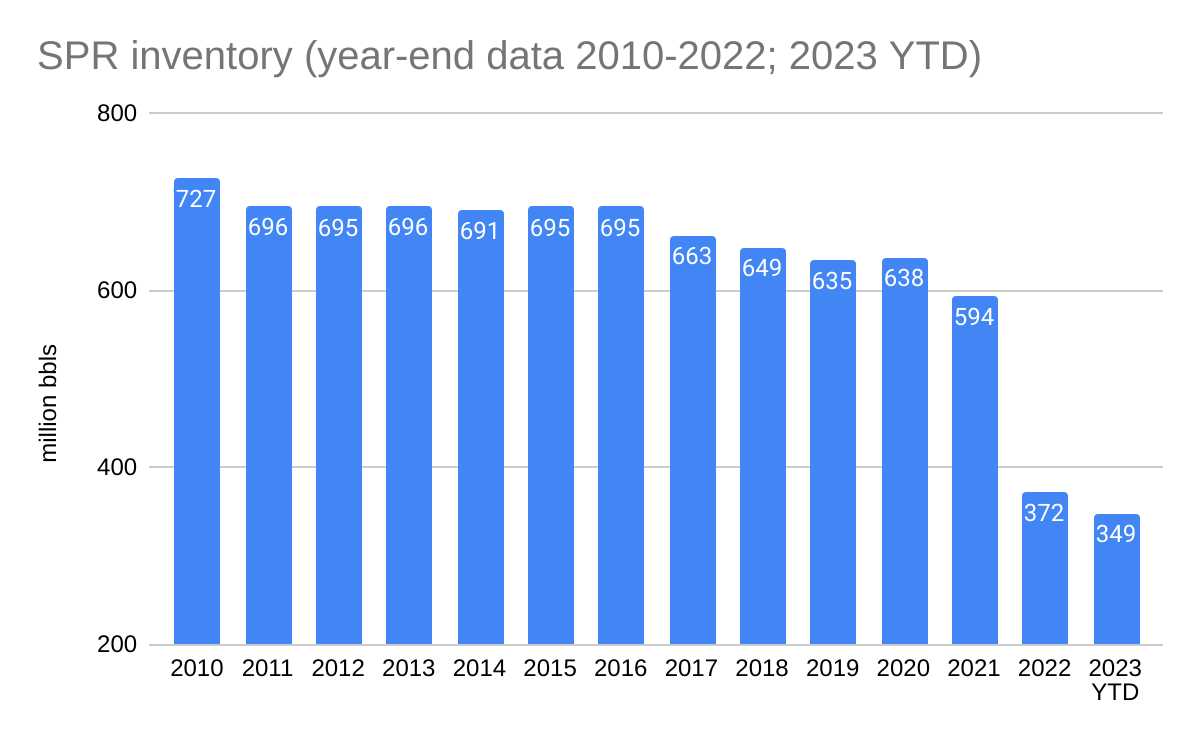
The Strategic Petroleum Reserve is now down to 351.7 million bbls, the lowest since 8/26/1983. The 6 million bbls in contracted and proposed purchases will replace only 30% of the oil withdrawn just in 2023 YTD, 2.0% of the amount withdrawn since 1/1/2021, and 1.6% of the volume needed to refill the SPR to capacity.

Given that 2024 is an election year, the prospects for substantial purchases next year would seem to be poor.

Read Full Post »

Per the latest update (5/12/2023), the Strategic Petroleum Reserve is down to 359.6 million barrels, more than 2 million bbls below the previous week. The “deficit” (i.e. the volume needed to completely refill the reserve) is now 367 million bbls, and you can’t print oil. The reserve volume is the lowest since 9/23/1983, when the SPR was still being filled.

Remember:

  • The maximum refill rate is 685,000 bopd. 
  • A complete refill at the maximum rate would require 536 days.
  • This excludes acquisition, operational, and maintenance delays, which are likely to be significant. 
  • Just adding 100 million barrels would require at least 146 days
  • Purchases of that magnitude significantly affect oil markets. Total US oil production is currently about 12 million bopd.
  • Filling the reserve to its 727 million barrel capacity was a 28 year process.

But fear not, DOE is soliciting the replacement of 0.1 to 1.0% of the oil that has been withdrawn from the SPR since January 2021. This amounts to only 2.5 to 25% of the oil sold from the reserve in 2023 alone (when we were supposedly refilling the reserve) and 0.04 to 0.4% of capacity!

DOE issued a solicitation May 15 for the oil, with delivery to occur Aug. 1-31, at a minimum offer quantity of 300,000 bbl and a maximum offer of 3 million bbl. Requests for earlier deliveries will be accommodated to the extent possible on a best-efforts basis.

OGJ

Meanwhile, oil demand and supply data do not look particularly favorable for any long term SPR purchases.

Read Full Post »

Per Bloomberg, DOE says they could begin refilling the reserve this fall “if the price is right.” What if it isn’t?

Keep in mind that the maximum refill rate is 685,000 bopd. A complete refill at the maximum rate would thus require 533 days, not counting acquisition, operational, and maintenance delays. Filling the reserve to its 727 million barrel capacity was a 28 year process.

Lastly, when will DOE conduct the strategic SPR review called for by the General Accountability Office (GAO) in 2018, well before DOE began rashly withdrawing oil to moderate prices? DOE concurred with GAO’s priority recommendation for periodic strategic reviews of the SPR that would be submitted to Congress. DOE told GAO that they “would complete a SPR Long-Term Strategic Review by the end of fiscal year 2021–5 years from the last review in 2016.” That review has still not been completed.

Update: Yesterday, members of Congress asked GAO to evaluate DOE’s management of the SPR and conduct an audit of the SPR modernization program.

Read Full Post »

« Newer Posts - Older Posts »