Feeds:
Posts
Comments

Posts Tagged ‘Russia’

Undersea nuclear

I’ll hold my opinions about nuclear power until the crisis in Japan eases. Instead, I thought I’d check on the status of offshore nuclear plant proposals.

Nuclear powered submarines date back to 1954 when the USS Nautilus was launched, and offshore nuclear plant concepts are almost as old. No such facilities have been built, but French companies are studying a subsea nuclear plant concept (see picture), and Russia has launched a floating nuclear plant prototype.

Less than a month ago, the Ecologist provided an update on the French and Russian projects. These plans will no doubt receive much more public attention as a result of the tragedy in Japan, but the French concept is quite interesting.

Pros:

Cores would be protected by three barriers: fuel cladding, reactor vessel and hull. The designers argue that immersion in sea water would ensure an infinite natural means of passive cooling and permit inherent safety and security. In addition, each plant would also be protected against potential intruders. The French argue that a submerged power plant would be less vulnerable to earthquakes, tsunamis, or floods, and would be far less vulnerable to terrorist attack.

Cons:

Sceptics are concerned that warmer water released from the reactors could be dangerous for local ecosystem. And, should there be a nuclear accident ‘the sea will be destroyed,’ according to the President of Anti-nuclear organisation Crilan, based in Cherbourg. ‘The fierce warming-up of the water will cause a massive thermal shock that will destroy sea life.’

Read Full Post »

No deepwater horizons in Russian arctic:

Developed by SevMash, the first Barents Sea oil rig will be a steel table the size of a football pitch and capable of withstanding temperatures of down to minus 50 Celsius. The whole point of it is that standing on the seabed, it will allow drilling and pumping the way they are done of firm land. This is a very far cry from the Deepwater Horizon. That platform was semi-submersed, positioned dynamically and designed to pump oil from beneath a mile of sea. When the oil gushed, the spill proved almost unstoppable. The Barents Sea platform will employ a very different production technology, which involves the use of powerful pumps. Chief Technology Officer of the Gazpromneft Shelf company Dr Alexander Kisser

Comment:

  1. Don’t demonize deepwater production to promote the arctic (or vice versa). The world needs responsible production from both.
  2. “Can’t happen here (or to me)” talk impresses no one. Explain how a disasters can happen to you and what you are doing to prevent them.
  3. Identify the special risks at your site and how they will be mitigated. Don’t tell us why the arctic isn’t the Gulf of Mexico.
  4. Perhaps we should present Can’t Happen Here awards as part of the Not My Job awards program.

Read Full Post »

From NPR:

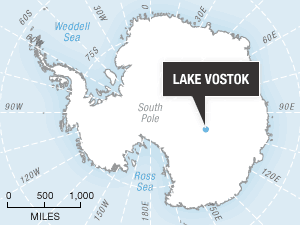
Russian scientists are on the verge of punching a hole into a vast Antarctic lake that’s buried under more than two miles of ice. If the Russians break through, they may tap into and disturb a primitive and pristine ecosystem has been untouched for millions of years.

One major concern is the Russians have filled the hole they’re drilling with more than 14,000 gallons of kerosene and Freon to prevent it from freezing shut. The Russians have engineered their system so that when they break through into the lake, water pressure from below is supposed to push the drilling fluids up the hole, rather than letting them pour into the lake and contaminate it.

Read Full Post »

« Newer Posts