

Feeds:
Posts
Comments

Posts Tagged ‘performance measures’

As is the case with many Federal and corporate entities, the Secret Service website is long on promotion and short on substantive details and performance data. The limited “Measurable Impact” statistics on their webpage advise that the Secret Service protected 6623 foreign and domestic visits “without incident” in Fiscal Year 2022, which ended 22 months ago.

Their 2024 budget request overview includes a bit more information (pasted below). The Secret Service gives themselves a perfect score if protectees arrive and depart safely. When your scores are always 100%, your performance measures are clearly inadequate.
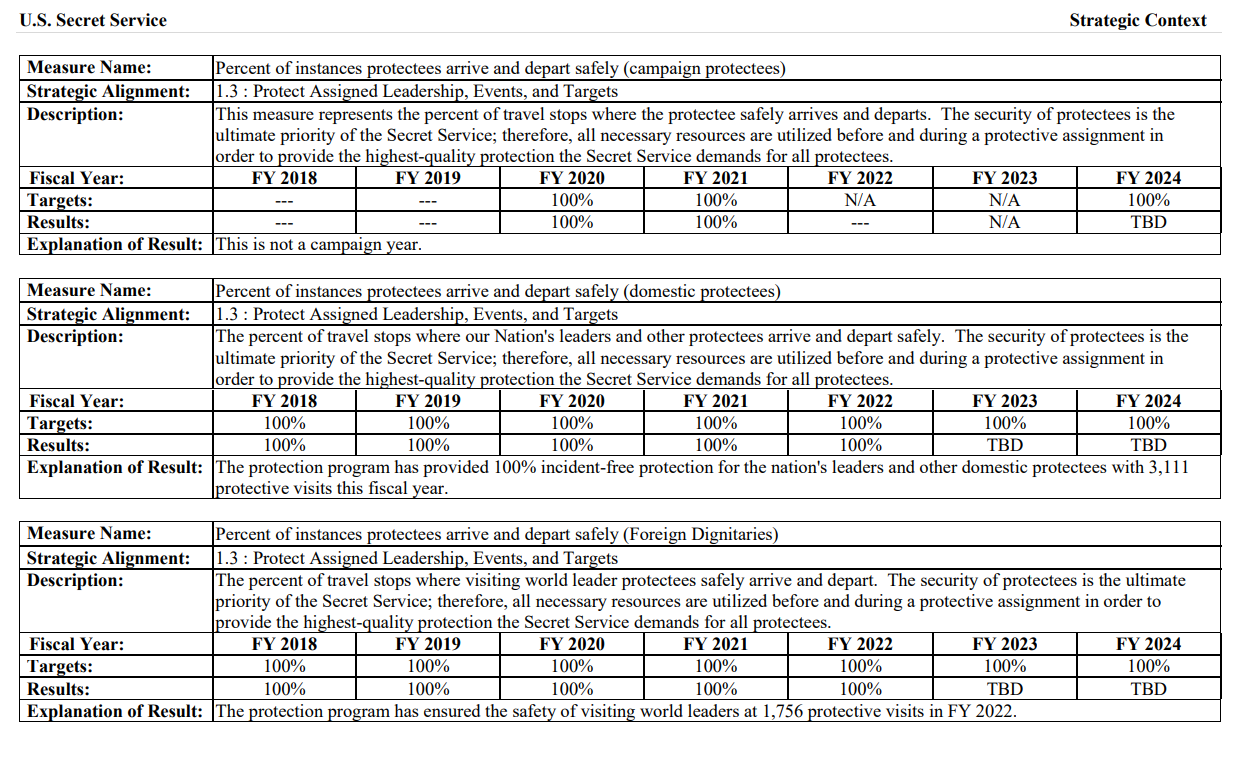
Like drilling blowouts, assassinations are low frequency, high consequence events. Prevention requires gathering data on lesser events, identifying leading indicators, and tracking high-potential precursors. You don’t prevent high consequence events by only tracking high consequence events.

Inspections are also critical. Does the Secret Service inspect events to assess protective measures such as verifying that the surrounding areas are cleared and being observed? If so, what do those numbers look like.

BSEE, the OCS safety regulator, does a good job of collecting data, but fails to compile and post updates in a timely manner. Their latest incident tables are for 2022, and even those data are incomplete. Panel investigations, which are conducted for the more serious incidents, now take 2.5 years to complete. This is unacceptable for an organization with BSEE’s talent, resources, and safety mandate.


Read Full Post »

  • Date: 3-4 Oct 2023
  • Location: Perth, Australia
  • Announcement

IRF conferences present an excellent opportunity for dialogue among regulators, operators, trade organizations, contractors, academics, and other interested parties.

Some suggested agenda topics for the Perth conference:

Read Full Post »

Among the more important workstreams of the International Regulators’ Forum, a group of offshore safety regulators, are country performance data which provide a means of measuring and comparing offshore safety performance internationally. As we near the midpoint of 2023, the last data posted are for 2020. This lag makes it difficult to assess current trends and risks.

In addition to more timely updates, there are significant holes in the IRF data sets. For example, per IRF guidelines fatalities associated with illnesses or “natural causes” are not counted; nor are helicopter incidents that are not in the immediate vicinity of an offshore facility. Also, incidents associated with geophysical surveys, many pipeline segments, and (inexplicably) subsea wells and structures are excluded (see excerpts below).

Excerpts from IRF Performance Measurement Guidelines:

  • Exclude Geophysical and Geotechnical surveying and support vessel operations not directly associated with activities at an Offshore Installation
  • Exclude horizontal components associated with incoming and outgoing pipelines and flowlines beyond either the first flange at the seabed near an Offshore Installation or a 500 meter radius, whichever is less.
  • Exclude helicopter operations at or near an Offshore Installation
  • Exclude mobile or floating Offshore Installations being transported to or from the offshore location.
  • Exclude subsea wells and structures.
  • Do not include Fatalities and Injuries that are self-inflicted.
  • Do not include Occupational Illnesses in Fatality or Injury counts.
  • Do not include fatalities that are due to natural causes.

Perhaps the IRF can consider these and other data collection and publication issues at their next conference. Because voluntary incident reporting schemes have always suffered from incomplete or selective reporting, the regulators have to drive incident data collection and transparency.

Parallel US concerns about offshore incident data: After a review of BSEE fatality data provided in response to a Freedom of Information Act request, WWNO reported that “nearly half of known offshore worker fatalities in the Gulf of Mexico from 2005 to 2019 didn’t fit BSEE’s reporting criteria.” They noted that 24 of the 83 known offshore worker fatalities during that period were classified as “non-occupational.” (As previously posted, the rash of “natural cause” deaths (12) at Gulf of Mexico facilities in 2021 and 2022 is particularly troubling and warrants further investigation.)

Read Full Post »