“If the sea state is too rough for a successful emergency ditching, then a helicopter shouldn’t be operating, period,” TSB’s Wendy Tadros said at a press conference in St. John’s Wednesday afternoon.
On Friday, the Canadian Association of Petroleum Producers said Newfoundland’s three offshore oil operators — Hibernia, Terra Nova and White Rose — would adopt the TSB’s recommendation.
Posts Tagged ‘Newfoundland’
Newfoundland operators to halt flights when seas are rough
Posted in accidents, tagged Canada, crash, helicopters, Newfoundland, offshore oil, safety on February 14, 2011| 1 Comment »
Canadian TSB releases helicopter crash report
Posted in accidents, tagged Canada, crash, helicopters, Newfoundland, offshore oil, safety on February 10, 2011| Leave a Comment »

Area map with helicopter track and impact position
BOE’s Cheryl Anderson has been tracking this story. Click here for the full TSB report.
Occurrence Summary:
On 12 March 2009 a Cougar Helicopters’ Sikorsky S-92A on a flight to the Hibernia oil production platform had a total loss of oil in the transmission’s main gear box. The flight crew descended to 800 feet and headed towards St. John’s. Approximately 35 nautical miles from St. John’s, during an attempted ditching, the helicopter struck the water in a high rate of descent. One passenger survived with serious injuries and the other seventeen occupants of the helicopter died of drowning.
Safety Issues
- Category A rotorcraft certified under the “extremely remote” criteria may not be capable of continued operation for 30 minutes with only residual main gear box lubrication.
- Given today’s operating environments, it may now be technically feasible and economically justifiable to produce a helicopter that can operate in excess of 30 minutes following a massive loss of main gear box lubricant.
- Helicopter crews and passengers in Canada remain at risk where helicopters are operated over sea states exceeding the capability of their Emergency Flotation Systems.
- Without a supplemental breathing system, occupants have very little time to egress from a submerged or capsized helicopter before breaking their breath-holds in cold water.
TSB Recommendations
- The Federal Aviation Administration, Transport Canada and the European Aviation Safety Agency remove the “extremely remote” provision from the rule requiring 30 minutes of safe operation following the loss of main gearbox lubricant for all newly constructed Category A transport helicopters and, after a phase-in period, for all existing ones.
- The Federal Aviation Administration assess the adequacy of the 30 minute main gearbox run dry requirement for Category A transport helicopters.
- Transport Canada prohibit commercial operation of Category A transport helicopters over water when the sea state will not permit safe ditching and successful evacuation.
- Transport Canada require that supplemental underwater breathing apparatus be mandatory for all occupants of helicopters involved in overwater flights who are required to wear a Passenger Transportation Suit System.
Canadian Helicopter Crash Report to be Released on Wednesday
Posted in accidents, tagged Canada, crash, helicopters, Newfoundland, offshore oil on February 7, 2011| 1 Comment »
The Canadian Transportation Safety Board’s report on the March 2009 helicopter crash that killed 17 workers offshore Newfoundland will be released on 9 February. This CTV piece provides a good summary of some of the significant issues that have surfaced in the press including:
Pre-crash warnings:
A Canadian investigator who red flagged main gearbox problems months before a Sikorsky helicopter crashed off Newfoundland says he’ll closely read a federal report on what caused the deadly accident.
Criticism of the FAA for their failure to respond:
He forwarded his results to the Federal Aviation Administration, the U.S. agency that originally certified the aircraft, saying he hoped to hear what a deeper probe would find.
FAA says “Not My Job:”
Les Dorr said the agency didn’t send any follow up research it did to Yearwood because it wasn’t under any obligation to do so under international agreements.
Transport Canada says “Not My Job” and points the finger at FAA:
Maryse Durette, a spokeswoman for the agency, says in an email the matter was the FAA’s responsibility and Transport Canada would wait for the original certifier to make recommendations before acting.
While the data suggest that the risk to offshore workers may be greatest when they are travelling to and from a facility, this investigation has received very little attention outside of Canada. That is unfortunate.
Report on Newfoundland helicopter crash to be released on 9 February
Posted in accidents, tagged accidents, Canada, helicopter crash, Newfoundland, offshore oil, Robert Wells, safety on January 22, 2011| Leave a Comment »
The Transportation Safety Board of Canada (TSB) will hold a news conference on Wednesday, February 9, 2011 to make public the final TSB investigation report (A09A0016) into the crash of a Cougar Helicopters Sikorsky S-92A off the coast of Newfoundland on March 12, 2009.
Independent Safety Regulator for Newfoundland?
Posted in accidents, tagged Canada, helicopter crash, Newfoundland, offshore oil, single regulator on December 14, 2010| Leave a Comment »
“I will be contacting the federal government to begin discussions about the setup of a stand-alone regulator,” Premier Kathy Dunderdale said to applause in the House of Assembly Monday.
Judge Wells Recommends Separate Offshore Safety Authority for Newfoundland
Posted in accidents, Regulation, tagged Canada, CNLOPB, helicopter crash, Newfoundland, regulatory philosophy, Robert Wells on November 18, 2010| Leave a Comment »
Judge Wells’ report is quite expansive in a way that may be unprecedented for a helicopter accident review. His commission delves into cultural and organizational issues and regulatory philosophy. Consistent with the international trend, the commission recommends a separate safety authority (page 302):
It is recommended that a new, independent, and stand alone Safety Regulator be established to regulate safety in the C-NL offshore. Such a Safety Regulator would have to be established, mandated, and funded by both Governments by way of legislative amendment, regulation, or memorandum ofunderstanding, or other means.
In his background remarks, Judge Wells makes this comment on regulatory culuture:
I have come to believe that regulation to be effective must encompass more than a list of do’s and don’ts. It must set in place and lead an inclusive regime of many players, some very important, others less so. All the available knowledge, skills, and wisdom of all participant sshould be harnessed in the safety cause.
Several interesting items!
Posted in Uncategorized, tagged accidents, Australia, blowouts, Canada, macondo, Newfoundland, NOPSA, offshore oil, safety, safety culture, well control on September 30, 2010| Leave a Comment »
- The Canada-Newfoundland and Labrador Offshore Petroleum Board unveiled their new website. Very impressive!
- Jane Cutler, CEO of NOPSA (Australia), made an outstanding (must-view) presentation on Safety Priorities for 2010. My favorite quote:
Safety culture is how the organization behaves when no one is watching.
Also, NOPSA’s September Newsletter has some interesting updates including information on the jackup failure offshore China.
- Joel Achenbach, a very good reporter, wrote an excellent Washington Post article on that addresses some of Macondo’s human and organizational factors. I do disagree with the deepwater emphasis, particularly his BOP comments. As we have noted on several occasions, subsea BOPs have a far better performance record than surface BOPs. Also, having the stack right at the surface is a hindrance, not a benefit, if the rig is on fire.
And how does a reporter question the humility of engineers? 🙂
Engineers do amazing things, but they aren’t always as smart as they think, nor their systems as robust as they seem on paper.
Personnel removed from offshore Newfoundland rigs in advance of Igor
Posted in Uncategorized, tagged Grand Banks, Igor, Newfoundland, Ruelokke, transocean on September 21, 2010| Leave a Comment »

Max Ruelokke
As a precaution in advance of Hurricane Igor, all personnel were removed from two Transocean rigs operating offshore Newfoundland. The rigs are the GSF Grand Banks and the Henry Goodrich. Igor headed for Newfoundland after battering Bermuda yesterday.
Max Ruelokke, Chairman and CEO of the Canada-Newfoundland and Labrador Offshore Petroleum Board, told BOE that this is the first time he can recall a Grand Bank’s rig being down-manned to zero in advance of a storm. Personnel are expected to return to both rigs tomorrow.
Ocean Ranger
Posted in accidents, tagged accidents, Canada, Newfoundland, Ocean Ranger on February 15, 2010| Leave a Comment »
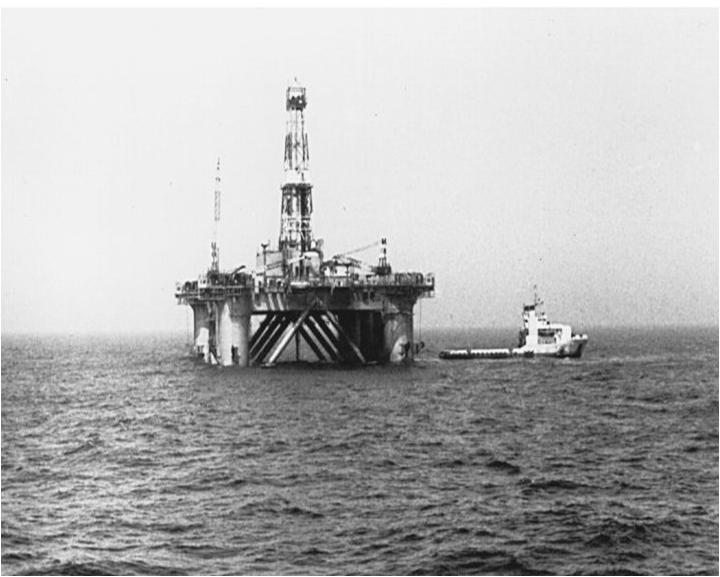
Ocean Ranger
Exactly 28 years ago (15 February 1982), the Ocean Ranger sank on the Grand Banks east of Newfoundland in one of the worst tragedies in the history of the offshore industry. Everyone associated with oil and gas operations was stung by the loss. Those of us in the USGS/MMS North Atlantic District were particularly touched by this tragic incident. We had seen what the North Atlantic can offer – “routine” 100 mph winds and 40-foot seas that tested equipment and personnel. The 84 men who died were our brothers, working in one of the world’s most challenging environments to support their families and help meet North America’s energy needs. The sinking of the Ocean Ranger and other offshore tragedies are not mere matters of chance. We must remember these incidents and work together to prevent their recurrence.
 Bud's Offshore Energy (BOE)