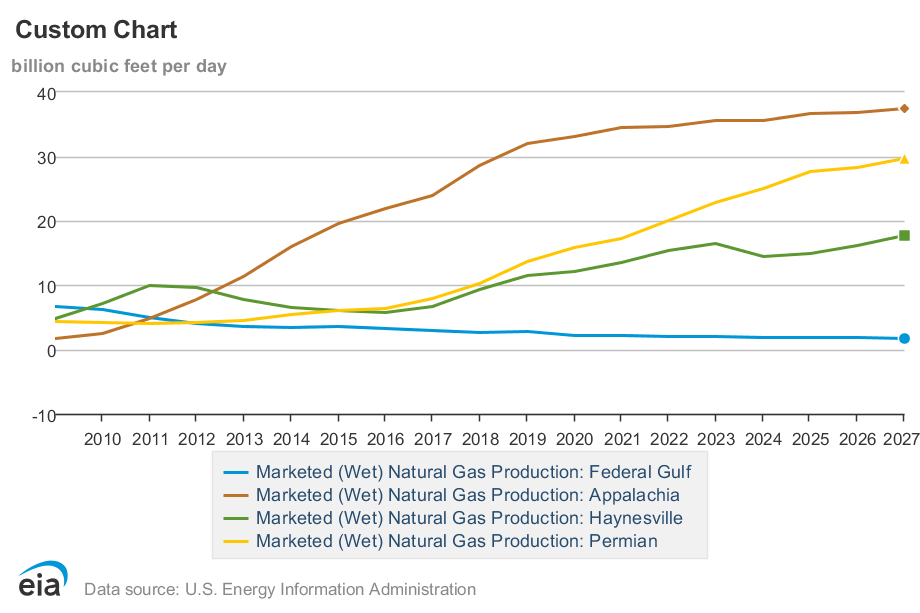
In 2025, more natural gas was produced in the Appalachia region of the Northeast than in any other US region, accounting for 31% of marketed natural gas production. (See the chart below.) Were it not for pipeline capacity limitations, recent growth in Appalachia production would have been greater.
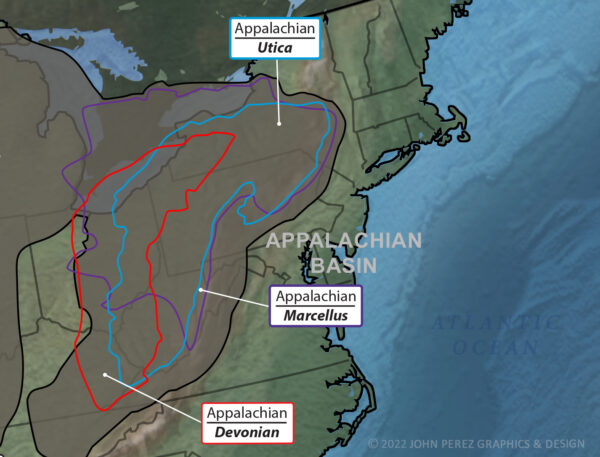
Appalachia production is primarily from the Marcellus and Utica shales in PA, WV, and Ohio.
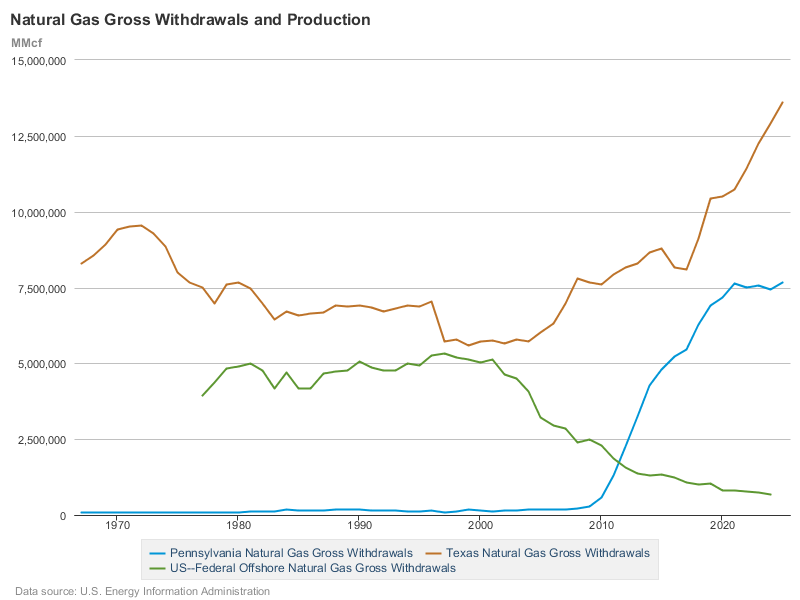
OCS gas production, 80% of which is now associated gas from deepwater oil wells, continues to lag the shale basins. This is a big change from 25 years ago when the OCS produced more gas than any state but Texas. (See the chart below.) Interest in ultradeep (subsurface) OCS shelf gas prospects remains scant despite favorable demand forecasts and technological advances.
Something here does not remotely add up. If New York state succeeds by 2030 in closing its natural gas plants — the plants that account for 60% of the State’s generation capacity — that would bring our total installed capacity down from 37.5 GW to as little as 15 GW. But we need almost 60 GW to meet projected demand. And that’s 60 GW that can be called on any time as needed to meet peak usage. The 9 GW of projected offshore wind turbines wouldn’t make much of a dent even if they operated all the time and could be dispatched to meet peak demand, which they can’t. Instead, they will operate only about a third of the time, and at their own whim. At best they will provide about 3 GW on average, when what we need for this full electrification project is more like 45 GW of dispatchable power to add to our existing hydro and nuclear.
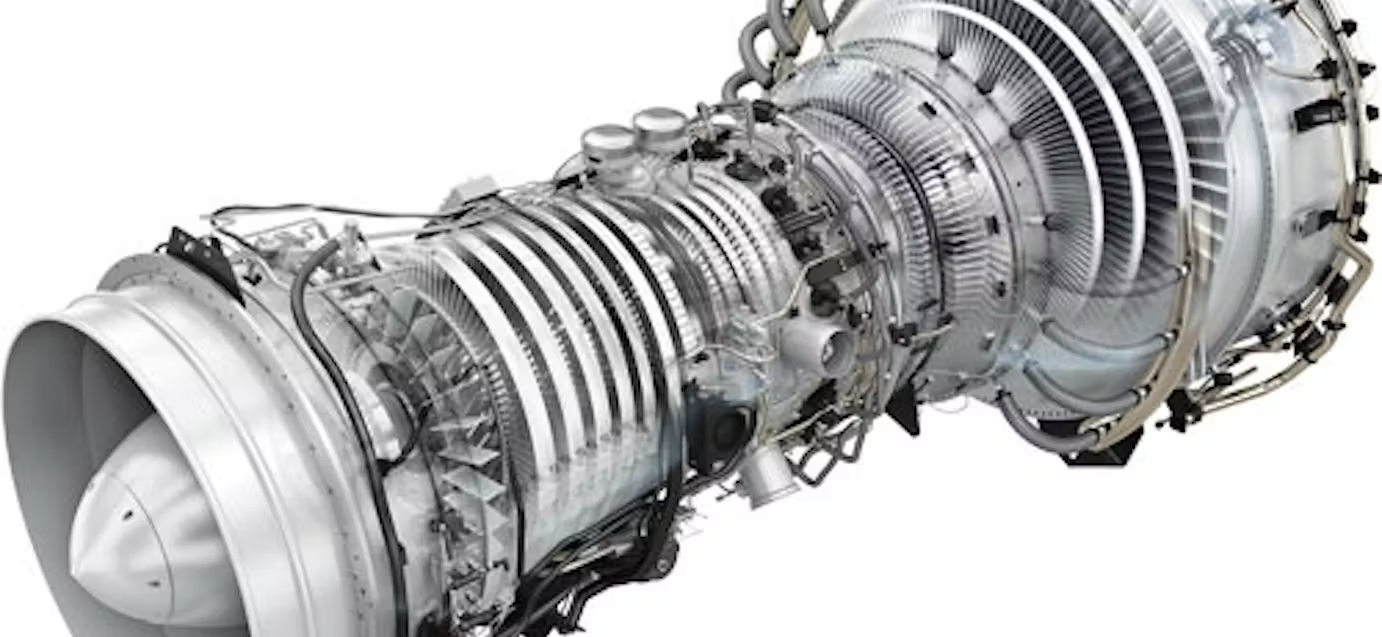
Offshore platforms: In some regions, there is a push to power platforms with renewable energy transported by electric cable. Currently, most platforms are efficiently powered by gas turbines which satisfy energy needs even when demand spikes during well operations like tripping out of the hole. The extent to which renewables can reliably support platform operations during these and other operations, when power interruptions are unacceptable from a safety standpoint, is a risk that must be assessed prior to committing to alternative energy sources.
The environmental benefits of powering platforms with renewable energy also have not been clearly documented. In most cases, offshore platforms produce sufficient gas to support their power demands. Should platforms be powered by imported electricity, gas that is not used for platform operations would presumably be marketed for consumption elsewhere or reinjected.
If the gas is marketed and consumed elsewhere, there is essentially no net (global) CO2 emissions reduction benefit. Gas that is reinjected is wasted unless there is an enhanced oil recovery benefit. So, the net environmental benefit from importing electric power seems questionable, and the operational risks could be significant.
§ 328-a provides that no fossil fuel industry member, as that term is defined in the bill, shall knowingly or recklessly create or contribute to a condition that endangers the safety or health of the public by
extracting, storing, transporting, refining, importing, reporting, producing, manufacturing, distributing. compounding, marketing, or sale of a "qualified product".

328-b declares that a violation of the new article that results in any harm shall be deemed climate negligence regardless of when the underlying conduct occurred.

328-c prohibits governmental enforcement. (i.e. prohibits govt intervention on behalf of the accused company)

328-d provides that any person, firm, corporation, or association that has been damaged as a result of a fossil fuel industry member's acts or omissions in violation of this article shall be entitled to bring an
action for recovery of damages.
This non-attorney suspects that the legislation might conflict with the Commerce Clause of the US Constitution (Article 1, Section 8, Clause 3), which gives Congress the power “to regulate commerce with foreign nations, and among the several states, and with the Indian tribes.” New York produces little oil, gas, or coal, so the legislation would largely affect operations that are conducted in other states, on Federal lands, or in foreign countries.
 Bud's Offshore Energy (BOE)