Feeds:
Posts
Comments

Posts Tagged ‘LSU’

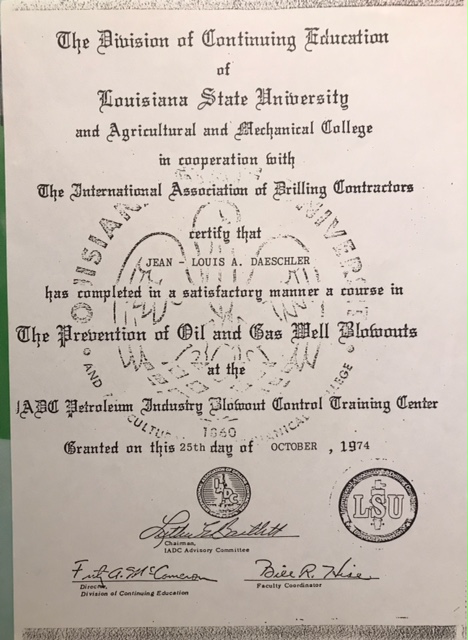
Pioneering offshore engineer J.L. Daeschler, a Frenchman who lives in Scotland and has worked on drilling rigs worldwide, shared his 1974 training certificate signed by Bill Hise, the first director of the Blowout Prevention and Well Control Training Center at LSU. JL recalls his training:

The LSU well control course was new and very well organized. Training options were limited at that time. LSU took a step forward and incorporated equipment donated by Cameron Iron Works, Armco Steel /National, VETCO, and others.

The course was split between indoor class room style and outdoor training on a live well to remind us of the real things, like hard hats, tally books, and safety shoes.

LSU had a 1200 ft vertical well and a small 2″ diameter gas injection line to create a bottom hole gas kick, using a nitrogen truck as the supply. (note: the live well was a first for any well control school.) You had a choice of several manual chokes.  I selected the Cameron Willis choke to circulate the gas kick out with no increase in mud weight (drillers method).

The mud return level, kick detection, and general management of the operation were realistic as if on a rig. The gas would whistle and escape thru a vent line.

The training was simple and effective in that proper well control procedures were learned. In the process, there were many errors. Mud was seen flying out of the mud shaker/pits. School management would bring things under control and explain the errors that were made !!!
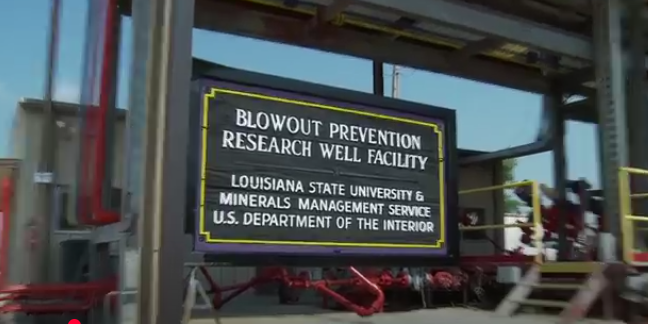
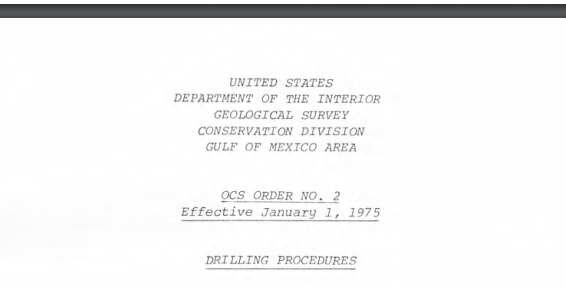
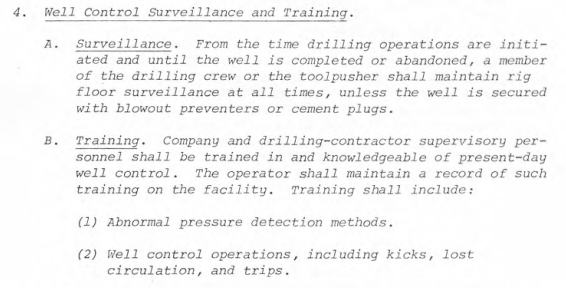
Given the importance of minimizing drilling risks, the Minerals Management Service (MMS) was the primary funder of the LSU facility. MMS predecessor, the Conservation Division of USGS, first established well control training requirements in 1975 (pasted below).

LSU’s well control center video:
Read Full Post »

The government’s decision to require that a capping stack be located in Guyana is prudent. Although the need for a capping stack is dependent on multiple barrier failures and is thus extremely low, the environmental and economic consequences of a prolonged well blowout warrant timely access to this tertiary well control option.

A capping stack must be properly maintained and deployable without delay. In that regard, BSEE has a good program for testing Gulf of Mexico capping stack readiness. Capping stack drills are an important post-Macondo addition to the unannounced oil spill response program that dates back to 1981.

The capping stack designed during the Macondo blowout shut-in the well on 15 July 2010. The decision process that allowed the well to remain shut-in was a bit perplexing, and we had a bizarre situation where the Federal Incident Commander threatened to require the resumption of the blowout. The same well integrity concerns had prematurely ended the “top kill” operation on 28 May, allowing the well to flow unnecessarily into the Gulf for an additional 48 days (5/28-7/15). (See this important paper by LSU Petroleum Engineering professor Dr. Mayank Tyagi et al: Analysis of Well Containment and Control Attempts in the Aftermath of the Deepwater Blowout in MC252)

“Troy Naquin, BSEE New Orleans District, observes as a capping stack is carefully lowered onto the deck of ship to be transported more than 100 miles offshore for a drill designed to test industry’s ability to successfully deploy it in case of an emergency, May 8, 2023.” BSEE photo/Bobby Nash

Read Full Post »

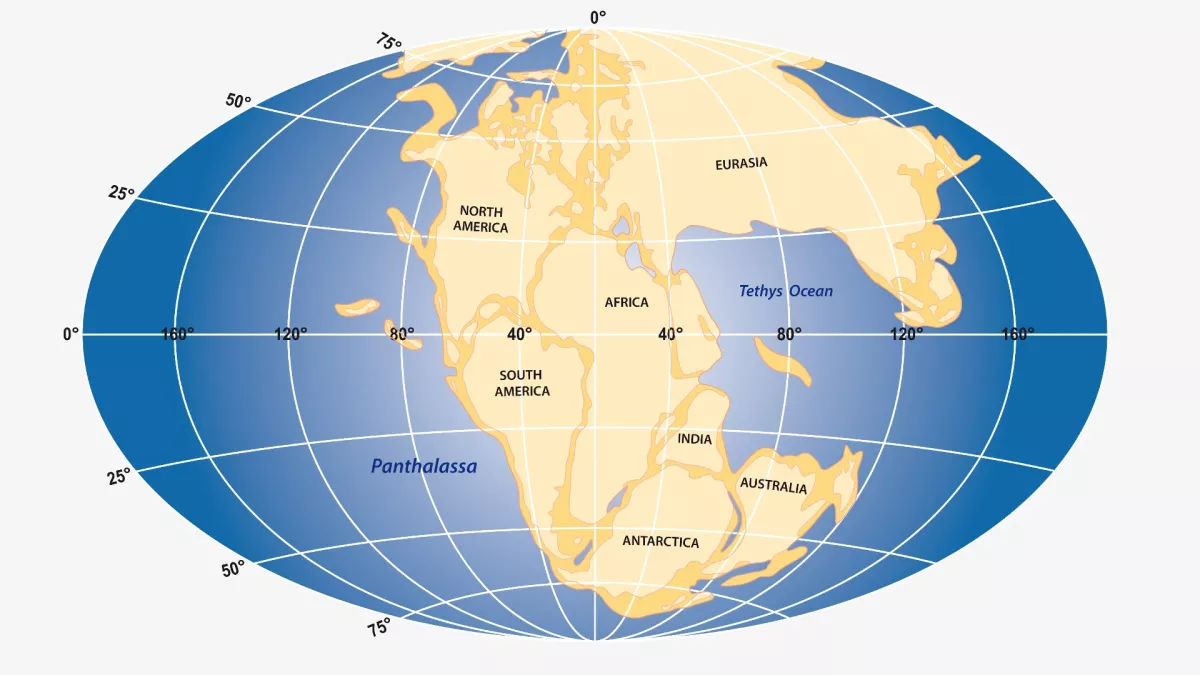
A. Pangea dining

B. Seismic touchdown

Lars Herbst assures us that no marine mammals were harmed by the Baton Rouge shock waves!

Read Full Post »

Contrary to national and regional planning documents and the associated response exercises, Energy Secretary Chu, whose department had no jurisdiction over offshore oil and gas operations or the emergency response, assumed the leadership role on the well control aspects of the blowout. Secretary Chu is a Nobel prize winning physicist and had the President’s support to get involved with the response. Although he was not a drilling engineer or geologist, he soon became the dominant figure on well control decisions.

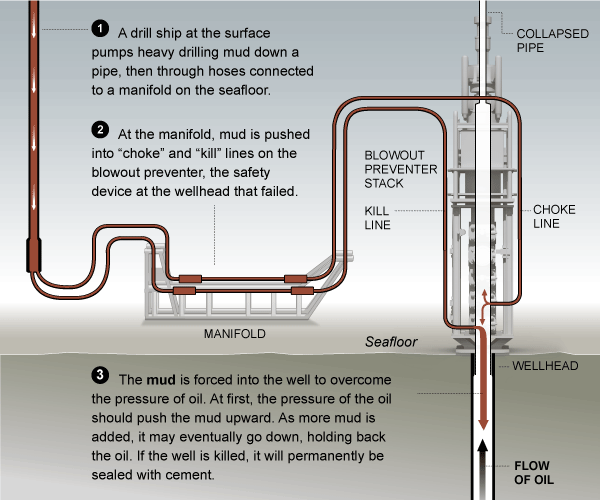
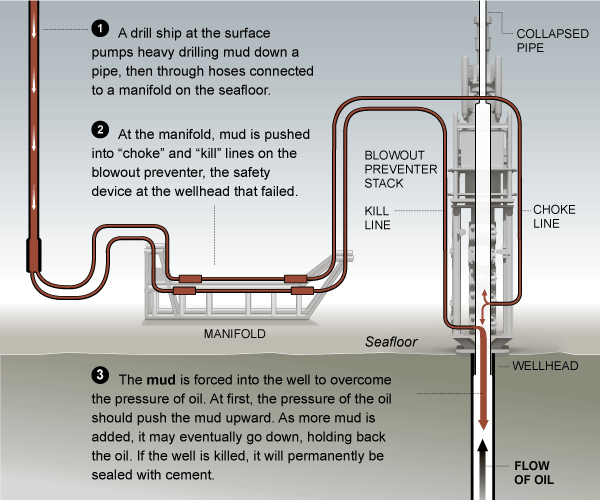
BP’s top kill operation (see diagram above) was intended to overcome and halt the flow of oil by pumping heavy mud into the well bore. Per an excellent paper by Dr. Mayank Tyagi and colleagues at LSU  (Analysis of Well Containment and Control Attempts in the Aftermath of the Deepwater Blowout in MC252), the operation was not successful because the pumping rate and mud weight did not generate sufficient pressure. 

Consistent with Dr. Tyagi’s analysis, the well would likely have been killed on 5/28/2010, shortening the blowout by 48 days, had Secretary Chu not stopped the top kill operation over the objections of BP engineers. While it was reasonable for the Secretary and his team to be concerned about possible casing leaks and the fracturing of subsurface formations, the subsequent (7/15/2010) closure of the capping stack demonstrated that the well had sufficient integrity to support the top kill operation. Questions about the aborted top kill effort and how that decision was made are therefore important and merit careful review. Did the Macondo well flow unnecessarily into the Gulf for an additional 48 days (5/28-7/15)? Did the National Incident Command facilitate or delay source control?

Keep in mind that the National Incident Command almost made a similar mistake in July. Even after the capping stack successfully shut-in the well on 7/15, Incident Commander Thad Allen (USCG) continued to call the closure of the capping stack a temporary test and threatened to require BP to resume flow from the well. We thus had a bizarre situation where the Federal Incident Commander was threatening to require the resumption of a blowout. Fortunately, informed input from experienced engineers prevailed. The well remained shut-in and the static well-kill operation was successful.

Read Full Post »

While the official BOEMRE-USCG and National Commission/Chief Counsel investigation reports were quite good and there are countless court documents and ad hoc reviews of the blowout, some important Macondo issues have not been fully addressed. BOE will touch on these issues periodically starting with the decision to terminate the top kill operation on 5/28/2010.

The top kill operation (see diagram above) was intended to overcome and halt the flow of oil by pumping heavy mud into the well bore.  The operation was not successful because the pumping rate and mud weight did not generate sufficient pressure.  Per an excellent paper by Dr. Mayank Tyagi and colleagues at LSU  (Analysis of Well Containment and Control Attempts in the Aftermath of the Deepwater Blowout in MC252):

It is very likely that if the top kill had been designed to deliver more than 109 bpm of 16.4 ppg drilling fluid below the BOP stack for a sustained period, the Macondo blowout could have been stopped between May 26-28, 2010. Given that the well was successfully shut-in with the capping stack in July, and that the subsequent bullhead (static) kill was successful, certainly a higher rate top kill would have been successful at that time.

The American Thinker, citing the New York Times, reports that Energy Secretary Chu stopped the top kill operation over the objections of some BP engineers. While it was reasonable to be concerned about possible casing leaks and the fracturing of subsurface formations, the subsequent (7/15/2010) closure of the capping stack demonstrated that the well had sufficient integrity to support the top kill operation. Questions regarding why a higher rate top kill effort was not attempted and how that decision was made are therefore important and merit discussion. Did the Macondo well flow unnecessarily into the Gulf for an additional 48 days (5/28-7/15)? Did the National Incident Command facilitate or delay source control?

Keep in mind that the NIC almost made a similar mistake in July. Even after the capping stack successfully shut-in the well on 7/15, Incident Commander Thad Allen (USCG) continued to call the closure of the capping stack a temporary test and threatened to require BP to resume flow from the well. Fortunately, informed input from experienced engineers prevailed. The well remained shut-in and the static well-kill operation was successful.

Read Full Post »

As a former New Orleans resident, I am an admirer of the Lousisiana Cajuns, their joie de vivre, and their sense of humor. I just received this “Boudreaux” story from a BOE contributor, and I must say that it is quite believable. If you have lived in South Louisiana, you’ll know what I mean!

The year is 2016 and the United States has just elected the first woman, a Louisiana State University graduate, as President of the United States, Susan Boudreaux.

 A few days after the election the president-elect calls her father and says, ‘So, Dad, I assume you will be coming to my inauguration?’

 ‘I don’t think so. It’s a 30 hour drive, your mother isn’t as young as she used to be, and my arthritis is acting up again.’

‘Don’t worry about it Dad, I’ll send Air Force One to pick you up and take you home. And a limousine will pick you up at your door.’

‘I don’t know. Everybody will be so fancy. What would your mother wear?’

 Oh Dad, replies Susan, ‘I’ll make sure she has a wonderful gown custom-made by the best designer in New York.

 ‘Honey,’ Dad complains, ‘you know I can’t eat those rich foods you and your friends like to eat.’

 The President-to-be responds, ‘Don’t worry Dad. The entire affair is going to be handled by the best caterer in New York, I’ll ensure your meals are salt free Dad, I really want you to come.’

 So Dad reluctantly agrees and on January 20, 2017, Susan Boudreaux is being sworn in as President of the United States.

 In the front row sits the new president’s Dad and Mom. Dad noticing the senator sitting next to him leans over and whispers, ‘You see that woman over there with her hand on the Bible, becoming President of the United States.’

 The Senator whispers back, ‘Yes I do.’

 Dad says proudly, ‘Her brother played football at LSU.’

Read Full Post »

Not surprisingly, the television networks embraced the “Georgia Study,” which estimates that up to 79% of the Macondo spillage remains in the Gulf. Correspondents, bobbing from boats, rushed to report the news.  Does this mean that the networks will resume their courageous Key West oil-watch?  How about those damage projections for East Coast beaches?

Anyone who thinks that 79% of the oil remains hasn’t spent much time observing oil spills.  NOAA’s peer reviewed numbers are more credible.

The major newspapers, to their credit, seem to be providing balanced coverage of the new report.  The New York Times has a good article and this comment from Ed Overton seems to be pretty much on target:

Other marine scientists involved in evaluating the impact of the spill defended the government’s findings. “I generally agreed with the results,” said Edward Overton, a biologist at Louisiana State University who was one of several scientists who reviewed the federal study prior to its release. “I think it’s close to being on the mark.”

Read Full Post »