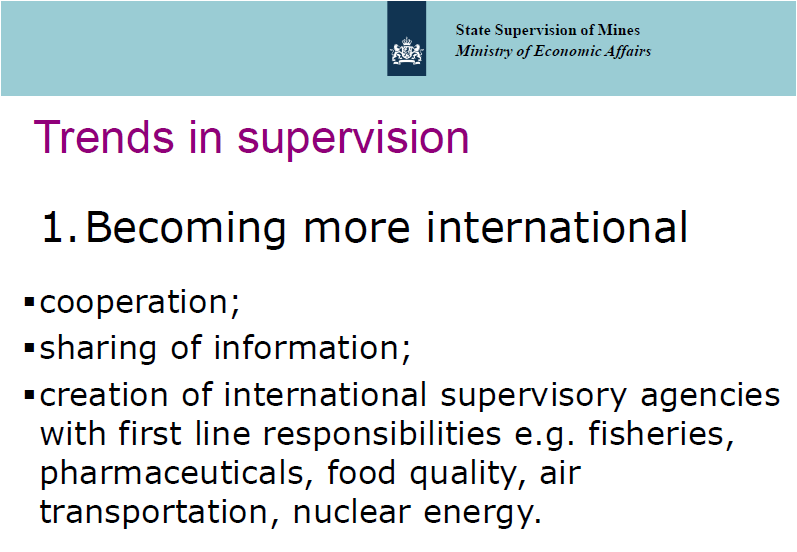
The above slide is from the excellent presentation that Jan de Jong (Inspector General, State Supervision of Mines, the Netherlands) never got to deliver in Vancouver. As session chair, Jan graciously yielded his time to his panelists.
Jan’s presentation notes the growing importance of international cooperation. This trend has the potential to improve regulatory capabilities, expand data availability and access, reduce regulatory costs through the sharing of resources, reduce costs for industry through greater international consistency and regulatory certainty, and improve international relations. The Netherlands, Russia, Norway, Cuba, the US, and everyone else should be on the same team when it comes to offshore safety and pollution prevention. Some near-term suggestions follow:
- Except where regional conditions dictate otherwise, the same standards should be applied worldwide. Government and industry should be collectively questioning, testing, and improving these standards. Remember that the goal is continuous improvement, not mere compliance.
- An international information system should provide for the collection and verification of incident and performance data.
- Using international data and expertise, a cooperative risk assessment program should be initiated.
- An organized international audit capability should be established to evaluate operators and regulators.
- To improve access to expertise and reduce costs, a network of specialists should assist regulators worldwide.
- Industry training requirements should be uniform and consistently applied, and regulator training programs should be consolidated regionally or internationally.
- The international research network should be expanded.
- To ensure that accidents are investigated independently and to minimize the potential for political influences on the investigation process, an international accident investigation capability should be established.
- The safety culture message should be promoted worldwide. Successes and failures should be cooperatively examined.

 Bud's Offshore Energy (BOE)