DOE (3/11/2026): “Earlier today, 32 member nations of the International Energy Agency unanimously agreed to President Trump’s request to lower energy prices with a coordinated release of 400 million barrels of oil and refined products from their respective reserves.
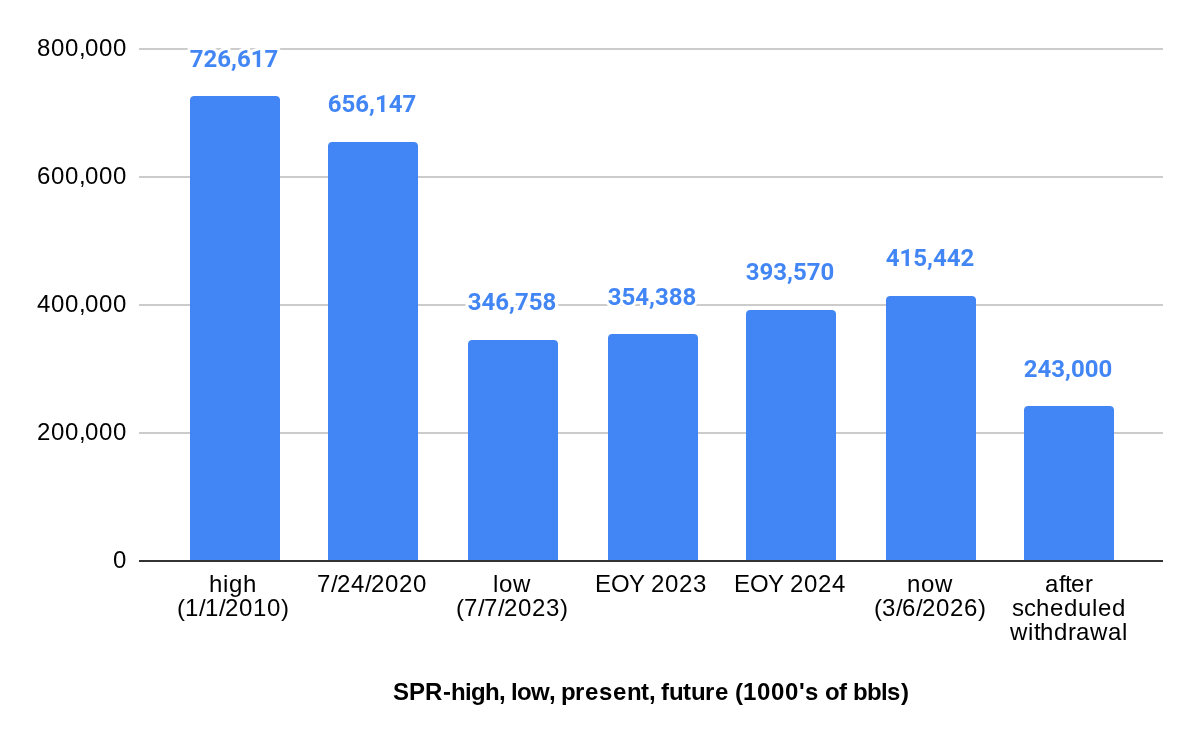
“As part of this effort, President Trump authorized the Department of Energy to release 172 million barrels from the Strategic Petroleum Reserve, beginning next week. This will take approximately 120 days to deliver based on planned discharge rates.
This will reduce the SPR to ~ 243 million bbls, 1/3 of capacity and the lowest level since it was initially filled in 2010. Market disturbances and national elections are too frequent to have confidence that the SPR will be refilled, even to the 500 million bbl level.
Meanwhile, the oil markets didn’t seem to be impressed by the announcement.
DUBAI, June 13 (Reuters) – OPEC does not see a peak in oil demand in its long-term forecast and expects demand to grow to 116 million barrels a day by 2045, and may be higher, the secretary general said on Thursday.
The International Energy Agency said in a report on Wednesday it sees oil demand peaking by 2029, levelling off at around 106 million barrels per day (bpd) towards the end of the decade.
Hathaim Al Ghais, writing in Energy Aspects, called the IEA report “dangerous commentary, especially for consumers, and will only lead to energy volatility on a potentially unprecedented scale”.
The IEA’s assessments face criticism, particularly in terms of the agency’s optimistic outlook on the growth and impact of renewable energy worldwide. The report suggests that renewables will meet half of the world’s power demand by 2030, based on optimistic scenarios, including the proliferation of electric vehicles (EVs) and substantial investments in offshore wind, solar, green hydrogen, and ammonia. The IEA emphasizes the idea that consumers worldwide are enthusiastic about changing their heating systems to electricity or heat pumps.
Simultaneously, the ongoing contentious relationship between the IEA and OPEC is poised to reach new levels of disagreement. The release of the IEA’s report shortly after OPEC’s relatively optimistic oil market report gives the impression that Paris is attempting to alarm markets without substantial grounds. It’s worth noting that, despite its inherent bias, OPEC’s reports have historically demonstrated a higher level of accuracy compared to the IEA reports from the early 21st century. Even OPEC’s most optimistic scenarios regarding hydrocarbon demand growth have been realized sooner than expected. The current IEA report appears to resemble a modern-day version of “Crying Wolf.” It’s possible that the underlying strategy of Paris and its supporters is to induce significant fear among investors, including clients, in the hope that their biased outlook becomes a reality. However, at present, such a scenario appears unlikely. It’s essential to keep in mind that the IEA will need to present a doomsday scenario for hydrocarbons, as it faces a different audience in Dubai in the coming weeks.
WP: “Chevron is acquiring oil driller Hess in a $53 billion all-stock deal announced Monday, bringing the energy giant deeper into the fossil fuel business at a time when policymakers are pressing for a broader transition to renewables.”
Comment: Many who live and work outside of the Post’s policy bubble differ on the urgency and practicality of the transition. Their primary concerns are reliable, secure, and affordable energy. Many elected representatives agree, which is why there is little national support for legislation restricting fossil fuels and imposing rigid transition timelines. Administrative actions, like the 5 year leasing plan, that handicap US offshore production are also being questioned.
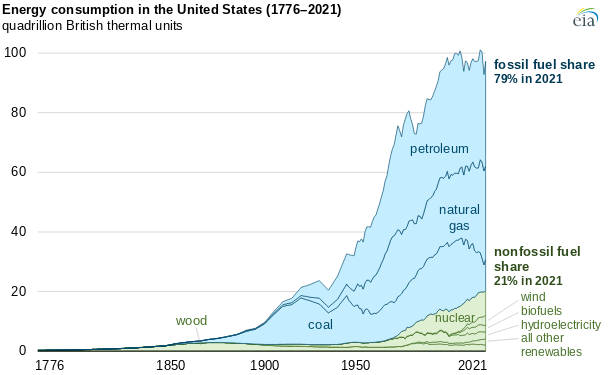
And what are we transitioning to? Wind and solar are intermittent energy sources that can complement fossil fuel power generation, but not replace it. Nuclear energy has strong proponents, but faces stiff opposition, much of which is from the same groups that oppose fossil fuels. Other energy alternatives like ultradeep geothermal are very promising but are still years away.
WP: “The investments run counter to U.S. and global climate policies, which aim to rapidly phase out the internal combustion engine and shift power grids to zero emissions energy. The International Energy Agency reported last month that demand for oil, gas and coal will peak by 2030 before going into a steady decline, leading its executive director, Fatih Birol, to warn oil company executives that decisions to double down on fossil fuel infrastructure could prove misguided.“
Comment: Fortunately, IEA does not dictate corporate investment decisions. Perhaps IEA should look more closely at their own forecasts which show essentially no decline in oil or gas demand through 2050. Their assertion that demand for all fossil fuels will peak by 2030 is based on their speculative forecast calling for a sharp decline in coal demand, even though coal consumption is currently at record levels. IEA’s forecasts are also dependent on questionable assumptions such as this: “50% of new US car registrations will be electric in 2030.”
WP: “Still, the massive acquisitions from both Chevron and Exxon indicate their executives believe fossil fuels will continue to drive their business well into the future. Emphasizing affordability, company executives have said they see oil and gas alongside renewables.”
Comment: Spot-on. The WP could have shortened their commentary to these 2 sentences.
WP: Alex Witt, senior adviser for oil and gas at the advocacy group Climate Power, said the Hess acquisition shows the company’s true priorities. “Today’s news proves what we already knew — Chevron executives only care about the short-term, putting potential profits over the lives of families and the future of our planet,” Witt said in a statement Monday.
Comment: Or perhaps both Chevron and the lives of families will benefit, as they have in the past.
All you need to know about how the vaunted ‘energy transition’ is going as 2022 comes to its merciful close is to read the headline of a Reuters story published last week: “Global coal consumption to reach all-time high this year – IEA”.
That isn’t how the narrative surrounding the energy transition assumed this would all be going in the year 2022. Certainly, it isn’t how IEA head Fatih Birol has wanted it to go, given his insistence that “more wind and solar” is the answer to seemingly every energy-related question.
Yet the proposed 5 Year OCS leasing program (p. 3) tells us that long term offshore production is not needed because the IEA’s “roadmap to net-zero emissions by 2050 for the global energy sector would require no new investment in fossil fuel supply projects (IEA 2021).”
Does the IEA dictate US energy policy? Dan Yergin has a far better grasp on the realities of energy consumption and transitions.
“Oil, discovered in 1859, did not surpass coal as the world’s primary energy source until the 1960s, yet today the world uses almost three times as much coal as it did in the ’60s.“
For a second time this week, Fatih Birol, the executive director of the International Energy Agency (IEA), called on the OPEC+ group on Wednesday to narrow the widening gap between its production quotas and the much lower actual supply to the market.
The International Energy Agency (IEA) said preliminary data showed oil demand hit a record high of 87.7 million barrels per day over the past 12 months.
The Organization of Petroleum Exporting Countries Monday said demand for its oil in 2011 will be stronger than it previously forecast owing to the recovery in the global economy.
BOE Comment: The deep water sector is the only option for significant near and intermediate-term increases in US oil production. Ditto for many other non-OPEC producers. We better get our act together soon.




 Bud's Offshore Energy (BOE)