Feeds:
Posts
Comments

Posts Tagged ‘Good Neighbor Agreement’

On Tuesday morning, the Nantucket Select Board blasted Vineyard Wind and gave the company 2 weeks to respond to their 15 demands. The Nantucket Current provides good coverage of the press conference. The specific demands are listed below.

  1. Text emergency notifications to designated Town officials within 1 hour.
  2. Alert the same officials when blade monitors detect anomalies.
  3. Share with Nantucket the content of any written communications with or from federal agencies regarding project failures that have impacts on Nantucket.
  4. Email detailed monthly project updates to the Select Board and Town Manager.
  5. Present updates and take public questions at Select Board meetings upon request and no less than quarterly.
  6. Respond to written questions from the Select Board within three business days.
  7. Provide relevant project reports within 1 week of submission to any agency.
  8. Share all studies or data reports on adverse effects within five business days of receipt.
  9. Disclose correspondence with regulatory agencies within 15 business days.
  10. Notify the Town if the company is asserting any confidentiality claims to shield public disclosure of reports or data in regulatory filings.
  11. Pay liquidated damages ($250,000) per violation of the above communication protocols.
  12. Pay liquidated damages ($25,000) per turbine per day) for each day that turbine lights are on without the Aircraft Detection and Lighting System (ADLS) being active.
  13. Within 2 months, initiate a process to seek public input on new emergency response plans—including blade failure scenarios.
  14. Establish and maintain a $10 million escrow fund to ensure coverage of cleanup costs from future failures.
  15. Permanently suspend new projects if any future incident forces beach closures or shellfish harvesting bans for seven consecutive days or 14 total days in any 6-month period.

I observed the press conference on the Town’s YouTube channel, and my sense is that this may be Vineyard Wind’s last chance to amicably resolve these issues. Board member Dawn Hill, who now regrets signing the increasingly unpopular Good Neighbor Agreement with Vineyard Wind, didn’t hold back when she said:

“These wind turbines are bigger, brighter, and much more impactful than we ever thought, and not to mention the environmental hazard from failures. But my choice would be with our new, federal administration to really wake up and try and put an end to these things, because they’re not worth it to the coast of the United States.”
Read Full Post »

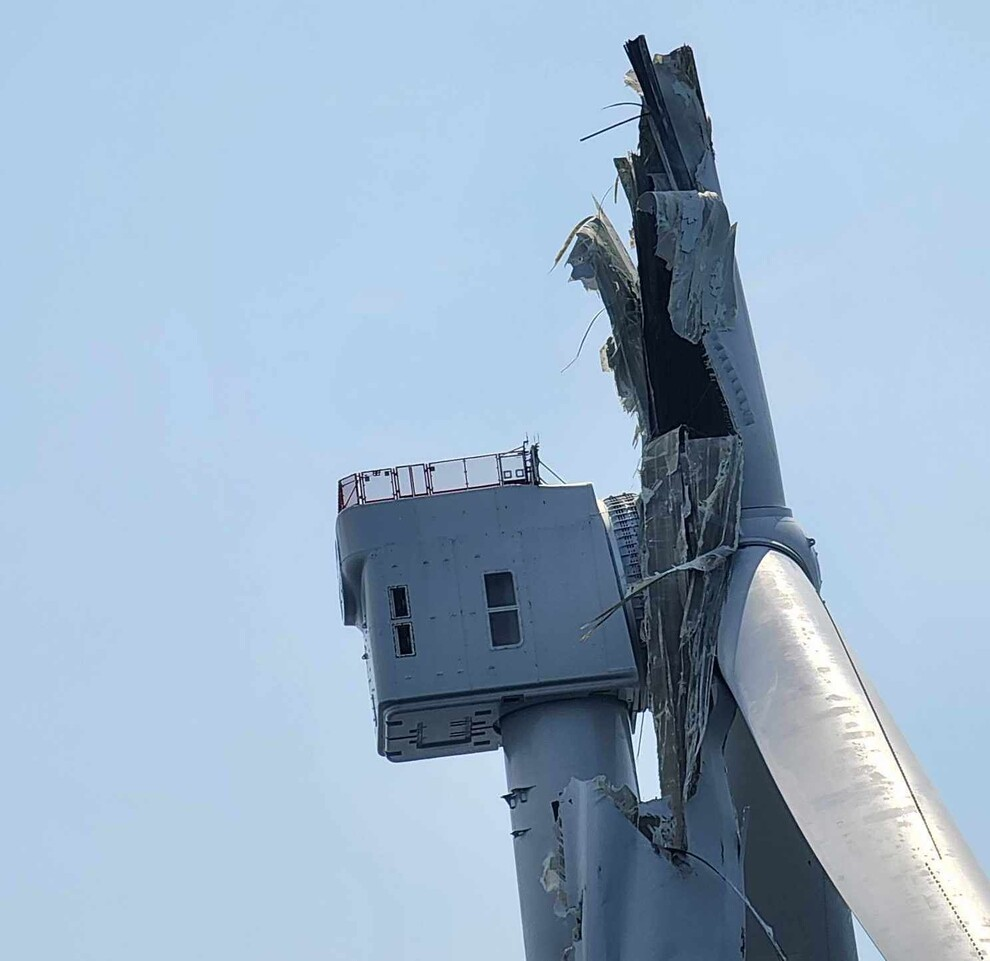
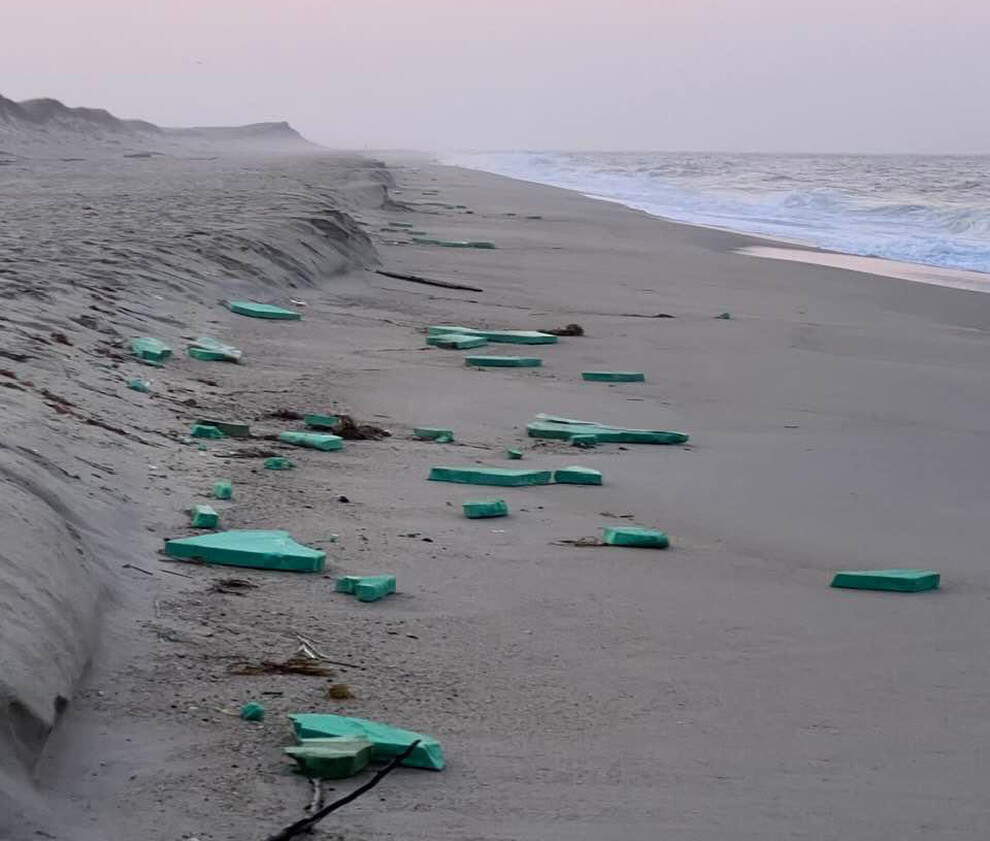
Debris from the failed Vineyard Wind blade littering the south shore of Nantucket in July 2024. Nantucket Current photo.

Nantucket reached a settlement agreement (attached) with turbine manufacturer GE Vernova (GEV), praising that company while criticizing Vineyard Wind (VW), the lessee and operator:

“The Town of Nantucket commends GE Vernova for its leadership in reaching this agreement. By contrast, the Town has found Vineyard Wind wanting in terms of its leadership, accountability, transparency, and stewardship in the aftermath of the blade failure and determined that it would not accept Vineyard Wind as a signatory to the settlement,” the town stated Friday morning.

Comments:

  • For a relatively modest sum ($10.5 million) paid by the contractor (GEV), the agreement further limits the Town’s ability to hold Vineyard Wind, the lessee and operating company, accountable. See sections 4, 5(a), and 9 of the agreement.
  • The Town’s ability to challenge the project was already compromised by their unpopular “Good Neighbor Agreement.”
  • What ever happened to operator responsibility? This fundamental tenet of the OCS oil and gas program also applies to offshore wind. Vineyard Wind should be the party that is fully accountable for the damages associated with their project. VW can seek compensation from GEV, but VW is the accountable party.
  • Can you imagine if BP had attempted to stay on the sidelines while Transocean and other contractors settled claims associated with the Macondo blowout? Unthinkable!
  • Nantucket should have insisted on VW’s participation, rather than excluding them.
  • Do we need an Offshore Wind Liability Trust Fund, ala the Oil Spill Liability Trust Fund?
  • What does the lessor, the Federal govt, have to say about damage compensation? Are civil penalties forthcoming? When will we finally see the BSEE investigation report!

Read Full Post »

A recent Nantucket Current piece criticizes the Nantucket Select Board for failing to address community concerns about the attached Good Neighbor Agreement (GNA) with Vineyard Wind. In particular, any discussion about the GNA was throttled at a recent public forum on the SouthCoast Wind project.

Some key points from the article and related thoughts:

  • Over 2,000 individuals and 150 businesses have signed a petition asking the Nantucket Select Board to withdraw from the GNA.
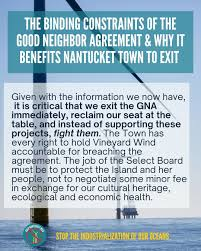
  • The GNA established a long-term relationship between Vineyard Wind and Nantucket. In essence, Nantucket became a partner and an advocate for the projects.
  • Sections 5.2 and 5.3 of the GNA are particularly striking and believed to be unprecedented in the history of Federal offshore energy programs.
  • Section 5.2 defines Nantucket’s broad advocacy responsibilities.
  • Section 5.3 stipulates that “the Nantucket Parties shall use their reasonable best efforts to inform federal, state, and local elected officials of their support for the Projects” throughout the environmental, historical, and state review processes. Wow, nothing subtle about that directive!
  • By signing the GNA with Vineyard Wind, Nantucket withdrew from the important National Historic Preservation Act consulting process for these projects.
  • Vineyard Wind, New England Wind, and the other projects that are covered under the GNA will add approximately 350 turbines off Nantucket’s south shore beaches.
  • Given the partnership with Vineyard Wind, it’s difficult for Nantucket to challenge the mitigations for another project, SouthCoast Wind, which is not covered by the GNA.

The Nantucket GNA controversy should be carefully considered by other communities that are tempted by developer incentives to enter into agreements that may not be in their best long-term interest.

Will Nantucket exit (Nexit) the GNA? The pressure is building.

Read Full Post »

Quotes from Nantucket Current article (emphasis added):

“While we continue to work to finalize our root cause analysis, our investigation to date indicates that the affected blade experienced a manufacturing deviation,” said GE Vernova CEO Scott Strazik. “We have not identified information indicating an engineering design flaw in the blade or information of a connection with the blade event we experienced at an offshore wind project in the UK, which was caused by an installation error out at sea. We are working with urgency to scrutinize our operations across offshore wind. Pace matters here. But we are going to be thorough, instead of rushed.”

“It’s been 11 days since the event, and just to reinforce from the start, we have no indications of an engineering design flaw,” Strazik said. “We have identified a material deviation or a manufacturing deviation in one of our factories that, through the inspection or quality assurance process, we should have identified. Because of that, we’re going to use our existing data and reinspect all of the blades we’ve made for offshore wind. For context, this factory in Gaspé, Canada where the material deviation existed we’ve made about 150 blades. 

Any comments from the CVA, assuming there was one?

Meanwhile, Nantucket will renegotiate their “Good Neighbor Agreement” with Vineyard Wind. Is this a lesson for other municipalities?

Read Full Post »

Nantucket Current photo: damaged Vineyard Wind turbine

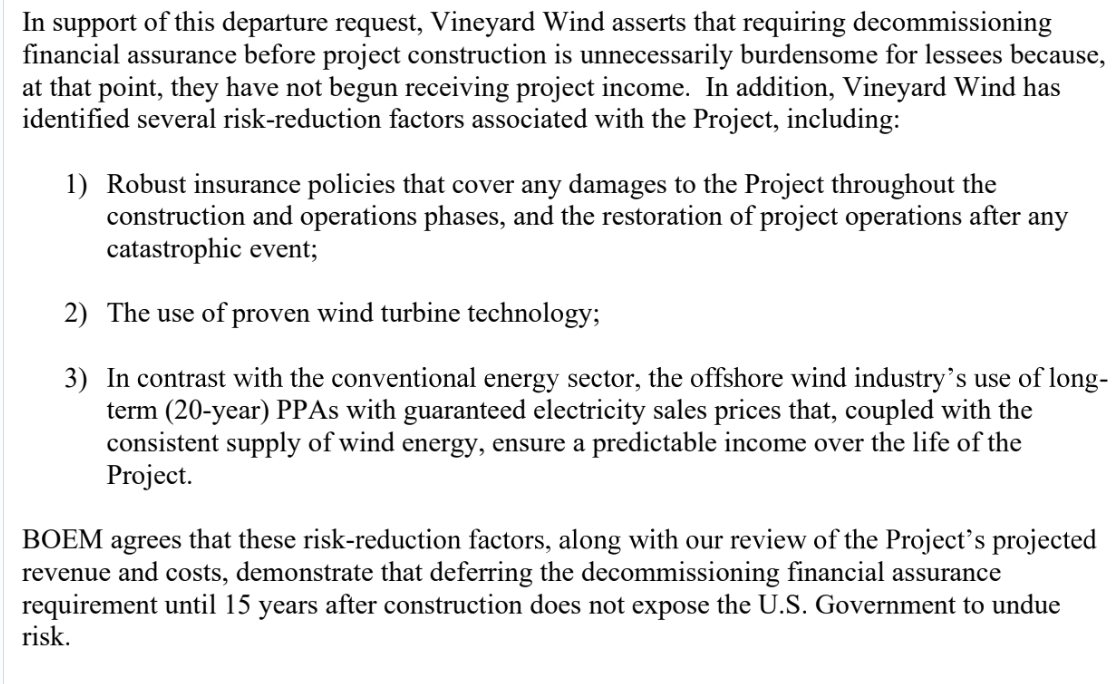
Pasted below is an excerpt from the BOEM letter waiving the“pay as you build” financial assurance requirement for the Vineyard Wind project.

Comments on the 3 risk reduction factors cited in the letter:

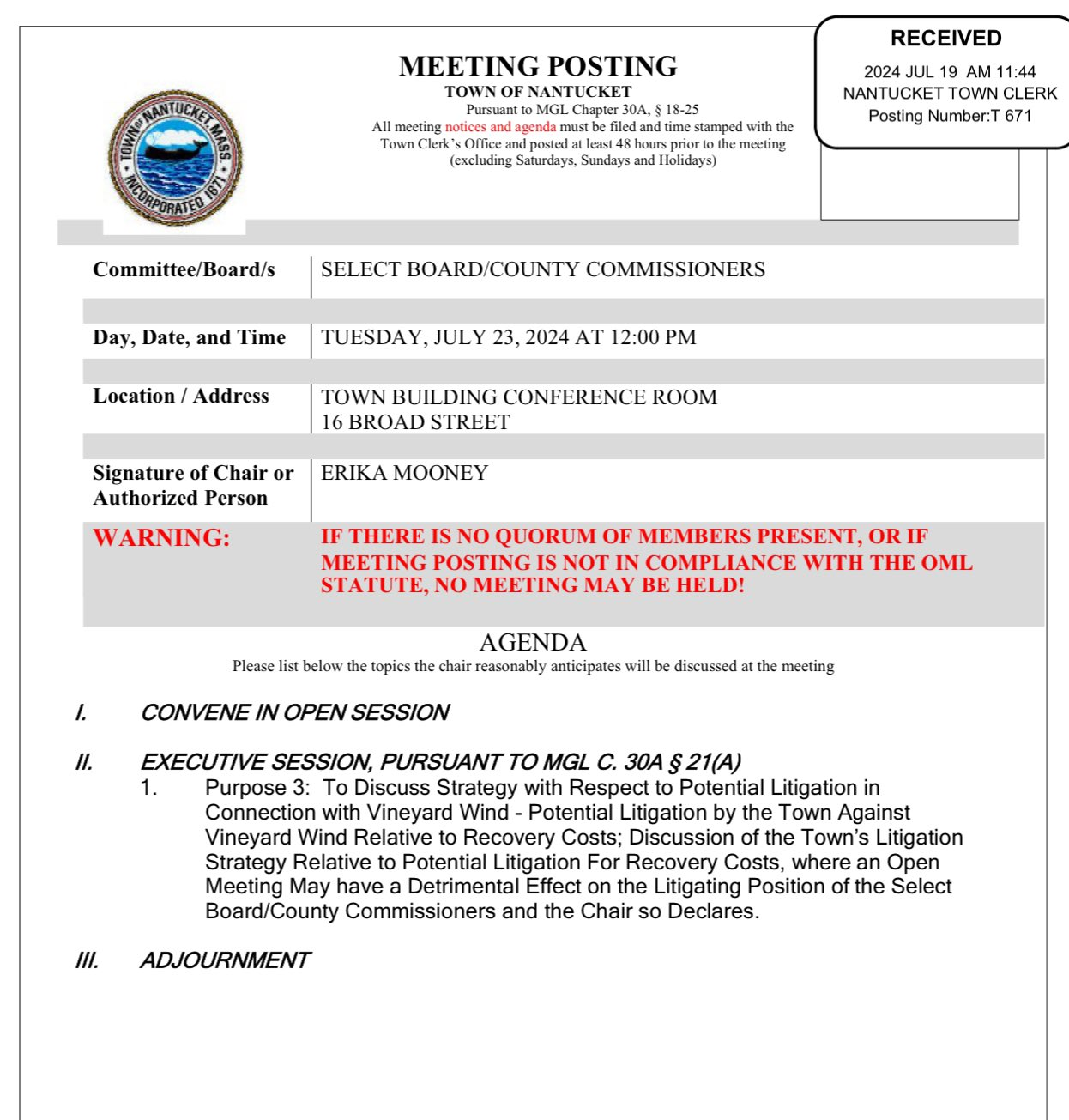
Factor 1: Those “robust insurance policies” may soon be tested given the costs associated with the turbine blade incident and potential law suits. (The notice pasted below informs that Nantucket officials will meet on Tuesday to consider litigation. A question for attorneys is the extent to which Nantucket is compromised by their good “Good Neighbor Agreement” with Vineyard Wind. That agreement essentially calls on Nantucket to promote the Vineyard Wind projects in return for payments that seem modest relative to the economic benefits from tourism and fishing.)

Factor 2: To the extent that GE Vernova Haliade-X 13 megawatt turbines are proven technology (and that is very much in doubt), the use of proven technology doesn’t prevent premature abandonment associated with unexpected incidents.

Factor 3: Reliable power generation and predictable long-term income remain to be demonstrated.

Read Full Post »