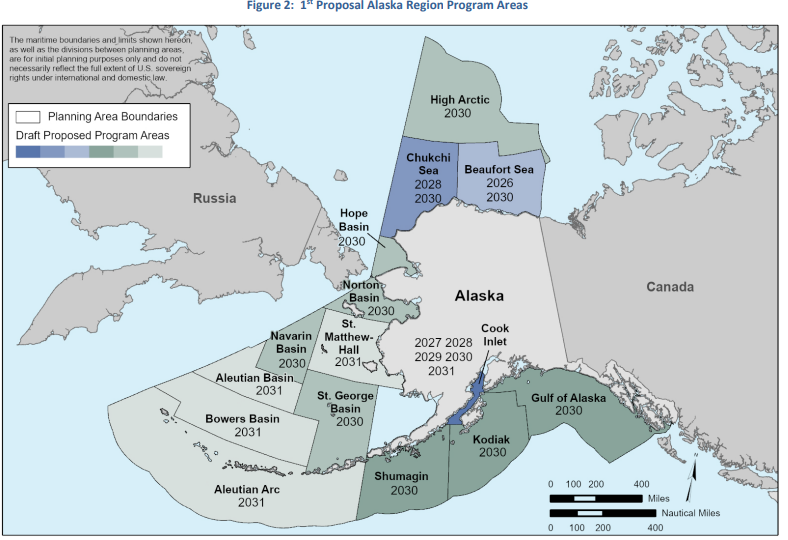
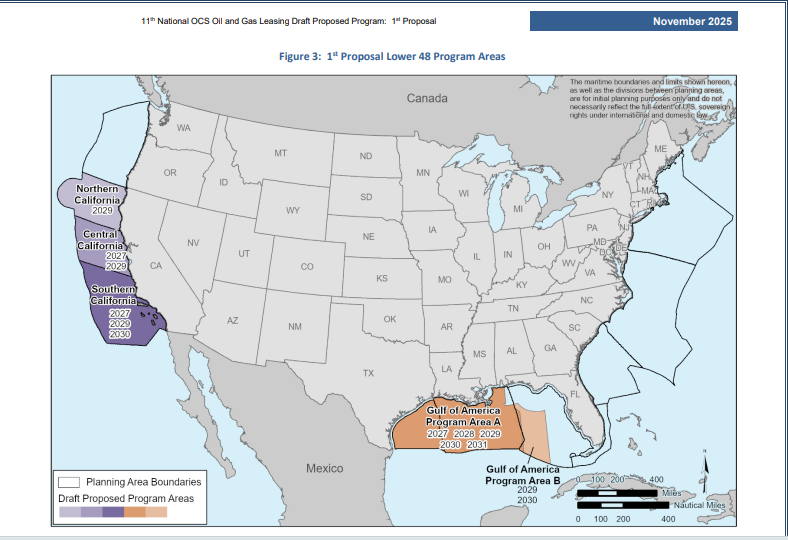
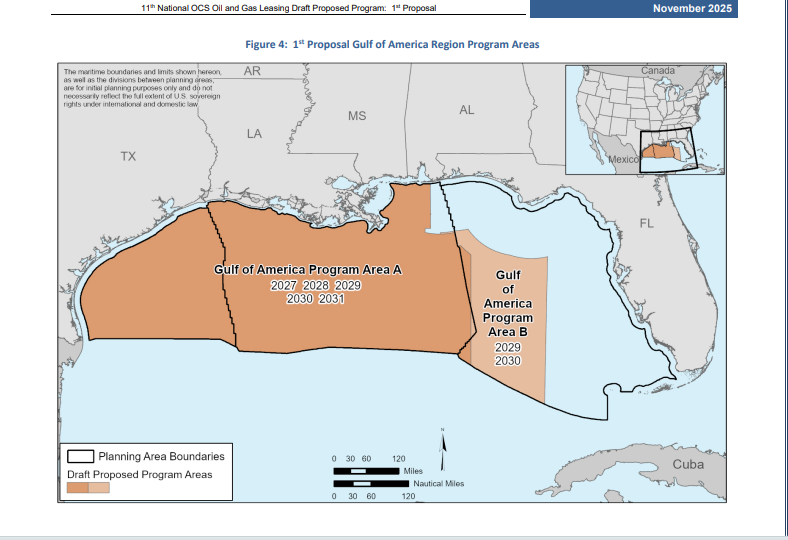
The press release and full program are linked. It looks like the most recent leaks were accurate. See the maps below with the locations and dates. This will stir the pot!
Posted in Alaska, California, energy policy, Gulf of Mexico, Offshore Energy - General, Uncategorized, tagged Alaska, California, Draft Proposed OCS Leasing Program, Florida, Gulf of America on November 20, 2025| 2 Comments »
The press release and full program are linked. It looks like the most recent leaks were accurate. See the maps below with the locations and dates. This will stir the pot!
Posted in California, energy policy, Gulf of Mexico, Offshore Energy - General, tagged 5 year leasing plan, Beaufort Sea, California, Florida, leaked report, Mid Atlantic, North Atlantic, South Atlantic on October 31, 2025| Leave a Comment »
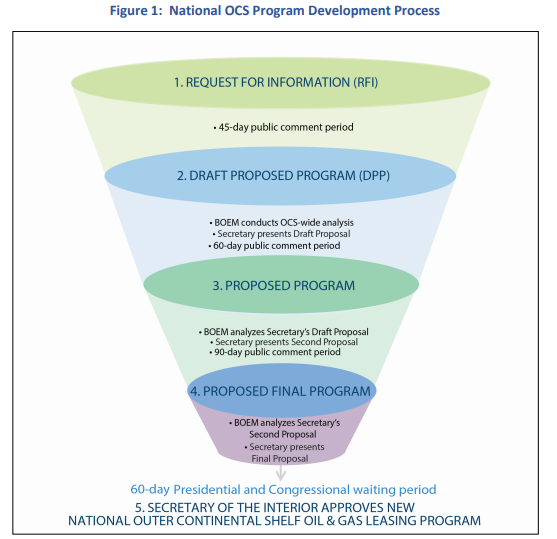
A leaked Dept. of the Interior (DOI) document will likely have little in common with the Draft Proposed Program (DPP, step 2 above). The DPP decisions will be made by the President, not by DOI staffers or managers.
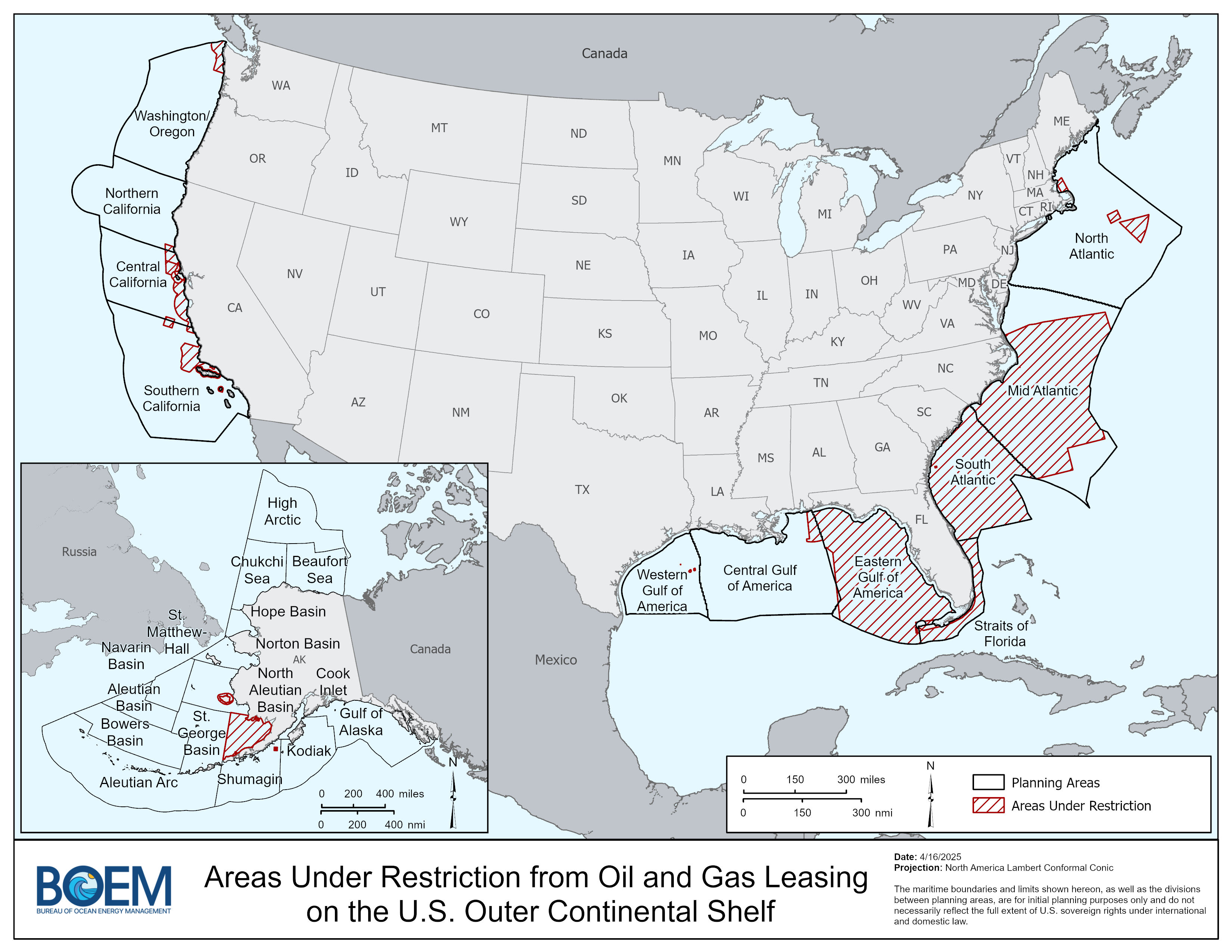
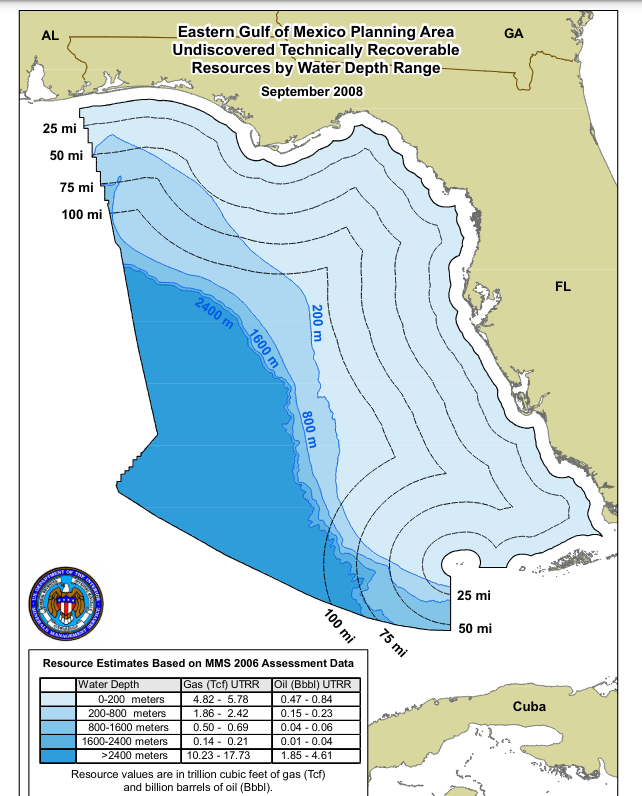
According to media reports, the leaked document includes lease sales offshore New England, the Carolina’s and California. Unless the President revokes his own 2020 withdrawals, the Carolina’s are off-limits until 2032. Ditto for the Eastern Gulf within 125 miles from Florida. (See the map below.)
Including North Atlantic and offshore California in the DPP would unleash a firestorm of opposition. In the case of the North Atlantic, the acreage may not be sufficiently prospective to justify the fight.
To the extent that marine sanctuary determinations do not preclude California offshore leasing, the litigation and legislative battles probably would. In the unlikely event that a sale could be held, who would bid? Who wants to be the next Sable?
The Beaufort Sea is the most likely frontier area to be included in the DPP given plans to open ANWR, operational history, resource potential, and State support.
Assuming the South Atlantic withdrawal could be partially lifted, a small, targeted lease sale would be of great interest to petroleum geologists and could have significant economic and national security implications. The late Paul Post, the foremost expert on the petroleum geology of the US Atlantic, saw great potential in the paleo deep- and ultra-deepwater areas. He advocated exploration concepts proven successful in analogous West African and South American settings where massive discoveries have been made. Samuel Epstein, another prominent petroleum geologist, also believes the deepwater Atlantic has great resource potential.
Finally, the extent of the Florida buffer needs to be considered given the high resource potential of the Eastern Gulf. Be it 75, 100, or 125 miles, leasing beyond that buffer should be a priority.
Posted in energy policy, Offshore Energy - General, tagged Atlantic leasing, Cruz Arrington bill, EGOM, Florida, offshore drilling, offshore oil and gas on January 17, 2025| 3 Comments »
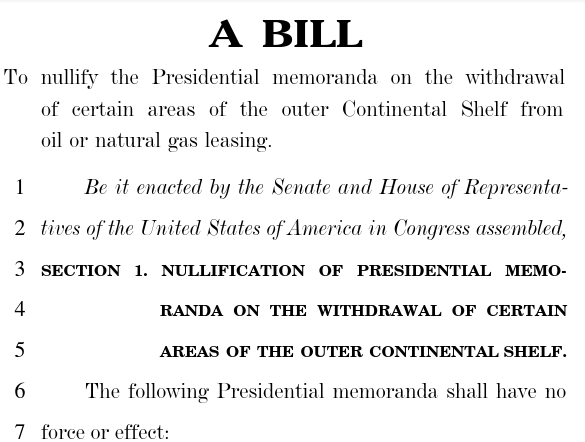
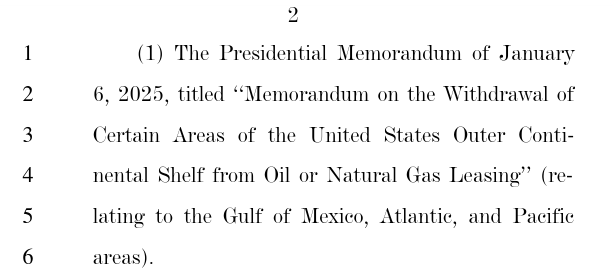
The Cruz-Arrington bill (pasted below), which would reverse the Biden oil and gas leasing bans, raises some interesting political questions:
I suspect that the answer to each question is no, which means the bill will be difficult to pass.
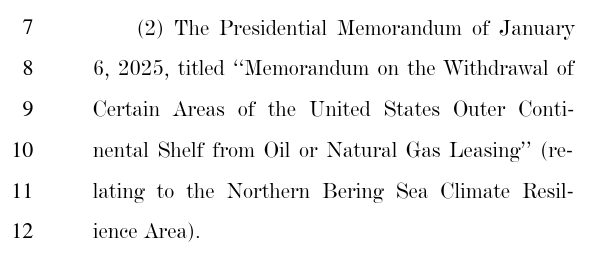
If the bill should pass, President Trump would presumably nullify his own Atlantic and Eastern Gulf withdrawals, which would otherwise remain in effect through 2032.
50 wells were drilled in the Atlantic between 1975 and 1985. The drilling followed the oil embargoes, gas lines, and price surges in the 1970s. Waiting for similar turmoil to overturn the leasing bans would not be prudent given the time that is needed to issue, explore, and develop leases. The optimal approach would be limited, staged leasing to better assess the resource potential in these areas.
Posted in energy policy, Florida, Gulf of Mexico, Offshore Energy - General, tagged EGOM, Florida, macondo, natural gas, offshore wind prohibition, oil and gas leasing on May 20, 2024| Leave a Comment »
Florida HB 1645 (attached) was signed by Gov. DeSantis on 5/15/2024. The bill boosts natural gas, prohibits offshore wind turbines, and deletes references to climate change and greenhouse gases in state law. Given the State’s support for traditional energy sources, is it time to renew the dialogue about exploration and production in the Eastern Gulf of Mexico (EGOM)?
HB 1645 prohibits offshore and coastal wind development (p. 30), acknowledges that natural gas is critical for power resiliency, prohibits zoning regulations that restrict gas storage facilities and gas appliances (p.8), and relaxes permitting requirements for pipelines <100 miles long.
Given Florida’s energy preferences as expressed in this legislation, the State could assist regional energy planners by better defining its position on oil and gas leasing in the EGOM. What limits, in terms of lease numbers and minimum distances from shore, would best improve Florida’s energy supply options while further minimizing environmental risks?
As illustrated on the map below, the petroleum geology of the EGOM and Florida’s preferences are likely aligned in that the best prospects for oil and gas production are in deep water and more than 100 miles from the State’s coast. Does Florida support a 100 mile buffer?
The 4/20/2010 Macondo blowout was a tragic failure that has been, and will continue to be, discussed at length on this blog. We should also acknowledge that prior to Macondo 25,000 wells were drilled on the US OCS over a 25 year period without a single well control fatality, an offshore safety record that was unprecedented in the U.S. and internationally. We should also applaud recent advances in well integrity and control, including the addition of capping stack capabilities that further reduce the risk of a sustained well blowout.
Florida’s independent thinking on energy policy is commendable. That independence is contingent on importing petroleum products and natural gas from elsewhere in the Gulf region. Securing that supply over the intermediate and longer term should be a priority for Florida. In that regard, EGOM production is an important consideration.
Posted in hurricanes, Uncategorized, tagged Cajun Navy, Florida, Hurricane Ian on September 30, 2022| Leave a Comment »

These dedicated and selfless volunteers are assisting in Florida rescue and recovery missions, and are once again making us proud!
Posted in cuba, Florida, tagged cuba, drilling, Florida, offshore oil on January 23, 2011| 2 Comments »
The Buchanan measure would permit the U.S. secretary of the interior to deny drilling leases to companies involved with countries facing trade sanctions. Buchanan specifically noted that Repsol, a Spanish corporation, has an agreement in place with Cuba to drill off the Florida coast. Sunshine News
Comment: In addition to the economic and foreign policy flaws, this legislation could increase risks to Florida by further limiting the pool of technically advanced and responsible companies that could participate in Cuban offshore drilling.
We would lose regardless of what these companies decided. If a company opted not to purchase US leases (so they could drill offshore Cuba), we would lose economically (i.e. jobs, revenue, and energy). If the company chose to exit Cuba, less capable companies would fill the void.
While it seems unlikely that this bill will pass, even its threat could influence the decisions of leading international companies. If Congress is interested in protecting US interests, how about a bill that would facilitate dialogue with Cuba on safety and pollution prevention issues? How about a bill that would allow leading American companies to work offshore Cuba?
Posted in cuba, Florida, Offshore Energy - General, tagged Bahamas, cuba, drilling, Florida, offshore oil on January 19, 2011| Leave a Comment »
Super-geologist Paul Post is tracking Cuban and Bahamian activity and sent this map and update.
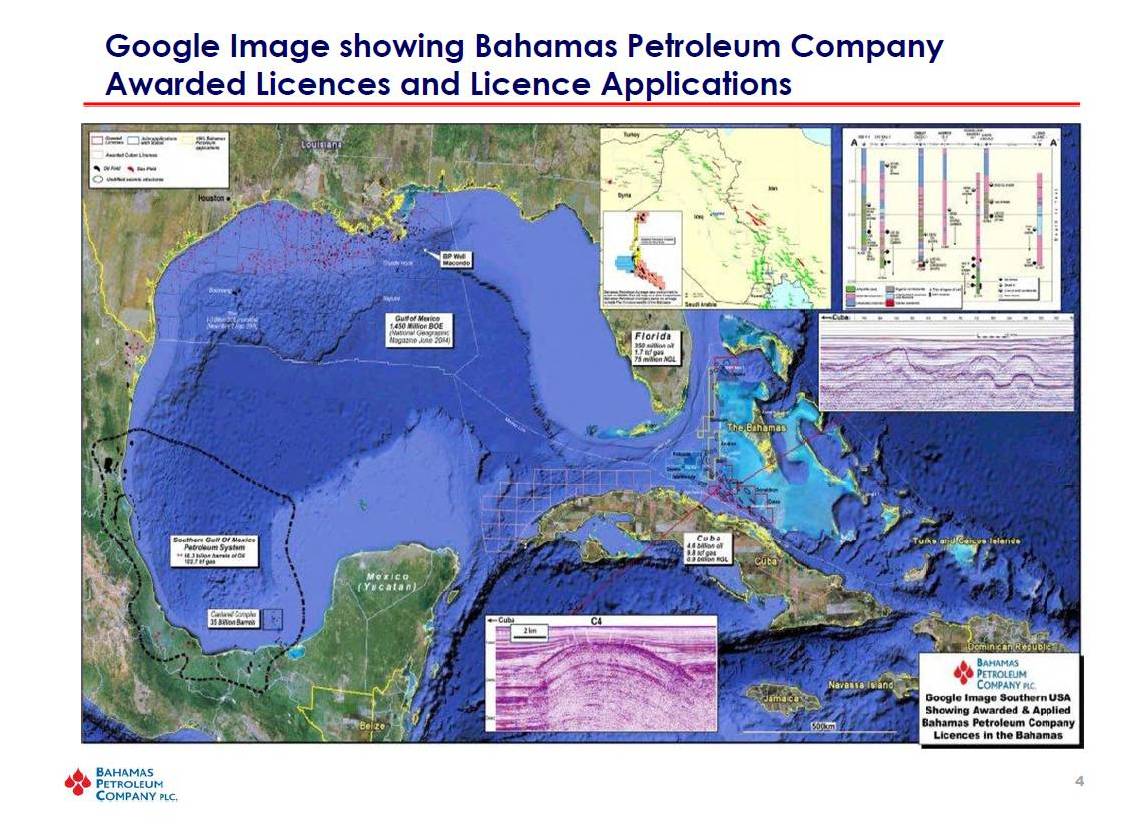
click on image to enlarge
Two thousand and eleven could be a key year for oil minnow Bahamas Petroleum Company. The AIM-quoted explorer has hired the Osprey Explorer seismic vessel, owned by Norway’s SeaBird Exploration, to shoot close-grid 2D over its four licences to the south of the Bahamas with a view to firming up a prospect for drilling in Q4. This would be the first well in Bahamian waters since 1986 and will be an acid test of BPC’s claim to be holding first mover advantage in waters that could be home to billions of barrels of oil. OilBarrel.com
Note that the area of interest is adjacent to Cuban waters, so the Cuban findings will be of great interest to the Bahamas. I don’t know if the two countries have an information sharing agreement. Perhaps the Scarabeo 9 semisubmersible will move to Bahamian waters after drilling one or more wells off Cuba.
Posted in cuba, drilling, offshore, tagged cuba, drilling, Florida, offshore oil, Repsol, Saipem, Scarabeo 9 on January 5, 2011| Leave a Comment »
Well, well. In early March, Cuba will commence with deep water drilling under contract with Repsol and Statoil ASA, using an older rig that was recently rehabbed by the Chinese. Reports indicate that it has fewer safety features than the BP’s infamous Deepwater Horizon. The site is located a scant sixty miles southeast of Key West, Florida. Benzinga.com
There are some errors and unsupported opinions in this article, so I would take the March spud date with a grain of salt. As confirmed by Rigzone, the Saipem Scarabeo 9 is a new rig, not a rebuild. It was built in China and commissioned in Singapore. The inflammatory comment about the rig having fewer safety features than the Deepwater Horizon is also without substance. Everything about the Scarabeo 9 appears to be state-of-the-art.
While a projected 2011 spud date has been reported and appears likely, Cuba’s deepwater drilling program has been marked by repeated delays. BOE has seen no confirmation that the rig has arrived or is en route to Cuba. We would appreciate any updates that others might be able to provide.
Posted in cuba, tagged cuba, drilling, Florida, offshore oil, Saimpem, venezuela on November 15, 2010| Leave a Comment »
Venezuelan state oil company PdVSA will “soon” being exploratory drilling in Cuban waters of the Gulf of Mexico, President Hugo Chávez said during a bilateral meeting in Havana earlier this week.

Scarabeo 9
It sounds like they may want to use Saipem’s new Scarabeo 9 which is scheduled to drill a well for Repsol early next year. The only sure thing is that they won’t be using the Aban Pearl.
Posted in drilling, Florida, gas, Offshore Energy - General, oil, tagged drilling, Florida, offshore, production on March 9, 2010| Leave a Comment »
 The Florida Legislature may soon decide whether to lift the 20 year ban on oil and gas exploration and production in State waters.
As part of the review process, the State has prepared a list of questions on the management and regulation of offshore oil and gas resources. Responses to these questions will help define the general terms of the regulatory regime that the State would follow if the ban is lifted.
The State is inviting input on any or all of the questions. Please email your responses to adam.blalock@myfloridahouse.gov by the close of business on Monday, March 15. Response should be limited to no more than 500 words per question.
 Bud's Offshore Energy (BOE)