Addressing regulatory fragmentation will improve efficiency and lower costs for industry and government while reducing safety and environmental risks.
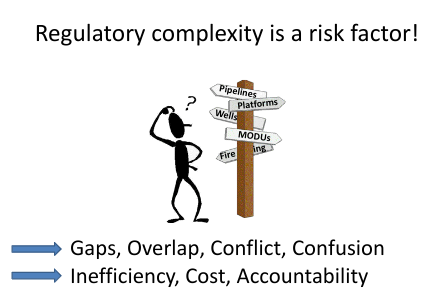
Unfortunately, the regulatory regime for US offshore oil and gas operations is noteworthy for redundancy, uncertainty, and complexity that divert industry and governmental attention from safety and environmental protection objectives to administrative processes, interpretations, and jurisdictional boundaries.
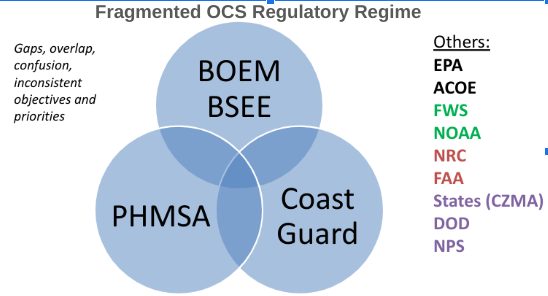
The 12 Federal entities that have some OCS regulatory responsibilities are identified in the above chart. The organizations with core regulatory roles are included in the overlapping circles. The responsibilities of BOEM and BSEE are so inextricably intertwined that those bureaus occupy the same circle.
Coastal states also have OCS regulatory roles through authority granted in the Coastal Zone Management Act.
When multiple agencies have jurisdiction over a facility, system, or procedure, the redundancy inevitably results in inconsistency, ambiguity, and gaps in oversight. The focus of operating companies and contractors is diverted from safety and risk management to understanding and satisfying the regulators. The inevitable result is a compliance mentality that weakens the safety culture.
Interagency agreements in the form of MOUs and MOAs, which are ostensibly for the purpose of managing redundancy, are often unclear or inconclusive. They tend to be more for the benefit of the agencies than the regulated industry. The interests of the regulators and protecting turf are paramount.
Regulatory fragmentation was a contributing factor to the two most fatal US OCS incidents in the past 35 years, the 2010 Macondo blowout and the South Pass 60 “B” fire and explosion in 1989.
Solutions:
- Where legislation is not required (e.g. BOEM and BSEE), use executive orders to combine and streamline the regulatory functions.
- Where agencies have separate legislative authority, establish a lead regulator by executive order pending corrective legislation. Under the EO, the agencies would function as a joint authority under the direction of the lead regulator.
- A combined BOEM/BSEE would be the logical choice for leading the joint authority given that OCS energy is their sole focus and they are accountable for the success of OCS programs.
- Use a management system regulatory approach that holistically considers all of the legislatively enacted regulatory objectives.
- Increase the attention given to regulator and operator performance in terms of both outcomes and efficiency.
- Reduce and simplify permitting requirements for operating companies that have demonstrated outstanding safety and environmental performance over a sustained period.
- See the findings and recommendations from the 2010 Vancouver IRF Conference.
 Bud's Offshore Energy (BOE)