Feeds:
Posts
Comments

Posts Tagged ‘cuba’

It sounds like they are talking about drilling directionally from onshore locations to offshore targets:

Cuba will drill 20 new oil wells in 2011, mainly in the area from Havana to Varadero, some 120 kilometers east of the island’s capital, said Rafael Tenreyro, head of the exploration group of the Petróleos de Cuba Company. He noted that the drilling will take place from the coast to the sea, to reduce the environmental impact, reported IPS. Havana Times

Read Full Post »

The Buchanan measure would permit the U.S. secretary of the interior to deny drilling leases to companies involved with countries facing trade sanctions. Buchanan specifically noted that Repsol, a Spanish corporation, has an agreement in place with Cuba to drill off the Florida coast. Sunshine News

Comment: In addition to the economic and foreign policy flaws, this legislation could increase risks to Florida by further limiting the pool of technically advanced and responsible companies that could participate in Cuban offshore drilling.

We would lose regardless of what these companies decided. If a company opted not to purchase US leases (so they could drill offshore Cuba), we would lose economically (i.e. jobs, revenue, and energy).  If the company chose to exit Cuba, less capable companies would fill the void.

While it seems unlikely that this bill will pass, even its threat could influence the decisions of leading international companies. If Congress is interested in protecting US interests, how about a bill that would facilitate dialogue with Cuba on safety and pollution prevention issues? How about a bill that would allow leading American companies to work offshore Cuba?

Read Full Post »

1. This is a surprise.  Does anyone know more about this conference?

U.S. experts will participate in a conference on oil safety in Cuba this April, Reuters reported. The conference comes as the BP disaster on the U.S. side of the Gulf of Mexico is raising concern over the start of offshore drilling in Cuban waters this year. The arrival of an exploratory drilling platform in Cuban waters that had been expected for early this year was reportedly postponed to summer.

2. TheHill.com has a pretty good energy blog of particular interest to Washington-types (you know who you are!).

National oil spill commission co-chairman William Reilly called on the Obama administration to think about negotiating a treaty with Mexico and possibly Cuba that would lay out uniform safety standards for offshore drilling in the Gulf of Mexico.

3. Nothing new is being reported on the blowout/uncontrolled flow/gas leak beneath the East Cameron block 278 B platform that Apache is calling a “water disturbance.” Spin doctors never sleep.

Based on the limited information that is available, well integrity issues loom large and there appear to be some disturbing similarities with the Main Pass 91 blowout in 2007.

Read Full Post »

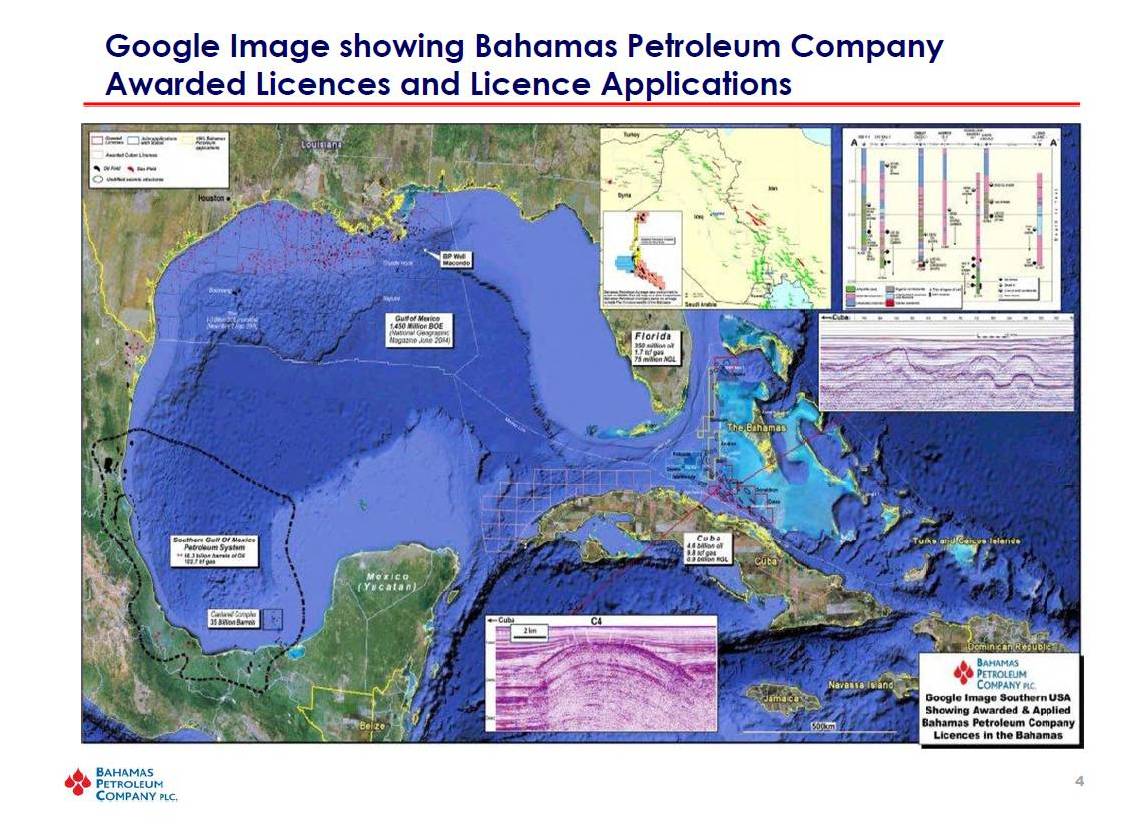
Super-geologist Paul Post is tracking Cuban and Bahamian activity and sent this map and update.

click on image to enlarge

Two thousand and eleven could be a key year for oil minnow Bahamas Petroleum Company. The AIM-quoted explorer has hired the Osprey Explorer seismic vessel, owned by Norway’s SeaBird Exploration, to shoot close-grid 2D over its four licences to the south of the Bahamas with a view to firming up a prospect for drilling in Q4. This would be the first well in Bahamian waters since 1986 and will be an acid test of BPC’s claim to be holding first mover advantage in waters that could be home to billions of barrels of oil. OilBarrel.com

Note that the area of interest is adjacent to Cuban waters, so the Cuban findings will be of great interest to the Bahamas.  I don’t know if the two countries have an information sharing agreement. Perhaps the Scarabeo 9 semisubmersible will move to Bahamian waters after drilling one or more wells off Cuba.

Read Full Post »

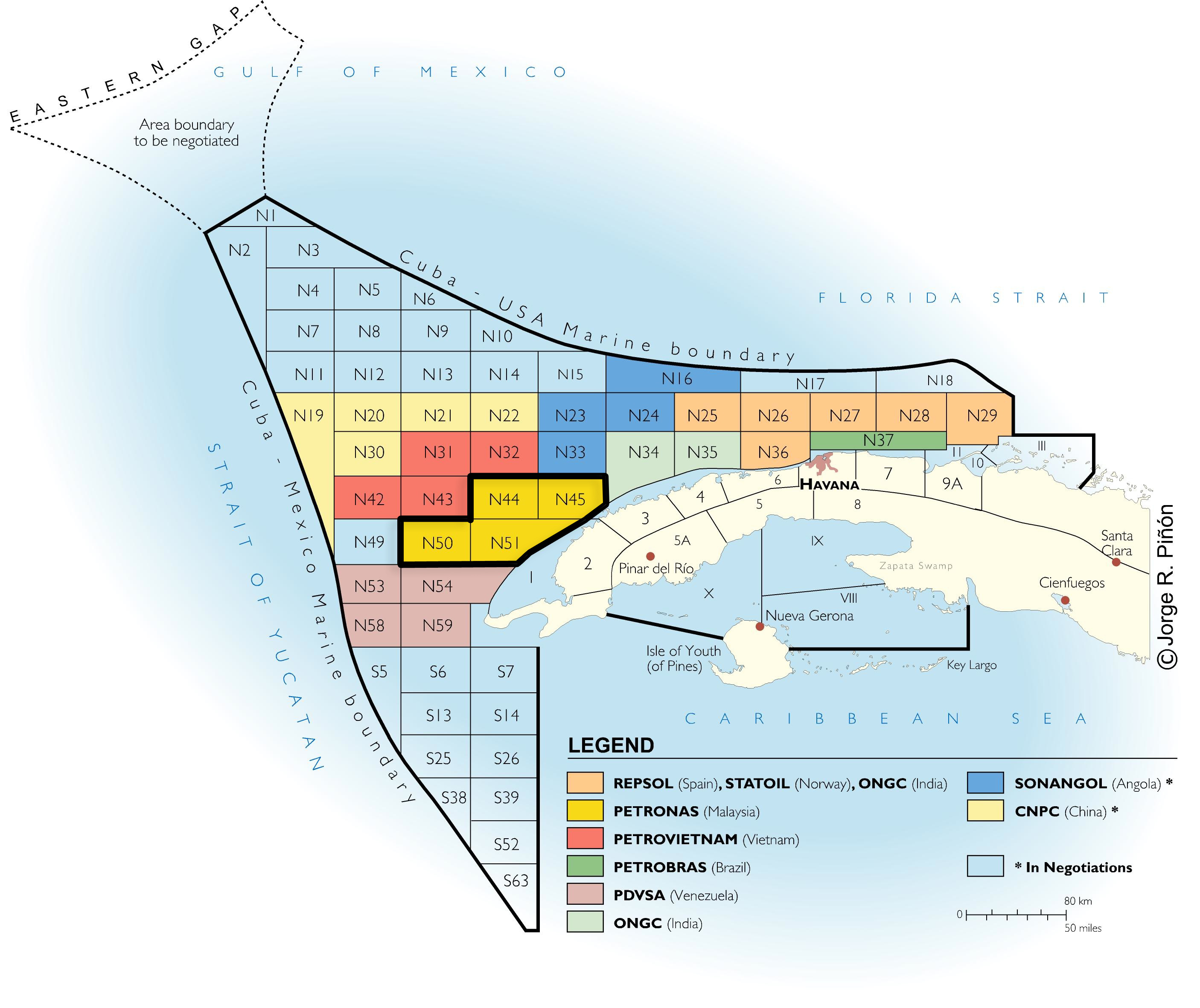
Well, well. In early March, Cuba will commence with deep water drilling under contract with Repsol and Statoil ASA, using an older rig that was recently rehabbed by the Chinese. Reports indicate that it has fewer safety features than the BP’s infamous Deepwater Horizon. The site is located a scant sixty miles southeast of Key West, Florida. Benzinga.com

There are some  errors and unsupported opinions in this article, so I would take the March spud date with a grain of salt.  As confirmed by Rigzone, the Saipem Scarabeo 9 is a new rig, not a rebuild. It was built in China and commissioned in Singapore. The inflammatory comment about the rig having fewer safety features than the Deepwater Horizon is also without substance. Everything about the Scarabeo 9 appears to be state-of-the-art.

While a projected 2011 spud date has been reported and appears likely, Cuba’s deepwater drilling program has been marked by repeated delays. BOE has seen no confirmation that the rig has arrived or is en route to Cuba. We would appreciate any updates that others might be able to provide.

Read Full Post »

According to CubaStandard.com, we can add Petronas, with Gazprom as a major partner, to the list of companies that will be drilling offshore Cuba next year.  So, as best we can determine, beginning in 2011 the following companies will be using Saipen’s Scarabeo 9 to drill wells offshore Cuba:

  1. Repsol (Spain) with Statoil (Norway) and ONGC (India) each holding a 30% interest
  2. PdVSA (Venezuela)
  3. Petronas (Malaysia ) with Gazprom (Russia) holding a 30% interest

Contrary to our energy, economic, and environmental interests, the US continues to prohibit governmental consultations on these important issues and participation by US companies in any aspect of Cuban offshore operations.

Read Full Post »

As if drilling offshore Cuba wasn’t already controversial enough, add Hugo Chavez to the mix.  Now this should be interesting:

Venezuelan state oil company PdVSA will “soon” being exploratory drilling in Cuban waters of the Gulf of Mexico, President Hugo Chávez said during a bilateral meeting in Havana earlier this week.

Scarabeo 9

It sounds like they may want to use Saipem’s new Scarabeo 9 which is scheduled to drill a well for Repsol early next year.  The only sure thing is that they won’t be using the Aban Pearl.

Read Full Post »

Scarabeo 9

According to the Miami Herald an Italian rig, the Scarabeo 9, will drill the long-awaited exploratory well offshore Cuba.  The article indicates that the new-build rig is expected to arrive in Cuba late this year.

Per Oil and Gas Interntional:

The Scarabeo 9 embodies the latest technology for deepwater drilling operations and is capable of drilling in waters 3,600 meters in depth. Expectations are it will mobilize to Cuban waters during the second or third quarter of 2011 and commence drilling during the third or fourth quarter. (note: the Miami Herald article projects an earlier arrival). Repsol holds the six blocks in the Cuban sector of the Gulf of Mexico in a production-sharing agreement with Union Cubapetroleo (Cupet), the Cuban national oil company. The concession encompasses Blocks N25, N26, N27, N28, N29, and N36, a combined area of some 10,200 sq km along the island’s northwest coast. Repsol is the operator of the six blocks with 40% interest in partnership with Statoil, holding 30% and Oil and Natural Gas Corporation (ONGC) with the remaining 30%.

Read Full Post »

In our last Cuba update, we noted that their next deepwater well always seems to be a year away. So it came as no surprise when we saw this in a New York Times article:

Yet next year, a Spanish company will begin drilling new wells 50 miles from the Florida Keys — in Cuba’s sovereign waters.

Comment: We have been hearing this for five years.  Will the well really be spudded next year?

The nascent oil industry in Cuba is far less prepared to handle a major spill than even the American industry was at the time of the BP spill. Cuba has neither the submarine robots needed to fix deepwater rig equipment nor the platforms available to begin drilling relief wells on short notice.

Comments: (1) Not a good time for the US to be lecturing Cuba about oil spills.  (2)In the event of a spill, all well intervention, relief well, and spill response equipment would no doubt be made available to Cuba without hesitation and with the full support of the US government. (3)A Cuban blowout is unlikely because every operator and contractor in the world will be focusing on well integrity and BOP performance issues that were factors in the Macondo blowout. (4)Informed international contacts have advised us that Cuban offshore officials are knowledgeable and committed to internationally accepted safety and pollution prevention standards.

My biggest concern with regard to Cuban offshore operations, assuming a moored rig is used, is that the rig would be set adrift during a hurricane and that anchors, mooring lines, or hulls could damage coral reefs and other sensitive seafloor features.  In the US, the MMS and industry did a lot of good work on mooring risk assessments and improved anchoring systems and mooring lines.   Given the significant probability that Cuban rigs will be exposed to hurricane conditions, it is imperative that US and Cuban specialists meet to discuss these issues.  Once a rig is adrift, there is not much that can be done to stop it.

Also, in an award winning project, a multi-agency US government team demonstrated enhanced satellite monitoring capabilities that provide timely information on the location of evacuated rigs.   These capabilities can be combined with gps systems to ensure continuous rig-tracking.

US-Cuban cooperation on offshore safety and pollution prevention issues is in the best interest of both countries, and should be encouraged without hesitation.

Read Full Post »
Cuba Watch; the Wait Continues

Cuba’s only deepwater well was drilled in July 2004 by Repsol, a Spanish company.  Repsol reported a non-commercial oil discovery 95 miles southwest of Key West.  For the past 5 years, there have been a series of announcements from Havana, but no offshore drilling activity.

Here is what we know about Cuba’s offshore oil and gas potential:

USGS (2005) estimates that Cuba’s northern offshore basin could contain 4.6 billion (mean) barrels of oil, with a 5% probability of discovering 9.4 billion barrels. Mean natural gas resources are estimated to be 9.8 trillion cubic feet.

Cuban government officials believe the USGS estimates are low.  They indicate that Cuba may have more than 20 billion barrels of recoverable oil.

Cuba’s 2008 oil production was estimated at 61,300 barrels per day.

Will the offshore activity and results ever match the inflated rhetoric?  We will be watching.

Read Full Post »

« Newer Posts