Scientific discovery, technological innovation, and human ingenuity are not finite!
The U.S. Geological Survey released its assessment of undiscovered gas and oil in the Bossier Formation along the Gulf Coast. USGS assesses that there are technically recoverable resources of 343.5 trillion cubic feet of gas – enough to supply the United States for more than 10 years at the current rate of consumption.
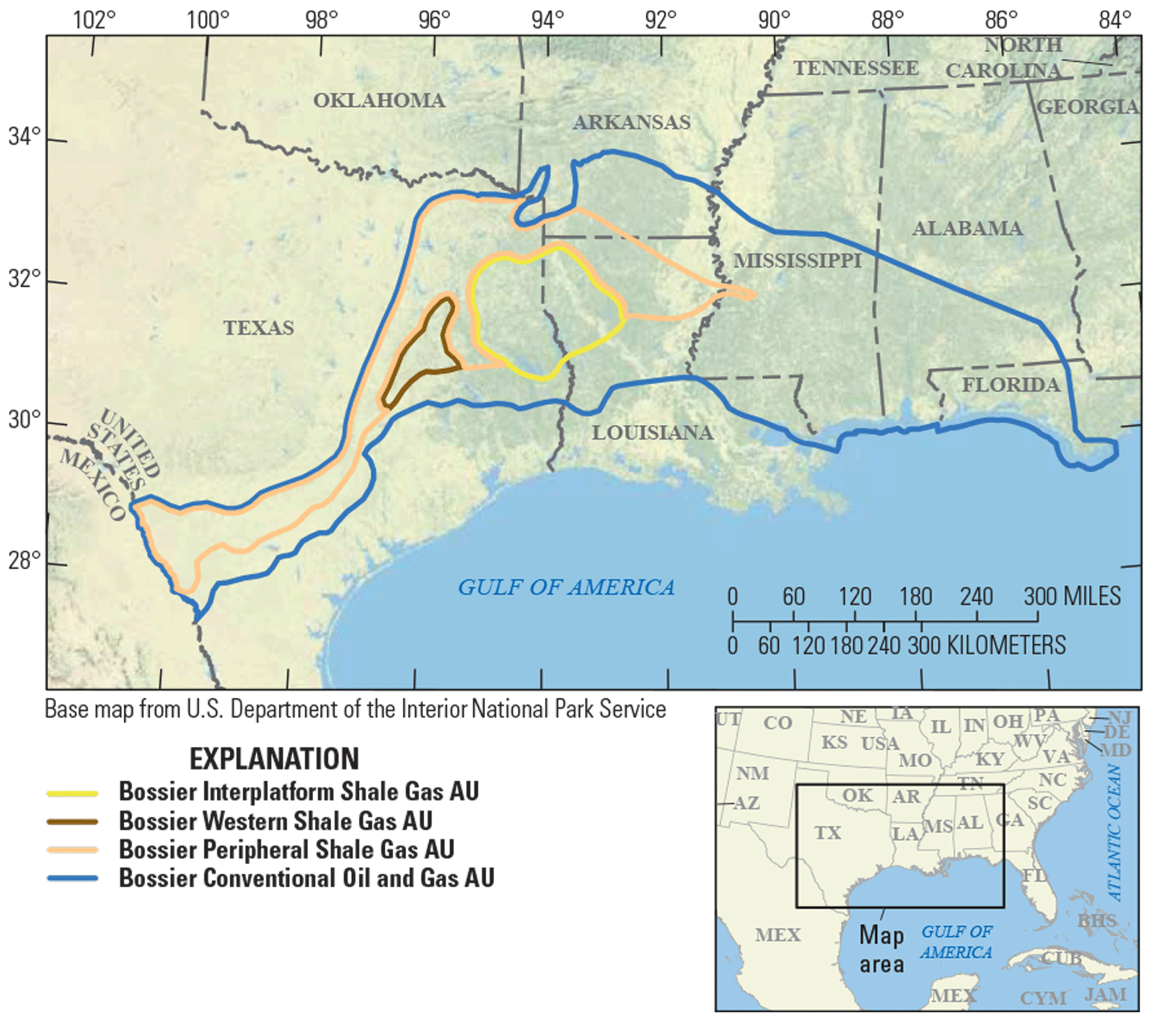
The USGS quantitatively assessed three continuous and one conventional AUs (assessment units) for undiscovered oil, gas, and natural gas liquid resources in the Bossier Formation. The estimated mean total resources in the four AUs are 3 million barrels of oil (MMBO), with an F95–F5 range from 1 to 8 MMBO; 343,499 billion cubic feet of gas (BCFG), or 343.5 trillion cubic feet of gas, with an F95–F5 range from 103,943 to 611,703 BCFG; and 374 million barrels of natural gas liquids (MMBNGL), with an F95–F5 range from 109 to 721 MMBNGL (table 2).
So much for the depletion of our natural gas resources! Long-time gas advocates knew that geologic studies, technology, and ingenuity would provide the resource, and that has been demonstrated in spades!
Kudos to USGS, headed by my former colleague Ned Mamula, for their important resource assessment studies!