Feeds:
Posts
Comments

Posts Tagged ‘BOPE’

JL Daeschler, pioneering subsea engineer and BOE contributor, recounted a frightening incident in 1976, a year after UK North Sea production began:

We found ourselves in a drastic situation. While working on a subsea well, the wireline retrievable tubing safety valve got tangled up in the tree area. We had an open well situation and couldn’t cut the wire in the subsea tree. Further, the weather was bad, and keeping on location was difficult. The riser hydraulic release was faulty, so there was an imminent high risk of a “jammed ” subsea tree, bent/damaged riser, and uncontrollable well flow.

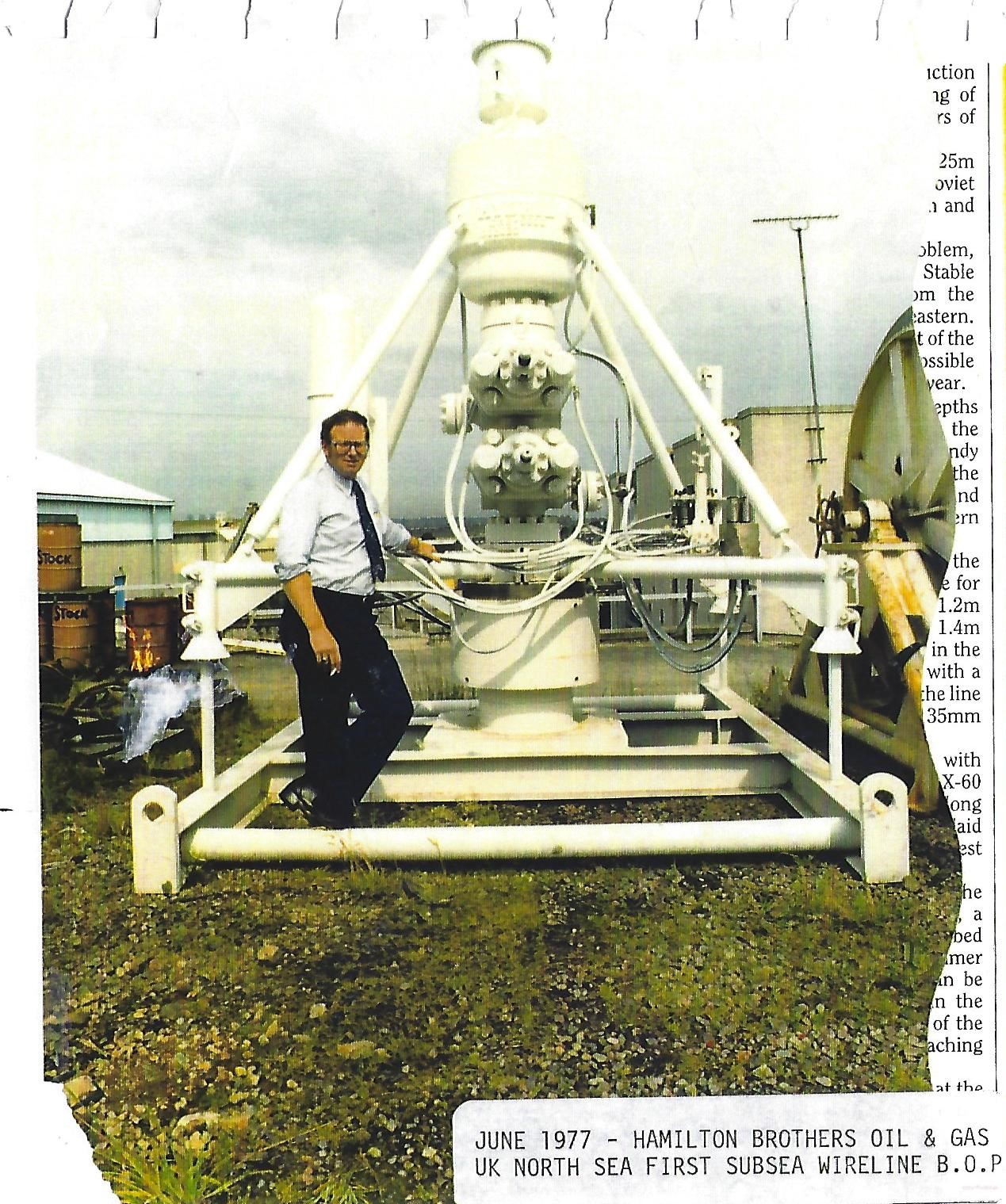
We got through this, but recognized that improved well control capabilities were needed during workover operations. Management decided that any future workover operations on a subsea tree/well would require a small diameter workover BOP with shearing capability immediately above the Xmas tree. A year later, we had the hybrid kit pictured below (with JL). Note that the guide funnels are slim to run on guide lines and not overshoot the guide base posts.
JL’s story reminds us once again that safety achievement is dependent on continuous improvement driven by experience, research, and technological advances.

When I was a young engineer with the US Geological Survey, the OCS safety regulator at the time, my boss and mentor Richard Krahl (known as “Mr. OCS” for his commitment to offshore safety) slammed😀 a copy of the first edition of API RP 14C (Analysis, Design, Installation, and Testing of Safety Systems for Offshore Production Facilities) on my desk and told me to read it carefully. That pioneering process safety document has grown with the offshore industry and is now in its 8th edition.

Similarly, API RP 2A-WSD (Planning, Designing, and Constructing Fixed Offshore Platforms— Working Stress Design) is now in its 22nd edition and API STD 53 (Well Control Equipment Systems for Drilling Wells) is in its 5th edition. There are countless other examples of the progression in safety equipment and practices.

As individuals, companies, agencies, and collectively as an industry, there can be no standing still. Nothing is routine and the challenges continue to grow: deeper wells, more complex geology, higher temperature and pressure, deeper water, harsher environments, remote locations, new security risks, and more. We get better or we get worse, and the latter is not an option. Onward!

Read Full Post »

Air France flight 447 went down June 1, 2009, amid an intense, high-altitude thunderstorm

Specialists are launching a fourth undersea search effort next week for the plane’s so-called black boxes, or flight recorders.

‘We are convinced if we find the black boxes we’ll be able to reconstruct what really happened on this tragic flight Air France 447,’ Enders said. Airbus officials say the search is a company priority.

Air France and Airbus will finance the estimated $12.5 million cost of the new search, in which three advanced underwater robots will scour the mountainous ocean floor between Brazil and western Africa, in depths of up to 4,000 meters (13,120 feet).

Already $27.5 million has been spent on three previous search attempts that failed to find Flight 447’s voice and data recorders.  Daily Mail

Aviation safety proponents have argued that it’s time to start replacing black boxes with satellite systems that stream critical data real time. Similarly, as we have previously suggested, it’s time for real time monitoring of wellhead and BOP pressures and functions. This relatively inexpensive improvement would support testing and maintenance programs, improve our understanding of BOP performance, assist with well control decisions, and facilitate investigations.

Read Full Post »

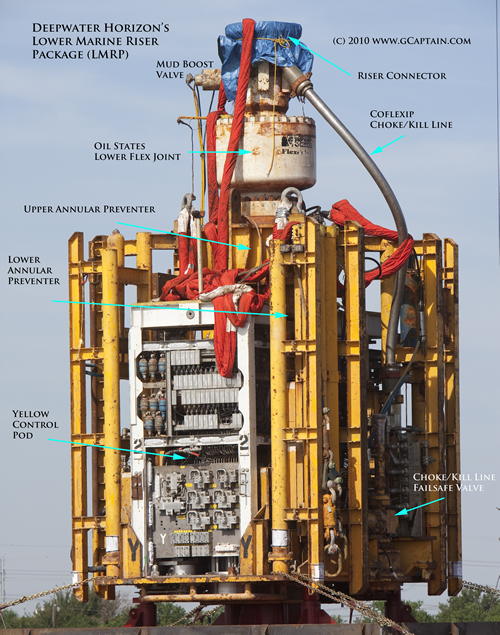
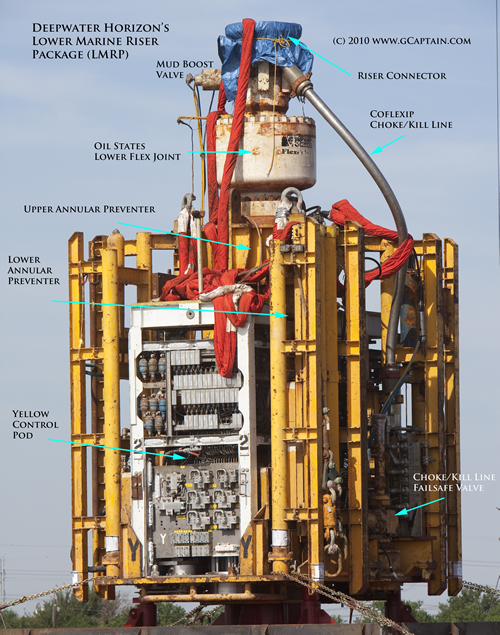
BOP stack awaiting post-Macondo inspection (from gCaptain.com)

In my 11 May 2010 testimony before the Senate Energy and Natural Resources Committee, I made ten recommendations. While many of the issues raised in that testimony are being addressed, one of the more important recommendations (no. 4) has received little or no attention. This recommendation calls for a public or private system for collecting and assessing failure date for blowout prevention equipment.  To the best of my knowledge, the only publicly available performance data for BOPE were collected by MMS and SINTEF and pertain to failures during BOP pressure testing, not failures during other operations.  How can we have a credible safety system without comprehensive failure data for such critical well control equipment?

Dr. Malcolm Sharples, an important BOE contributor, identified a number of BOP performance issues since Macondo.  Here are a few examples:

  1. During routine tests on the device, the locking system of one of the rams jammed in a locked position. Sevan is working with Petrobras and the supplier, Cameron, to find a solution.
  2. Reliance suspended all drilling work in the block after the Transocean rig Deepwater Expedition developed technical problems in its BOP. Reliance was drilling the KGV-D3-W1 well in the contract area since April 2010.
  3. The rig was offshore Australia for Shell early last month when newly installed BOP components failed during operations. Following several unsuccessful attempts to rectify the problems in the field, the failing BOP component is currently undergoing repairs in Singapore.

How is this information not important to every operator, regulator, and drilling contractor?  A comprehensive BOP failure reporting system should be a high and immediate priority for the offshore industry.  The information should be verified and published so that all may learn and future performance improved. Requirements for providing such information should be included in contracts and, if necessary, regulations.

An other major void that I have been talking about for years, without much success, is the absence of a comprehensive and verified international incident reporting system.  I assumed this would be universally recognized immediate necessity, and a critical element of the offshore industry’s initiatives agenda. Apparently that is not the case.  More on this to follow.

Read Full Post »