Feeds:
Posts
Comments

Posts Tagged ‘bid adequacy procedures’

15,531 of the 15,537 comments on the bid adequacy rule were from a single organization, Friends of the Earth. I have no problem with the Friends of the Earth campaign given that their comment letter is pertinent to the topic. Their main point is that the bid adequacy process fails “to factor in the climate and social costs of continued Outer Continental Shelf oil and gas lease sales into the bid process.” Although that may be a reasonable position, those issues are addressed in the programmatic and sale specific environmental reviews which factor into when and where sales are held, tract exclusions, special lease stipulations, and the comprehensive operating regulations. Once bids are submitted, the issue (and the sole purpose of the bid adequacy rule) is whether those bids represent fair market value for the oil and gas resource potential of the leases being offered.

Given that 96.3% of the US OCS is off-limits to oil and gas leasing, only 0.7% is currently open to exploration, and the new 5 year plan includes the fewest lease sales in OCS program history, it’s rather a stretch to argue that environmental concerns are not being prioritized.

The State of Alaska submitted very good comments (attached) that point to the historical differences in Gulf of Mexico and Alaska leasing. The State argues that a simpler approach to determining fair market value would encourage exploration and development on offshore lands that have seen little of either in recent years. Knowing BOEM’s expectations prior to the sale, perhaps through higher minimum bid requirements, would ensure that companies do not underbid and that tracts are successfully leased.

The Gulf of Mexico leasing program of today is looking more like the frontier area leasing of the past. As previously noted, the uncertainty regarding future sales changes the historic GoM leasing dynamic. The next opportunity for purchasing unleased GoM tracts is now a troubling unknown. This would seem to make it less prudent to reject bids based on uncertain prospect evaluations. Absent leasing and exploration, the true resource and revenue potential will never be known.

It was good to see the strong comments submitted by my former Minerals Management Service colleagues Dr. Marshall Rose and Ted Tupper. Marshall, who was our Chief Economist, commented that the proposed rule did not identify the problem and explain how the rule addressed that problem. Ted, a senior statistician, points to past failures of the bid adequacy process and proposes specific changes. It’s great to see the passion that our retired employees have for the program they were so instrumental in developing and managing.

The rule was finalized without any substantive changes.

Read Full Post »

BOEM has accepted 76 of the Sale 259 bids to date including 18 of the 29 legitimate (non-CCS) bids for shelf leases.

Interestingly, none of Exxon’s 69 high bids for shelf leases have been accepted to date. Given that the Exxon bids were for tracts that are presumably considered “nonviable” from an oil and gas production standpoint, those bids should have been accepted by now were they deemed to be valid.

Perhaps BOEM, to their credit, is planning to reject the CCS bids as they may when an unusual bidding pattern has been identified. It is now quire clear (unlike in the immediate aftermath of Sale 257) that Exxon was seeking to acquire these leases for carbon sequestration purposes. That is not allowed given that both Sales 257 and 259 were oil and gas lease sales. As similarly noted for Sale 257:

  • Sale 259 was an oil and gas lease sale. The Notice of Sale said nothing about carbon sequestration and did not offer the opportunity to acquire leases for that purpose. Therefore, the public notice requirements for CCS leasing (30 CFR § 556.308) were not fulfilled.
  • Because there was no draft or final Notice of Sale for CCS leases, interested parties and the public did not have the opportunity to consider and comment on CCS leasing, tract exclusions, bidding parameters, and other factors.
  • 30 CFR § 556.308 requires publication of a lease form. No CCS lease form was posted or published for comment.
  • CCS operations were not considered in the environmental assessments conducted prior to the sale.
  • No evaluation criteria for CCS bids have been published.

Meanwhile, the decision on Green Canyon Block 777 will also be of interest, given that a higher Sale 257 bid for this block was rejected.

Finally, there was a second bid (red block below) from Focus Exploration for one of the blocks Exxon bid on (blue). Will that lower bid, which was presumably for oil and gas exploration purposes, be accepted if the Exxon bids are rejected?

Read Full Post »

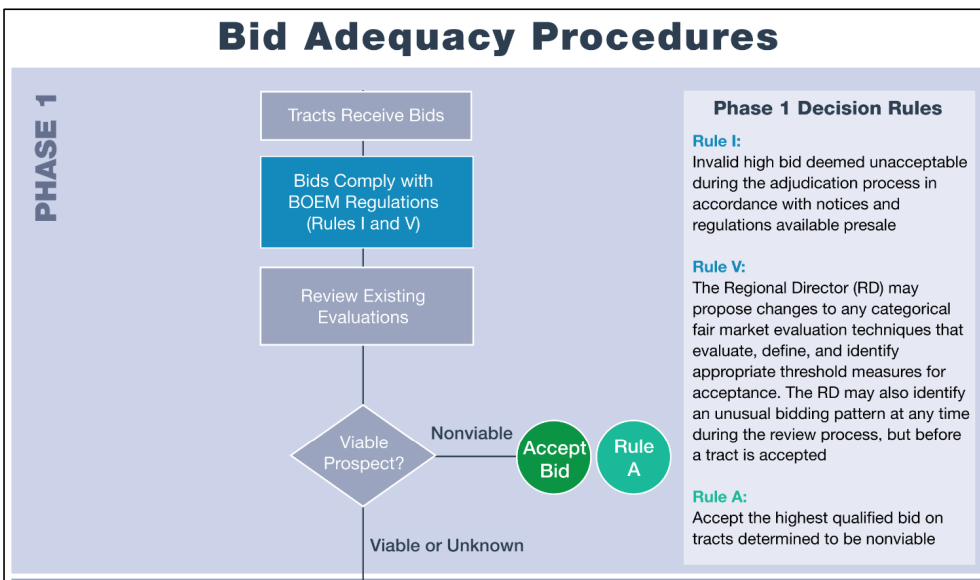
BOEM’s new procedures, which have been published for public comment, seem reasonable. However, it would be helpful to learn more about the testing of the new methodology. (See the quote below). Further, would the rejected Sale 257 bid have been accepted? What was the LBCI for that tract? Would any accepted Sale 257 bids have been rejected? Would the outcome of other sales have been affected?

After a 2-year comprehensive technical review of the delayed valuation methodology, BOEM intends to replace the delayed valuation methodology with a statistical lower bound confidence interval (LBCI) at a 90 percent confidence level as a decision criterion for accepting or rejecting qualified high bids on tracts offered in OCS oil and gas lease sales. Following extensive testing of the alternative approaches using both historical and current lease sale tract data and existing BOEM cash flow simulation models, BOEM determined that the LBCI approach would be the most appropriate substitute for the delayed valuation methodology. The LBCI is a statistical concept that captures the lower bound of a range of values encompassing the true unknown mean of the risked present worth of the resources at the time of the lease sale. The LBCI incorporates the uncertainty of parameters unique to the valuation of each OCS oil and gas lease sale tract. These parameters may include, but are not limited to, subsurface characterization of reservoir properties, cost and timing of the development, and projected revenues. Unlike the delayed valuation methodology, the LBCI approach would not require that BOEM estimate the time delay period between the current OCS oil and gas lease sale and the projected next lease sale. As such, BOEM finds the LBCI to be a better approach going forward.

Federal Register

Below is the flow chart for the new procedures. It’s interesting that high bids on nonviable tracts are automatically (and gratefully) accepted! 😉

Read Full Post »