Feeds:
Posts
Comments

Posts Tagged ‘Atlantic’

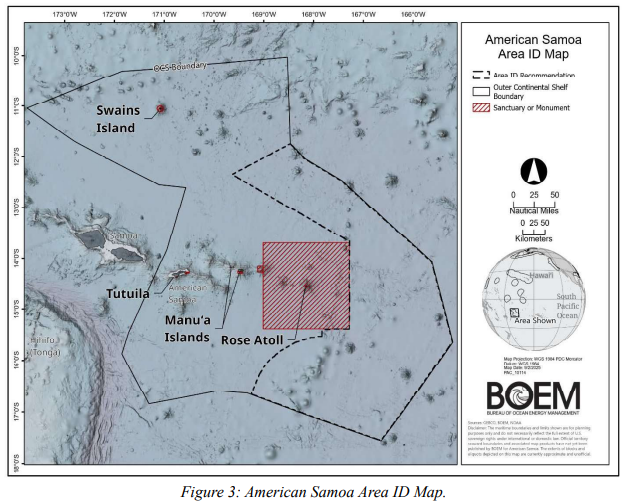
BOEM completed the area identification (outlined in diagram above) for marine minerals offshore American Samoa. The full decision memorandum is attached.

In response to BOEM’s Request for Information, Impossible Metals confirmed their interest in the identified area. Several other companies also expressed interest. The Governor and a number of other parties submitted interesting comments, which are summarized on p. 2 of the attachment.

The first two steps in a process that could ultimately lead to a mineral lease sale have thus been completed. Steps 3 to 6 remain. (See below)

  1. Request for Information and Interest (RFI) published in the Federal Register. complete
  2. Identification of Areas to be considered for leasing. complete
  3. Environmental Analysis for the lease sale.
  4. Proposed Leasing Notice Published in the Federal Register.
  5. Leasing Notice Published in the Federal Register.
  6. Competitive Lease Sale

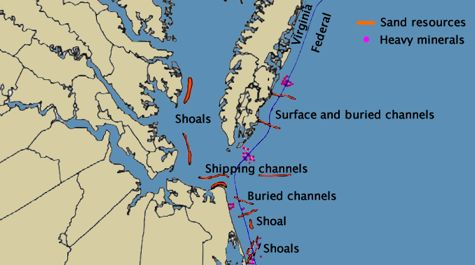
Meanwhile, Odyssey Marine has requested a critical minerals lease sale in the Atlantic.

The proposed lease area, located within the U.S. outer continental shelf (OCS) off the Mid-Atlantic coast, is highly prospective for heavy mineral sands rich in titanium, zirconium, rare earth elements (REEs), and phosphate.

This would be a shelf dredging operation rather than the deepwater module collection being proposed for the Pacific.
Read Full Post »

As expected, the White House announced the largest ever permanent ban on offshore oil and gas leasing in the US, and to the best of my knowledge, anywhere in the world.

The sheer magnitude of the ban makes other such withdrawals appear modest by comparison. It’s amazing how bold Presidents (and their handlers) become when they are about to leave office.

The permanent ban includes:

  • The entire Atlantic Outer Continental Shelf (OCS): While there are no current oil and gas leases in the US Atlantic, the region is highly prospective and could contain more than 20 billion barrels of oil equivalent (BOE).
  • The Eastern Gulf of Mexico: This is the OCS area that many petroleum geologists find most attractive. The best prospects are >100 miles from shore which minimizes coastal risks, and the high natural gas potential aligns with Florida legislation supporting the use of gas for power generation.
  • The entire Pacific OCS: While the resources are substantial, their loss has been a foregone conclusion for 25 years. When you can’t even decommission old platforms or restore production on important existing facilities (i.e. the Santa Ynez Unit), how can you possibly expect to issue new leases?
  • The remainder of the OCS offshore western Alaska. The wishes of the majority of Alaskans, who support offshore exploration and development, have been largely ignored for decades.

President-elect Trump has vowed to reverse President Biden’s leasing ban, but that may not be so easy. This is not a matter of simply reversing an executive order. Sec. 12(a) of OCSLA grants the authority to withdraw lands to the President and does not provide for reversal by future Presidents. The attached NYU Law brief concludes that “a subsequent president lacks authority to restore previously withdrawn lands to the federal oil and gas leasing inventory.”

The new Administration will no doubt have a different view than that expressed in the NYU Law brief, but any reversal decision will likely be challenged in court.

Those who wrote and approved Sec. 12(a) should have had more foresight. However, 72 years ago the authors presumably thought Presidents would only use the authority to remove small, especially sensitive areas from leasing consideration, and never thought that a President would remove both of our oceans and much of the Gulf of Mexico!

Congress could of course reverse the Biden bans, but given the complexity of offshore energy issues, such legislation may be difficult to pass.

Read Full Post »

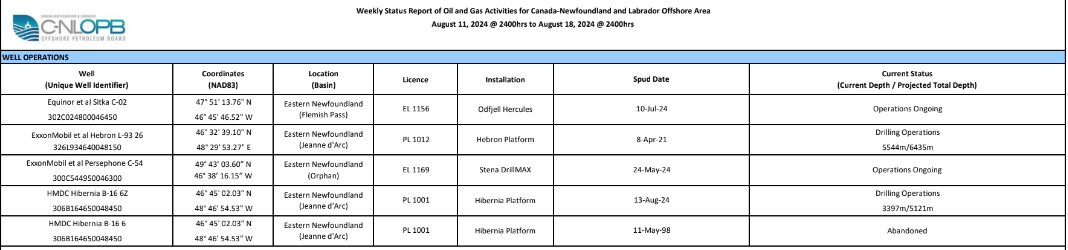
To find the sole exploratory well being drilled in the vast North American Atlantic, you have to exit “wind-only” US waters, head NE to St. John’s, NL (advancing your watch by 1.5 hours 😉), and transit another 317 miles NE to the Stena DrillMAX working for Exxon in the Orphan Basin.

The latest (8/20/2024) CNLOPB report (below) is that operations are ongoing. The well was spudded 3 months ago. That is about all they can disclose without compromising confidentiality. Even seemingly innocuous information like the current and projected well depth provides the opportunity to speculate about geologic conditions and current well activities.

We can assume that there have been no safety or environmental incidents to date, because the CNLOPB does a good job of posting such information in a timely manner.

Previous posts on this well

Read Full Post »

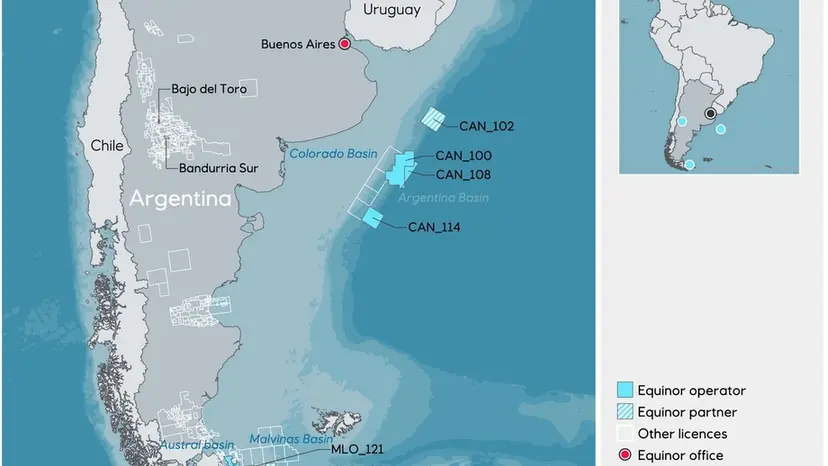
The Valaris DS-17 drillship is now on location to drill the Algerich-1 well for Equinor 315 km from Mar del Plata in 1527 m of water at Block CAN 100.

Concurrently, at the opposite end of the Pan American continents, the Stena DrillMAX is closing in on Exxon’s Orphan Basin location offshore Newfoundland to drill another high potential well.

Meanwhile, the US Atlantic is “wind-only,” despite high deepwater oil and gas potential. The late Paul Post, an esteemed colleague and the leading expert on the petroleum geology of the US Atlantic, believed the deepwater US Atlantic could contain >20 billion BOE. No other Pan American nation has completely closed its Atlantic margin to oil and gas exploration.

Can a nation with a debt of $35 trillion afford to ignore oil and gas resources that will remain in high demand for decades?

Read Full Post »

….. and oil prices fall by more that $10.  See how easy this is 🙂

Even if the legislation is passed by the Senate and enacted (unlikely), the only mandated sale outside of the Gulf of Mexico would be a small wedge in the Atlantic. This wedge would likely be reduced to a sliver by Defense Department concerns.

See our previous comments on this and the two companion House bills.

Read Full Post »

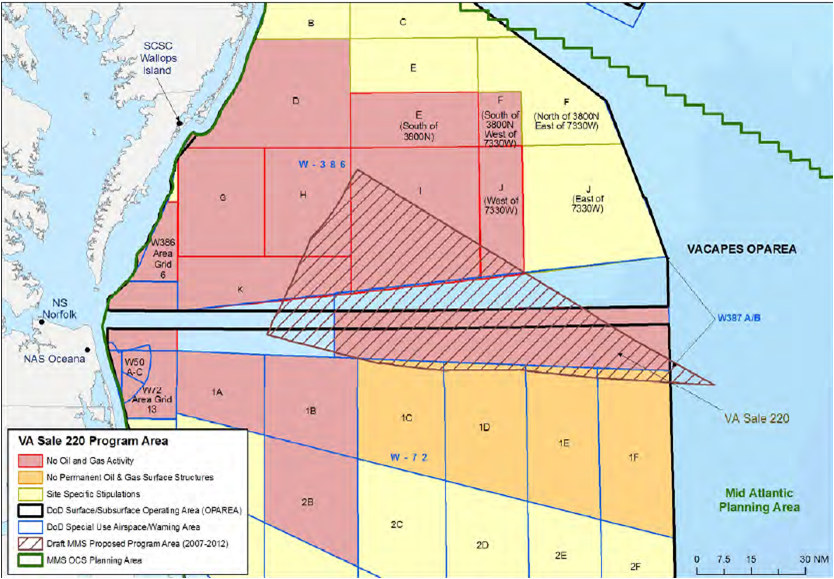
…but the only Atlantic area included in the present 5-year oil and gas leasing program  is the cross-hatched wedge in the map below.  This area was to have been considered for leasing  in Sale 220, but the sale was cancelled following the blowout. The House Natural Resources Committee has passed legislation that would require that sale to be held.

No matter what happens, Sale 220 isn’t much to get excited about, especially if the Department of Defense has its way. In light of world events and the fuel demands of our military, one would assume that DOD would be a leading advocate for offshore energy exploration and development. However, rightly or wrongly, preventing disruptions to military training and operations has always been a higher DOD priority than domestic energy production.

With regard to Sale 220, DOD wants 72% of this already small area (magenta) removed from consideration. So even if this lease sale is held, the maximum offering would likely be the cross-hatched blue micro-sliver. That would be the extent of Atlantic leasing for the foreseeable future.

Oil is where you find it, not where you wish it was, where it is most convenient, or where you legislate it to be. Ditto for natural gas. We need an offshore oil and gas program that identifies the most prospective targets, provides for exploratory drilling to evaluate these targets, facilitates production, and effectively manages the safety and environmental risks. We can’t just explore the small slivers that remain after political and administrative reviews have eliminated the rest.

Like it or not, our Outer Continental Shelf lands belong to the entire nation. We need to manage these lands and the associated resources in a manner that is in the best interest of all Americans.

Read Full Post »

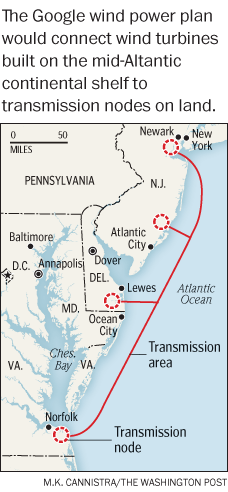
Washington Post diagram

Comment: Kudos to Google for their leadership in financing a power grid for Atlantic wind projects.  The grid should greatly improve the economics of offshore wind development.  The challenge for the  Google team and other wind developers will be demonstrating that they can manage complex offshore projects, protect workers, and maintain the integrity of their assets.

Read Full Post »